
Revolutionizing Internal Business Operations with AI
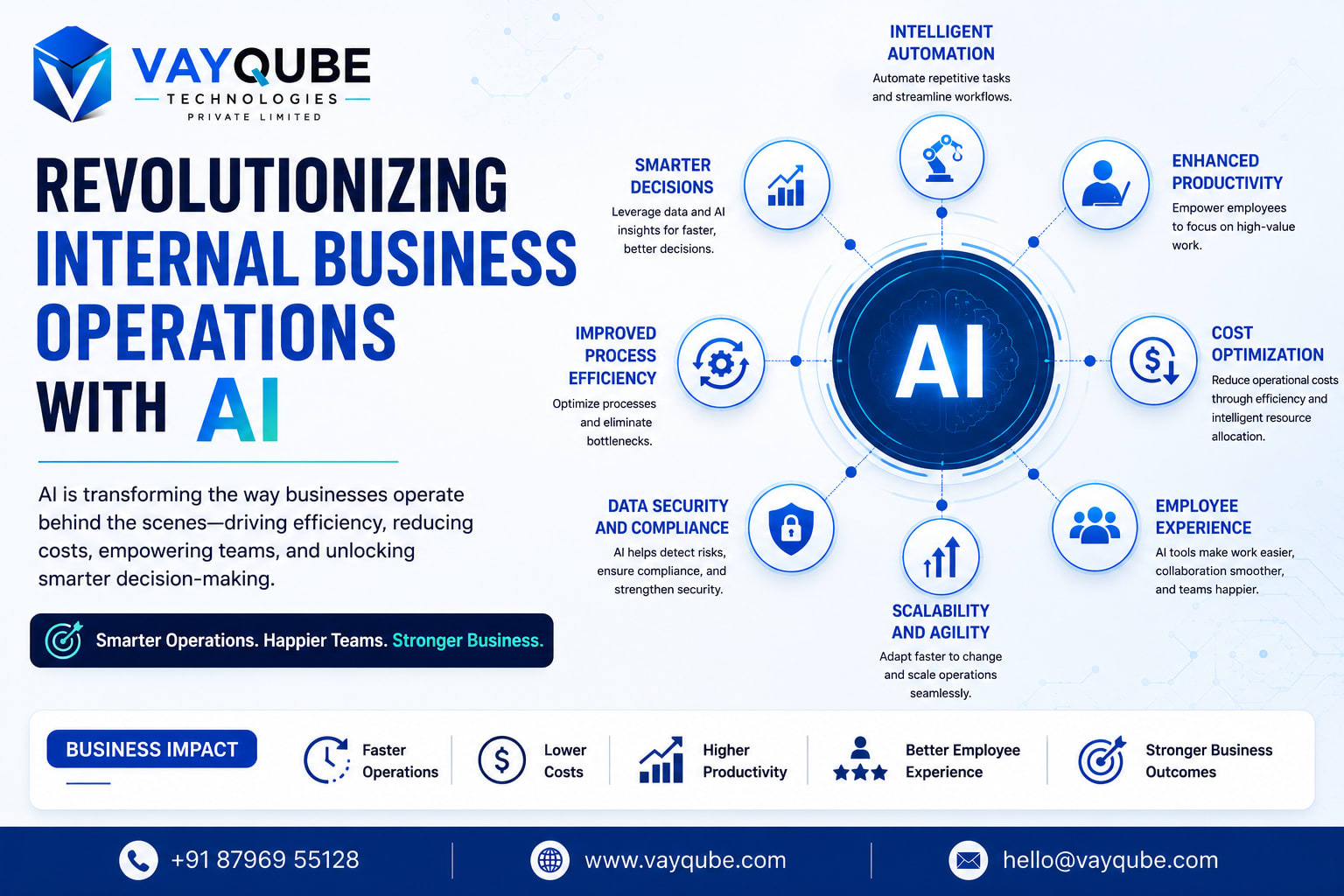
AI is revolutionizing internal business operations by streamlining processes, enhancing productivity, and informing strategic decisions. Learn more about the transformative power of AI.
Vayqube Team
Software architecture and product engineering
Introduction to AI in Internal Business Operations
The integration of Artificial Intelligence (AI) into internal business operations has been a transformative force, revolutionizing the way companies manage their core functions. From automating mundane tasks to providing predictive insights, AI has become an indispensable tool for modern businesses.
Brief History and Evolution of AI Adoption
The adoption of AI in business operations has a relatively short but intense history. Initially, AI technologies were met with skepticism and were primarily used in niche areas such as research and development. However, as the technology improved and the cost of implementation decreased, businesses began to explore its potential in various operational aspects. Today, AI is used in everything from customer service chatbots to complex predictive analytics, indicating a significant shift towards embracing technology for operational efficiency.
Key milestones in the evolution of AI adoption include:
- Early experimentation with rule-based expert systems
- The rise of machine learning and its application in data analysis
- The development of deep learning algorithms that can handle complex, unstructured data
- The integration of AI with other technologies like cloud computing and the Internet of Things (IoT) to enhance operational capabilities
Impact on Business Operations
The impact of AI on internal business operations is multifaceted. It not only automates routine tasks, thereby increasing efficiency and reducing labor costs, but also provides businesses with the ability to make data-driven decisions. By analyzing vast amounts of data, AI systems can identify patterns and predict future trends, enabling companies to stay ahead of the competition. Moreover, AI-powered tools can enhance customer experience, improve supply chain management, and optimize resource allocation, leading to overall business scalability and growth.
As businesses continue to navigate the complexities of the digital age, the role of AI in internal operations is expected to expand. With its ability to learn, adapt, and improve over time, AI is poised to play a critical role in shaping the future of business operations, making them more agile, responsive, and competitive.
Real-World Applications and Future Directions
In real-world scenarios, AI is being used to streamline operations, enhance productivity, and foster innovation. For instance, companies are using AI to manage their inventory, predict demand, and personalize customer interactions. The future of AI in internal business operations holds much promise, with potential applications in areas such as autonomous decision-making, advanced predictive maintenance, and holistic operational optimization. As technology continues to evolve, it's crucial for businesses to stay informed and adapt to the changing landscape of AI in internal operations.
Why It Matters
The integration of Artificial Intelligence (AI) in internal business operations is no longer a novelty but a necessity for modern businesses. AI plays a crucial role in enhancing operational efficiency, reducing costs, and improving decision-making processes.
Addressing Key Challenges
AI addresses several key challenges that businesses face today, including:
- Automating repetitive and mundane tasks, thereby freeing up human resources for more strategic and creative work
- Enhancing customer experience through personalized services and real-time support
- Providing predictive analytics to inform business decisions and mitigate risks
- Improving supply chain management and logistics
Impact on Competitiveness and Growth
The impact of AI on a company's competitiveness and growth cannot be overstated. Businesses that adopt AI solutions are more likely to:
- Stay ahead of the competition by innovating and adapting to changing market conditions
- Achieve significant cost savings and productivity gains
- Enhance their brand reputation and customer loyalty
- Drive revenue growth through data-driven decision making and targeted marketing efforts
The importance of AI in modern business is further underscored by its ability to analyze vast amounts of data, identify patterns, and provide actionable insights. This enables businesses to respond quickly to changing market conditions, capitalize on new opportunities, and navigate complex regulatory environments.
Real-World Applications
In real-world scenarios, AI is being used to revolutionize internal business operations in various ways, such as:
- Implementing chatbots and virtual assistants to provide 24/7 customer support
- Using machine learning algorithms to predict and prevent equipment failures
- Developing predictive models to forecast sales and optimize inventory management
- Creating personalized marketing campaigns based on customer behavior and preferences
By leveraging AI in these ways, businesses can unlock new levels of efficiency, agility, and innovation, ultimately driving competitiveness and growth in an increasingly complex and interconnected world.
Production Considerations
As businesses consider implementing AI solutions, they must also think about production readiness and the potential impact on their operations. This includes:
- Ensuring that AI systems are integrated with existing infrastructure and workflows
- Developing strategies for data management and governance
- Providing training and support for employees to work effectively with AI systems
- Continuously monitoring and evaluating the performance of AI solutions to ensure they are meeting business objectives.
Core Architecture
The core architecture of AI-powered internal operations consists of several key components that work together to drive business efficiency and productivity.
Components of AI-powered Internal Operations
The main components include:
- Machine learning algorithms that analyze data and make predictions or recommendations
- Data analytics platforms that provide insights into business operations and performance
- Automation tools that streamline workflows and reduce manual errors
- Integration layers that connect AI systems with existing infrastructure and applications
Machine Learning and Data Analytics
Machine learning and data analytics are crucial components of AI-powered internal operations. By applying machine learning algorithms to large datasets, businesses can identify trends, patterns, and correlations that inform strategic decisions. Data analytics platforms provide real-time insights into business performance, enabling organizations to respond quickly to changing market conditions and customer needs.
Integration with Existing Systems and Infrastructure
To maximize the benefits of AI-powered internal operations, integration with existing systems and infrastructure is essential. This includes:
- Integrating AI systems with enterprise resource planning (ERP) systems
- Connecting AI platforms with customer relationship management (CRM) systems
- Linking AI tools with supply chain management (SCM) systems
- Ensuring seamless communication between AI systems and other business applications
By integrating AI-powered internal operations with existing systems and infrastructure, businesses can create a unified and cohesive technology landscape that supports efficient and effective operations. This enables organizations to respond quickly to changing market conditions, improve customer satisfaction, and drive business growth.
Implementation Considerations
When implementing AI-powered internal operations, businesses must consider several key factors, including:
- Data quality and availability
- Algorithmic transparency and explainability
- System scalability and reliability
- Change management and training for employees
- Cybersecurity and data protection
By carefully evaluating these factors and designing a robust core architecture, businesses can unlock the full potential of AI-powered internal operations and achieve significant improvements in efficiency, productivity, and competitiveness.
Business Benefits
The integration of AI in internal business operations has a profound impact on the overall performance and success of an organization. By leveraging AI, businesses can experience significant improvements in various areas, leading to enhanced competitiveness and growth.
Efficiency and Productivity Gains
Increased efficiency and productivity are among the most notable benefits of AI adoption. Automating routine and repetitive tasks enables employees to focus on higher-value activities, such as strategy development, innovation, and customer engagement. This shift in focus leads to improved job satisfaction, reduced turnover rates, and enhanced overall productivity. For instance, AI-powered tools can automate data entry, document processing, and other administrative tasks, freeing up staff to concentrate on core business functions.
Data-Driven Decision Making
AI also enhances decision-making and insights by providing businesses with access to vast amounts of data and advanced analytics capabilities. This enables organizations to make informed, data-driven decisions, rather than relying on intuition or anecdotal evidence. With AI, businesses can analyze customer behavior, market trends, and operational performance, identifying areas for improvement and optimizing their strategies accordingly. For example, AI-powered predictive analytics can help companies forecast demand, manage inventory, and optimize pricing strategies.
Customer Experience and Satisfaction
Improved customer experience and satisfaction are critical outcomes of AI adoption. By leveraging AI-powered chatbots, virtual assistants, and other digital channels, businesses can provide 24/7 customer support, personalized recommendations, and tailored experiences. AI also enables companies to analyze customer feedback, sentiment, and behavior, allowing them to identify areas for improvement and optimize their customer service strategies. For instance, AI-powered sentiment analysis can help businesses detect early warning signs of customer dissatisfaction, enabling them to take proactive measures to address concerns and prevent churn.
Key benefits of AI adoption in internal business operations include:
- Enhanced efficiency and productivity through automation and process optimization
- Improved decision-making and insights through advanced data analytics and predictive modeling
- Increased customer satisfaction and loyalty through personalized experiences and proactive support
- Better risk management and compliance through AI-powered monitoring and reporting
- Improved employee engagement and job satisfaction through automation of routine tasks and focus on higher-value activities
By embracing AI and integrating it into their internal operations, businesses can unlock significant benefits, drive growth, and stay competitive in an increasingly complex and dynamic market landscape.
Scalability
To ensure the long-term success of AI-powered internal business operations, scalability is a critical factor. As the organization grows, the AI system must be able to handle increasing data volumes and adapt to changing business needs.
Handling Growing Data Volumes
The ability to handle growing data volumes is essential for maintaining performance and accuracy. Key considerations include:
- Data storage and management solutions that can scale up or down as needed
- Distributed processing architectures that can handle large volumes of data
- Machine learning algorithms that can efficiently process and analyze large datasets
Adapting to Changing Business Needs
Flexibility is crucial in adapting to changing business needs, such as shifts in market trends or customer behavior. This can be achieved through:
- Modular architecture that allows for easy integration of new components or features
- Agile development methodologies that enable rapid iteration and deployment of new solutions
- Continuous monitoring and feedback mechanisms that enable the AI system to learn and adapt to changing conditions
Scalable Architecture for Future Growth
A scalable architecture is essential for future growth, enabling the organization to expand its AI-powered operations without compromising performance. Key considerations include:
- Cloud-based infrastructure that can scale up or down as needed
- Microservices architecture that allows for flexible and modular deployment of new services
- Containerization and orchestration tools that enable efficient management of complex workflows
By prioritizing scalability, organizations can ensure that their AI-powered internal business operations are well-equipped to handle the challenges of growth and change, and can continue to drive business value and innovation over time.
Implementation Strategy
When implementing an AI-powered internal business operation, it's essential to consider scalability from the outset. This includes:
- Developing a clear understanding of the organization's growth plans and projections
- Designing a scalable architecture that can adapt to changing business needs
- Implementing agile development methodologies and continuous monitoring and feedback mechanisms to enable rapid iteration and deployment of new solutions.
Real-World Examples
Real-world examples of scalable AI-powered internal business operations include:
- Automated customer service platforms that can handle large volumes of customer inquiries
- Predictive maintenance systems that can analyze large datasets to predict equipment failures
- Supply chain optimization systems that can adapt to changing market trends and customer behavior.
Production Considerations
When deploying AI-powered internal business operations in production, it's essential to consider factors such as:
- Data quality and integrity
- Model drift and concept drift
- Security and access controls
- Monitoring and feedback mechanisms to ensure the system is operating as intended.
Implementation Challenges
Implementing AI solutions for internal business operations can be complex and requires careful consideration of several factors. One of the primary challenges is ensuring the quality and preparation of data used to train AI models.
Data Quality and Preparation
Data quality is crucial for the success of AI-powered internal business operations. Poor data quality can lead to biased or inaccurate results, which can have significant consequences. To address this challenge, businesses must invest in data cleansing, normalization, and feature engineering. This involves identifying and correcting errors, handling missing values, and transforming data into a format suitable for AI models. Additionally, businesses must ensure that their data is diverse, representative, and free from biases.
Change Management and Training
Another significant challenge is change management and training. Implementing AI solutions requires significant changes to business processes, which can be daunting for employees. To address this challenge, businesses must provide comprehensive training and support to help employees understand the benefits and limitations of AI-powered internal business operations. This includes training on new tools and technologies, as well as change management initiatives to help employees adapt to new workflows and processes.
Addressing Potential Biases and Errors
AI models can perpetuate existing biases and errors if they are not designed and trained carefully. To address this challenge, businesses must implement robust testing and validation procedures to identify and mitigate potential biases and errors. This includes using diverse and representative data sets, testing for bias, and implementing procedures for human review and oversight. By addressing these challenges, businesses can ensure that their AI-powered internal business operations are fair, accurate, and reliable.
Some key considerations for addressing these challenges include:
- Developing a comprehensive data management strategy
- Providing ongoing training and support for employees
- Implementing robust testing and validation procedures
- Continuously monitoring and evaluating AI model performance
- Addressing potential biases and errors through human review and oversight
By taking a proactive and structured approach to addressing these challenges, businesses can unlock the full potential of AI-powered internal business operations and achieve significant benefits in terms of efficiency, productivity, and innovation.
Use Cases
The application of AI in internal business operations is vast and varied, with numerous use cases that can drive significant value for organizations.
Automating Routine Tasks and Workflows
Automating routine tasks and workflows is one of the most compelling use cases for AI in internal business operations. By leveraging machine learning algorithms and natural language processing, businesses can automate tasks such as data entry, document processing, and workflow management. This not only reduces the risk of human error but also frees up staff to focus on higher-value tasks that require creativity, problem-solving, and innovation. For instance, AI-powered chatbots can be used to automate customer support, while machine learning algorithms can be used to automate data analysis and reporting.
Predictive Maintenance and Quality Control
Predictive maintenance and quality control is another key use case for AI in internal business operations. By analyzing sensor data and other inputs, AI algorithms can predict when equipment is likely to fail or when quality control issues are likely to arise. This enables businesses to take proactive measures to prevent downtime, reduce waste, and improve overall quality. For example, a manufacturing company can use AI-powered predictive maintenance to predict when a machine is likely to fail, allowing them to schedule maintenance and minimize downtime.
Personalized Customer Service and Support
Personalized customer service and support is a critical use case for AI in internal business operations. By analyzing customer data and behavior, AI algorithms can provide personalized recommendations, offers, and support to customers. This not only improves customer satisfaction but also drives revenue growth and loyalty. For instance, an e-commerce company can use AI-powered chatbots to provide personalized customer support, while also using machine learning algorithms to analyze customer behavior and provide personalized product recommendations.
Some of the key benefits of these use cases include:
- Improved efficiency and productivity
- Enhanced customer experience
- Increased revenue growth and loyalty
- Reduced risk of human error and downtime
- Improved quality control and predictive maintenance
By implementing AI-powered solutions, businesses can drive significant value and competitive advantage in their internal operations. However, it's essential to consider the implementation strategy and production readiness to ensure successful adoption and deployment of AI solutions.
Real-World Examples
Real-world examples of AI in internal business operations include companies like Amazon, which uses AI-powered chatbots to provide personalized customer support, and General Electric, which uses AI-powered predictive maintenance to predict equipment failure and reduce downtime. These examples demonstrate the potential of AI to drive significant value and competitive advantage in internal business operations.
Implementation Considerations
When implementing AI solutions, businesses should consider factors such as data quality, algorithmic complexity, and integration with existing systems. It's also essential to have a clear understanding of the business problem being addressed and the metrics used to measure success. By taking a structured approach to implementation, businesses can ensure successful adoption and deployment of AI solutions.
Best Practices
To ensure successful implementation of AI in internal business operations, it's crucial to follow a set of best practices. These guidelines will help organizations maximize the benefits of AI while minimizing potential risks and challenges.
Strategic Alignment
Start with a clear business strategy and goals, ensuring that AI implementation aligns with the organization's overall objectives. This involves identifying areas where AI can have the most significant impact, such as process automation, predictive analytics, or customer service enhancement. By establishing a strong strategic foundation, businesses can set themselves up for success and create a roadmap for AI adoption.
Data Management
Develop a robust data management plan to support AI implementation. This includes data collection, storage, processing, and analysis. A well-designed data management plan enables organizations to provide high-quality training data for AI models, ensuring accurate and reliable results. Key considerations include data security, compliance, and governance, as well as the development of data pipelines and architecture.
Performance Monitoring
Monitor and evaluate AI performance regularly to ensure it meets business objectives and continues to deliver value. This involves tracking key performance indicators (KPIs), such as model accuracy, processing time, and user adoption. By continuously monitoring AI performance, organizations can identify areas for improvement, address potential issues, and optimize AI systems for better outcomes.
Some key considerations for AI performance monitoring include:
- Establishing clear KPIs and metrics
- Developing a feedback loop for continuous improvement
- Implementing automated testing and validation
- Conducting regular model retraining and updates
By following these best practices, organizations can unlock the full potential of AI in internal business operations, driving innovation, efficiency, and growth.
Implementation Roadmap
A well-structured implementation roadmap is essential for successful AI adoption. This involves:
- Defining project scope and timelines
- Identifying necessary resources and skills
- Developing a change management plan
- Establishing a governance framework for AI decision-making
By taking a structured approach to AI implementation, businesses can minimize risks, ensure smooth integration, and maximize the benefits of AI-powered internal business operations.
Frequently Asked Questions
To address common concerns and inquiries about implementing AI in internal business operations, we have compiled a list of frequently asked questions.
Common AI Applications
The most common AI applications in internal business operations include:
- Automating repetitive tasks and workflows
- Enhancing customer service through chatbots and virtual assistants
- Improving data analysis and decision-making with machine learning
- Optimizing resource allocation and supply chain management
- Predicting and preventing security threats with AI-powered monitoring
Getting Started with AI Implementation
To get started with implementing AI in your organization, consider the following steps:
- Identify areas where AI can bring the most value and improvement
- Assess your current infrastructure and technology stack for compatibility
- Develop a clear implementation strategy and roadmap
- Invest in employee training and education to ensure a smooth transition
- Start with small-scale pilot projects to test and refine your approach
Potential Risks and Limitations
The potential risks and limitations of AI adoption include:
- Job displacement and changes to the workforce
- Dependence on high-quality data and potential biases
- Cybersecurity threats and vulnerabilities
- Regulatory compliance and potential legal issues
- Integration challenges with existing systems and infrastructure
Mitigating Risks and Ensuring Success
To mitigate these risks and ensure a successful AI implementation, it is essential to:
- Develop a comprehensive change management plan
- Invest in ongoing employee education and training
- Implement robust data governance and quality control measures
- Conduct thorough risk assessments and security audits
- Establish clear policies and procedures for AI adoption and use
Real-World Examples and Lessons Learned
Real-world examples of successful AI implementation include companies like Amazon, Google, and Microsoft, which have leveraged AI to improve operational efficiency, enhance customer experience, and drive innovation. By learning from these examples and understanding the potential risks and limitations, organizations can develop effective strategies for implementing AI in their internal business operations.
Production Readiness and Scalability
When implementing AI in production environments, it is crucial to consider scalability, reliability, and performance. This includes ensuring that AI systems can handle large volumes of data, integrate with existing infrastructure, and provide real-time insights and decision-making support. By prioritizing production readiness and scalability, organizations can unlock the full potential of AI and achieve significant business benefits.
Conclusion
The integration of AI in internal business operations has the potential to revolutionize the way companies function, making them more efficient, productive, and competitive.
Key Takeaways
- AI can automate routine tasks, freeing up human resources for more strategic and creative work
- Implementing AI solutions requires a thorough understanding of the business needs and challenges
- A well-designed core architecture is crucial for the successful integration of AI in business operations
- Scalability and flexibility are essential considerations when implementing AI solutions
- Real-world use cases have demonstrated significant business benefits, including improved customer experience and increased revenue
Future Outlook
As AI technology continues to evolve, we can expect to see even more innovative applications in internal business operations.
- Advancements in machine learning and natural language processing will enable more sophisticated automation and decision-making capabilities
- The increasing use of cloud-based services will make it easier for businesses to adopt and implement AI solutions
- The development of more user-friendly interfaces will make AI more accessible to non-technical stakeholders
Call to Action
Businesses that have not yet explored the potential of AI in their internal operations should start by assessing their current challenges and identifying areas where AI can have the most impact.
- They should develop a clear implementation strategy, taking into account scalability, flexibility, and production readiness
- They should also consider seeking guidance from experts and exploring real-world use cases to inform their decision-making
- By adopting AI solutions, businesses can stay ahead of the competition, improve their bottom line, and create a more sustainable and efficient operation.
Next Steps
To get started with AI adoption, businesses should:
- Conduct a thorough assessment of their current operations and identify areas for improvement
- Develop a roadmap for AI implementation, including timelines, budgets, and resource allocation
- Establish a cross-functional team to oversee the implementation and ensure smooth integration with existing systems
- Continuously monitor and evaluate the effectiveness of AI solutions, making adjustments as needed to optimize results.
Related Vayqube Resources
- Why Most Ai Projects Fail Before Production
- Best Mobile App Development Company In New York
- Real Time Application Development
- Event Driven Architecture Development
- Ai Agents Changing Customer Support Operations 2026
- Businesses Replacing Manual Workflows With Ai Agents 2026
Next Step
If your systems are struggling with scalability, automation, architecture complexity, or operational efficiency, it's time to modernize your infrastructure and workflows.
👉 Talk to a Vayqube solution architect and build systems designed for long-term production growth: