
Cost to Build SaaS Platform in 2026: Realistic Breakdown
Building a SaaS platform in 2026 involves more than just coding. This analysis breaks down real-world costs across infrastructure, talent, and operations to help you plan effectively.
Vayqube Team
Software architecture and product engineering
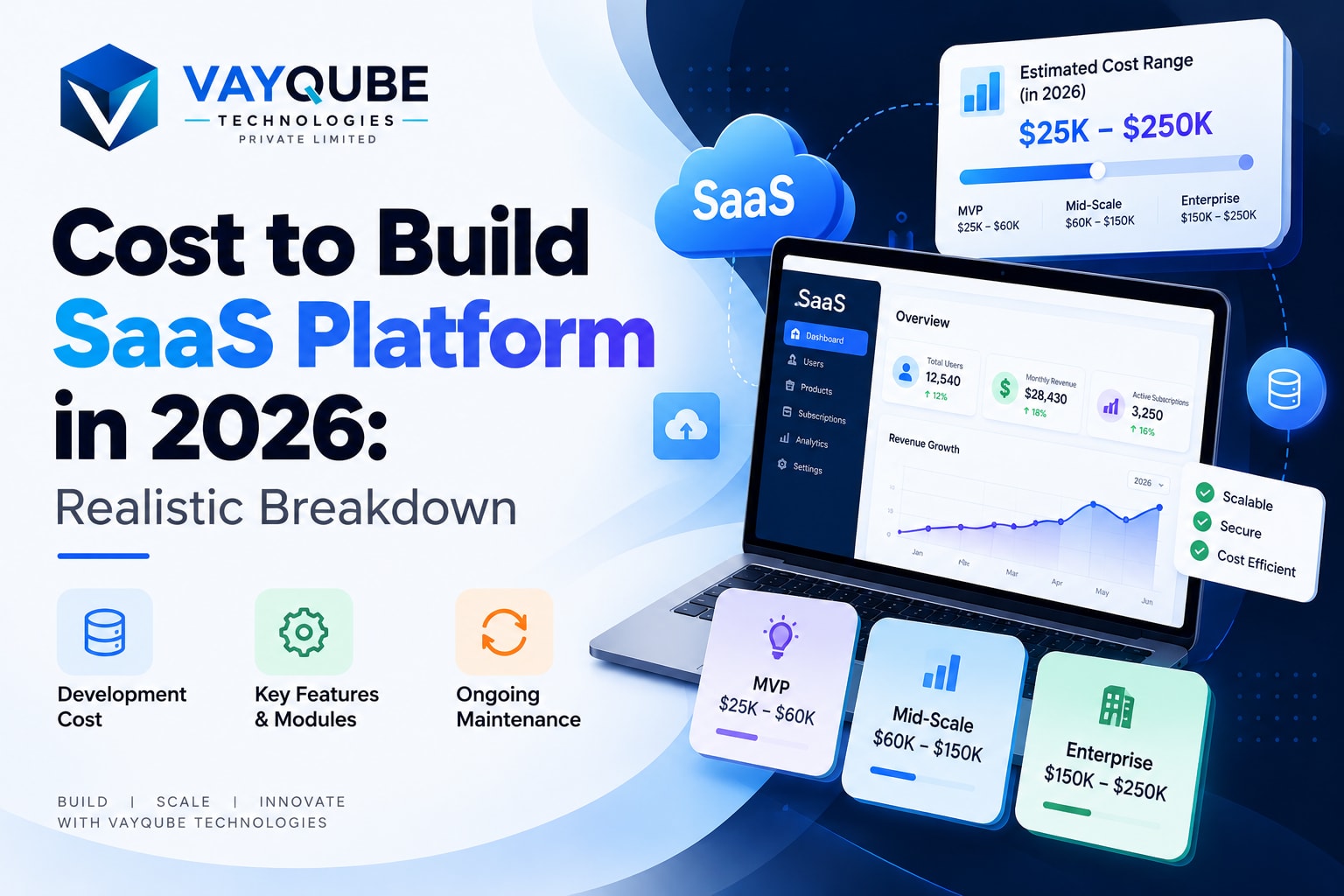
How much does it cost to build a SaaS platform in 2026? Short answer: a focused MVP runs $20k–$50k, a growth-stage multi-tenant platform $60k–$150k, and enterprise-grade builds start at $150k+ — with monthly infrastructure adding anywhere from $200 to $30k+ depending on scale. This guide breaks down where that money actually goes: architecture choices, talent, and the hidden infrastructure costs most estimates miss.
SaaS Platform Cost Breakdown (2026)
| Stage | Timeline | Indicative build cost | Monthly infrastructure |
|---|---|---|---|
| MVP | 2–4 months | $20k–$50k | $200–$1k |
| Growth | 4–8 months | $60k–$150k | $1k–$8k |
| Enterprise | 8–14 months | $150k–$400k+ | $8k–$30k+ |
Indicative market ranges for 2026. Actual costs vary with scope, team location, and architecture choices.
Baseline Architecture Assumptions for a Modern SaaS Platform
We assume a multi‑tenant microservices architecture with a versioned API gateway. Backend services are event‑driven (e.g., user sign‑up, payment webhook, data ingestion) rather than monolithic request‑driven, allowing independent scaling of bursty workloads while keeping steady‑state services lean.
Core bounded services:
- User management – authentication, role‑based access, profile storage.
- Billing – subscription cycles, invoicing, payment gateway integration.
- Analytics – usage event collection, metric aggregation, feeds for reporting or ML.
- Domain‑specific SaaS functionality – the product's unique value (design editor, workflow engine, data transformation, etc.).
Services run either in Kubernetes clusters or as serverless functions (AWS Lambda, Azure Functions) based on latency and scaling needs. Stateless API workers sit behind the gateway; stateful components use managed data stores—PostgreSQL for relational data, MongoDB Atlas for document workloads, Snowflake for large‑scale analytical queries. Object storage (S3‑compatible) holds user files, backups, static assets. Observability is provided by a managed telemetry stack (Datadog‑like) aggregating logs, traces, metrics. CI/CD pipelines are defined in Terraform and executed via GitHub Actions, making infrastructure changes versioned and testable.
How Service Boundaries and Tenancy Shape Costs
Multi‑tenancy lets a single service instance serve many customers, reducing the number of runtime environments but introducing shared‑resource contention and the need for isolation mechanisms that affect compute and storage sizing.
Primary Cost Drivers: Development, Talent, and Infrastructure
Costs fall into three broad categories.
Development – engineering effort to build features, design UI/UX, write automated tests, and integrate third‑party services. This includes salaries for frontend, backend, DevOps, and QA engineers, as well as product management and design.
Talent – recruitment, onboarding, benefits, and ongoing compensation for the team. Hiring senior engineers or specialists can increase base pay, while equity or bonuses affect total compensation.
Infrastructure – ongoing cloud spend for compute, storage, networking, and managed services (databases, messaging, observability). The mix of container‑based versus serverless workloads, choice of instance types, and data transfer patterns drive the monthly infrastructure bill.
Hidden Infrastructure Overheads: Networking, Data, and Idle Waste
Data transfer costs can become a hidden expense when traffic crosses availability zones, regions, or travels to the public internet. For platforms that move large volumes—such as video streaming, file sharing, or analytics pipelines—egress fees may rival or exceed compute charges if not monitored.
Storage expenses often creep up when data remains in premium performance tiers longer than necessary. Without automated lifecycle policies, frequently accessed "hot" data stays in expensive storage while older or rarely accessed blocks could be moved to cooler, cheaper tiers. Regularly reviewing access patterns and configuring transition rules helps keep storage aligned with actual usage.
Idle or over‑provisioned resources are another common source of waste. Examples include containers that run at low utilization, reserved instances that are never fully used, and development or test environments left running after a feature branch is merged. Without continuous visibility, these resources can accumulate and represent a noticeable portion of the monthly bill.
Managed service add-ons such as VPC endpoints, private links, or extended log retention incrementally increase costs. While each item may seem minor, their collective impact can be significant, especially when they are provisioned for convenience rather than strict necessity and are not included in early cost models.
Rightsizing, Optimization, and Cost Control Tactics
Right‑sizing compute begins with observing actual CPU and memory consumption. Autoscaling policies that adjust replica counts based on real‑time demand prevent over‑allocation during low‑traffic periods. For batch‑oriented workloads, spot or preemptible instances can reduce compute spend, provided the application can tolerate occasional interruptions.
Storage optimization involves applying lifecycle rules that shift data to cooler tiers after a defined period of inactivity. Compressing logs, downsampling high‑frequency metrics, and storing analytical data in columnar formats such as Parquet reduce both storage footprint and query costs.
Financial accountability is reinforced through consistent tagging of resources, enabling cost allocation to teams, services, or product lines. Showback or chargeback models make engineering groups aware of the financial impact of their operational choices, encouraging cost‑conscious decisions during sprint planning.
Monitoring should be proactive: budget alerts trigger when spending deviates from forecasts, anomaly detection surfaces unexpected spikes, and monthly cost reviews treat expense as a non‑functional requirement. Integrating these practices into the development lifecycle helps keep infrastructure spend aligned with business objectives.
Budget Modeling and Ongoing Cost Monitoring Frameworks
A useful cost model ties cloud expenses to measurable usage drivers rather than to headcount or calendar time. Key drivers include the number of active monthly users, volume of API calls, amount of data ingested, and total storage under management. Expressing costs as a function of these variables makes it easier to predict how changes in product adoption will affect the bill.
Unit economics provide a lens for efficiency. Metrics such as cost per active user, cost per transaction, or cost per gigabyte of stored data allow teams to track trends over time and compare them against pricing tiers or gross‑margin targets. When unit costs rise, it signals a need to investigate underlying inefficiencies.
Service‑level metering allocates cloud spend to individual features, microservices, or customer segments. By instrumenting each service to emit usage data that can be joined with billing information, teams gain insight into which functionalities are most expensive and can prioritize optimization efforts accordingly.
Cost models should be revisited on a regular cadence—quarterly is a common baseline—or after any major release that introduces new data‑intensive workflows, third‑party integrations, or significant architectural changes. Updates ensure that forecasts remain realistic and that variance analysis highlights areas where actual consumption diverges from expectations.
Frequently Asked Questions
How does choosing between Kubernetes and serverless functions affect infrastructure costs for a SaaS platform?
Kubernetes involves ongoing costs for cluster management, node provisioning, and idle capacity, while serverless charges per execution and duration, which can be more cost-effective for bursty workloads but may increase latency and complexity for stateful services. The optimal choice depends on traffic patterns, scaling needs, and team operational overhead. Neither option is universally cheaper—costs vary by usage and implementation.
What trade-offs should be considered when hiring senior engineers versus junior talent for SaaS development in 2026?
Senior engineers command higher salaries but can accelerate development, reduce architectural rework, and improve system reliability, potentially lowering long-term costs. Junior talent reduces initial payroll but may require more supervision and extend timelines, especially for complex distributed systems. The decision should align with product maturity, timeline pressure, and internal mentorship capacity.
How does multi-tenancy influence infrastructure sizing and ongoing cloud spend in a SaaS architecture?
Multi-tenancy allows shared service instances, reducing the number of deployments and baseline resource needs compared to single-tenant models. However, it requires careful resource isolation and monitoring to prevent noisy neighbor problems, which can lead to over-provisioning if not managed. Storage and database costs may rise with data growth across tenants, necessitating efficient partitioning and archiving strategies.
Related Vayqube Resources
- Multi-Tenant SaaS vs Single-Tenant Architecture: Scaling for Success
- Cloud Cost Optimization Strategies for SaaS Startups
- Real Time Application Development
- Event Driven Architecture Development
- High Performance Backend Development
- Cloud Wars: AWS vs Azure vs GCP for Modern SaaS
Next Step
Need help estimating the engineering and infrastructure effort?