
Cost of Hiring Developers in USA vs India: A 2026 Comparison
A practical breakdown of developer salaries, hourly rates, and fully-loaded hiring costs in the USA versus India, with guidance on when each option makes sense.
Vayqube Team
Software architecture and product engineering
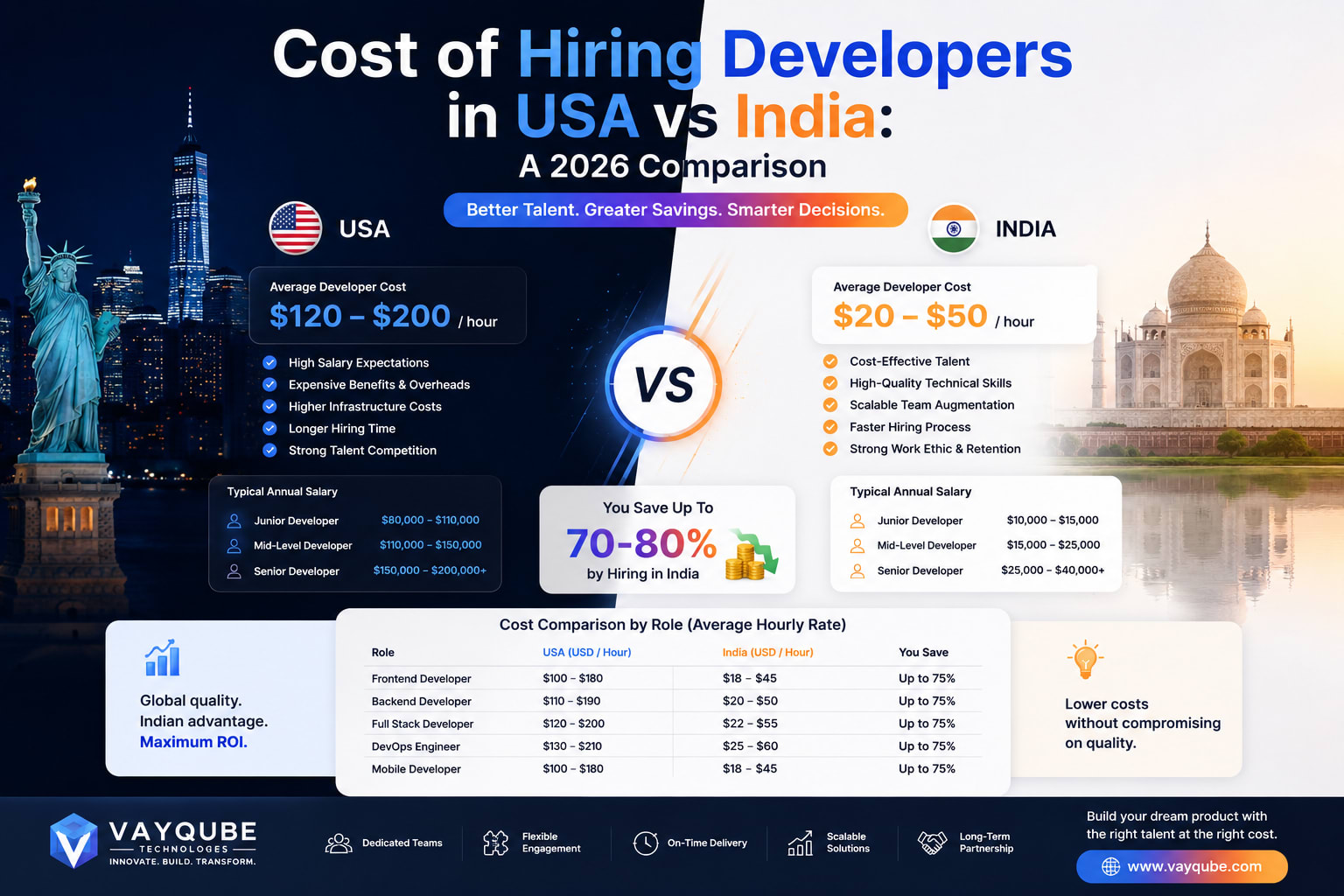
Cost of Hiring Developers in USA vs India: A 2026 Comparison
Introduction
Every CTO and founder eventually asks the same question: should we hire developers locally, or build the team offshore? The honest answer depends less on opinion and more on arithmetic — salary bands, employer overhead, tooling, and how those numbers compound across a full engineering team over a year. This guide breaks down real cost ranges for hiring developers in the USA versus India in 2026, and explains where the savings actually come from, not just the headline number.
By the end of this article, you will understand fully-loaded cost differences by role, what drives the price gap beyond salary, and how to decide which model fits your product stage and budget.
Who This Guide Is For
This is written for startup founders planning their first engineering hires, CTOs comparing in-house hiring against a dedicated offshore team, and finance or operations leaders building an annual engineering budget. If you are choosing between a US-based hire, a contractor, or a dedicated developer in India, this comparison gives you the numbers to make that decision with confidence.
Quick Summary
Hiring a mid-to-senior developer in the USA typically costs 3-5x more in fully-loaded cost than hiring an equivalent senior developer in India, once you account for salary, payroll tax, benefits, and overhead. The gap is largest for specialized roles like AI/ML and DevOps engineers, and smallest for junior generalist roles. The practical decision is rarely "cheapest option" — it's matching the seniority and governance model to what your roadmap actually needs.
Typical Developer Costs: USA vs India (2026)
| Role | USA (Annual, fully loaded) | India (Annual, fully loaded) | Approx. Savings |
|---|---|---|---|
| Junior Full-Stack Developer | $85,000 - $110,000 | $18,000 - $28,000 | ~70-75% |
| Mid-Level Backend/Frontend Developer | $120,000 - $150,000 | $28,000 - $42,000 | ~70-75% |
| Senior Full-Stack Developer | $150,000 - $190,000 | $42,000 - $60,000 | ~65-70% |
| DevOps / Cloud Engineer | $140,000 - $180,000 | $35,000 - $55,000 | ~65-70% |
| AI/ML Engineer | $170,000 - $220,000 | $45,000 - $70,000 | ~65-70% |
These figures include base salary plus typical employer overhead — payroll taxes, benefits, and standard employment costs. Actual numbers vary by city, company stage, and specialization.
Why the Cost Gap Exists
The difference is not just "cheaper labor" — it comes from several compounding factors. Cost of living and local salary benchmarks are structurally lower in India's major tech hubs, which lowers base compensation without lowering engineering quality at the senior level. Employer overhead is lower too, since benefits, payroll tax structures, and statutory costs differ significantly between the two countries. Currency and purchasing power mean a competitive senior-India salary converts to a fraction of the equivalent US figure. None of this means lower standards — it means the same seniority and output cost less to deliver.
What Teams Should Evaluate Before Deciding
| Area | What to Check | Why It Matters |
|---|---|---|
| Role Specialization | How niche is the skill (AI/ML, DevOps, etc.) | Specialized US roles carry the largest cost premium |
| Governance Model | Direct hire, staff augmentation, or dedicated pod | Changes who owns quality and delivery accountability |
| Time Zone Overlap | Hours of real-time collaboration needed | Impacts communication cadence and delivery speed |
| Compliance Needs | Data residency, labor law, IP protection | Affects contract structure and where the team can be based |
| Team Maturity | Whether you need a technical lead or just extra hands | Determines whether staff augmentation or a managed pod fits better |
Practical Steps to Compare Costs Accurately
- List the exact roles and seniority levels you need, not just headcount.
- Price out fully-loaded cost for each role in both markets — salary plus overhead, not just base pay.
- Factor in management overhead: a self-managed offshore team needs a technical lead; a managed pod includes one.
- Run the numbers over 12 months, not per-hire, since attrition and ramp-up time affect real cost.
- Weigh time zone overlap against cost savings — a small overlap window can slow delivery even at a lower price.
- Pilot with a single role or small pod before committing to a full team build-out.
Business Impact of Getting This Decision Right
The hiring model you choose affects far more than payroll. Runway extends significantly when engineering cost drops 60-70% per role, giving startups more time to reach product-market fit. Delivery speed can actually improve with offshore teams when time zone overlap is used well, since work continues across more hours per day. Hiring risk drops because offshore dedicated pods can scale up or down in weeks, while US senior hires often take three to six months to close. Quality is protected only when seniority is matched correctly — the savings disappear fast if a junior-heavy offshore team creates rework that a senior team wouldn't have.
Common Mistakes When Comparing Costs
Teams comparing India and USA hiring costs often make the same avoidable mistakes. Comparing base salary only, without including US payroll tax and benefits, which understates the real gap. Assuming offshore always means junior talent, when senior India-based engineers are widely available at rates far below US mid-level developers. Ignoring management overhead, which can erase savings if there's no technical lead coordinating the offshore team. Choosing the cheapest vendor instead of the right governance model for the project's complexity and compliance needs.
When Each Model Makes Sense
| Situation | Recommended Approach |
|---|---|
| Early-stage MVP, tight budget | Dedicated developers in India |
| Highly regulated, data-residency-sensitive project | US-based hire or compliant managed offshore team |
| Short-term specialized skill gap | Staff augmentation |
| Long-term product roadmap, multiple roles | Dedicated offshore pod with a senior technical lead |
Related Vayqube Resources
FAQ
Is it really 3-5x cheaper to hire developers in India than the USA? For most mid-to-senior roles, yes — once you include US payroll tax, benefits, and overhead, fully-loaded cost in India is typically 65-75% lower for equivalent seniority.
Does lower cost mean lower quality? No. Senior engineers in India work on the same modern stacks and production systems as US engineers; the cost difference comes from market wages and overhead, not skill level.
Which roles have the smallest cost gap between USA and India? Junior generalist roles tend to have a smaller relative gap than highly specialized roles like AI/ML or senior DevOps, where US salaries are particularly high.
Should we hire individual developers or a dedicated pod? A dedicated pod (with a technical lead, QA, and engineers) works better for sustained roadmap work; individual hires or staff augmentation suit short-term or narrowly scoped needs.
How much time zone overlap do we need with an India-based team? Three to four working hours of overlap is usually enough to keep standups, reviews, and blockers moving without slowing delivery.
Are there hidden costs when hiring offshore? Yes, if not planned for — management overhead, onboarding time, and tooling access all need to be budgeted, though they're still small relative to US salary savings.
Ready to compare exact costs for your team? Talk to Vayqube about building a cost-efficient, senior-led development team in India.