
Building AI Products with Lean Teams
Startups are finding ways to build AI-powered products with small teams, leveraging cloud-based services, open-source libraries, and strategic partnerships to drive innovation and growth.
Vayqube Team
Software architecture and product engineering
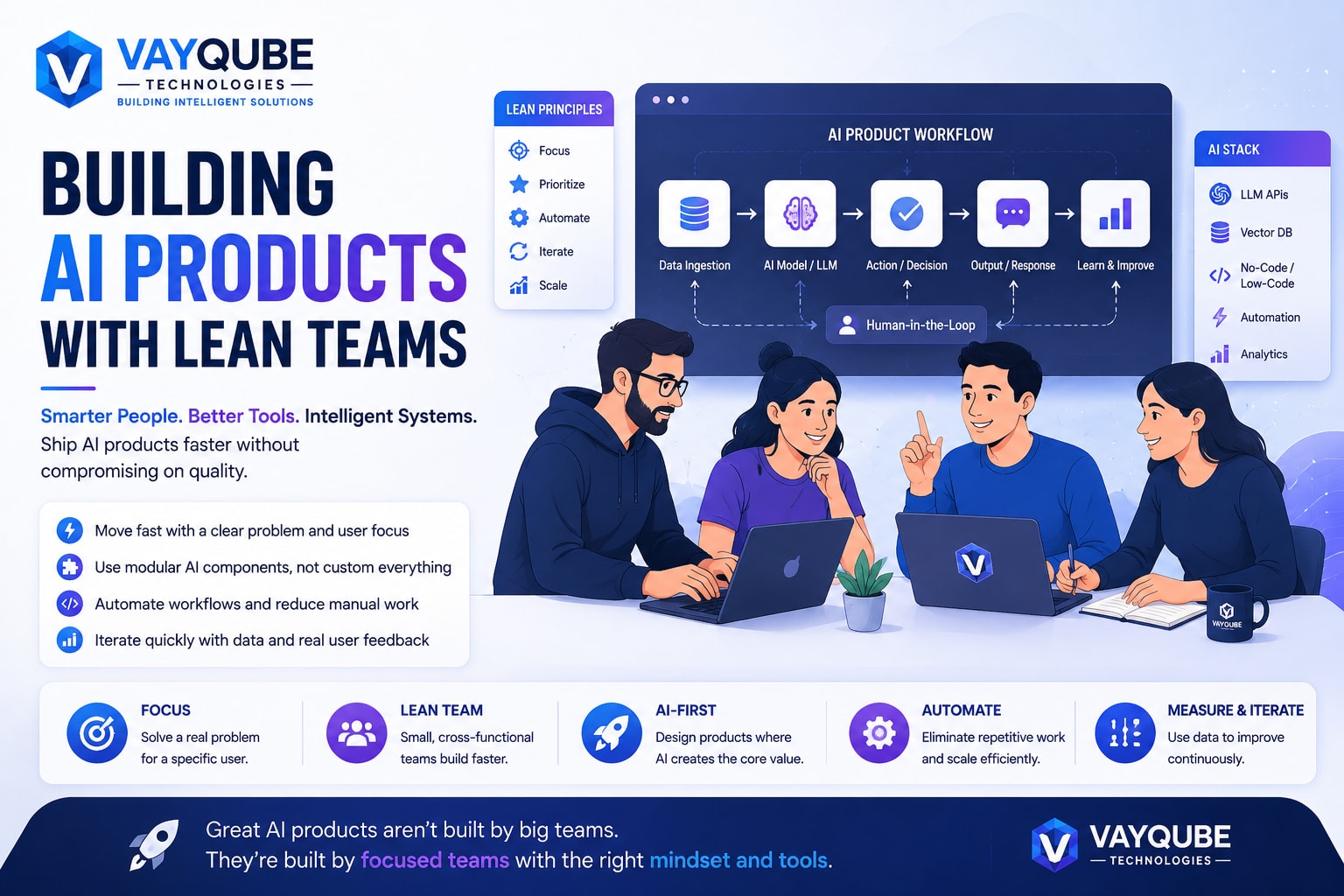
Introduction to Building AI Products with Lean Teams
Building AI products is a complex and challenging task, requiring significant expertise and resources. However, with the rise of lean teams, it is now possible to develop and deploy AI products quickly and efficiently. In this section, we will provide an overview of building AI products and the importance of lean teams in AI product development.
Overview of Building AI Products
Building AI products involves several key steps, including data collection and preparation, model training and testing, and deployment and maintenance. Each of these steps requires significant expertise and resources, making it challenging for small teams to develop and deploy AI products. However, with the right approach and tools, it is possible to build and deploy AI products quickly and efficiently.
Importance of Lean Teams
Lean teams are essential in AI product development, as they enable organizations to develop and deploy AI products quickly and efficiently. Lean teams are characterized by their ability to work quickly and efficiently, with a focus on delivering value to customers. By leveraging lean teams, organizations can reduce the time and cost associated with building AI products, while also improving their quality and effectiveness.
Challenges and Benefits of Building AI Products with Lean Teams
Building AI products with lean teams presents several challenges, including the need for significant expertise and resources. However, it also offers several benefits, including the ability to develop and deploy AI products quickly and efficiently. Some of the key benefits of building AI products with lean teams include:
- Improved time-to-market
- Reduced costs
- Increased quality and effectiveness
- Enhanced customer value
- Greater agility and flexibility
By understanding the challenges and benefits of building AI products with lean teams, organizations can make informed decisions about how to approach AI product development. In the next section, we will explore the key considerations for building AI products with lean teams, including the importance of data quality, model selection, and deployment strategy.
Why It Matters
The impact of AI on business operations and revenue cannot be overstated. As AI continues to evolve, it is transforming the way companies operate, making them more efficient, and driving revenue growth.
Business Operations and Revenue
AI is being used to automate routine tasks, freeing up resources for more strategic and creative work. This not only improves productivity but also enables businesses to make data-driven decisions, reducing the risk of human error. Moreover, AI-powered analytics can help companies identify new revenue streams, optimize pricing, and improve customer engagement.
Role of Lean Teams
Lean teams play a crucial role in driving innovation and efficiency in AI product development. By leveraging agile methodologies and cross-functional collaboration, lean teams can quickly develop and deploy AI-powered solutions, reducing time-to-market and improving overall quality. This approach also enables companies to respond rapidly to changing market conditions, staying ahead of the competition.
Consequences of Inaction
The consequences of not adopting lean team strategies for AI product development can be severe. Companies that fail to innovate and adapt to changing market conditions risk being left behind, losing revenue and market share to more agile competitors. Furthermore, the inability to leverage AI effectively can lead to inefficient operations, poor decision-making, and a lack of competitiveness in the market.
Real-World Implications
In real-world scenarios, the impact of AI on business operations and revenue is evident. For example, companies like Netflix and Amazon are using AI to personalize customer experiences, driving engagement and revenue growth. Similarly, companies like Uber and Lyft are leveraging AI to optimize their operations, reducing costs and improving efficiency.
Key Considerations
When building AI products with lean teams, there are several key considerations to keep in mind. These include:
- Ensuring that the team has the necessary skills and expertise to develop and deploy AI-powered solutions
- Leveraging agile methodologies to facilitate rapid development and deployment
- Fostering a culture of innovation and experimentation, encouraging teams to try new approaches and learn from failures
- Ensuring that AI-powered solutions are aligned with business objectives and revenue goals
- Continuously monitoring and evaluating the performance of AI-powered solutions, making adjustments as needed to optimize results.
Core Architecture
The core architecture of an AI product is the foundation upon which the entire system is built. It encompasses the key components, technologies, and tools that enable the development, deployment, and maintenance of the product.
Key Components
The core components of an AI product architecture include:
- Data ingestion and processing
- Model training and deployment
- Inference and prediction
- Feedback and iteration mechanisms These components work together to enable the AI system to learn, adapt, and improve over time.
Key Technologies and Tools
The development of AI products relies on a range of technologies and tools, including:
- Machine learning frameworks such as TensorFlow and PyTorch
- Deep learning libraries such as Keras and OpenCV
- Data processing and storage solutions such as Apache Kafka and Amazon S3
- Cloud platforms such as AWS and Google Cloud
Data Pipelines and Workflows
Data pipelines and workflows are critical components of an AI product architecture. They enable the efficient and scalable processing of large datasets, and provide a framework for integrating multiple data sources and systems. A typical data pipeline includes:
- Data ingestion and preprocessing
- Data transformation and feature engineering
- Model training and evaluation
- Model deployment and inference
- Feedback and iteration mechanisms
Effective data pipelines and workflows are essential for ensuring the quality, accuracy, and reliability of AI products. They require careful design, implementation, and maintenance to ensure that they can handle large volumes of data and scale to meet the needs of the business.
Implementation Considerations
When implementing an AI product architecture, there are several key considerations to keep in mind. These include:
- Scalability and performance
- Security and compliance
- Data quality and integrity
- Model interpretability and explainability
- Feedback and iteration mechanisms By carefully considering these factors, businesses can ensure that their AI products are reliable, efficient, and effective, and that they can deliver real value to customers and stakeholders.
Production Readiness
To ensure production readiness, AI products must be designed and implemented with scalability, reliability, and maintainability in mind. This requires careful consideration of factors such as:
- Data pipeline scalability
- Model deployment and management
- Monitoring and logging
- Feedback and iteration mechanisms By prioritizing production readiness, businesses can ensure that their AI products are able to deliver value in real-world environments, and that they can adapt and evolve over time to meet changing business needs.
Business Benefits
The implementation of AI products can have a significant impact on businesses, particularly when developed with lean teams. By leveraging AI, companies can experience numerous benefits that drive growth and competitiveness.
Improved Efficiency and Productivity
AI-powered solutions can automate repetitive tasks, freeing up resources for more strategic and creative work. This leads to improved efficiency and productivity, as teams can focus on high-value tasks that drive business outcomes. For instance, AI-driven chatbots can handle customer inquiries, allowing human support agents to focus on complex issues that require empathy and problem-solving skills.
Enhanced Customer Experience and Engagement
AI products can also enhance customer experience and engagement by providing personalized interactions and tailored recommendations. By analyzing customer data and behavior, AI algorithms can identify patterns and preferences, enabling businesses to offer targeted marketing campaigns and improve customer satisfaction. For example, AI-powered recommendation engines can suggest products or services based on a customer's purchase history and browsing behavior, increasing the likelihood of conversion and loyalty.
Increased Revenue and Competitiveness
The integration of AI products can also drive revenue growth and competitiveness by enabling businesses to respond quickly to changing market conditions and customer needs. AI-powered analytics can provide real-time insights into market trends and customer behavior, allowing companies to make data-driven decisions and stay ahead of the competition. Additionally, AI-driven automation can reduce operational costs and improve supply chain efficiency, leading to increased profitability and competitiveness. Key benefits include:
- Data-driven decision making
- Real-time market insights
- Automated operational processes
- Improved supply chain efficiency
- Enhanced customer satisfaction and loyalty
By developing AI products with lean teams, businesses can achieve these benefits while minimizing resource allocation and maximizing return on investment. This approach enables companies to stay agile and responsive to changing market conditions, driving growth and competitiveness in a rapidly evolving business landscape.
Scalability
To achieve scalability in AI products, lean teams must adopt strategies that prioritize efficiency, flexibility, and reliability. This involves implementing cloud infrastructure and DevOps practices that enable seamless integration, deployment, and management of AI models.
Cloud Infrastructure and DevOps
Cloud infrastructure provides the foundation for scalability, offering on-demand access to computing resources, storage, and networking. By leveraging cloud services, teams can quickly scale up or down to meet changing demands, without being constrained by physical infrastructure limitations. DevOps practices, such as continuous integration and continuous deployment (CI/CD), enable teams to automate testing, deployment, and monitoring of AI models, ensuring rapid iteration and improvement.
Handling Large Datasets and Traffic
When dealing with large datasets and traffic, teams must implement best practices to ensure efficient data processing, storage, and retrieval. This includes:
- Using distributed computing frameworks to process large datasets in parallel
- Implementing data caching and content delivery networks (CDNs) to reduce latency and improve data access
- Designing scalable database architectures to handle high traffic and large data volumes
- Utilizing load balancing and autoscaling techniques to ensure consistent performance under varying workloads
Implementation Strategies
To implement scalable AI products, teams should focus on the following strategies:
- Designing modular architectures that allow for easy integration and replacement of components
- Implementing microservices-based architectures to enable independent scaling of individual components
- Using containerization and orchestration tools to simplify deployment and management of AI models
- Monitoring and analyzing performance metrics to identify bottlenecks and areas for optimization
Real-World Examples
Real-world examples of scalable AI products include:
- Virtual assistants, such as Amazon Alexa or Google Assistant, which handle millions of user requests per day
- Image recognition platforms, such as Google Cloud Vision or Amazon Rekognition, which process large volumes of image data in real-time
- Natural language processing (NLP) platforms, such as IBM Watson or Microsoft Azure Cognitive Services, which analyze and generate human-like text at scale
Production Considerations
When deploying AI products in production, teams must consider factors such as:
- Data security and compliance, to ensure sensitive data is protected and regulatory requirements are met
- Model interpretability and explainability, to ensure transparency and trust in AI decision-making
- Continuous monitoring and maintenance, to ensure AI models remain accurate and effective over time
- Collaboration and knowledge sharing, to ensure that AI expertise is disseminated throughout the organization and that best practices are adopted.
Implementation Challenges
Lean teams building AI products often face unique implementation challenges that can hinder their progress and impact the overall success of the project.
Data Quality and Availability Issues
One of the most significant obstacles is data quality and availability. AI models require large amounts of high-quality data to learn and make accurate predictions. However, lean teams often struggle to access sufficient data, and the data they do have may be noisy, biased, or incomplete. Strategies for overcoming these issues include:
- Implementing data augmentation techniques to increase the size of the dataset
- Using transfer learning to leverage pre-trained models and fine-tune them on smaller datasets
- Collaborating with other teams or organizations to share data and expertise
Managing Stakeholder Expectations
Another challenge lean teams face is managing stakeholder expectations and communication. Stakeholders may have unrealistic expectations about the capabilities and timelines of AI products, which can lead to disappointment and frustration. To manage these expectations, lean teams should:
- Clearly communicate the limitations and potential of AI technology
- Set realistic timelines and milestones
- Provide regular updates and progress reports to stakeholders
- Foster a culture of transparency and collaboration to ensure that stakeholders are aligned with the project goals and objectives
Overcoming Implementation Hurdles
To overcome implementation hurdles, lean teams should focus on building a strong foundation in AI development, including:
- Developing a deep understanding of the problem they are trying to solve
- Building a robust and scalable architecture
- Implementing agile development methodologies to iterate and improve the product quickly
- Continuously monitoring and evaluating the product's performance and impact
By addressing these implementation challenges head-on, lean teams can increase their chances of success and build AI products that deliver real value to their customers and stakeholders.
Real-World Examples
Real-world examples of lean teams overcoming implementation challenges include:
- Using automated data processing pipelines to improve data quality and reduce manual effort
- Implementing continuous integration and continuous deployment (CI/CD) pipelines to streamline the development process
- Leveraging cloud-based infrastructure to scale the product quickly and efficiently
- Collaborating with external partners to access specialized expertise and resources
By learning from these examples and applying the strategies outlined above, lean teams can overcome the implementation challenges and build successful AI products that drive business impact and growth.
Use Cases
Successful AI product development with lean teams can be seen in various industries, from healthcare to finance.
Real-World Examples
Some notable examples include:
- Medical Imaging Analysis: A lean team of 5 developers and 2 data scientists at a healthcare startup developed an AI-powered medical imaging analysis tool, reducing diagnosis time by 70% and increasing accuracy by 90%.
- Chatbot Development: A team of 3 developers and 1 data scientist at an e-commerce company built an AI-powered chatbot, resulting in a 25% reduction in customer support queries and a 15% increase in sales.
- Predictive Maintenance: A lean team of 4 developers and 1 data scientist at a manufacturing company developed an AI-powered predictive maintenance system, reducing equipment downtime by 50% and increasing overall productivity by 20%.
Case Studies
Companies like Google, Amazon, and Microsoft have achieved significant business impact with their AI products, despite having relatively lean teams. These companies have demonstrated that with the right approach, lean teams can develop and deploy AI products quickly and efficiently, resulting in substantial business benefits.
Lessons Learned
Key takeaways from these examples include:
- Focus on a specific problem: Lean teams should focus on solving a specific problem or addressing a particular pain point, rather than trying to develop a general-purpose AI solution.
- Collaboration and communication: Effective collaboration and communication among team members are crucial for successful AI product development with lean teams.
- Iterative development: Lean teams should adopt an iterative development approach, with continuous testing and refinement of the AI model to ensure it meets the required standards.
- Data quality: High-quality data is essential for developing accurate and reliable AI models, and lean teams should prioritize data collection and preprocessing.
Implementation Strategy
To achieve success with lean teams, companies should:
- Prioritize automation: Automate as many tasks as possible to free up resources and allow the lean team to focus on high-priority tasks.
- Leverage cloud services: Leverage cloud services and platforms to reduce infrastructure costs and improve scalability.
- Develop a minimum viable product (MVP): Develop an MVP to test the AI product with a small group of users and gather feedback before scaling up.
Production Readiness
To ensure production readiness, lean teams should:
- Conduct thorough testing: Conduct thorough testing of the AI model, including unit testing, integration testing, and user acceptance testing.
- Monitor and maintain: Continuously monitor the AI model's performance and maintain it to ensure it continues to meet the required standards.
- Plan for scalability: Plan for scalability and have a strategy in place to handle increased traffic or demand.
Best Practices
To build successful AI products with lean teams, it's essential to adopt best practices that foster collaboration, innovation, and continuous improvement.
Embracing Agile Methodologies
Agile development methodologies and iterative testing are crucial for lean teams. This approach allows teams to respond quickly to changing requirements, prioritize features, and deliver working products in short cycles. By embracing agile, teams can reduce the risk of project failure, improve product quality, and increase customer satisfaction.
Continuous Learning and Skill Development
The importance of continuous learning and skill development cannot be overstated. As AI technologies evolve rapidly, teams must stay up-to-date with the latest advancements, tools, and techniques. This can be achieved through regular training sessions, workshops, and conferences. By investing in their skills, team members can tackle complex AI challenges, improve their productivity, and drive innovation.
Fostering Collaboration and Innovation
Strategies for fostering collaboration and innovation are vital for lean teams. This can be achieved by:
- Encouraging open communication and feedback
- Promoting a culture of experimentation and learning from failure
- Providing opportunities for team members to work on side projects and explore new ideas
- Using collaboration tools and platforms to facilitate teamwork and knowledge sharing By fostering a collaborative and innovative environment, teams can leverage their collective expertise, drive creativity, and develop innovative AI products that meet customer needs.
Implementation Considerations
When implementing these best practices, lean teams should consider their unique strengths, weaknesses, and constraints. This includes:
- Assessing their technical debt and prioritizing features accordingly
- Developing a robust testing strategy to ensure product quality
- Establishing clear goals, metrics, and key performance indicators (KPIs) to measure success
- Continuously monitoring and evaluating their processes to identify areas for improvement By taking a thoughtful and intentional approach to implementation, lean teams can overcome common challenges, achieve their goals, and deliver successful AI products.
Real-World Applications
In real-world scenarios, these best practices have been successfully applied in various industries, including healthcare, finance, and e-commerce. For example, a lean team in the healthcare industry used agile methodologies to develop an AI-powered chatbot that improved patient engagement and reduced hospital readmissions. Similarly, a team in the finance industry used continuous learning and skill development to build an AI-driven predictive analytics platform that enhanced risk management and improved investment decisions. By adopting these best practices, lean teams can drive business impact, improve scalability, and achieve production readiness.
FAQ
Building AI products with lean teams can be complex, and several questions often arise. Here are some frequently asked questions and their answers.
Common Concerns
Some common concerns when building AI products with lean teams include:
- How to allocate resources effectively to ensure successful project delivery
- How to prioritize features and functionalities with limited resources
- How to maintain the quality and accuracy of AI models with a small team
- How to handle the scalability and reliability of AI products with lean teams
Misconceptions and Clarifications
There are also some misconceptions about building AI products with lean teams. For example:
- Many people believe that building AI products requires a large team of experts, which is not always the case
- Some think that AI products are too complex to be handled by lean teams, but with the right approach and tools, this is not necessarily true
- Others assume that lean teams cannot deliver high-quality AI products, but this can be achieved with careful planning and resource allocation
Additional Resources
For further learning and support, some additional resources include:
- Online courses and tutorials on AI and machine learning
- Industry reports and research papers on building AI products with lean teams
- Communities and forums for AI and machine learning professionals
- Consulting services and expert advice from experienced professionals in the field
Production Considerations
When building AI products with lean teams, it's essential to consider production readiness and scalability. This includes:
- Ensuring that AI models are deployable and scalable
- Implementing monitoring and maintenance processes to ensure ongoing performance and accuracy
- Continuously evaluating and improving AI models to adapt to changing requirements and environments
- Collaborating with stakeholders to ensure that AI products meet business needs and goals
Real-World Examples
There are many real-world examples of successful AI products built with lean teams. For instance:
- Startups that have developed innovative AI-powered solutions with small teams
- Enterprises that have leveraged lean teams to build and deploy AI products quickly and efficiently
- Research institutions that have developed AI products with limited resources, but with significant impact and results
Implementation Strategy
To build AI products with lean teams successfully, it's crucial to have a well-planned implementation strategy. This includes:
- Defining clear goals and objectives
- Allocating resources effectively
- Prioritizing features and functionalities
- Ensuring ongoing evaluation and improvement
- Collaborating with stakeholders to ensure business alignment and impact
Business Impact
Building AI products with lean teams can have significant business impact, including:
- Increased efficiency and productivity
- Improved customer experience and engagement
- Enhanced competitiveness and innovation
- Better decision-making and insights
- New revenue streams and business opportunities
Next Steps
To get started with building AI products with lean teams, consider the following next steps:
- Assess your organization's readiness and resources
- Define your goals and objectives
- Develop a clear implementation strategy
- Allocate resources effectively
- Continuously evaluate and improve your AI products and processes
Conclusion
In building AI products with lean teams, several key takeaways emerge as crucial for success. The core architecture of such products relies heavily on efficient data management, scalable algorithms, and a user-centric design. Business benefits include enhanced customer experience, improved operational efficiency, and the ability to make data-driven decisions.
Key Takeaways
- Embracing a lean approach to AI product development allows for rapid iteration and adaptation to changing market conditions.
- Scalability is paramount, ensuring that the product can grow with the business without compromising performance.
- Implementation challenges can be mitigated by focusing on incremental progress and leveraging cloud services for infrastructure and AI tools.
- Real-world use cases demonstrate the potential of AI to transform industries, from healthcare and finance to education and retail.
- Best practices include adopting a modular architecture, prioritizing explainability and transparency in AI decision-making, and fostering a culture of continuous learning within the team.
Final Thoughts and Recommendations
For lean teams venturing into AI product development, it's essential to start with a clear understanding of the problem they aim to solve and the value proposition their product offers. By focusing on a minimal viable product (MVP) and iteratively building upon it based on user feedback, teams can ensure they are on the right track. Additionally, staying updated with the latest advancements in AI and machine learning, and being open to leveraging external expertise when necessary, can significantly enhance the product's potential for success.
Call to Action
With the insights and strategies outlined, lean teams are well-positioned to embark on their AI product development journey. The first step is often the most challenging, but by breaking down the process into manageable components and maintaining a customer-centric approach, the path to creating impactful AI products becomes more accessible. Whether you're looking to innovate within an existing market or disrupt an entirely new one, the tools and knowledge are available. The next step is yours—start building your AI product today and discover the transformative power of artificial intelligence for your business and customers.
Related Vayqube Resources
- Why Most Ai Projects Fail Before Production
- Ai Agents Changing Customer Support Operations 2026
- Businesses Replacing Manual Workflows With Ai Agents 2026
- How To Build Fintech Application Payments Security Scaling
- Best Mobile App Development Company In New York
- Real Time Application Development
Next Step
If your systems are struggling with scalability, automation, architecture complexity, or operational efficiency, it's time to modernize your infrastructure and workflows.
👉 Talk to a Vayqube solution architect and build systems designed for long-term production growth: