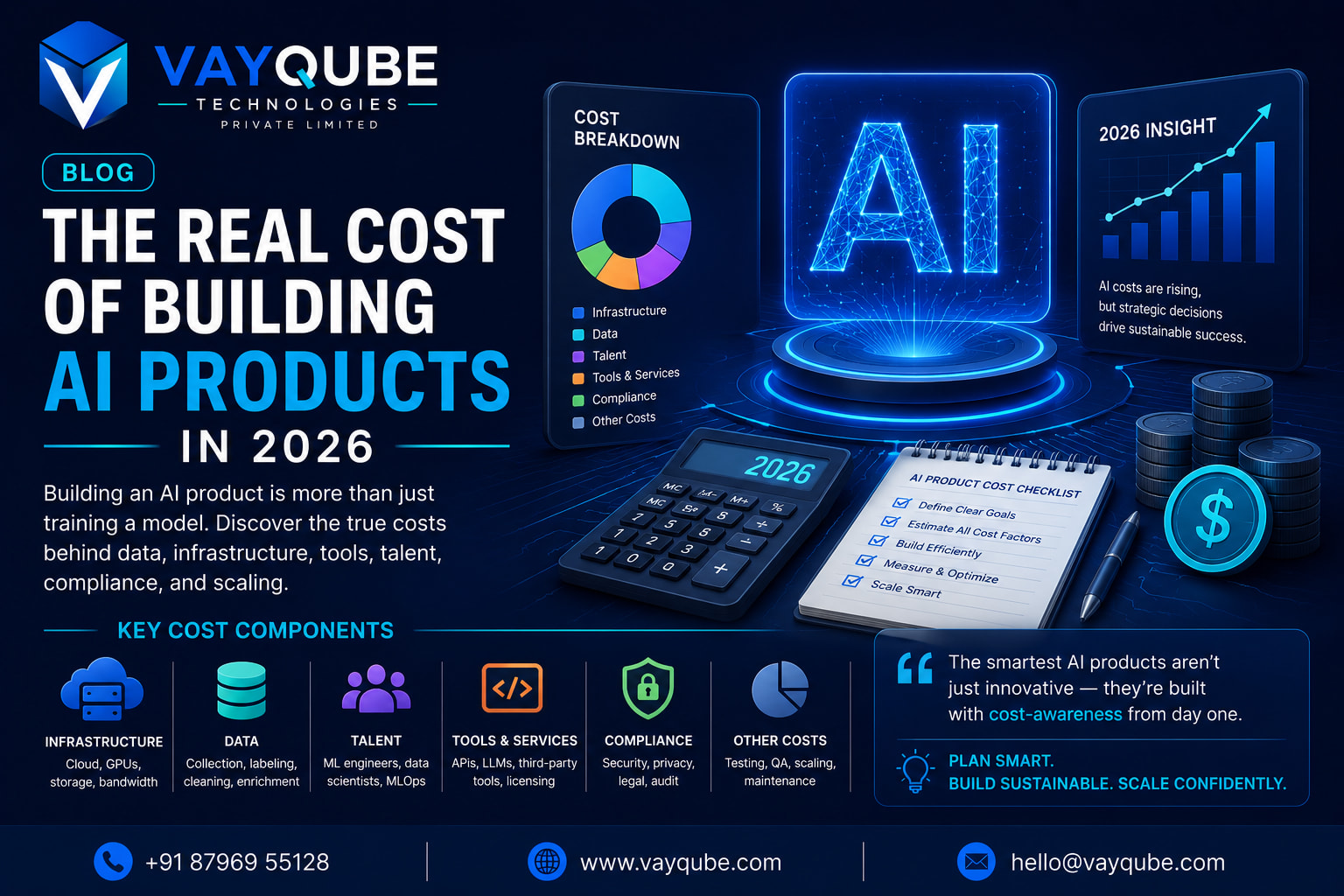
The Real Cost of Building AI Products in 2026
Building AI products can be costly, but understanding the expenses can help businesses plan and budget effectively. Learn about the real cost of AI product development.
Vayqube Team
Author


Introduction to AI Product Development Costs
The development of AI products has become a crucial aspect of business strategy in 2026, with companies across various industries investing heavily in AI-powered solutions. As AI technology continues to evolve, it's essential for businesses to understand the costs involved in building AI products to make informed decisions and allocate resources effectively.
Understanding the Complexity of AI Product Development
Building AI products is a complex process that requires significant expertise, resources, and investment. The cost of developing AI products goes beyond just the initial development phase, as it involves ongoing maintenance, updates, and training to ensure the AI system remains accurate and effective. Companies must consider the total cost of ownership, including the cost of data preparation, model training, and deployment, as well as the cost of integrating AI with existing systems and infrastructure.
The Importance of Cost Considerations
Understanding the costs involved in AI product development is critical for businesses to ensure they can scale their AI initiatives effectively. By considering the costs upfront, companies can avoid unexpected expenses, reduce the risk of project failure, and make more informed decisions about their AI investments. Moreover, understanding the costs involved can help businesses identify areas where they can optimize their AI development process, reduce costs, and improve the overall return on investment (ROI) of their AI initiatives.
Some key cost considerations for AI product development include:
- Data acquisition and preparation costs
- Model development and training costs
- Deployment and integration costs
- Ongoing maintenance and update costs
- Talent acquisition and retention costs
Real-World Implications
In real-world scenarios, the cost of building AI products can vary significantly depending on the complexity of the project, the size of the team, and the technology stack used. For instance, developing a simple chatbot may require a relatively small investment, while building a complex AI-powered predictive analytics platform may require a significant upfront investment. By understanding the costs involved, businesses can better plan and execute their AI initiatives, ensuring they achieve their desired outcomes and maximize their ROI.
Next Steps
To better understand the costs involved in building AI products, it's essential to delve deeper into the various components of AI product development, including data preparation, model development, and deployment. By examining each of these components in detail, businesses can gain a more comprehensive understanding of the costs involved and make more informed decisions about their AI investments.
Financial Implications of AI Development
The financial implications of AI development are a crucial aspect to consider when building AI products. The cost of developing and implementing AI solutions can be substantial, and it's essential to understand the potential return on investment (ROI) to make informed decisions.
Some key financial considerations include:
- Development costs: hiring AI engineers, data scientists, and other specialized professionals can be expensive
- Infrastructure costs: investing in hardware and software to support AI workloads can be a significant expense
- Maintenance costs: ensuring AI models are accurate and up-to-date requires ongoing investment in data quality, model retraining, and monitoring
Impact on Business Strategy
The financial implications of AI development can have a significant impact on business strategy and decision-making. For instance, companies may need to:
- Reallocate budget from other areas to support AI development
- Prioritize AI projects based on potential ROI and business impact
- Develop new revenue streams or business models to offset the costs of AI development
The impact of AI development on business strategy can be far-reaching, influencing everything from product development to customer engagement. By understanding the financial implications of AI development, businesses can make more informed decisions about where to invest their resources and how to maximize the potential of AI.
Decision-Making Considerations
When it comes to decision-making, AI development can introduce new complexities and considerations. For example:
- How to measure the success of AI projects and determine their impact on the business
- How to balance the potential benefits of AI with the potential risks and challenges
- How to ensure that AI development aligns with overall business goals and objectives
By carefully considering these factors, businesses can develop a more nuanced understanding of the real cost of building AI products and make more informed decisions about how to invest in AI development.
Core Architecture
The core architecture of AI systems is a critical component of building successful AI products. It encompasses the key components that enable AI systems to function efficiently and effectively.
Key Components
The key components of AI systems include:
- Data ingestion and processing
- Model training and deployment
- Inference and prediction
- Feedback and iteration These components work together to enable AI systems to learn, adapt, and improve over time.
Infrastructure and Technology Requirements
The infrastructure and technology requirements for AI systems are significant. They include:
- High-performance computing resources, such as GPUs and TPUs
- Large-scale data storage and management systems
- Advanced software frameworks and tools, such as TensorFlow and PyTorch
- Specialized hardware, such as ASICs and FPGAs These requirements can be costly and complex to implement, especially for large-scale AI systems.
The choice of infrastructure and technology can have a significant impact on the performance, scalability, and cost of AI systems. For example, cloud-based infrastructure can provide greater flexibility and scalability, but may also increase costs and introduce security risks. On-premises infrastructure, on the other hand, can provide greater control and security, but may also be more expensive and difficult to scale.
In real-world scenarios, companies like Google and Amazon have invested heavily in building custom AI infrastructure, including data centers and specialized hardware. This has enabled them to achieve significant performance and scalability advantages, but has also required significant investment and expertise.
When designing the core architecture of AI systems, it is essential to consider the trade-offs between different infrastructure and technology options. This includes evaluating factors such as cost, performance, scalability, security, and maintainability. By carefully considering these factors, organizations can build AI systems that meet their specific needs and requirements, while also minimizing costs and risks.
Implementation Considerations
Implementation considerations are critical when building AI systems. This includes:
- Ensuring data quality and integrity
- Implementing robust security and access controls
- Developing scalable and flexible architecture
- Ensuring compliance with relevant regulations and standards These considerations can help organizations avoid common pitfalls and ensure successful implementation of AI systems.
In production environments, AI systems must be able to handle large volumes of data, traffic, and user requests. This requires careful planning, testing, and optimization to ensure that the system can scale and perform as expected. By considering these implementation factors, organizations can build AI systems that are reliable, efficient, and effective in real-world scenarios.
Business Benefits
The integration of AI into products can have a significant impact on a company's bottom line. By leveraging AI, businesses can gain a competitive advantage in their respective markets. This advantage can be attributed to the unique insights and capabilities that AI provides, enabling companies to make data-driven decisions and automate complex processes.
Competitive Advantage
The adoption of AI can be a key differentiator for companies, setting them apart from their competitors. By harnessing the power of AI, businesses can:
- Enhance customer experiences through personalized interactions
- Optimize operational efficiency by automating routine tasks
- Improve product development through predictive analytics and machine learning
Revenue Growth and Cost Savings
The implementation of AI can also lead to significant revenue growth and cost savings. For instance:
- AI-driven sales and marketing efforts can result in increased conversions and reduced customer acquisition costs
- AI-powered supply chain management can lead to reduced logistics and inventory costs
- AI-enabled customer service can decrease support queries and improve resolution rates, resulting in lower support costs and increased customer satisfaction
By investing in AI, companies can unlock new revenue streams and reduce expenses, ultimately driving business growth and profitability. The key to realizing these benefits lies in the successful implementation and integration of AI into existing products and processes.
Implementation Considerations
To achieve the desired business benefits, companies must carefully consider their AI implementation strategy. This includes:
- Assessing the current state of their technology infrastructure and identifying areas for improvement
- Developing a clear understanding of their business goals and objectives, and how AI can be leveraged to achieve them
- Building a skilled and experienced team to design, develop, and deploy AI-powered products and solutions
By taking a thoughtful and strategic approach to AI adoption, businesses can minimize risks and maximize returns, ultimately driving long-term success and growth.
Scalability
As AI products become increasingly complex, scalability emerges as a significant challenge. The ability to efficiently grow and deploy AI systems is crucial for businesses to reap the benefits of AI while minimizing costs.
Challenges of Scaling AI Systems
Scaling AI systems poses several challenges, including:
- Data management: handling large volumes of data, ensuring data quality, and providing secure access to data
- Computational resources: providing sufficient computational power to train and deploy AI models
- Model complexity: managing the complexity of AI models, ensuring they remain accurate and efficient as they scale
- Integration: integrating AI systems with existing infrastructure and applications
Strategies for Efficient Growth and Deployment
To overcome these challenges, businesses can employ several strategies for efficient growth and deployment of AI systems:
- Cloud-based infrastructure: leveraging cloud-based infrastructure to provide scalable computational resources and data management
- Distributed architecture: designing distributed architectures to handle large volumes of data and provide secure access
- Model pruning: using model pruning techniques to reduce the complexity of AI models and improve efficiency
- Automated deployment: using automated deployment tools to streamline the deployment process and reduce errors
Real-World Examples
Real-world examples of successful AI scalability include:
- Netflix's use of cloud-based infrastructure to provide personalized recommendations to millions of users
- Google's use of distributed architecture to handle large volumes of search queries
- Amazon's use of model pruning to improve the efficiency of its AI-powered customer service chatbots
Production Considerations
When implementing AI systems, businesses must consider production requirements, including:
- Data security and compliance
- Model monitoring and maintenance
- Integration with existing systems and applications
- Scalability and performance testing to ensure the system can handle increased traffic and data volume.
Implementation Strategy
A well-planned implementation strategy is crucial for successful AI scalability. This includes:
- Defining clear scalability requirements and goals
- Developing a phased implementation plan
- Establishing a cross-functional team to oversee implementation and deployment
- Continuously monitoring and evaluating the system's performance and scalability.
Implementation Challenges
Implementing AI products can be a complex and daunting task, even for the most experienced organizations. Several common obstacles can hinder the development process, leading to delays, increased costs, and reduced quality.
Common Obstacles in AI Development
Some of the most significant challenges in AI development include:
- Data quality and availability issues
- Insufficient computational resources and infrastructure
- Limited expertise and talent in AI and machine learning
- Difficulty in integrating AI with existing systems and infrastructure
- Ensuring explainability, transparency, and accountability in AI decision-making
These obstacles can have a significant impact on the success of AI projects, and if not addressed properly, can lead to project failures or significant cost overruns.
Mitigation Strategies and Best Practices
To overcome these challenges, organizations can adopt several mitigation strategies and best practices, including:
- Developing a robust data management strategy to ensure high-quality and relevant data
- Investing in cloud-based infrastructure and leveraging scalable computing resources
- Building a diverse team with expertise in AI, machine learning, and domain-specific knowledge
- Adopting a modular and microservices-based architecture to facilitate integration with existing systems
- Implementing model interpretability and explainability techniques to ensure transparency and accountability
By adopting these strategies and best practices, organizations can reduce the risks associated with AI development and ensure successful implementation of AI products.
Real-World Examples and Production Considerations
In real-world scenarios, organizations have successfully implemented AI products by prioritizing data quality, investing in scalable infrastructure, and building diverse teams with expertise in AI and domain-specific knowledge. For instance, companies like Netflix and Amazon have leveraged AI to personalize customer experiences, improve recommendation engines, and optimize supply chain operations.
To ensure production readiness, organizations should focus on developing robust testing and validation frameworks, implementing continuous integration and deployment pipelines, and monitoring AI system performance in real-time. By doing so, organizations can ensure that their AI products are reliable, scalable, and meet the required business and technical standards.
Use Cases
The implementation of AI products has numerous real-world applications across various industries. To understand the true potential of AI, it's essential to explore successful use cases and industry-specific applications.
Industry-Specific Applications
Several industries have benefited significantly from AI implementations, including:
- Healthcare: AI-powered diagnostic tools, personalized medicine, and patient data analysis
- Finance: AI-driven risk management, predictive analytics, and automated trading platforms
- Retail: AI-powered customer service chatbots, personalized product recommendations, and inventory management
- Manufacturing: AI-driven predictive maintenance, quality control, and supply chain optimization
Real-World Examples
Companies like Netflix and Amazon have successfully implemented AI to enhance customer experience and drive business growth. For instance:
- Netflix uses AI to recommend content to users based on their viewing history and preferences
- Amazon employs AI to optimize its supply chain, predict demand, and improve customer service
Benefits and Challenges
While AI implementations offer numerous benefits, they also come with challenges. Some of the benefits include:
- Improved efficiency and productivity
- Enhanced customer experience
- Increased accuracy and precision
- Better decision-making capabilities However, challenges like data quality, integration complexity, and talent acquisition must be addressed to ensure successful AI implementations.
Production Considerations
When implementing AI products in production environments, it's crucial to consider factors like:
- Data security and compliance
- Scalability and performance
- Integration with existing systems
- Continuous monitoring and maintenance By carefully evaluating these factors, businesses can ensure seamless AI integration and maximize the benefits of AI implementations.
Implementation Strategy
A well-planned implementation strategy is vital to the success of AI products. This includes:
- Defining clear goals and objectives
- Assessing data quality and availability
- Selecting the right AI technologies and tools
- Developing a robust testing and validation framework
- Ensuring ongoing support and maintenance By following a structured approach, businesses can navigate the complexities of AI implementation and achieve tangible results.
Best Practices
To ensure the successful development and deployment of AI products, it's essential to follow established guidelines and learn from industry leaders. Effective AI development and deployment require a deep understanding of the technology, as well as the business and operational implications.
Guidelines for Development
Key considerations for AI development include:
- Defining clear objectives and outcomes
- Ensuring high-quality training data
- Selecting the most suitable AI algorithms and models
- Implementing robust testing and validation procedures
- Continuously monitoring and updating AI systems
Lessons Learned
Industry leaders and experts have shared valuable insights and lessons learned from their experiences with AI development and deployment. These include:
- The importance of human oversight and review
- The need for transparency and explainability in AI decision-making
- The value of ongoing maintenance and updates
- The potential risks and challenges associated with AI, such as bias and job displacement
Implementation Strategy
A well-planned implementation strategy is critical to the success of AI products. This includes:
- Developing a clear roadmap and timeline
- Establishing a cross-functional team with diverse skills and expertise
- Ensuring adequate resources and budget
- Fostering a culture of innovation and experimentation
- Continuously evaluating and improving AI systems
Real-World Examples
Real-world examples of successful AI implementation can provide valuable insights and inspiration. For instance, companies like Netflix and Amazon have leveraged AI to personalize customer experiences and improve operational efficiency. Similarly, healthcare organizations have used AI to analyze medical images and develop more effective treatment plans.
Production Considerations
When deploying AI products in production environments, it's essential to consider factors such as:
- Scalability and performance
- Security and compliance
- Integration with existing systems and infrastructure
- Ongoing maintenance and support
- Continuous monitoring and evaluation to ensure AI systems are meeting business objectives and delivering expected outcomes.
Frequently Asked Questions
The cost of building AI products is a complex and multifaceted topic, and many organizations have questions about what to expect. Here are some frequently asked questions about AI development costs, along with answers and insights from industry experts.
What are the key cost drivers for AI development?
The key cost drivers for AI development include:
- Data acquisition and preparation: High-quality data is essential for training AI models, and acquiring and preparing this data can be time-consuming and expensive.
- Model development and training: Developing and training AI models requires significant expertise and computational resources.
- Integration with existing systems: Integrating AI models with existing systems and infrastructure can be complex and require significant customization.
- Maintenance and updates: AI models require ongoing maintenance and updates to ensure they remain accurate and effective.
How do I estimate the cost of building an AI product?
Estimating the cost of building an AI product requires a thorough understanding of the project requirements and scope. Factors to consider include:
- The complexity of the AI model and the data required to train it
- The expertise and resources required to develop and integrate the model
- The infrastructure and hardware required to support the model
- The ongoing maintenance and update requirements for the model
What are the benefits of outsourcing AI development versus building in-house?
Outsourcing AI development can provide several benefits, including:
- Access to specialized expertise and resources
- Faster time-to-market for AI products
- Reduced upfront costs and infrastructure requirements However, building AI development capabilities in-house can also provide benefits, including:
- Greater control over the development process and IP
- Improved integration with existing systems and infrastructure
- Enhanced security and compliance
How do I ensure the scalability and reliability of my AI product?
Ensuring the scalability and reliability of an AI product requires careful planning and design. Factors to consider include:
- The ability of the AI model to handle increasing volumes of data and traffic
- The reliability and uptime of the infrastructure and hardware supporting the model
- The ability to monitor and update the model in real-time to ensure ongoing accuracy and effectiveness
What are the most common mistakes to avoid when building AI products?
Common mistakes to avoid when building AI products include:
- Underestimating the complexity and cost of AI development
- Failing to properly validate and test AI models
- Ignoring the need for ongoing maintenance and updates
- Failing to consider the ethical and regulatory implications of AI development
- Ignoring the need for human oversight and review of AI decision-making.
Conclusion
The journey of building AI products in 2026 is complex and multifaceted, involving significant investments of time, money, and resources. As we reflect on the key takeaways from our exploration, it's clear that the real cost of building AI products extends far beyond the initial development phase.
Summary of Key Takeaways
- The core architecture of AI systems requires careful planning and design to ensure scalability and reliability.
- Business benefits of AI adoption include enhanced customer experiences, improved operational efficiency, and increased revenue potential.
- Implementation challenges such as data quality, talent acquisition, and regulatory compliance must be addressed through strategic planning and investment.
- Real-world use cases demonstrate the potential of AI to drive innovation and growth in various industries.
Future Outlook and Recommendations
As we look to the future, it's essential to consider the following recommendations for AI adoption:
- Develop a clear understanding of the total cost of ownership for AI systems, including ongoing maintenance and updates.
- Invest in talent acquisition and development to ensure a skilled workforce capable of designing, implementing, and managing AI systems.
- Prioritize data quality and governance to ensure the integrity and reliability of AI decision-making.
- Stay informed about emerging trends and technologies in the AI landscape, such as explainable AI and edge AI.
By following these recommendations and taking a strategic approach to AI adoption, businesses can unlock the full potential of AI and drive long-term growth and success. The future of AI is exciting and full of possibilities, and those who are prepared to invest in this technology will be well-positioned to thrive in a rapidly changing world.
Production Considerations
When implementing AI products in production environments, it's crucial to consider factors such as:
- Scalability and reliability
- Security and compliance
- Monitoring and maintenance
- Continuous integration and delivery
By carefully evaluating these production considerations, businesses can ensure that their AI systems are deployed efficiently and effectively, driving maximum value and return on investment.
Real-World Examples
Real-world examples of successful AI adoption can be seen in industries such as:
- Healthcare, where AI is being used to improve patient outcomes and streamline clinical workflows.
- Finance, where AI is being used to detect fraud and improve risk management.
- Retail, where AI is being used to personalize customer experiences and optimize supply chain operations.
These examples demonstrate the potential of AI to drive innovation and growth in various industries, and highlight the importance of careful planning and strategic investment in AI adoption.
Related Vayqube Resources
- Ai Agents Changing Customer Support Operations 2026
- Best Software Development Company In New York
- Best Fintech Software Development Company In New York
- Healthcare Software Development Company New York
- Logistics Software Development Company New York
- How To Build Fintech Application Payments Security Scaling
Next Step
If your systems are struggling with scalability, automation, architecture complexity, or operational efficiency, it's time to modernize your infrastructure and workflows.
👉 Talk to a Vayqube solution architect and build systems designed for long-term production growth: