
Vector Databases Simplified
Vector databases are a new way to manage complex data, learn how they work and how to implement them. Improve your data management and scalability with vector databases
Vayqube Team
Software architecture and product engineering
Introduction
Vector databases are a crucial component in modern applications, particularly those involving artificial intelligence, machine learning, and data science. They enable efficient storage, search, and management of dense vectors, which are essential in various tasks such as image and speech recognition, natural language processing, and recommendation systems.
Overview of Vector Databases
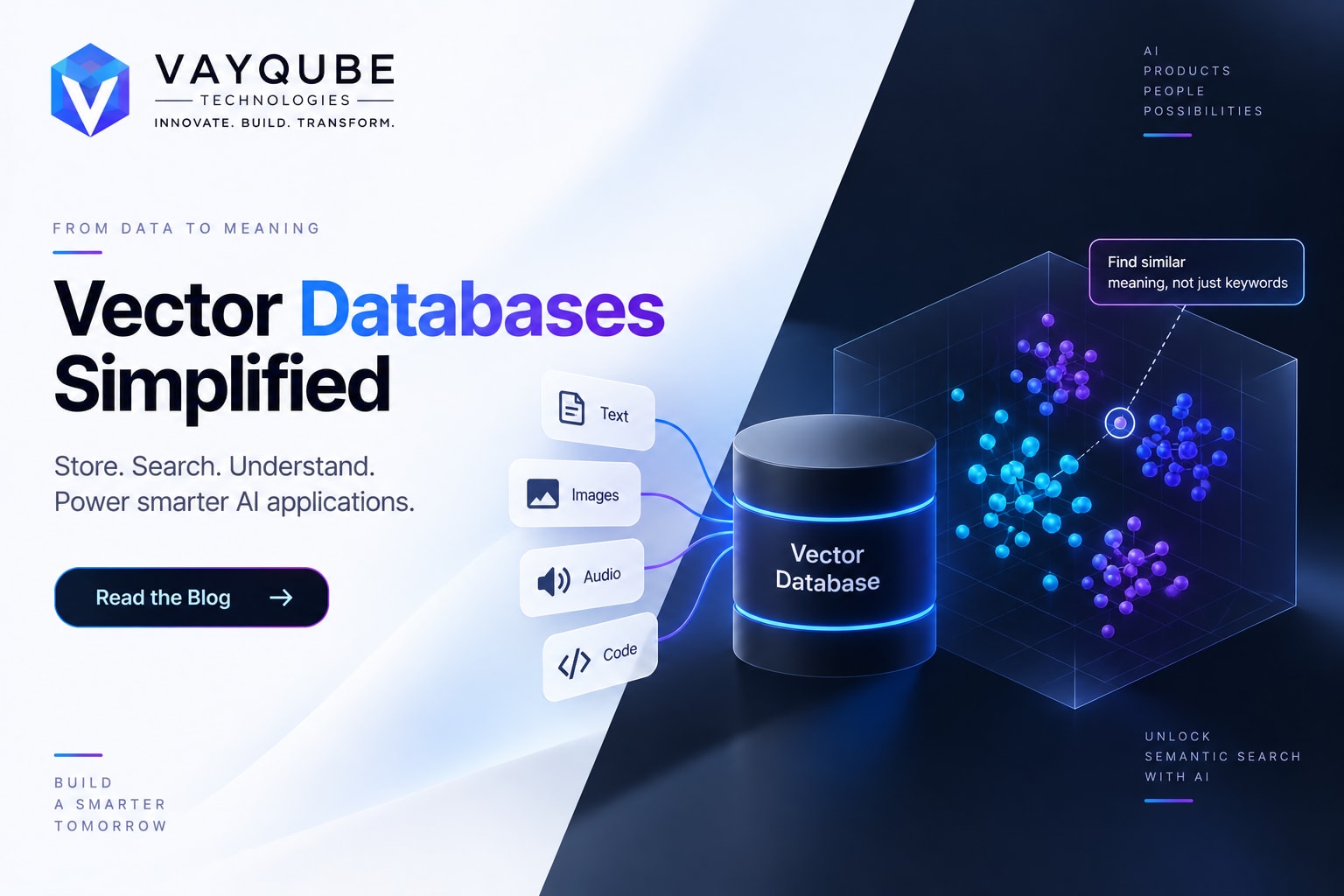
A vector database is a type of database designed to store and manage vector embeddings, which are dense vectors used to represent complex data such as images, text, and audio. These databases provide an efficient way to search, filter, and retrieve similar vectors, making them ideal for applications that require similarity search, clustering, and anomaly detection. Vector databases use various indexing techniques, such as trees, graphs, and hashing, to enable fast and accurate vector similarity search.
Importance in Modern Applications
The importance of vector databases lies in their ability to support a wide range of applications, including:
- Image and speech recognition
- Natural language processing
- Recommendation systems
- Anomaly detection
- Clustering and classification Vector databases provide a scalable and efficient way to manage and search large volumes of vector data, making them a crucial component in modern applications. They enable developers to build applications that can efficiently process and analyze complex data, providing valuable insights and improving overall performance.
Some of the key benefits of using vector databases include:
- Improved search accuracy and efficiency
- Enhanced scalability and performance
- Simplified data management and analysis
- Support for a wide range of applications and use cases
- Ability to handle large volumes of complex data
In modern applications, vector databases are used in various industries, including healthcare, finance, and e-commerce, to support tasks such as image classification, sentiment analysis, and recommendation systems. They provide a powerful tool for developers to build innovative applications that can efficiently process and analyze complex data, driving business value and improving customer experiences.
The use of vector databases is becoming increasingly important as the amount of complex data continues to grow, and the need for efficient and scalable solutions to manage and analyze this data becomes more pressing. As a result, vector databases are likely to play a critical role in the development of future applications and systems, enabling organizations to unlock the full potential of their data and drive business success.
Why It Matters
Vector databases offer significant advantages over traditional databases, particularly in handling complex, high-dimensional data.
Advantages over Traditional Databases
Traditional databases are designed to store and manage structured data, which can be limiting when dealing with large amounts of unstructured or semi-structured data. Vector databases, on the other hand, are optimized for storing and querying vector embeddings, which are dense representations of data in a high-dimensional space. This allows for more efficient and effective data retrieval and analysis. Some key benefits of vector databases include:
- Improved data compression, reducing storage costs
- Enhanced query performance, enabling faster and more accurate search and retrieval
- Support for advanced data analysis and machine learning techniques, such as similarity search and clustering
Enhanced Data Retrieval and Analysis
Vector databases enable enhanced data retrieval and analysis by allowing users to query data based on semantic similarity, rather than exact matches. This is particularly useful in applications such as image and video search, natural language processing, and recommender systems. By using vector embeddings to represent data, vector databases can efficiently search and retrieve similar items, even if they do not have exact matches. This enables a range of use cases, including:
- Image and video search, where users can search for similar images or videos based on visual features
- Natural language processing, where users can search for similar text based on semantic meaning
- Recommender systems, where users can receive personalized recommendations based on their past behavior and preferences.
The ability to efficiently store, query, and analyze large amounts of high-dimensional data makes vector databases an essential tool for a range of applications, from computer vision and natural language processing to recommender systems and beyond.
Core Architecture
The core architecture of a vector database is designed to efficiently store, index, and query large datasets of dense vectors. This is achieved through a combination of several key components.
Components of a Vector Database
The main components of a vector database include:
- Vector Storage: responsible for storing the dense vectors, often using a combination of compression algorithms and storage formats optimized for vector data.
- Indexing Mechanism: enables efficient querying and similarity search by organizing the vectors in a way that allows for fast lookup and comparison.
- Query Engine: handles incoming queries, leveraging the indexing mechanism to quickly identify the most similar vectors.
- Metadata Management: stores and manages additional information about the vectors, such as labels, tags, or other relevant data.
How Vectors are Stored and Indexed
Vectors are typically stored in a compressed format to reduce storage costs and improve data transfer efficiency. The indexing mechanism is crucial for achieving fast query performance. Common indexing techniques include:
- Brute Force: compares the query vector to every vector in the database, which can be computationally expensive for large datasets.
- Tree-based Indexing: organizes vectors in a hierarchical structure, allowing for faster lookup and comparison.
- Hash-based Indexing: uses hash functions to map similar vectors to the same or nearby locations, enabling efficient similarity search.
- Graph-based Indexing: represents vectors as nodes in a graph, with edges connecting similar vectors, facilitating fast query and traversal operations.
Effective vector database architecture must balance storage efficiency, query performance, and scalability to support real-world applications, such as image and speech recognition, natural language processing, and recommender systems.
Business Benefits
The implementation of vector databases can have a significant impact on businesses, driving growth and improvement in various areas.
Improved Data Insights
Vector databases enable organizations to unlock complex data insights, which can be particularly useful in applications such as image and speech recognition, natural language processing, and recommendation systems. By leveraging these insights, businesses can develop a more nuanced understanding of their customers, markets, and operations, ultimately informing strategic decisions.
Enhanced Decision Making
With vector databases, businesses can enhance their decision-making capabilities by analyzing large amounts of complex data. This can lead to more accurate predictions, better risk assessments, and more effective resource allocation. For instance, a company can use vector databases to analyze customer behavior and preferences, allowing them to create targeted marketing campaigns and improve customer engagement.
Increased Efficiency
The use of vector databases can also increase efficiency in various business processes. By reducing the need for manual data analysis and processing, vector databases can automate tasks, freeing up resources for more strategic and high-value activities. Additionally, vector databases can facilitate the integration of data from multiple sources, reducing data silos and improving overall data management. This can lead to significant cost savings and improved productivity, as businesses can focus on higher-level tasks and drive innovation.
Some key benefits of vector databases include:
- Faster data processing and analysis
- Improved data accuracy and quality
- Enhanced scalability and flexibility
- Better support for complex data types and applications
- Increased collaboration and knowledge sharing across teams and departments
Overall, the implementation of vector databases can have a transformative impact on businesses, driving growth, improvement, and innovation in various areas. By unlocking complex data insights, enhancing decision-making capabilities, and increasing efficiency, vector databases can help organizations stay competitive and achieve their goals in today's fast-paced and data-driven business landscape.
Scalability
To achieve scalability in vector databases, several strategies can be employed.
Horizontal Scaling
Horizontal scaling involves adding more nodes to the database cluster to increase its capacity. This approach allows the database to handle increased workloads and larger datasets by distributing the data across multiple nodes. Key considerations for horizontal scaling include:
- Node configuration and resource allocation
- Data distribution and replication strategies
- Network latency and communication overhead between nodes
Distributed Architecture
A distributed architecture is essential for achieving scalability in vector databases. This involves designing the database to operate across multiple machines, with each machine responsible for a portion of the overall workload. Distributed architectures can be categorized into:
- Shared-nothing architecture, where each node is independent and self-sufficient
- Shared-disk architecture, where multiple nodes share a common disk storage system
- Shared-memory architecture, where multiple nodes share a common memory space
High-Performance Computing
High-performance computing (HPC) techniques can be applied to vector databases to accelerate query performance and improve scalability. This includes:
- Leveraging GPU acceleration for compute-intensive operations
- Utilizing high-speed interconnects for low-latency communication between nodes
- Implementing parallel processing and concurrent query execution to maximize resource utilization Real-world examples of scalable vector databases include those used in large-scale image and video analysis, natural language processing, and recommender systems.
In production environments, scalability is critical to ensure the vector database can handle varying workloads and large datasets. By employing horizontal scaling, distributed architecture, and high-performance computing techniques, organizations can build scalable vector databases that meet their business needs.
Implementation Challenges
Implementing a vector database can be a complex task, requiring careful consideration of several key factors.
Data Preparation and Integration
Data preparation and integration are critical steps in the implementation process. This involves collecting, processing, and indexing large amounts of data from various sources, such as images, text, or audio files. The data must be converted into a format that can be efficiently stored and queried in the vector database. Some key considerations include:
- Data quality and preprocessing
- Handling missing or incomplete data
- Integrating with existing data pipelines and infrastructure
Query Optimization
Query optimization is another important challenge in implementing a vector database. This involves designing and optimizing queries to efficiently retrieve relevant data from the database. Some key considerations include:
- Indexing and caching strategies
- Query language and syntax
- Balancing query performance with accuracy and relevance
System Maintenance
System maintenance is an ongoing challenge in implementing a vector database. This involves ensuring the database remains scalable, secure, and performant over time. Some key considerations include:
- Monitoring and logging
- Backup and recovery strategies
- Upgrading and patching the database software
Effective implementation of a vector database requires careful consideration of these challenges and a deep understanding of the underlying technology and use case. By prioritizing data preparation and integration, query optimization, and system maintenance, organizations can unlock the full potential of vector databases and drive business value.
Some real-world examples of vector databases in action include image and video search, natural language processing, and recommender systems. In each of these cases, the vector database is used to efficiently store and query large amounts of complex data, enabling fast and accurate retrieval of relevant information.
When implementing a vector database, it's essential to consider the production environment and the potential impact on existing systems and infrastructure. This includes evaluating the scalability and performance of the database, as well as ensuring seamless integration with existing applications and services.
By taking a thoughtful and strategic approach to implementation, organizations can overcome the challenges associated with vector databases and unlock the full potential of this powerful technology.
Use Cases
Vector databases have numerous applications across various industries, and their use cases continue to expand. Some of the most notable applications include:
- Recommendation Systems: By leveraging vector databases, companies can build more accurate and personalized recommendation systems. For instance, a music streaming service can use vector databases to recommend songs based on a user's listening history and preferences.
- Natural Language Processing: Vector databases can be used to improve natural language processing tasks such as text classification, sentiment analysis, and language translation. This can be particularly useful for chatbots, virtual assistants, and other applications that rely on human-computer interaction.
- Computer Vision Applications: Vector databases can also be applied to computer vision tasks such as image classification, object detection, and facial recognition. This can be used in various applications, including security systems, self-driving cars, and medical diagnosis.
Recommendation Systems
In recommendation systems, vector databases can be used to create high-dimensional vector representations of users and items. These vectors can then be used to calculate similarities between users and items, allowing for more accurate recommendations. For example, a movie streaming service can use vector databases to recommend movies based on a user's watching history and ratings.
Natural Language Processing
In natural language processing, vector databases can be used to improve the accuracy of tasks such as text classification and sentiment analysis. By representing words and phrases as high-dimensional vectors, vector databases can capture subtle nuances in language and improve the accuracy of these tasks. For instance, a company can use vector databases to analyze customer feedback and sentiment, allowing them to make more informed decisions.
Computer Vision Applications
In computer vision applications, vector databases can be used to improve the accuracy of tasks such as image classification and object detection. By representing images as high-dimensional vectors, vector databases can capture subtle patterns and features in images, allowing for more accurate classification and detection. For example, a self-driving car can use vector databases to detect and classify objects on the road, improving safety and navigation.
Best Practices
To get the most out of vector databases, it's essential to follow best practices that ensure efficient data management, fast query performance, and reliable operations.
Data Modeling and Schema Design
Proper data modeling and schema design are critical in vector databases. This involves understanding the structure and relationships of the data, as well as the queries that will be executed. A well-designed schema can significantly improve query performance and reduce storage costs. Some key considerations include:
- Defining the optimal vector dimensionality and data type
- Selecting the appropriate indexing strategy
- Organizing data into collections or partitions for efficient querying
Indexing and Query Optimization
Indexing and query optimization are crucial for achieving fast query performance in vector databases. This includes:
- Creating indexes on frequently queried vectors or metadata
- Using techniques like quantization or approximation to reduce index size and improve query speed
- Optimizing query algorithms and parameters for specific use cases, such as nearest-neighbor search or similarity search
Monitoring and Troubleshooting
Monitoring and troubleshooting are vital for ensuring the reliability and performance of vector databases. This includes:
- Tracking key metrics like query latency, throughput, and error rates
- Implementing logging and alerting mechanisms to detect issues and anomalies
- Developing a troubleshooting strategy to quickly identify and resolve problems, such as data corruption or indexing issues.
By following these best practices, organizations can unlock the full potential of vector databases and achieve scalable, efficient, and reliable operations.
FAQ
To address common questions and concerns, let's dive into the fundamentals of vector databases and their applications.
What is a Vector Database?
A vector database is a type of database designed to store, index, and manage vector data, such as embeddings, graphs, and other complex data structures. It enables efficient similarity searches, clustering, and other operations on high-dimensional data, making it a crucial component in various AI and machine learning applications.
How does it differ from a Traditional Database?
Unlike traditional databases that store and manage structured data, vector databases are optimized for unstructured or semi-structured data, such as images, text, and audio. They use specialized indexing techniques, like quantization and graph-based methods, to reduce storage requirements and improve query performance. This difference in design and functionality allows vector databases to tackle complex tasks that traditional databases struggle with.
What are the Key Applications?
Some of the key applications of vector databases include:
- Image and Video Search: enabling efficient similarity searches for visual content
- Natural Language Processing (NLP): powering tasks like text classification, clustering, and semantic search
- Recommendation Systems: providing personalized recommendations based on user behavior and preferences
- Anomaly Detection: identifying unusual patterns and outliers in complex data sets These applications demonstrate the versatility and potential of vector databases in various industries and use cases.
Conclusion
In summary, vector databases have emerged as a crucial component in various applications, including artificial intelligence, machine learning, and data science. The key points to consider when exploring vector databases include their core architecture, business benefits, scalability, implementation challenges, and best practices.
Summary of Key Points
- Vector databases enable efficient storage and querying of dense vectors, facilitating similarity searches and machine learning model training
- A well-designed core architecture is essential for optimal performance and scalability
- Business benefits include improved search functionality, enhanced customer experiences, and accelerated innovation
- Scalability is critical to handle large volumes of data and support growing workloads
- Implementation challenges can be addressed through careful planning, best practices, and strategic partnerships
Future of Vector Databases
As the use of vector databases continues to expand, we can expect significant advancements in areas like:
- Improved query performance and accuracy
- Enhanced support for diverse data types and formats
- Increased adoption in industries beyond technology and finance
- Integration with emerging technologies like quantum computing and edge AI
Call to Action for Implementation
To stay ahead of the curve, organizations should consider the following steps:
- Assess their current data management infrastructure and identify opportunities for vector database integration
- Evaluate potential use cases and prioritize those with the greatest business impact
- Develop a strategic implementation plan, including timelines, resource allocation, and key performance indicators
- Collaborate with experts and explore partnerships to ensure successful deployment and ongoing support By taking proactive steps to leverage vector databases, businesses can unlock new possibilities for innovation, growth, and competitiveness in an increasingly data-driven world.
Related Vayqube Resources
- Best Software Development Company In Singapore City
- Best Fintech Software Development Company In Singapore City
- Healthcare Software Development Company Singapore City
- Best Software Development Company In New York
- Best Mobile App Development Company In Singapore City
- Best Fintech Software Development Company In New York
Next Step
If your systems are struggling with scalability, automation, architecture complexity, or operational efficiency, it's time to modernize your infrastructure and workflows.
👉 Talk to a Vayqube solution architect and build systems designed for long-term production growth: