
AI Agents in Action: Real Applications
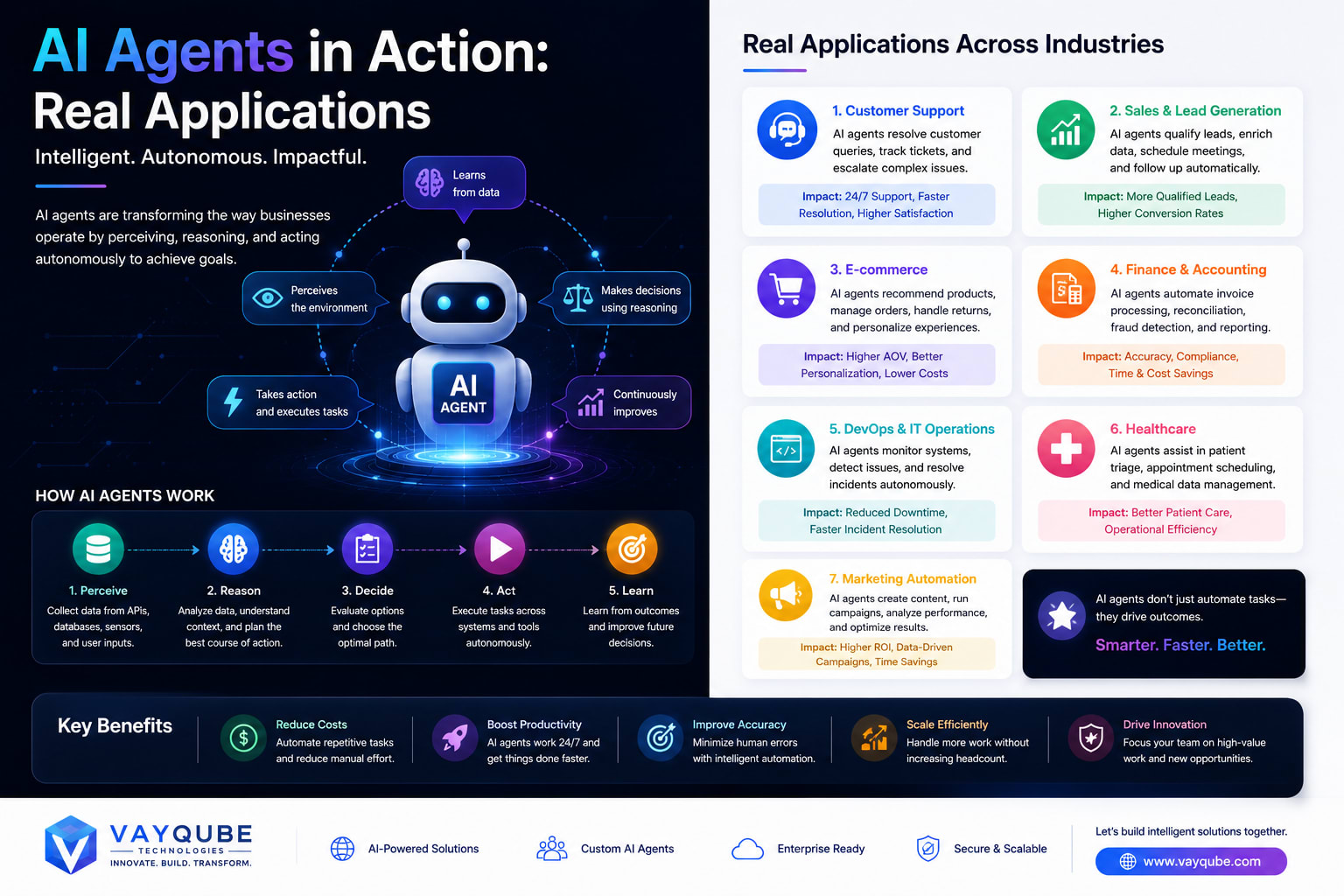
AI agents are transforming industries with their ability to learn and adapt. From chatbots to predictive analytics, AI agents are driving business value in real-world applications.
Vayqube Team
Author
Introduction to AI Agents
AI agents have emerged as a transformative force in the technology landscape, enabling organizations to automate complex tasks, enhance customer experiences, and unlock new business opportunities. At their core, AI agents are software programs that use artificial intelligence and machine learning to perform tasks that typically require human intelligence, such as reasoning, problem-solving, and decision-making.
Evolution of AI Agents
The concept of AI agents has been around for several decades, with the first AI programs developed in the 1950s and 1960s. However, it wasn't until the 1990s and 2000s that AI agents began to gain traction, with the development of expert systems, decision support systems, and autonomous agents. Today, AI agents are being used in a wide range of applications, from virtual assistants and chatbots to predictive maintenance and quality control.
Key milestones in the evolution of AI agents include:
- The development of the first AI program, called Logical Theorist, in 1956
- The creation of the first expert system, called MYCIN, in 1976
- The emergence of autonomous agents in the 1990s, with the development of systems like IBM's Deep Blue
- The widespread adoption of virtual assistants, such as Siri and Alexa, in the 2010s
Real-World Applications of AI Agents
AI agents are being used in a variety of real-world applications, including:
- Customer service and support
- Predictive maintenance and quality control
- Healthcare and medical diagnosis
- Financial analysis and portfolio management
- Cybersecurity and threat detection
These applications demonstrate the potential of AI agents to transform industries and revolutionize the way businesses operate. By leveraging AI agents, organizations can improve efficiency, reduce costs, and enhance customer experiences, ultimately driving business growth and competitiveness.
Brief History of AI Agents
The history of AI agents is marked by significant advancements in areas like machine learning, natural language processing, and computer vision. These advancements have enabled the development of more sophisticated AI agents that can perform complex tasks, learn from data, and interact with humans in a more natural way. As AI technology continues to evolve, we can expect to see even more innovative applications of AI agents in the future.
Why It Matters
The integration of AI agents into business operations has far-reaching implications that can significantly impact a company's bottom line. By automating routine tasks and providing personalized customer experiences, AI agents can help businesses streamline their operations, reduce costs, and increase revenue.
Business Operations Impact
The impact of AI agents on business operations is multifaceted. Some key benefits include:
- Improved efficiency: AI agents can automate tasks such as data entry, bookkeeping, and customer service, freeing up human resources for more strategic and creative work.
- Enhanced accuracy: AI agents can perform tasks with a high degree of accuracy, reducing errors and improving overall quality.
- Increased scalability: AI agents can handle large volumes of data and transactions, making them ideal for businesses that need to scale quickly.
Enhanced Customer Experience
AI agents can also play a crucial role in enhancing the customer experience. By providing personalized recommendations, offering real-time support, and helping customers navigate complex products and services, AI agents can help businesses build strong relationships with their customers. Some key benefits include:
- Personalized interactions: AI agents can analyze customer data and behavior to provide personalized recommendations and offers.
- Real-time support: AI agents can provide customers with immediate support and answers to their questions, reducing wait times and improving overall satisfaction.
- Improved customer insights: AI agents can analyze customer data and behavior to provide businesses with valuable insights and trends.
Competitive Advantage
The use of AI agents can also provide businesses with a significant competitive advantage. By leveraging AI technology, businesses can differentiate themselves from their competitors, improve their market position, and attract new customers. Some key benefits include:
- Unique value proposition: AI agents can provide businesses with a unique value proposition that sets them apart from their competitors.
- Improved market position: AI agents can help businesses improve their market position by providing them with real-time insights and trends.
- Increased customer loyalty: AI agents can help businesses build strong relationships with their customers, increasing customer loyalty and retention.
Core Architecture
The core architecture of AI agents is comprised of several key components that work together to enable intelligent decision-making and automation.
Components of AI Agents
The primary components of AI agents include:
- Perception Module: responsible for collecting and processing data from various sources
- Reasoning Module: uses machine learning algorithms to analyze data and make decisions
- Action Module: executes the decisions made by the reasoning module
- Knowledge Base: stores information and knowledge gathered by the AI agent
Machine Learning Algorithms
Machine learning algorithms play a crucial role in the functioning of AI agents. These algorithms enable the agent to learn from data, identify patterns, and make predictions or decisions. Some common machine learning algorithms used in AI agents include:
- Supervised learning
- Unsupervised learning
- Reinforcement learning
- Deep learning
Integration with Existing Systems
To be effective, AI agents must be able to integrate with existing systems and infrastructure. This includes:
- Data Integration: ability to collect and process data from various sources
- System Integration: ability to integrate with existing systems and applications
- API Integration: ability to interact with other systems and services using APIs
- Security Integration: ability to ensure the security and integrity of data and systems
Effective integration with existing systems enables AI agents to leverage existing data and infrastructure, reducing the need for duplicate data collection and processing. This also facilitates the development of more accurate and informed decision-making models.
In real-world applications, AI agents are being used to automate tasks, provide customer support, and analyze large datasets. For example, chatbots are being used to provide customer support, while virtual assistants are being used to automate tasks and provide personalized recommendations.
The ability of AI agents to integrate with existing systems and infrastructure is critical to their success. As AI agents continue to evolve and improve, we can expect to see even more innovative applications of this technology in the future.
Key considerations for implementing AI agents include:
- Scalability: ability of the AI agent to handle large volumes of data and traffic
- Flexibility: ability of the AI agent to adapt to changing requirements and conditions
- Security: ability of the AI agent to ensure the security and integrity of data and systems
- Usability: ability of the AI agent to provide a user-friendly and intuitive interface.
Business Benefits
The integration of AI agents into business operations can have a significant impact on overall performance. One of the primary advantages is increased efficiency. By automating repetitive and mundane tasks, AI agents can free up human resources to focus on more complex and high-value tasks. This can lead to improved productivity and reduced turnaround times for critical projects.
Efficiency Gains
Some of the key areas where AI agents can drive efficiency gains include:
- Automated data processing and analysis
- Streamlined customer service and support
- Enhanced supply chain management and logistics
- Improved resource allocation and scheduling
Informed Decision-Making
AI agents can also improve decision-making by providing real-time insights and analytics. This can be particularly valuable in areas such as:
- Market trend analysis and forecasting
- Customer behavior and preference analysis
- Operational performance monitoring and optimization
- Risk management and mitigation
Cost Savings
The cost savings associated with AI agents can be substantial. By reducing the need for manual labor and minimizing errors, businesses can lower their operational expenses. Additionally, AI agents can help identify areas of waste and inefficiency, allowing for more targeted cost-cutting measures. Some of the key areas where AI agents can drive cost savings include:
- Reduced labor costs through automation
- Minimized error rates and improved quality control
- Optimized resource utilization and allocation
- Improved predictive maintenance and reduced downtime
Scalability
To ensure AI agents can handle the demands of real-world applications, scalability is crucial. This involves designing systems that can efficiently process large volumes of data, adapt to changing business needs, and maintain reliability and uptime.
Handling High Volumes of Data
AI agents must be able to handle high volumes of data from various sources, including sensors, logs, and user interactions. This requires:
- Distributed architectures that can scale horizontally to handle increased data loads
- Efficient data processing and storage solutions, such as cloud-based services or NoSQL databases
- Real-time data processing capabilities to enable timely decision-making and action
Adapting to Changing Business Needs
Business needs can change rapidly, and AI agents must be able to adapt to these changes. This involves:
- Modular designs that allow for easy integration of new components or replacement of existing ones
- Agile development methodologies that enable rapid iteration and deployment of new features and models
- Continuous monitoring and feedback mechanisms to ensure AI agents remain aligned with business objectives
Ensuring Reliability and Uptime
AI agents must be reliable and always available to ensure continuous operation and minimize downtime. This requires:
- Redundant systems and failover mechanisms to ensure high availability
- Regular maintenance and updates to prevent technical debt and ensure compatibility with changing infrastructure
- Real-time monitoring and alerting systems to quickly identify and address potential issues before they impact operations
By focusing on these key areas, organizations can develop AI agents that are not only effective but also scalable, adaptable, and reliable, enabling them to drive real business value and competitive advantage.
Implementation Challenges
When implementing AI agents, several challenges can hinder their effectiveness and overall performance.
Data Quality and Availability
Data quality and availability are crucial for training and deploying AI agents. Inaccurate, incomplete, or biased data can lead to suboptimal decision-making and poor outcomes. Ensuring access to high-quality, relevant data is essential for successful AI agent implementation. This can be achieved by:
- Implementing robust data validation and cleansing processes
- Establishing data governance policies to ensure data accuracy and consistency
- Developing strategies to address data gaps and scarcity
Integrating with Legacy Systems
Integrating AI agents with existing legacy systems can be complex and time-consuming. These systems often have unique architectures, data formats, and integration requirements, making it challenging to incorporate AI agents seamlessly. To overcome this challenge:
- Conduct thorough system assessments to identify potential integration points and challenges
- Develop customized integration strategies to accommodate legacy system requirements
- Consider leveraging APIs, messaging queues, or other integration technologies to facilitate communication between AI agents and legacy systems
Addressing Potential Biases
AI agents can perpetuate and amplify existing biases if not properly addressed. This can result in unfair outcomes, damaged reputation, and legal repercussions. To mitigate these risks:
- Regularly audit AI agent decision-making processes to detect potential biases
- Implement debiasing techniques, such as data preprocessing, feature engineering, and model regularization
- Establish clear guidelines and standards for AI agent development and deployment to ensure fairness and transparency
Use Cases
AI agents are being used in various industries to improve efficiency, reduce costs, and enhance customer experience. Some of the notable use cases include:
- Customer service chatbots: Many companies are using AI-powered chatbots to provide 24/7 customer support. These chatbots can help answer frequent questions, route complex issues to human representatives, and even help with transactional tasks such as returns and exchanges.
- Predictive maintenance: AI agents are being used in industries such as manufacturing and logistics to predict when equipment is likely to fail. This allows companies to perform maintenance before a failure occurs, reducing downtime and increasing overall efficiency.
- Personalized marketing: AI agents can help companies personalize their marketing efforts by analyzing customer data and behavior. This can include tailoring ads, offers, and content to individual customers, increasing the likelihood of conversion and loyalty.
Customer Service Chatbots
Customer service chatbots are one of the most common use cases for AI agents. These chatbots can be integrated into websites, mobile apps, and even social media platforms to provide customers with quick and easy access to support. Some of the benefits of using customer service chatbots include:
- Reduced support costs: Chatbots can help reduce the number of support requests that need to be handled by human representatives, freeing up resources for more complex issues.
- Improved response times: Chatbots can respond to customer inquiries immediately, reducing the time it takes for customers to get the help they need.
- Enhanced customer experience: Chatbots can provide customers with a more personalized and engaging experience, increasing customer satisfaction and loyalty.
Predictive Maintenance
Predictive maintenance is another important use case for AI agents. By analyzing data from sensors and other sources, AI agents can predict when equipment is likely to fail, allowing companies to perform maintenance before a failure occurs. Some of the benefits of using predictive maintenance include:
- Reduced downtime: By performing maintenance before a failure occurs, companies can reduce downtime and increase overall efficiency.
- Improved safety: Predictive maintenance can help identify potential safety hazards before they become major issues.
- Cost savings: Predictive maintenance can help companies avoid costly repairs and replacements by identifying issues before they become major problems.
Personalized Marketing
AI agents can also be used to personalize marketing efforts, increasing the likelihood of conversion and loyalty. By analyzing customer data and behavior, AI agents can help companies tailor their marketing efforts to individual customers. Some of the benefits of using personalized marketing include:
- Increased conversion rates: Personalized marketing can increase the likelihood of conversion by tailoring ads, offers, and content to individual customers.
- Improved customer loyalty: Personalized marketing can help build stronger relationships with customers, increasing loyalty and retention.
- Better ROI: Personalized marketing can help companies get a better return on investment by targeting the right customers with the right message.
Best Practices
To ensure the effective deployment and maintenance of AI agents, it's crucial to follow best practices that promote reliability, efficiency, and continuous improvement.
Performance Monitoring
Monitoring and evaluating the performance of AI agents is essential to identify areas of improvement and optimize their operation. This involves tracking key performance indicators (KPIs) such as accuracy, response time, and user satisfaction. By analyzing these metrics, organizations can refine their AI agents to better meet the needs of their users.
Model Updates and Refining
AI models must be continuously updated and refined to adapt to changing user behaviors, preferences, and market conditions. This can be achieved through regular training on new data, incorporating user feedback, and leveraging advancements in AI research. By keeping their models up-to-date, organizations can ensure their AI agents remain relevant and effective.
Transparency and Explainability
Ensuring transparency and explainability in AI decision-making is vital for building trust with users and complying with regulatory requirements. This can be achieved by providing clear explanations for the recommendations or actions taken by AI agents, as well as offering insights into the data used to train the models. By prioritizing transparency and explainability, organizations can foster a sense of accountability and reliability in their AI-powered systems.
Some key considerations for implementing these best practices include:
- Establishing a robust monitoring and evaluation framework
- Developing a culture of continuous learning and improvement
- Implementing transparent and explainable AI models
- Encouraging user feedback and incorporating it into model refinement
- Staying abreast of the latest advancements in AI research and technologies
By following these best practices, organizations can unlock the full potential of their AI agents and drive meaningful business outcomes.
FAQ
To address common questions and concerns about AI agents, we'll delve into their definition, learning processes, and potential risks.
What are AI Agents?
AI agents refer to autonomous systems that use artificial intelligence to perform tasks, make decisions, and interact with their environment. These agents can be simple or complex, ranging from chatbots to sophisticated robots. They are designed to operate independently, using algorithms and data to guide their actions.
How do AI Agents Learn and Improve?
AI agents learn and improve through various methods, including:
- Machine learning: enabling agents to adapt based on data and experiences
- Reinforcement learning: using rewards or penalties to guide decision-making
- Human feedback: allowing agents to learn from user interactions and corrections
- Self-supervised learning: enabling agents to generate their own training data and learn from it
What are the Potential Risks and Limitations?
While AI agents offer numerous benefits, they also come with potential risks and limitations, such as:
- Bias in decision-making: if agents are trained on biased data, they may perpetuate existing prejudices
- Lack of transparency: complex AI systems can be difficult to interpret and understand
- Dependence on data quality: agents are only as good as the data they're trained on, and poor data can lead to poor performance
- Security vulnerabilities: AI agents can be vulnerable to cyber attacks and data breaches, compromising sensitive information
These risks and limitations highlight the need for careful consideration and planning when implementing AI agents in real-world applications. By understanding these challenges, organizations can better navigate the complexities of AI agent development and deployment.
Conclusion
The integration of AI agents in various industries has shown promising results, transforming the way businesses operate and interact with customers.
Key Takeaways
To recap, the key points discussed include:
- The core architecture of AI agents and their components
- The business benefits of adopting AI agents, such as enhanced customer experience and improved operational efficiency
- The scalability and implementation challenges associated with AI agents
- Real-world use cases and best practices for successful adoption
Future Outlook
As AI technology continues to evolve, we can expect to see even more sophisticated AI agents being developed. Potential applications include:
- Enhanced customer service chatbots that can understand and respond to complex queries
- Intelligent virtual assistants that can learn and adapt to individual user preferences
- Automated decision-making systems that can analyze vast amounts of data and make informed decisions
Call to Action
For businesses looking to stay ahead of the curve, adopting AI agents can be a strategic move. By leveraging AI agents, businesses can:
- Improve customer engagement and loyalty
- Increase operational efficiency and reduce costs
- Gain a competitive edge in the market It is essential for businesses to start exploring the potential of AI agents and develop a strategy for implementation. By doing so, they can unlock new opportunities for growth and stay competitive in a rapidly changing market.
Next Steps
To get started, businesses should consider the following steps:
- Assess their current infrastructure and identify areas where AI agents can be integrated
- Develop a clear understanding of their customer needs and preferences
- Explore different AI agent solutions and choose the one that best aligns with their business goals By taking these steps, businesses can embark on a successful AI agent adoption journey and reap the benefits of this emerging technology.
Related Vayqube Resources
- Best Mobile App Development Company In Singapore City
- Best Mobile App Development Company In Usa
- Best Mobile App Development Company In New York
- Best Software Development Company In Singapore City
- Best Fintech Software Development Company In Singapore City
- Healthcare Software Development Company Singapore City
Next Step
If your systems are struggling with scalability, automation, architecture complexity, or operational efficiency, it's time to modernize your infrastructure and workflows.
👉 Talk to a Vayqube solution architect and build systems designed for long-term production growth: