
FinTech App Development Challenges: Security, Compliance & Scalability
Security, compliance, and scalability are deeply interconnected in FinTech development. This guide shows how architectural decisions in one area impact the others—and how to prioritize trade-offs early.
Vayqube Team
FinTech compliance and secure systems engineering
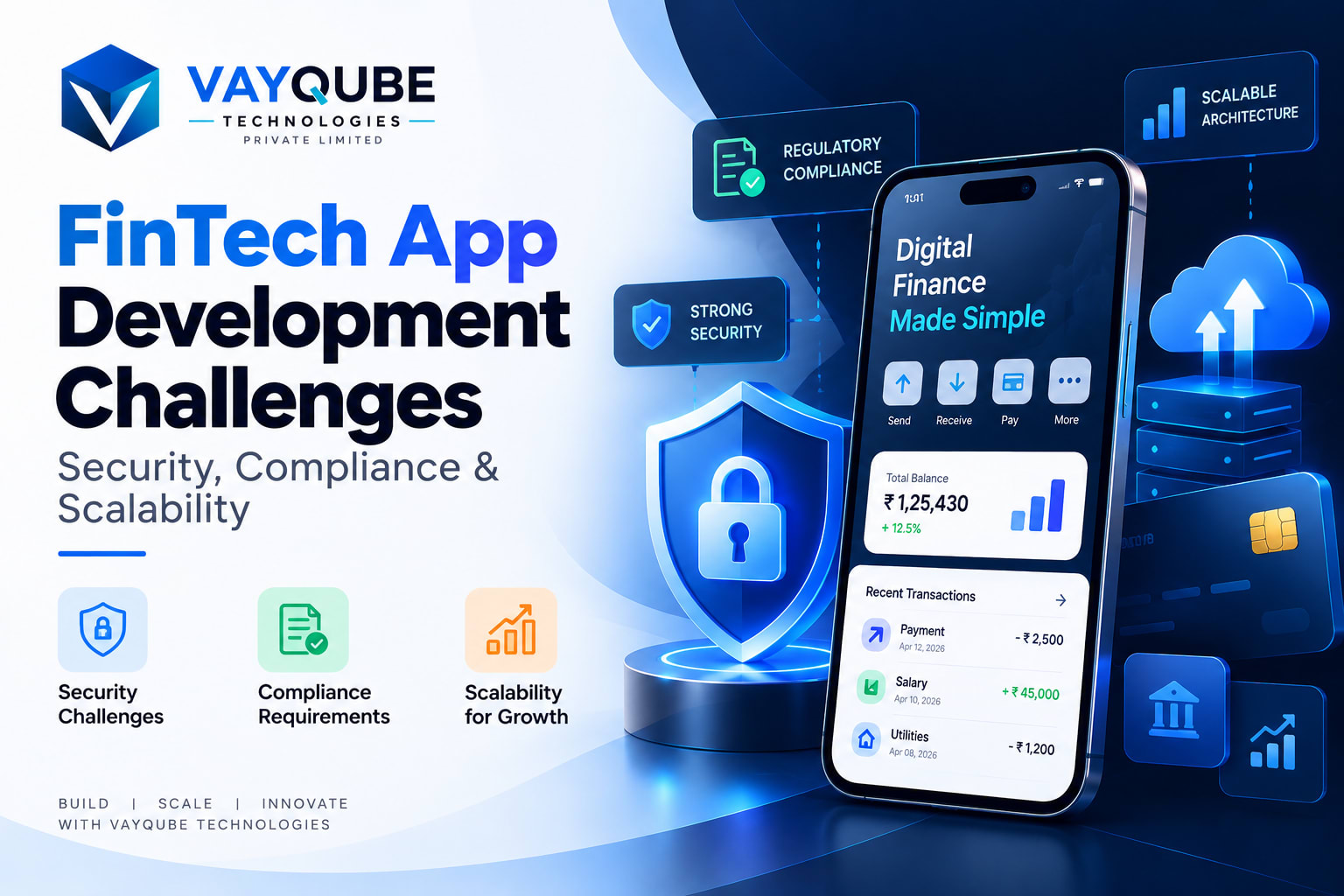
The Triad of Constraints in FinTech Development
Security, compliance, and scalability influence each other from the first line of code. Encrypting every payment transaction protects card data but consumes CPU cycles that reduce the number of requests a service can handle per second. Enforcing strict role‑based access control prevents unauthorized transfers, yet each policy check adds latency that can accumulate across microservice chains. Regulations such as PSD2 require immutable audit trails and real‑time fraud screening, which push architects toward append‑only log patterns that affect how data can be sharded or replicated for horizontal scaling.
Treating these domains as sequential checklists creates a false sense of progress. A team might first build a high‑throughput payment pipeline, then later add encryption to satisfy PCI DSS, only to discover that the cryptographic overhead cuts throughput and forces a redesign of the scaling strategy. Similarly, adding audit logging after launch often means re‑architecting data pipelines to accommodate immutable logs, which can clash with existing caching layers and increase operational complexity. The rework consumes engineering time and delays market entry—a critical disadvantage in regulated environments where sandbox approval windows or partnership launch dates are narrow.
Regulatory timelines amplify this pressure. GDPR’s data‑residency rules, for example, mandate that personal data of EU users remain within specific jurisdictions, limiting the ability to use a single global cache or CDN. If a product launch is scheduled before the data‑partitioning scheme is in place, the team must either delay the rollout or risk non‑compliance fines. Likewise, user‑growth expectations create opposing demands: a sudden spike in transactions requires rapid horizontal scaling, yet compliance controls such as real‑time AML/KYC screening cannot be easily decoupled from the transaction flow without sacrificing detection accuracy. When growth outpaces the capacity of those controls, the system becomes a bottleneck; when controls are tightened to meet regulatory scrutiny, the system’s ability to scale diminishes.
The net effect is that early architectural decisions must weigh the latency cost of security controls against the throughput needed for scaling, and they must anticipate how compliance mandates will shape data storage, access patterns, and audit mechanisms. Ignoring these interdependencies leads to costly retrofits, technical debt, and missed market windows—outcomes that are especially painful in FinTech, where trust, speed, and regulatory adherence are non‑negotiable.
How Security Requirements Shape Scalability Limits
End‑to‑end encryption transforms every payment message into a cryptographic operation that must complete before the transaction can be acknowledged. In real‑time payment switches, latency budgets are tight; AES‑256 GCM on a general‑purpose core adds measurable delay that can become a scaling limiter when the system is already operating near its network‑interface capacity. Offloading to AES‑NI instructions or dedicated crypto accelerators reduces the per‑byte cost, but once the crypto block becomes the bottleneck, scaling plateaus, prompting consideration of session‑key schemes or hardware‑bound cryptographic modules.
Tokenization replaces the primary account number with a surrogate value, shrinking PCI DSS scope. However, each token must be resolved back to the PAN for settlement, refunds, or fraud lookups. If the token vault is a centralized relational store, every resolution adds a read latency that can accumulate under high volume. Distributed token stores or caching layers can mitigate this, but they introduce consistency challenges and must still respect PCI DSS scoping rules.
Compliance as an Architectural Driver, Not Just a Checklist
Data residency rules under GDPR and similar sovereignty laws turn geography into a first‑class design constraint. Rather than treating “store data in the EU” as a post‑deployment checklist item, architects must decide early whether to partition datasets by country, region, or even specific legal entities. This partitioning directly interferes with global caching layers and CDN edge strategies: a cache that serves a user in Frankfurt cannot lawfully hold a copy of personal data that originated in Madrid unless the cache node is also located within the Spanish jurisdiction. Consequently, teams often deploy regional cache layers or replicate data only within jurisdictional boundaries, which increases operational overhead and can limit the effectiveness of global edge networks.
Beyond residency, regulations such as PSD2’s strong customer authentication and AML/KYC requirements shape data‑flow design. Real‑time fraud screening must have immediate access to raw transaction data, while SOC 2 demands tamper‑proof audit logs. Meeting both often requires separating the low‑latency detection path from an immutable write path—for example, by using a high‑speed buffer for scoring and a separate idempotent writer to an append‑only log. This decoupling preserves detection latency but adds monitoring complexity to ensure the buffer and store stay in sync.
Where Security and Compliance Conflict with Scalability Goals
Role‑based access control is a common source of latency in microservice‑based FinTech backends. When a central policy engine evaluates every request—fetching roles, permissions, and contextual attributes from a single datastore—each hop adds round‑trip time and creates a single point of failure. Under burst traffic the engine can become a throughput ceiling, forcing teams to either over‑provision the policy service or accept increased response times. A decentralized approach mitigates this by distributing policy evaluation to the service side or to a sidecar. Tools such as Open Policy Agent allow policies to be compiled into lightweight bundles that are fetched periodically and enforced locally. Latency drops to a few microseconds, and failure of the central distribution node does not block request processing, though it does require careful versioning and rollout strategies to avoid policy drift across instances.
Real‑time fraud detection pipelines need immediate access to raw transaction streams to apply scoring models within milliseconds. SOC 2, however, mandates tamper‑proof audit logs that guarantee immutability and chronological integrity. Writing each event to an append‑only log (e.g., Kafka with log compaction or AWS QLDB) introduces a serialization step and often a synchronous acknowledgment to meet the “write‑once” guarantee. If the logging path shares the same network or disk resources as the detection path, ingestion can stall under high volume, increasing detection latency. Teams often separate the paths: the detection service reads from a fast buffer (such as an in‑memory topic or shared‑memory ring), while a distinct idempotent process writes events to the immutable log. This separation keeps scoring latency low but introduces the need to monitor the lag between buffer and persistent store as a new service‑level objective.
Third‑party compliance APIs (for tax reporting, AML screening, or regulatory filing) shift development effort to a vendor and provide ready‑made connectors. The trade‑off is network dependency: each call adds latency and introduces a failure domain outside the team’s control. If the provider experiences throttling or an outage, compliance reporting can lag or fail, potentially triggering regulatory penalties. Building the same capability in‑house removes that external latency but shifts burden to operations: the team must maintain data pipelines, handle schema changes from regulators, and ensure the service meets the same availability and audit standards as the core platform. The decision often hinges on volume and variability—low‑frequency, stable reporting tasks are good candidates for external APIs; high‑frequency or jurisdiction‑specific workflows tend to favor internal modules.
Data masking in non‑production environments aims to protect PII while preserving realistic datasets for performance testing. Over‑aggressive masking (e.g., replacing all numeric values with a constant) can destroy data distributions, making load‑test results misleading. Under‑masking leaves sensitive fields exposed, violating privacy policies. A balanced approach masks only the fields required by regulation (e.g., account numbers, SSNs) while preserving statistical properties such as range, cardinality, and correlation. Techniques like format‑preserving encryption or deterministic tokenization allow test suites to run against realistic volume patterns without exposing actual PANs or personal identifiers.
Design Patterns for Balancing All Three: Encryption, Auditing, and Access Control
Zero‑trust architecture removes the assumption that internal networks are safe by default. Instead, every request is authenticated and authorized based on identity, device posture, and contextual signals before it reaches a service. In practice, this means deploying a service mesh such as Istio or Linkerd that enforces mutual TLS and policy checks at the sidecar layer. Policies are expressed through tools like OPA or SPIFFE‑based identity bundles, allowing decisions to be made locally without a central authority. The trade‑off is added latency per hop and operational complexity in managing identity rotation, but the benefit is that security scales horizontally with the number of microservices—no need to widen firewalls or reconfigure network zones as the system grows.
Event sourcing paired with CQRS provides a way to meet regulator‑mandated immutable audit trails while still handling high write volumes. All state‑changing commands are written as events to an append‑only log (Kafka, EventStoreDB, or Pulsar). The write model relies on the log as the authoritative source; read models are built asynchronously from the log, optimized for query patterns. Because events are never altered, auditors can replay the log to reconstruct any point‑in‑time state, satisfying SOC 2 and ISO 27001 requirements without locking tables or triggering costly snapshot processes. The downside is increased storage consumption and the need to manage event schema evolution; teams often mitigate this by versioning events and using compacted topics for snapshots when read‑side performance becomes a concern.
Confidential computing addresses the “data in use” gap that traditional encryption leaves open. Platforms such as AWS Nitro Enclaves, Azure Confidential Compute, or Google Confidential VMs create isolated execution environments where the CPU decrypts data only within a secure enclave, keeping plaintext invisible to the host OS, hypervisor, or even the cloud provider. This enables operations like fraud scoring or AML screening on sensitive payloads without exposing them to the broader infrastructure. Performance impact varies by workload; cryptographic off‑loading to dedicated hardware (e.g., Intel SGX or AMD SEV) can keep latency within acceptable bounds for real‑time payment processing, but developers must refactor code to run inside the enclave and manage
Frequently Asked Questions
How does implementing real-time fraud detection while maintaining immutable audit logs affect system architecture in FinTech applications?
Real-time fraud detection requires low-latency access to raw transaction streams, while immutable audit logs demand append-only writes that guarantee tamper-proof integrity. To balance both, teams often split the flow: a rapid buffer supplies the detection engine, while a distinct idempotent process appends events to the immutable log. This keeps detection latency low but adds the operational task of tracking the lag between buffer and store.
When should a FinTech team consider building compliance reporting in-house versus using third-party APIs, based on volume and regulatory variability?
Low-frequency, stable reporting tasks—such as periodic tax filings or standard AML screenings—are suitable for third-party APIs, reducing development effort. High-frequency or jurisdiction-specific workflows, like real-time transaction reporting under PSD2, often favor internal modules to avoid external latency and failure domains. The decision hinges on balancing operational control against external dependency and maintenance overhead.
What architectural pattern supports both horizontal scalability and regulator-mandated immutable audit trails without creating write bottlenecks?
Event sourcing combined with CQRS allows all state changes to be recorded as immutable events in an append-only log (e.g., Kafka or Pulsar), satisfying audit requirements. The write model treats the log as the source of truth, while read models are built asynchronously for query optimization. This decouples ingestion from querying, enabling high write throughput and auditable state reconstruction.
Related Vayqube Resources
- How to Build a FinTech Application (Payments, Security & Scaling Guide)
- How to Build a Scalable Node.js Backend (Production Guide)
- Digital Banking Software Development
- Cloud Cost Optimization Strategies for SaaS Startups
- Real Time Application Development
- Event Driven Architecture Development
Next Step
Looking to turn this strategy into an implementation plan?