
Open-Source vs Closed AI Models: Enterprise Deployment Tradeoffs
Choosing between open-source and closed AI models impacts more than performance—it shapes deployment control, data governance, and long-term flexibility. This comparison clarifies how model openness affects enterprise integration, compliance, and operational overhead.
Vayqube Team
FinTech compliance and secure systems engineering
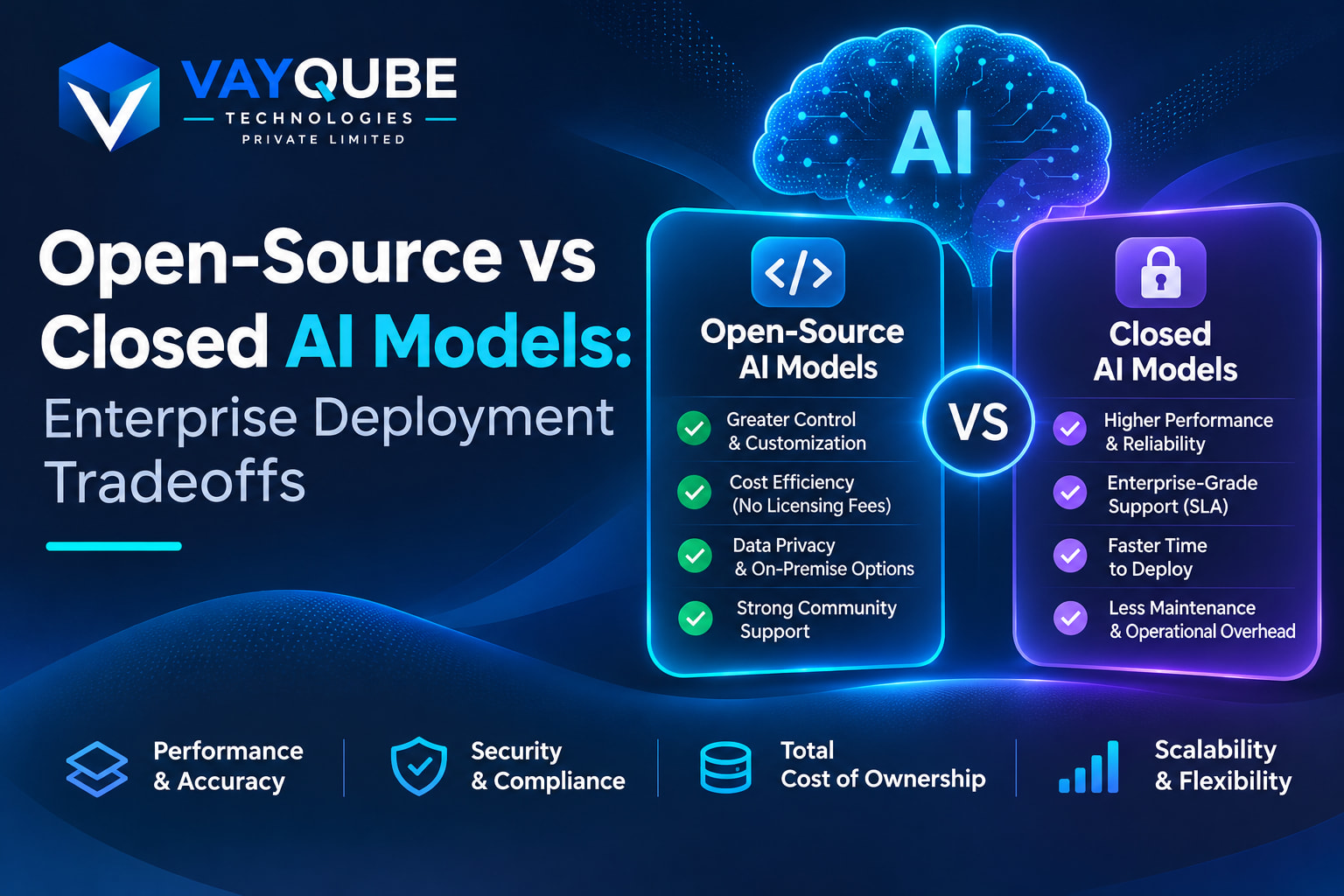
Framing the Enterprise AI Model Choice
Enterprise AI adoption is rarely decided by raw accuracy or latency alone. When a model must sit alongside legacy ERP systems, handle regulated patient data, or plug into existing MLOps pipelines, the question becomes one of fit: how the model will be deployed, who controls the data it sees, and what freedom the organization retains to evolve the solution as regulations or business needs shift. Evaluating openness through these lenses surfaces constraints that performance leaderboards do not capture.
Open‑source models provide the weights and architecture, allowing an enterprise to run the model on its own hardware or within a private cloud. This removes the provider as a gatekeeper for fine‑tuning, quantization, or custom serving stacks, but it also transfers the operational burden of provisioning GPUs, maintaining inference servers (for example, Triton Inference Server or TorchServe), scaling services, and patching software vulnerabilities to the internal team. Closed models expose only an API endpoint; the provider manages the underlying infrastructure, versioning, and uptime guarantees, reducing immediate DevOps load. However, that convenience constrains where data can be sent, how quickly a new model version can be adopted, and the extent to which the model can be altered to match proprietary workflows or specialized hardware accelerators.
These trade‑offs create a tension between innovation speed and operational control. Teams prioritizing rapid experimentation may favor the immediacy of a managed API, accepting limited customization and potential data‑handling restrictions. Organizations with stringent data‑residency rules, mature MLOps practices, or a desire to avoid future vendor lock‑in may find the upfront engineering investment of self‑hosting justified by the long‑term ability to audit, modify, and run the model independently of any provider’s roadmap. The choice therefore hinges less on benchmark scores and more on which deployment model aligns with existing enterprise controls, compliance requirements, and strategic flexibility.
Deployment Control and Infrastructure Implications
Running an open‑source model on‑premises places the full inference stack under the enterprise’s responsibility. To serve a large language model at production scale you must provision GPU nodes that match the model’s memory and compute footprint—often multiple A100 or H100 GPUs per replica—and configure a model serving layer such as NVIDIA Triton Inference Server, TorchServe, or Hugging Face Text Generation Inference. This layer handles request batching, dynamic batching, and hardware‑specific optimizations (e.g., TensorRT, ONNX Runtime). Beyond the serving software, you need to design networking that keeps latency low between application services and the inference endpoints, implement autoscaling policies that react to queue depth or GPU utilization, and set up health checks, logging, and metric pipelines for observability. All of these tasks fall under DevOps or platform engineering, increasing the operational headcount required to keep the service running, patch vulnerabilities, and roll out updates.
Consuming a closed model through a managed API offloads GPU provisioning, serving‑software maintenance, and scaling logic to the provider. The enterprise only needs to handle authentication, request formatting, and error handling. This reduction in infrastructure management can accelerate initial integration, especially for teams without deep GPU expertise. However, operational characteristics that were once under direct control now reside with the provider. Network latency becomes a function of the public internet or the provider’s regional edge locations; if the model is only available in certain geographies, applications deployed elsewhere may experience higher round‑trip times or need to route traffic through a VPN or interconnect. Providers also dictate versioning schedules—new model releases, deprecations, or breaking changes arrive on their timetable, which can force urgent application updates with limited testing windows. Enterprises that require deterministic rollout processes may find this lack of version‑control a significant drawback.
To satisfy internal data‑transfer policies, many organizations cannot send raw prompts or responses over the open internet. Consequently, they layer private connectivity constructs such as AWS PrivateLink, Azure Virtual Network integration, or Google Cloud Private Service Connect between their VPC and the provider’s API endpoint. While these solutions keep traffic within a trusted network fabric, they introduce additional architectural components: VPC peering, route tables, security group rules, and sometimes custom DNS resolution. Each of these pieces must be provisioned, monitored, and maintained, partially offsetting the infrastructure savings gained from the API model. Moreover, private links are often subject to regional availability limits; if a provider’s service is not offered in the same region as the enterprise’s workload, data may need to traverse a longer path or incur extra transfer costs.
Self‑hosted open‑source models demand substantial GPU provisioning, serving‑stack expertise, and continuous DevOps effort, but they give full control over scaling, versioning, and network path. API‑based closed models relieve the enterprise of hardware and serving‑software management, yet they shift latency predictability, version governance, and network topology to the provider, often necessitating private links to meet internal networking policies.
Data Governance and Compliance Considerations
Self‑hosting an open‑source model keeps the entire inference pipeline inside an environment that the enterprise controls—whether a private cloud VPC, a dedicated on‑premises cluster, or a hybrid edge node. Because the model weights, serving software, and input data never leave that boundary, the organization can enforce data residency rules directly: personal data subject to GDPR can remain in an EU‑regulated zone, PHI covered by HIPAA can stay within a covered entity’s network, and SOC 2 trust‑service criteria around data location can be satisfied by configuring the underlying infrastructure accordingly. This containment also simplifies data‑transfer impact assessments, as there is no cross‑border movement to document.
Invoking a closed model through a provider’s API sends the inference request—and often the accompanying payload—to the vendor’s managed service. Even when the API endpoint is reachable via a private link (AWS PrivateLink, Azure VNet integration, or Google’s Private Service Connect), the data is processed in the provider’s multi‑tenant environment. Visibility into what happens to that data after it arrives is limited to what the vendor discloses in its data‑processing addendum, privacy policy, or compliance reports. Enterprises cannot independently verify retention periods, backup locations, or whether sub‑processors (e.g., third‑party logging or analytics services) have accessed the payload. This opacity complicates GDPR Article 30 records of processing activities, HIPAA business‑associate agreements that require explicit safeguards for PHI, and SOC 2 examinations that demand evidence of logical access controls and data‑flow diagrams.
Model‑governance capabilities further differentiate the two approaches. With a self‑hosted deployment, teams can instrument the serving layer to log every inference request, associate it with a user or service identity, and tag the input data with lineage metadata. Access controls can be enforced at the network, Kubernetes namespace, or service‑mesh level, and audit trails can be exported to SIEM tools for retention periods required by regulators. Closed‑model APIs typically provide only basic request‑response logs, if any, limiting the ability to reconstruct processing activities for audits.
Customization, Fine‑Tuning, and Adaptability
When an enterprise seeks to align a foundation model with its internal lexicon, regulatory language, or specialized workflows, the feasibility of doing so hinges on whether the model’s parameters are accessible for modification. Open‑source releases that publish the weights—such as those hosted on Hugging Face or made available under permissive licenses—allow the organization to treat the model as a mutable artifact. With full access to the parameter tensors, gradients, and optimizer states, data science teams can apply standard supervised fine‑tuning, continue pretraining on domain‑specific corpora, or run reinforcement learning from human feedback (RLHF) loops. Techniques like PEFT, LoRA, or full‑parameter updates can be executed on self‑managed GPU clusters, and the training data never leaves the enterprise’s controlled environment. This setup also permits architectural tweaks—adding new layers, changing activation functions, or integrating retrieval modules—because the underlying framework (e.g., PyTorch or TensorFlow) is fully visible and editable.
Closed models, by contrast, are typically exposed only through inference APIs. Providers such as AWS Bedrock, Azure AI, or Google Vertex AI may offer a fine‑tuning endpoint, but the service abstracts away the training loop. Enterprises can upload a labeled dataset and select a few hyperparameters (learning rate, number of epochs, batch size), yet they cannot inspect or alter gradients, retrieve intermediate checkpoints, or modify the optimizer state. The provider performs the weight updates on its own infrastructure and returns a new model version that is accessible only via the same API boundary. Consequently, any attempt to pursue continued pretraining or RLHF is blocked; the only permissible adaptation is the supervised fine‑tuning mode that the API explicitly supports.
The data‑movement requirement introduces a procedural barrier. For closed‑model fine‑tuning, the enterprise must transfer training data to the provider’s environment, which may trigger additional data‑governance reviews and extend project timelines. Self‑hosted fine‑tuning keeps all data within the organization’s trust boundary, eliminating that overhead.
Operational Overhead and MLOps Integration
Maintaining a healthy serving stack for a self‑hosted open‑source model falls to the enterprise team. You must apply patches to the inference server—whether Triton Inference Server, TorchServe, or a custom wrapper—as soon as security advisories appear, test those patches against your model version, and roll them out without disrupting traffic. GPU utilization becomes a metric you watch continuously: spikes can indicate a runaway batch job, while chronic underuse signals over‑provisioned nodes that drive up cost. Logging inference requests, latency distributions, and error codes is not optional; you need to feed those signals into monitoring stacks (Prometheus, Grafana) and alerting pipelines so that drift or degradation surfaces before it affects downstream applications. When a model update—whether a security fix, a quality retrain, or a quantized variant—is ready, you own the entire promotion path: building a new container image, pushing it to a registry, triggering a canary rollout, and validating that the new weights produce expected outputs against a held‑out test set.
Consuming a closed model through an API offloads the infrastructure chores to the provider. The vendor handles server patches, GPU fleet scaling, and baseline latency guarantees. However, you inherit a different class of operational risk: versioning. Providers may deprecate a model endpoint, change the default temperature, or adjust tokenization without giving you a long notice period. If your application pins a specific model identifier, a sudden deprecation forces an urgent code bump, often with a testing window measured in hours rather than weeks. Even when the provider offers versioned endpoints (e.g., model-v1, model-v2), you must decide whether to lock to a version and forego future improvements or track the latest and accept the possibility of breaking changes. This tension shapes your testing cadence: you tend to run more frequent smoke tests against the API, maintain feature flags that can switch between versions, and keep a rollback plan that relies on redeploying the application code rather than swapping a model artifact.
Enterprise MLOps practices map more cleanly onto self‑hosted workflows. Because you control the deployment artifact—a Docker image or Helm chart that bundles the model weights, serving configuration, and any custom code—you can version the artifact alongside your application code, apply the same promotion pipelines used for other services, and integrate model updates into existing CI/CD flows. API‑based models decouple the model artifact from your deployment pipeline; updates are invisible until they affect request latency or output quality, which can complicate rollback and audit trails.
Licensing, Vendor Lock-in, and Long-Term Flexibility
Open‑source model licenses determine what an enterprise can do with the weights, the code, and any derivatives, while closed‑model service agreements define what the provider permits through its API and how those terms evolve over time. The practical impact shows up in three areas: commercial exploitation, the freedom to modify and redistribute, and the cost and effort required to leave a provider or change deployment style.
Commercial use and redistribution
Permissive licenses such as Apache 2.0 or MIT place few conditions beyond attribution and preservation of the license notice. Enterprises can incorporate models released under these terms into commercial products, offer them as a service, or redistribute modified versions without seeking additional permission. This clarity simplifies legal review and supports long‑term product planning.
Other open‑source licenses impose usage‑based restrictions. The Llama 2 Community License, for example, allows research and commercial use but requires a separate license request once the model’s monthly active users exceed a defined threshold or when the model is used to train another large language model. Mistral’s licensing follows a similar pattern, offering an open weights release under a custom agreement that limits certain high‑volume commercial scenarios. Falcon, released under Apache 2.0, avoids those constraints. For enterprises, the presence
Frequently Asked Questions
How does self-hosting an open-source model affect the enterprise's ability to meet data residency requirements under regulations like GDPR or HIPAA?
Self-hosting keeps model weights, serving software, and inference data entirely within the enterprise's controlled environment, such as a private cloud or on-premises cluster. This allows the organization to enforce data residency rules directly by ensuring data never leaves a specific geographic or jurisdictional boundary. It simplifies compliance by eliminating cross-border data transfers that would require additional documentation under GDPR or HIPAA.
What operational responsibilities shift to the enterprise when choosing to self-host an open-source model instead of using a closed-model API?
The enterprise assumes responsibility for provisioning and maintaining GPU infrastructure, managing the inference serving stack (e.g., Triton Inference Server or TorchServe), applying security patches, setting up autoscaling, logging, monitoring, and handling model version updates through CI/CD pipelines. These tasks increase the operational burden on DevOps and platform engineering teams. In contrast, API-based models offload infrastructure management to the provider but introduce versioning and latency predictability risks.
When evaluating open-source versus closed AI models for enterprise use, how should teams assess the long-term cost implications beyond initial infrastructure or API fees?
Teams should factor in ongoing DevOps effort for maintenance, monitoring, and updates when self-hosting, as well as potential costs for data transfer, private connectivity (e.g., AWS PrivateLink), and model retraining. For closed models, long-term costs include API usage at scale, potential fees for fine-tuning or custom model hosting, and the operational overhead of managing version changes, breaking updates, and vendor-dependent roadmaps. Licensing terms that restrict commercial use or redistribution may also create future legal or engineering work.
Related Vayqube Resources
- Scaling Enterprise AI Systems for Business Success
- Building AI Products with Lean Teams
- How to Build a FinTech Application (Payments, Security & Scaling Guide)
- How to Build a Scalable Node.js Backend (Production Guide)
- High Performance Backend Development
- MCP for Enterprise AI: Architecture, Security & Real-World Use Cases
Next Step
Need help evaluating the right architecture for your product?