
Revolutionizing Sales: The Impact of AI Agents on Operations
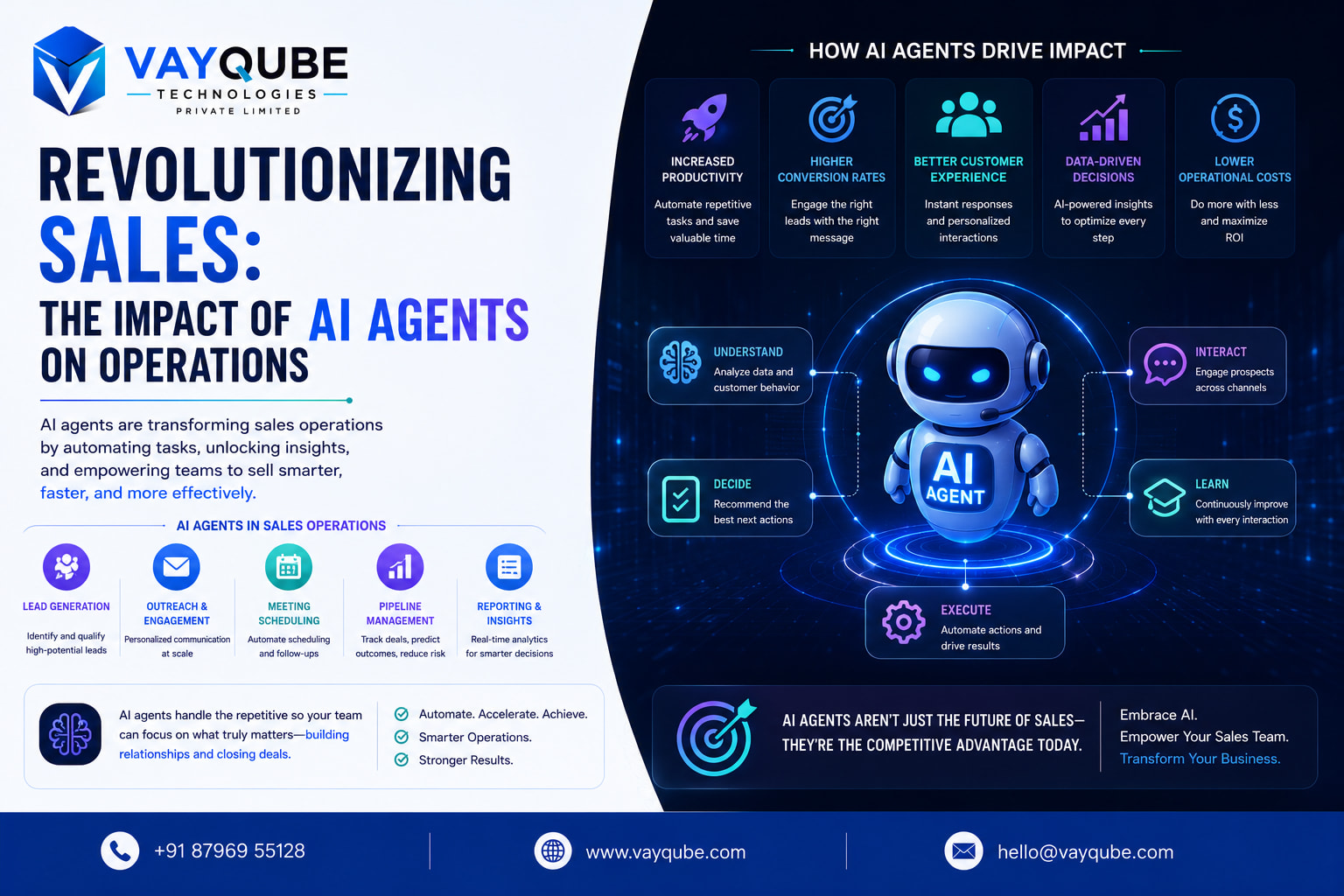
AI agents are revolutionizing sales operations by automating routine tasks, providing predictive analytics, and enabling personalized customer interactions, leading to increased efficiency and revenue.
Vayqube Team
Author
Introduction to AI Agents in Sales Operations
The integration of AI agents in sales operations has transformed the way businesses approach sales, enabling them to streamline processes, enhance customer engagement, and ultimately drive revenue growth. At the forefront of this transformation are AI agents, designed to automate routine tasks, provide predictive insights, and facilitate personalized customer interactions.
Brief History and Evolution of AI in Sales
The concept of AI in sales is not new, with its roots tracing back to the early 2000s when basic automation tools began to emerge. However, it wasn't until the advent of more sophisticated machine learning algorithms and the proliferation of cloud computing that AI started to make a significant impact on sales operations. Over the years, AI has evolved from simple chatbots to complex systems capable of analyzing vast amounts of data, predicting customer behavior, and even autonomously executing sales strategies.
Key milestones in the evolution of AI in sales include:
- The development of CRM systems integrated with AI to analyze customer data and predict sales outcomes
- The introduction of AI-powered chatbots for real-time customer support and engagement
- The use of machine learning algorithms to personalize sales approaches based on customer preferences and behaviors
- The integration of AI with sales analytics to provide actionable insights and forecast sales performance
Impact on Sales Operations
The impact of AI agents on sales operations is multifaceted, ranging from enhanced efficiency and productivity to improved customer satisfaction and increased sales. By automating routine tasks such as data entry, lead qualification, and follow-up communications, AI agents enable sales teams to focus on high-value activities like strategy development, customer relationship building, and closing deals. Furthermore, AI-driven analytics provide sales teams with the insights needed to tailor their approaches to individual customers, leading to more effective sales strategies and higher conversion rates.
The implementation of AI agents in sales operations also raises important considerations regarding data privacy, security, and the ethical use of AI in customer interactions. As businesses continue to adopt and integrate AI agents into their sales operations, addressing these concerns will be crucial to ensuring the long-term success and sustainability of AI-driven sales strategies.
Why It Matters
The integration of AI agents in sales operations is no longer a novelty, but a necessity for businesses seeking to stay competitive. AI agents play a crucial role in modern sales strategies, enabling companies to streamline processes, enhance customer interactions, and drive revenue growth.
Impact on Sales Strategies
AI agents bring a level of sophistication to sales operations, allowing businesses to analyze vast amounts of data, identify patterns, and make informed decisions. This leads to more effective sales forecasting, improved lead qualification, and personalized customer engagement. By leveraging AI agents, sales teams can focus on high-value activities, such as building relationships and closing deals, rather than tedious data entry and research.
Customer Experience and Revenue Growth
The impact of AI agents on customer experience is significant. AI-powered chatbots and virtual assistants provide 24/7 support, helping customers find answers to their queries and resolving issues promptly. This leads to increased customer satisfaction, loyalty, and ultimately, revenue growth. Moreover, AI agents can analyze customer behavior, preferences, and purchase history, enabling businesses to offer tailored recommendations and promotions, further enhancing the customer experience.
Key benefits of AI agents in sales operations include:
- Enhanced customer engagement and personalization
- Improved sales forecasting and pipeline management
- Increased efficiency and productivity
- Better decision-making through data-driven insights
- Scalability and flexibility to adapt to changing market conditions
Real-World Applications
Companies like Salesforce and HubSpot have already embraced AI agents in their sales operations, achieving remarkable results. For instance, AI-powered sales assistants can help identify potential leads, automate follow-ups, and provide personalized content recommendations. By adopting AI agents, businesses can stay ahead of the competition, drive innovation, and achieve sustainable growth.
The successful implementation of AI agents in sales operations requires careful consideration of several factors, including data quality, integration with existing systems, and ongoing training and maintenance. By understanding the importance of AI agents and their potential impact on customer experience and revenue growth, businesses can develop effective implementation strategies and reap the benefits of this revolutionary technology.
Core Architecture
The core architecture of AI-powered sales systems is built around several key components that work together to drive sales operations.
Key Components
The main components include:
- Data ingestion and processing
- Machine learning models
- Data analytics and visualization
- Integration with existing sales tools and platforms
- AI agents that can interact with customers and sales teams
These components enable AI-powered sales systems to analyze customer data, predict sales outcomes, and provide personalized recommendations to sales teams.
Role of Machine Learning
Machine learning plays a critical role in AI-powered sales systems, as it enables the analysis of large datasets and the identification of patterns and trends. By applying machine learning algorithms to customer data, sales teams can gain insights into customer behavior and preferences, and develop targeted sales strategies.
Data Analytics and Visualization
Data analytics and visualization are also essential components of AI-powered sales systems, as they enable sales teams to understand and act on the insights generated by machine learning models. By providing real-time visibility into sales performance and customer behavior, data analytics and visualization tools help sales teams to identify areas for improvement and optimize their sales strategies.
Implementation Considerations
When implementing AI-powered sales systems, it's essential to consider the scalability and production readiness of the solution. This includes ensuring that the system can handle large volumes of customer data, and that it can integrate seamlessly with existing sales tools and platforms.
Real-World Examples
In real-world scenarios, AI-powered sales systems have been used to drive significant improvements in sales performance and customer engagement. For example, companies have used AI agents to personalize customer interactions, and to provide sales teams with real-time insights and recommendations. By leveraging the power of AI and machine learning, sales teams can optimize their sales strategies and drive business growth.
Production Readiness
To ensure production readiness, AI-powered sales systems must be thoroughly tested and validated to ensure that they can handle the demands of a production environment. This includes testing the system's scalability, reliability, and performance, as well as its ability to integrate with existing sales tools and platforms. By ensuring production readiness, companies can minimize the risk of implementation and maximize the benefits of AI-powered sales systems.
Business Benefits
The integration of AI agents in sales operations has numerous benefits for businesses. One of the primary advantages is the significant increase in efficiency and productivity. By automating routine tasks and providing real-time support, AI agents enable sales teams to focus on high-value activities, such as building relationships and closing deals.
Enhanced Decision-Making
AI agents also enhance decision-making by providing data-driven insights. They can analyze large amounts of data, identify patterns, and offer recommendations, enabling sales teams to make informed decisions. This data-driven approach helps businesses to optimize their sales strategies, improve customer engagement, and ultimately drive revenue growth.
Personalized Customer Interactions
AI agents also enable personalized customer interactions, which is critical in today's competitive market. By analyzing customer data and behavior, AI agents can help sales teams to tailor their interactions, providing customers with relevant and timely information. This personalized approach helps to build trust, increase customer satisfaction, and drive loyalty.
Some key benefits of AI agents in sales operations include:
- Improved sales forecasting and pipeline management
- Enhanced customer segmentation and targeting
- Real-time sales analytics and performance monitoring
- Automated sales reporting and dashboards
- Personalized customer engagement and support
The implementation of AI agents in sales operations requires careful consideration of several factors, including data quality, integration with existing systems, and training of sales teams. However, the benefits of AI agents in terms of increased efficiency, enhanced decision-making, and personalized customer interactions make them an attractive solution for businesses looking to revolutionize their sales operations.
Implementation Considerations
When implementing AI agents in sales operations, businesses should consider the following factors:
- Data quality and availability
- Integration with existing sales systems and tools
- Training and support for sales teams
- Continuous monitoring and evaluation of AI agent performance
- Alignment with overall business strategy and goals
By carefully considering these factors and leveraging the benefits of AI agents, businesses can unlock significant improvements in sales efficiency, effectiveness, and customer engagement.
Scalability
To truly revolutionize sales operations, AI agents must be able to scale to meet the demands of large and growing customer bases. This means having the ability to handle large volumes of customer data, including interactions, preferences, and behaviors.
Handling Large Volumes of Data
AI agents must be designed to process and analyze vast amounts of data in real-time, providing insights that inform sales strategies and improve customer engagement. This requires significant computational power and advanced data management capabilities.
- Leverage cloud-based infrastructure to scale computing resources up or down as needed
- Implement data compression and encryption techniques to ensure efficient and secure data storage
- Utilize distributed computing architectures to process large datasets in parallel
Integration with Existing Infrastructure
Scalability also depends on the flexibility of AI agents to integrate with existing sales infrastructure, including CRM systems, marketing automation platforms, and customer service tools.
- Develop APIs and data exchange protocols to facilitate seamless integration with various systems
- Use containerization and microservices architecture to enable modular and flexible deployment
- Implement data mapping and transformation capabilities to ensure compatibility with diverse data formats and structures
By addressing these scalability challenges, businesses can ensure that their AI-powered sales operations are capable of handling large volumes of customer data and integrating with existing infrastructure, ultimately driving more efficient and effective sales processes.
Production Readiness
To achieve production readiness, AI agents must be thoroughly tested and validated in real-world environments, with careful consideration given to factors such as data quality, system latency, and user adoption.
- Conduct thorough testing and quality assurance to ensure AI agents perform as expected in production environments
- Monitor system performance and latency to identify areas for optimization
- Develop user training and support programs to ensure successful adoption and utilization of AI-powered sales tools.
Implementation Challenges
To successfully integrate AI agents into sales operations, organizations must address several key challenges.
Data Quality and Integration Issues
Data quality and integration are critical factors in implementing AI agents. Sales teams rely on accurate and timely data to inform their decisions and interactions with customers. However, data quality issues, such as incomplete or inconsistent data, can significantly impact the effectiveness of AI agents.
- Inconsistent data formats
- Missing or incomplete data
- Data silos and integration challenges
Organizations must invest in data quality initiatives, such as data cleansing and normalization, to ensure that AI agents have access to accurate and reliable data. Additionally, integrating AI agents with existing sales systems and tools can be complex, requiring significant technical expertise and resources.
Change Management and Training for Sales Teams
Implementing AI agents also requires significant change management and training efforts for sales teams. Sales teams must be trained to work effectively with AI agents, understanding how to leverage their capabilities to enhance sales performance.
- Developing new sales strategies and processes
- Providing ongoing training and support
- Addressing potential job displacement concerns
Effective change management and training programs can help sales teams adapt to the new technology and realize the full benefits of AI agents. This includes providing ongoing support and feedback mechanisms to ensure that sales teams are comfortable and confident using AI agents in their daily work.
By addressing these implementation challenges, organizations can unlock the full potential of AI agents and revolutionize their sales operations.
Use Cases
The integration of AI agents in sales operations has numerous applications, transforming the way businesses interact with customers and manage their sales processes.
Lead Qualification and Routing
AI-powered agents can efficiently qualify leads, analyzing data and behavior to determine the likelihood of conversion. This enables sales teams to focus on high-potential leads, streamlining the sales process and improving conversion rates. By automating the initial stages of lead engagement, businesses can reduce the workload on human sales representatives, allowing them to concentrate on building relationships and closing deals.
Sales Forecasting and Pipeline Management
AI agents can analyze historical sales data, seasonal trends, and market conditions to provide accurate sales forecasts. This enables businesses to make informed decisions about resource allocation, inventory management, and strategic planning. Additionally, AI-powered pipeline management tools can identify potential bottlenecks and areas of improvement, allowing sales teams to optimize their processes and maximize revenue.
Customer Service and Support
AI-driven chatbots and virtual assistants can provide 24/7 customer support, responding to common queries and resolving simple issues. This not only improves customer satisfaction but also reduces the workload on human customer support agents, allowing them to focus on complex issues that require a personal touch. By integrating AI agents with customer relationship management (CRM) systems, businesses can gain valuable insights into customer behavior and preferences, enabling them to deliver personalized experiences and build strong relationships.
Key benefits of AI agents in sales operations include:
- Enhanced lead qualification and conversion rates
- Improved sales forecasting and pipeline management
- Personalized customer experiences and support
- Increased efficiency and productivity
- Data-driven decision making and strategic planning
As businesses continue to adopt AI agents in their sales operations, it is essential to consider the implementation strategy and potential challenges that may arise. By understanding the use cases and benefits of AI agents, organizations can develop effective integration plans, ensuring a seamless transition and maximizing the potential of these innovative technologies.
Real-World Applications
Real-world examples of AI agents in sales operations include companies like Salesforce, which uses AI-powered chatbots to provide customer support and improve user engagement. Another example is HubSpot, which leverages AI-driven tools to analyze sales data and provide personalized recommendations to sales teams. These examples demonstrate the potential of AI agents to transform sales operations, enabling businesses to drive growth, improve efficiency, and deliver exceptional customer experiences.
Production Considerations
When implementing AI agents in sales operations, businesses must consider several production factors, including data quality, integration with existing systems, and ongoing maintenance and support. By carefully evaluating these factors and developing a comprehensive implementation strategy, organizations can ensure a successful integration of AI agents, maximizing their potential and driving long-term growth and success.
Best Practices
To maximize the impact of AI agents on sales operations, it's essential to follow a set of best practices that ensure seamless integration and optimal performance.
Setting the Foundation
Start with clear goals and objectives that outline what you want to achieve with AI agents. This could be improving sales forecasting, enhancing customer engagement, or streamlining sales processes. Having well-defined objectives helps in measuring the success of AI implementation and making data-driven decisions.
Performance Monitoring
Monitor and evaluate AI agent performance regularly to identify areas of improvement. This involves tracking key performance indicators (KPIs) such as sales conversion rates, customer satisfaction scores, and response times. Continuous monitoring enables businesses to adjust their strategies and make necessary adjustments to AI models.
Continuous Improvement
Continuously train and improve AI models to ensure they remain relevant and effective. This can be achieved through ongoing data analysis, feedback collection, and model refinement. As sales operations evolve, AI agents must adapt to new challenges and opportunities, making continuous training a critical component of their success.
Real-World Applications
In real-world scenarios, businesses have seen significant improvements in sales operations by following these best practices. For instance, companies that have clearly defined goals and objectives for their AI agents have reported better alignment between sales and marketing teams. Similarly, continuous monitoring and evaluation have helped businesses identify bottlenecks in their sales processes and implement targeted solutions.
Key Considerations
When implementing AI agents, consider the following:
- Align AI goals with overall business objectives
- Ensure data quality and availability for AI model training
- Establish a feedback loop for continuous improvement
- Monitor AI performance regularly and adjust strategies accordingly
- Stay up-to-date with the latest advancements in AI technology to leverage new capabilities and features.
By focusing on these best practices and considerations, businesses can unlock the full potential of AI agents in sales operations, leading to improved efficiency, enhanced customer experiences, and increased revenue growth.
Implementation Strategy
A well-planned implementation strategy is crucial for the successful integration of AI agents into sales operations. This involves assessing current sales processes, identifying areas where AI can add value, and developing a roadmap for AI adoption. By taking a structured approach to implementation, businesses can minimize disruptions, ensure smooth integration, and maximize the benefits of AI agents.
Production Readiness
Ensuring production readiness is a critical step in the implementation of AI agents. This involves testing AI models in real-world scenarios, validating their performance, and making any necessary adjustments before full deployment. By prioritizing production readiness, businesses can guarantee that their AI agents are reliable, efficient, and capable of delivering expected results in live sales environments.
FAQ
To address common questions and concerns about AI agents in sales, we've compiled a list of key points to consider.
Key Differences and Capabilities
The main differences between AI agents and traditional sales tools lie in their ability to learn, adapt, and interact with customers. Traditional sales tools are typically rule-based and lack the nuance of human interaction, whereas AI agents can understand context, sentiment, and intent. Some key aspects of AI agents include:
- Ability to process and analyze large amounts of data
- Capacity to learn from interactions and improve over time
- Ability to handle complex customer inquiries and provide personalized responses
Handling Complex Customer Inquiries
AI agents are designed to handle complex customer inquiries by using natural language processing (NLP) and machine learning algorithms. These technologies enable AI agents to:
- Understand the context and intent behind customer inquiries
- Provide personalized and relevant responses
- Escalate complex issues to human representatives when necessary
Potential Risks and Limitations
While AI agents offer many benefits, there are potential risks and limitations to consider. Some of these include:
- Dependence on high-quality training data
- Risk of bias in AI decision-making
- Potential for AI agents to misinterpret or misunderstand customer inquiries
- Need for ongoing maintenance and updates to ensure AI agents remain effective and accurate
Implementation and Integration
To mitigate these risks and ensure successful implementation, it's essential to carefully plan and integrate AI agents into existing sales operations. This includes:
- Developing a clear understanding of business goals and objectives
- Selecting the right AI technology and vendor
- Providing ongoing training and support for human representatives
- Continuously monitoring and evaluating AI agent performance to identify areas for improvement
Real-World Examples and Considerations
In real-world scenarios, AI agents have been successfully used to improve sales operations and customer engagement. For example, AI-powered chatbots have been used to provide 24/7 customer support, while AI-driven sales analytics have helped businesses better understand customer behavior and preferences. When implementing AI agents, it's essential to consider production readiness, scalability, and business impact to ensure a successful and effective deployment.
Conclusion
The integration of AI agents into sales operations has revolutionized the way businesses approach sales, enabling them to streamline processes, enhance customer experiences, and drive revenue growth.
Summary of Impact
Key benefits of AI agents in sales operations include:
- Enhanced sales forecasting and pipeline management
- Personalized customer interactions through data-driven insights
- Automated routine tasks, freeing up human sales teams for strategic activities
- Real-time performance monitoring and coaching for continuous improvement
- Improved sales content management and delivery
Future Outlook
As AI technology continues to evolve, we can expect even more sophisticated applications in sales operations, such as:
- Advanced predictive analytics for more accurate forecasting
- Integration with other business functions, like marketing and customer service, for a unified customer view
- Further automation of complex sales tasks, leveraging machine learning and natural language processing
- Enhanced decision-making capabilities through real-time data analysis and visualization
Potential Developments
Potential future developments in AI-powered sales include:
- Increased use of voice-activated interfaces for sales interactions
- More widespread adoption of AI-driven sales coaching and training platforms
- Development of AI-powered sales tools tailored to specific industries or sectors
- Greater emphasis on explainability and transparency in AI decision-making processes
Production Considerations
As businesses look to implement AI agents in their sales operations, they must consider factors such as:
- Data quality and integration to ensure accurate AI decision-making
- Change management and training for sales teams to effectively leverage AI tools
- Ongoing monitoring and evaluation of AI performance to identify areas for improvement
- Balancing automation with human touch to maintain personalized customer relationships
Real-World Applications
Real-world examples of successful AI agent implementation in sales operations include:
- A leading software company using AI to analyze customer interactions and predict churn risk
- A retail business leveraging AI-powered chatbots to provide 24/7 customer support and drive sales
- A financial services firm utilizing AI-driven sales analytics to optimize portfolio management and client engagement
Implementation Strategy
To maximize the impact of AI agents on sales operations, businesses should focus on:
- Developing a clear implementation roadmap and change management plan
- Investing in ongoing training and education for sales teams
- Continuously monitoring and evaluating AI performance to identify areas for improvement
- Fostering a culture of innovation and experimentation to drive AI adoption and growth.
Related Vayqube Resources
- Best Software Development Company In Singapore City
- Best Fintech Software Development Company In Singapore City
- Ai Agents Changing Customer Support Operations 2026
- Best Software Development Company In New York
- Best Mobile App Development Company In Singapore City
- Best Fintech Software Development Company In New York
Next Step
If your systems are struggling with scalability, automation, architecture complexity, or operational efficiency, it's time to modernize your infrastructure and workflows.
👉 Talk to a Vayqube solution architect and build systems designed for long-term production growth: