
AI Agents vs Chatbots: Understanding the Key Differences
AI agents and chatbots are often used interchangeably, but they have distinct differences. Learn how to leverage these technologies to enhance customer experience and drive business growth.
Vayqube Team
Software architecture and product engineering
Introduction to AI Agents and Chatbots
AI agents and chatbots are two types of automated systems that have gained significant attention in recent years. While they share some similarities, they have distinct differences in their capabilities, functionalities, and applications.
To understand the key differences between AI agents and chatbots, it's essential to define each term. AI agents refer to autonomous systems that can perform tasks, make decisions, and interact with their environment using artificial intelligence and machine learning algorithms. These agents can learn from data, adapt to new situations, and optimize their performance over time.
Chatbots, on the other hand, are computer programs designed to simulate human-like conversations with users. They use natural language processing (NLP) and machine learning algorithms to understand and respond to user inputs. Chatbots are commonly used in customer service, tech support, and other applications where human-like interaction is required.
Key Differences Overview
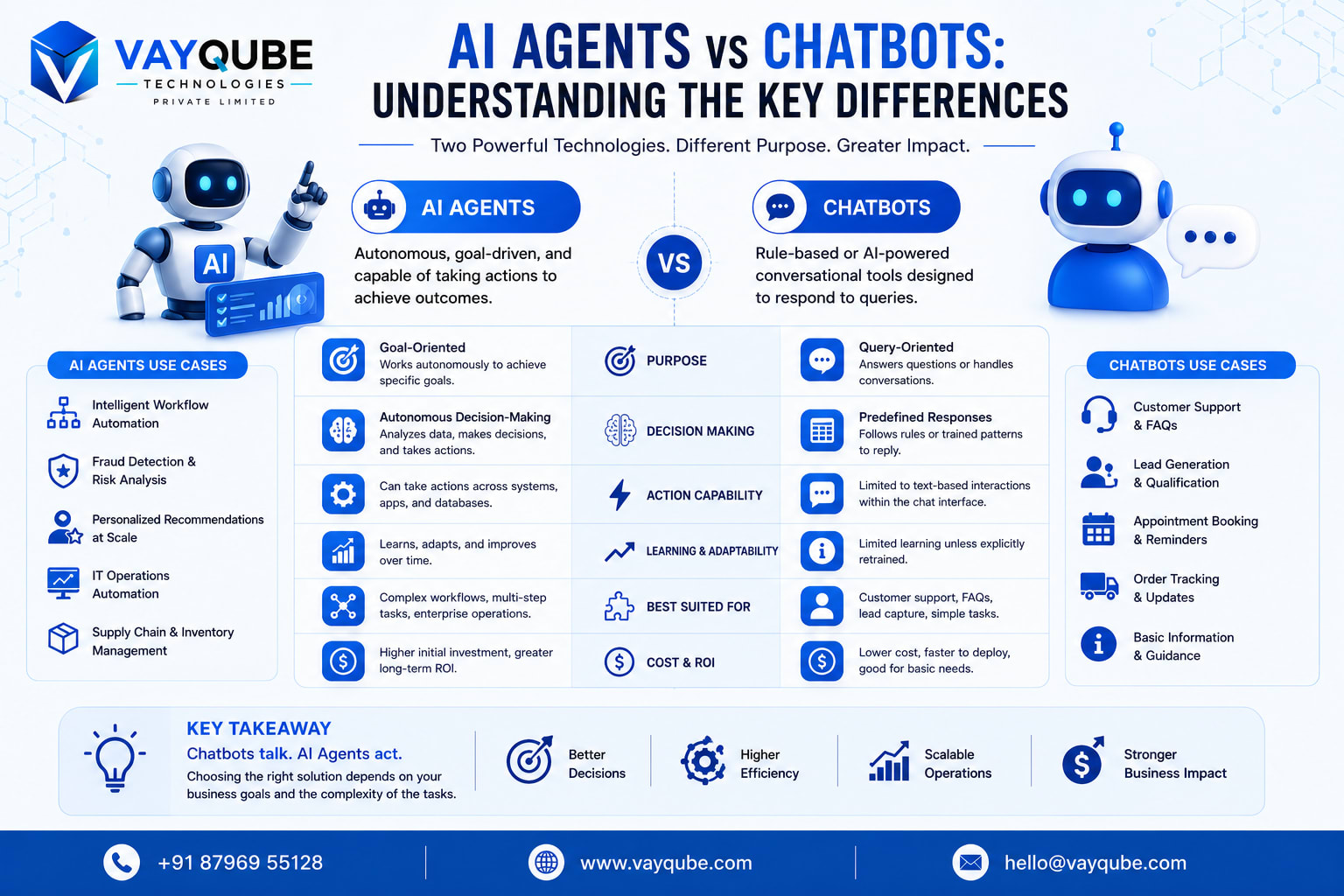
The key differences between AI agents and chatbots lie in their purpose, functionality, and level of autonomy. Some of the main differences include:
- Autonomy: AI agents have a higher level of autonomy, as they can make decisions and take actions without human intervention. Chatbots, while able to respond to user inputs, typically require human oversight and guidance.
- Functionality: AI agents can perform a wide range of tasks, from data analysis to process automation. Chatbots, by contrast, are primarily designed for conversational interactions.
- Learning capabilities: AI agents can learn from data and adapt to new situations, while chatbots typically rely on pre-defined rules and scripts to generate responses.
Understanding these differences is crucial for businesses and organizations looking to implement AI-powered solutions. By recognizing the strengths and limitations of each technology, companies can make informed decisions about which type of system to use and how to deploy it effectively.
Real-World Applications
In real-world applications, AI agents and chatbots are used in various industries, including customer service, healthcare, and finance. For example, AI agents can be used to analyze large datasets, identify patterns, and make predictions, while chatbots can be used to provide personalized customer support and answer frequently asked questions.
By exploring the key differences between AI agents and chatbots, businesses can unlock new opportunities for automation, efficiency, and innovation. In the next section, we will delve deeper into the capabilities and limitations of each technology, and explore how they can be used to drive business success.
Why It Matters
The distinction between AI agents and chatbots has significant implications for businesses, affecting both their operations and customer interactions.
Impact on Business Operations
Understanding the differences between AI agents and chatbots is crucial for businesses to make informed decisions about which technology to implement. This choice can impact various aspects of business operations, including:
- Automation of tasks: AI agents can automate complex tasks, freeing up human resources for more strategic activities.
- Data analysis: AI agents can analyze large datasets, providing valuable insights that can inform business decisions.
- Integration with existing systems: AI agents can integrate with various systems, enabling seamless data exchange and workflow optimization.
Customer Experience Implications
The choice between AI agents and chatbots also has significant implications for customer experience. AI agents can provide personalized support, using machine learning algorithms to understand customer behavior and preferences.
- Personalization: AI agents can offer tailored recommendations, enhancing the customer experience and increasing loyalty.
- Proactive support: AI agents can anticipate customer needs, providing proactive support and resolving issues before they escalate.
- Multichannel engagement: AI agents can engage with customers across multiple channels, ensuring a consistent and seamless experience.
In real-world scenarios, businesses that effectively leverage AI agents can experience improved operational efficiency, enhanced customer satisfaction, and increased revenue growth. Conversely, those that rely solely on chatbots may miss out on opportunities to drive meaningful engagement and loyalty. By recognizing the differences between AI agents and chatbots, businesses can develop targeted strategies to harness the potential of these technologies, driving innovation and staying ahead of the competition.
Production Considerations
When implementing AI agents or chatbots, businesses must consider several production factors, including:
- Scalability: The ability of the technology to handle increased traffic and user engagement.
- Security: The measures in place to protect customer data and prevent potential breaches.
- Maintenance: The resources required to update, maintain, and refine the technology over time. By carefully evaluating these factors, businesses can ensure a successful implementation that meets their unique needs and goals.
Core Architecture
The core architecture of AI agents and chatbots is a crucial aspect to consider when understanding the key differences between these two technologies.
AI Agent Architecture
AI agents are built using a more complex architecture that enables them to perform tasks autonomously. This architecture typically consists of several components, including:
- A knowledge base that stores information about the environment and the tasks to be performed
- A reasoning engine that uses the knowledge base to make decisions and take actions
- A set of sensors that provide input from the environment
- A set of effectors that enable the agent to interact with the environment This architecture allows AI agents to learn from their experiences and adapt to new situations, making them more flexible and scalable.
Chatbot Architecture
Chatbot architecture, on the other hand, is designed to facilitate human-computer interaction. It typically consists of:
- A natural language processing (NLP) engine that analyzes user input and generates responses
- A dialogue management system that determines the flow of the conversation
- A set of intents that define the chatbot's capabilities and limitations
- A set of integration points with external systems, such as databases or APIs This architecture enables chatbots to provide quick and accurate responses to user queries, making them ideal for customer support and other applications where human interaction is required.
Comparison of Architectural Differences
The key differences between AI agent architecture and chatbot architecture lie in their design goals and functionality. While AI agents are designed to perform tasks autonomously, chatbots are designed to interact with humans.
- AI agents are more focused on decision-making and problem-solving, whereas chatbots are focused on communication and customer support
- AI agents require a more complex architecture to support their autonomous decision-making capabilities, whereas chatbots rely on pre-defined intents and dialogue management systems
- AI agents are more scalable and flexible, as they can learn from their experiences and adapt to new situations, whereas chatbots are more limited in their capabilities and require frequent updates to remain effective.
In real-world applications, these architectural differences have significant implications for implementation strategy and production readiness. For instance, AI agents may be more suitable for applications that require autonomous decision-making, such as robotics or financial trading, whereas chatbots may be more suitable for applications that require human interaction, such as customer support or tech support. Ultimately, the choice between AI agents and chatbots depends on the specific requirements of the application and the goals of the organization.
Business Benefits
The integration of AI agents and chatbots can have a significant impact on businesses, driving growth, and improving customer satisfaction.
Enhanced Customer Engagement
AI agents and chatbots can be used to provide 24/7 customer support, helping to resolve issues quickly and efficiently. This can lead to increased customer satisfaction, loyalty, and retention. By leveraging AI-powered chatbots, businesses can offer personalized experiences, tailored to individual customer needs and preferences. For example, AI-driven chatbots can be used to:
- Provide instant responses to customer inquiries
- Offer personalized product recommendations
- Help customers track orders and resolve issues
Operational Efficiency Gains
The implementation of AI agents and chatbots can also lead to significant operational efficiency gains. By automating routine tasks and processes, businesses can free up resources, reduce costs, and improve productivity. Some key benefits include:
- Automated customer support, reducing the need for human intervention
- Streamlined workflows, enabling faster response times and improved issue resolution
- Enhanced data analysis, providing valuable insights into customer behavior and preferences
Competitive Advantage
In today's competitive market, businesses need to stay ahead of the curve to remain relevant. The integration of AI agents and chatbots can provide a significant competitive advantage, enabling businesses to differentiate themselves from competitors. By leveraging AI-powered technologies, businesses can:
- Offer innovative and personalized customer experiences
- Improve operational efficiency, reducing costs and improving productivity
- Gain valuable insights into customer behavior, enabling data-driven decision making
The key to success lies in understanding the unique strengths and capabilities of AI agents and chatbots, and implementing them in a way that drives real business value. By doing so, businesses can unlock new opportunities, drive growth, and stay ahead of the competition.
In terms of implementation, businesses should consider a phased approach, starting with small-scale pilots and gradually scaling up to larger deployments. This will enable them to test and refine their AI-powered solutions, ensuring they meet the needs of their customers and drive real business value.
Ultimately, the effective integration of AI agents and chatbots requires a deep understanding of the underlying technologies, as well as the needs and preferences of the target audience. By taking a customer-centric approach, and leveraging the latest AI-powered technologies, businesses can unlock new opportunities, drive growth, and stay ahead of the competition.
Scalability
As businesses continue to adopt AI-powered solutions, scalability becomes a critical factor in determining the long-term viability of these systems. In the context of AI agents and chatbots, scalability refers to the ability of these systems to handle increasing volumes of user interactions, data, and complexity without compromising performance.
Scaling AI Agents
AI agents are designed to handle complex tasks and interactions, making them more resource-intensive than chatbots. To scale AI agents, businesses can employ various strategies, including:
- Distributed architecture: breaking down the AI agent into smaller, independent components that can be scaled individually
- Cloud-based infrastructure: leveraging cloud computing resources to provide on-demand scalability and flexibility
- Load balancing: distributing incoming traffic across multiple instances of the AI agent to ensure optimal performance
Scaling Chatbots
Chatbots, on the other hand, are typically designed for simpler, more straightforward interactions. Scaling chatbots can be achieved through:
- Horizontal scaling: adding more instances of the chatbot to handle increased traffic
- Vertical scaling: increasing the resources allocated to individual chatbot instances
- Caching and content delivery networks (CDNs): optimizing data storage and retrieval to reduce latency and improve performance
Comparing Scalability
When comparing the scalability of AI agents and chatbots, it's essential to consider the specific use case and requirements. AI agents, with their more complex architecture, may require more significant resources to scale. However, their ability to handle complex tasks and interactions can provide a more substantial return on investment (ROI) in the long run. Chatbots, while easier to scale, may become less effective as the volume and complexity of interactions increase. Businesses must carefully evaluate their needs and choose the solution that best aligns with their goals and scalability requirements.
In real-world scenarios, businesses have successfully scaled AI agents and chatbots to handle large volumes of user interactions. For example, a customer service AI agent can be designed to handle thousands of concurrent conversations, while a chatbot can be scaled to provide 24/7 support to customers. By understanding the scalability limitations and opportunities of each solution, businesses can make informed decisions about which technology to deploy and how to optimize its performance.
Implementation Challenges
Implementing AI agents and chatbots can be a complex task, requiring careful consideration of several key factors.
Technical Complexity
One of the primary challenges is the technical complexity involved in building and deploying these systems. AI agents, in particular, require significant expertise in areas such as machine learning, natural language processing, and software development. The need to integrate multiple technologies and tools can add to the complexity, making it difficult for organizations to develop and maintain these systems in-house.
Integration with Existing Systems
Another significant challenge is integrating AI agents and chatbots with existing systems and infrastructure. This can include customer relationship management (CRM) systems, enterprise resource planning (ERP) systems, and other software applications. Ensuring seamless integration with these systems is crucial to provide a cohesive and personalized experience for users.
Data Quality and Availability
Data quality and availability are also critical factors to consider when implementing AI agents and chatbots. These systems rely on high-quality data to function effectively, and any inaccuracies or inconsistencies can significantly impact their performance. Additionally, ensuring the availability of relevant data in real-time is essential to provide timely and personalized responses to user queries.
Some key considerations for addressing these challenges include:
- Developing a clear understanding of the technical requirements and expertise needed to build and deploy AI agents and chatbots
- Establishing a robust integration strategy to ensure seamless connectivity with existing systems
- Implementing data quality and governance processes to ensure the accuracy and availability of relevant data
- Providing ongoing training and support to ensure that the systems are used effectively and efficiently
By carefully considering these factors and developing a comprehensive implementation strategy, organizations can overcome the challenges associated with AI agents and chatbots and unlock their full potential.
Real-World Examples
Real-world examples of successful implementations can provide valuable insights and lessons learned. For instance, a leading customer service provider implemented an AI-powered chatbot to handle routine customer inquiries, resulting in a significant reduction in response times and an improvement in customer satisfaction. Similarly, a major e-commerce company developed an AI agent to provide personalized product recommendations, leading to a substantial increase in sales and revenue.
Production Considerations
When moving AI agents and chatbots to production, it is essential to consider factors such as scalability, security, and monitoring. This includes ensuring that the systems can handle a high volume of user interactions, protecting sensitive user data, and monitoring system performance to identify areas for improvement. By carefully considering these production considerations, organizations can ensure that their AI agents and chatbots are reliable, efficient, and effective in meeting user needs.
Use Cases
The distinction between AI agents and chatbots has significant implications for various business applications. Understanding the unique strengths of each technology is crucial for effective implementation.
Customer Service
AI agents can be leveraged to provide personalized customer support, using machine learning algorithms to analyze customer interactions and offer tailored solutions. In contrast, chatbots are often used for more straightforward customer inquiries, such as answering frequently asked questions or providing basic product information. For instance, a company like Amazon might use AI agents to offer personalized product recommendations based on a customer's purchase history, while using chatbots to handle more general customer inquiries.
Sales and Marketing
In sales and marketing, AI agents can be used to analyze customer data and behavior, providing valuable insights that can inform targeted marketing campaigns. Chatbots, on the other hand, can be used to engage with potential customers, answering questions and providing basic information about products or services. A company like Salesforce might use AI agents to analyze customer interactions and identify potential sales opportunities, while using chatbots to nurture leads and provide basic product information.
Internal Process Automation
AI agents can also be used to automate internal business processes, such as data analysis and reporting. By leveraging machine learning algorithms, AI agents can analyze large datasets and provide actionable insights, freeing up human resources for more strategic tasks. Chatbots, while not as effective for complex data analysis, can be used to automate more straightforward internal processes, such as employee onboarding or benefits enrollment. For example, a company like IBM might use AI agents to analyze internal data and provide insights on operational efficiency, while using chatbots to automate routine HR tasks.
Key considerations for implementing AI agents and chatbots include:
- Defining clear use cases and requirements
- Selecting the right technology and vendor
- Ensuring seamless integration with existing systems
- Providing ongoing training and support
- Monitoring and evaluating performance and effectiveness
By understanding the unique strengths and limitations of AI agents and chatbots, businesses can make informed decisions about how to leverage these technologies to drive growth, improve efficiency, and enhance customer experience.
Best Practices
To maximize the potential of AI agents and chatbots, it's essential to follow best practices that ensure successful implementation and optimal performance.
Defining Clear Objectives
Defining clear objectives is crucial for determining the type of technology to use and how to measure its effectiveness. This involves identifying the specific business problems to be solved, the target audience, and the desired outcomes. By establishing clear objectives, organizations can ensure that their AI agents or chatbots are aligned with their overall business strategy and goals.
Choosing the Right Technology
Choosing the right technology is critical for the success of AI agents and chatbots. This involves selecting a platform that can integrate with existing systems, provides the necessary features and functionality, and can scale to meet growing demands. Organizations should consider factors such as natural language processing (NLP) capabilities, machine learning algorithms, and data analytics when selecting a technology platform.
Monitoring and Evaluation
Monitoring and evaluation are essential for ensuring that AI agents and chatbots are performing optimally and achieving their intended objectives. This involves tracking key performance indicators (KPIs) such as user engagement, conversation completion rates, and customer satisfaction. By continuously monitoring and evaluating their AI agents and chatbots, organizations can identify areas for improvement and make data-driven decisions to optimize their performance.
Some key considerations for monitoring and evaluation include:
- Tracking user interactions and feedback
- Analyzing conversation logs and transcripts
- Monitoring system performance and uptime
- Evaluating the effectiveness of machine learning models and NLP algorithms
- Identifying areas for improvement and optimizing system configuration
By following these best practices, organizations can ensure that their AI agents and chatbots are effective, efficient, and provide a positive user experience. This, in turn, can lead to increased customer satisfaction, improved operational efficiency, and enhanced business outcomes.
Implementation Strategy
A well-planned implementation strategy is critical for the successful deployment of AI agents and chatbots. This involves developing a roadmap that outlines the key milestones, timelines, and resource requirements. Organizations should consider factors such as system integration, data migration, and user training when developing their implementation strategy.
Some key considerations for implementation strategy include:
- Defining the project scope and objectives
- Identifying the necessary resources and budget
- Developing a detailed project timeline and milestones
- Coordinating with stakeholders and team members
- Planning for system testing and quality assurance
By following a structured approach to implementation, organizations can minimize the risk of delays, cost overruns, and system failures. This, in turn, can ensure a smooth and successful deployment of AI agents and chatbots, and help organizations achieve their desired business outcomes.
Real-World Examples
Real-world examples of AI agents and chatbots can provide valuable insights and lessons learned for organizations looking to implement these technologies. For example, companies such as Amazon and Google have successfully deployed AI-powered chatbots to provide customer support and improve user engagement. These examples demonstrate the potential of AI agents and chatbots to drive business value and improve operational efficiency.
Some key takeaways from real-world examples include:
- The importance of clear objectives and well-defined use cases
- The need for continuous monitoring and evaluation
- The value of integrating AI agents and chatbots with existing systems and processes
- The potential for AI agents and chatbots to drive business innovation and growth
By studying these examples and applying the lessons learned, organizations can develop a deeper understanding of the potential and challenges of AI agents and chatbots, and make informed decisions about their implementation and use.
Frequently Asked Questions
The distinction between AI Agents and Chatbots can be unclear, even for those well-versed in the technology. Here, we address some of the most common questions regarding these technologies to provide clarity and insight into their applications and future developments.
Primary Differences
What are the primary differences between AI Agents and Chatbots? The key distinction lies in their capabilities and the level of autonomy. AI Agents are designed to perform tasks independently, often involving complex decision-making and the ability to learn from their environment. In contrast, Chatbots are primarily used for interactive communication, relying on pre-defined rules or simple machine learning models to respond to user inputs. This fundamental difference impacts their application, scalability, and the business benefits they can offer.
Choosing Between AI Agents and Chatbots
How do I choose between AI Agents and Chatbots for my business? The choice depends on your specific needs and goals. If your focus is on automating complex processes, enhancing customer service through personalized interactions, or analyzing large datasets for insights, AI Agents might be the better choice. However, if your primary objective is to provide basic support, answer frequent queries, or guide users through a simple process, Chatbots could be more suitable. Consider the scalability requirements, the complexity of tasks, and the level of human intervention needed to make an informed decision.
Future Developments
What are the future developments in AI Agents and Chatbots? As AI technology continues to evolve, we can expect significant advancements in both AI Agents and Chatbots. Future developments are likely to include enhanced natural language processing (NLP) capabilities, increased use of machine learning for more personalized and adaptive interactions, and greater integration with other technologies such as IoT devices and augmented reality. These advancements will further blur the lines between AI Agents and Chatbots, potentially leading to more sophisticated and autonomous systems that can seamlessly interact with humans and other machines, revolutionizing various industries and aspects of our daily lives.
Implementation Considerations
When considering the implementation of either AI Agents or Chatbots, it's crucial to think about production readiness and real-world use cases. This includes assessing the current infrastructure, the potential need for data privacy and security measures, and the importance of continuous monitoring and updates to ensure these systems remain effective and aligned with business objectives. Understanding the potential challenges and benefits through case studies and best practices can provide valuable insights into how these technologies can be harnessed for business impact and scalability.
Real-World Applications
Some key areas to consider for real-world applications include:
- Customer Service: Enhancing user experience through personalized and efficient support.
- Automation: Streamlining processes and reducing manual labor through autonomous agents.
- Data Analysis: Utilizing AI Agents for complex data analysis and insights generation.
- User Engagement: Improving interaction and engagement through more sophisticated and adaptive chat systems.
By understanding the differences, applications, and future developments of AI Agents and Chatbots, businesses can make informed decisions about which technology best suits their needs, ultimately driving innovation, efficiency, and growth.
Conclusion
In the realm of artificial intelligence, AI agents and chatbots have emerged as two distinct entities, each with its own set of capabilities and applications. To effectively leverage these technologies, it's crucial to understand their key differences.
Summary of Key Differences
The primary distinction between AI agents and chatbots lies in their purpose and functionality. AI agents are designed to perform complex tasks, learn from their environment, and adapt to new situations, whereas chatbots are primarily focused on simulating human-like conversations to provide customer support or answer frequently asked questions. Other key differences include:
- Autonomy: AI agents can operate independently, making decisions based on their programming and learning, while chatbots typically rely on predefined rules and workflows.
- Intelligence: AI agents possess a higher level of intelligence, enabling them to analyze data, recognize patterns, and make predictions, whereas chatbots are limited to processing and responding to user input.
- Scalability: AI agents can handle multiple tasks and adapt to changing environments, making them more scalable than chatbots, which are often designed for specific use cases.
Future Outlook and Recommendations
As AI technology continues to evolve, we can expect to see increased adoption of AI agents and chatbots across various industries. To stay ahead of the curve, businesses should consider the following recommendations:
- Invest in AI agent technology to automate complex tasks and improve operational efficiency.
- Implement chatbots to enhance customer engagement and provide 24/7 support.
- Develop a strategic roadmap for AI adoption, considering factors such as scalability, security, and integration with existing systems.
- Focus on creating a seamless user experience, leveraging AI agents and chatbots to provide personalized and intuitive interactions.
- Continuously monitor and evaluate the performance of AI agents and chatbots, making adjustments as needed to ensure optimal results.
Related Vayqube Resources
- Ai Agents Changing Customer Support Operations 2026
- Businesses Replacing Manual Workflows With Ai Agents 2026
- Best Software Development Company In Usa
- Best Software Development Company In New York
- Best Fintech Software Development Company In Usa
- Best Fintech Software Development Company In New York
Next Step
If your systems are struggling with scalability, automation, architecture complexity, or operational efficiency, it's time to modernize your infrastructure and workflows.
👉 Talk to a Vayqube solution architect and build systems designed for long-term production growth: