
Benefits of Offshore Engineering Teams: A Practical Guide for Scaling Product Development
How offshore engineering teams help SaaS founders, CTOs, and enterprises cut costs, ship faster, and scale delivery without sacrificing code quality or security.
Vayqube Team
Software architecture and product engineering
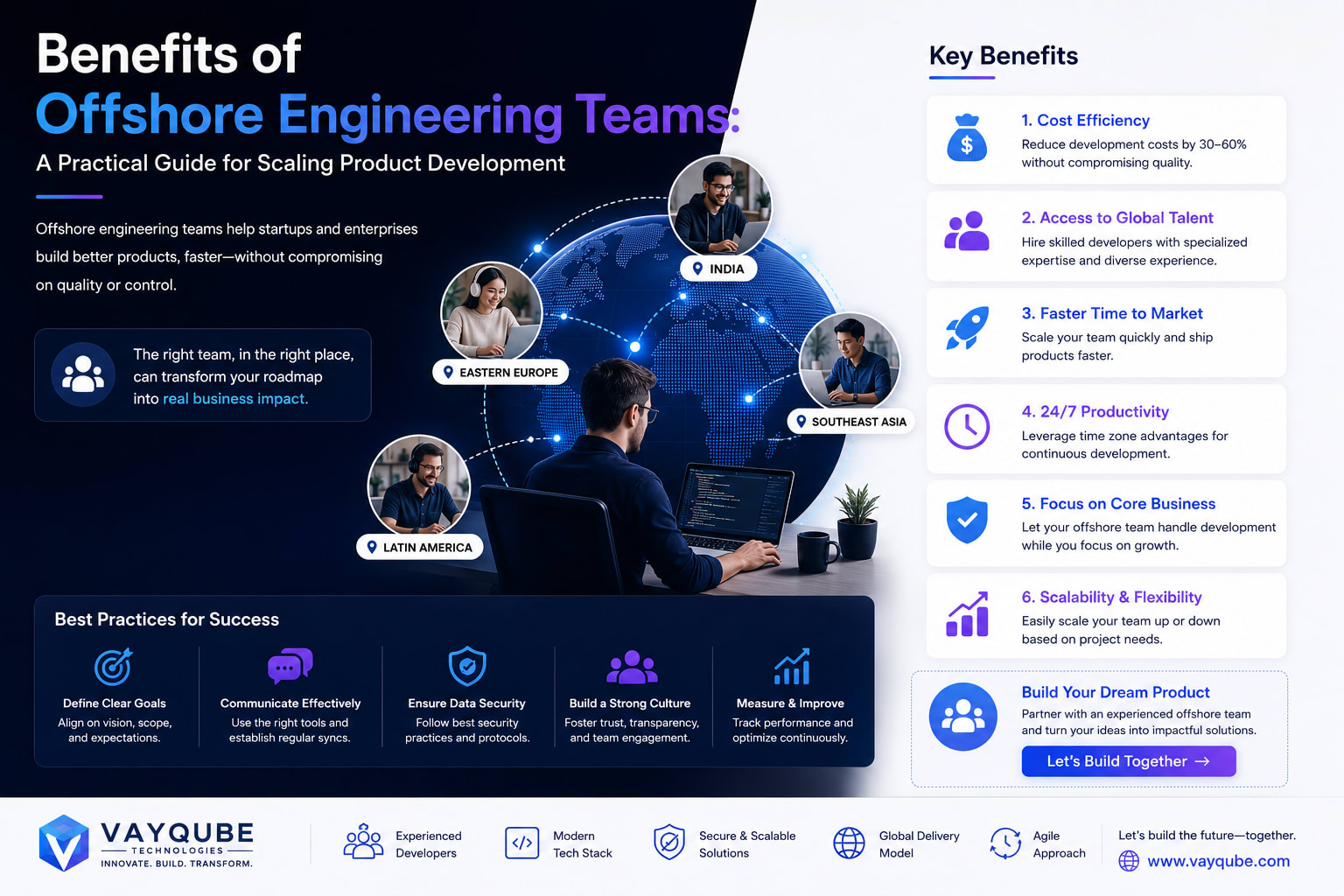
Benefits of Offshore Engineering Teams
Introduction
Most engineering leaders don't struggle with finding good ideas — they struggle with finding enough hands to build them fast enough. Hiring locally is slow, senior talent is expensive, and every open requisition delays a roadmap that competitors are already shipping against. This is the operational reality that pushes SaaS founders, CTOs, and product leaders toward offshore engineering teams.
An offshore engineering team is a dedicated group of developers, working from another country, that integrates directly into your existing product and delivery process. Done correctly, it is not a cost-cutting shortcut — it is a way to add senior engineering capacity, extend development coverage across more hours per day, and keep shipping velocity high without the six-to-nine month hiring cycles typical of local senior hires.
By the end of this guide, you will understand where offshore teams create real business value, how to structure the engagement so quality doesn't slip, and what to evaluate before committing budget to a delivery partner.
Who This Guide Is For
This guide is written for SaaS founders scaling a roadmap faster than their local team can absorb, CTOs who need senior engineering bandwidth without inflating fixed payroll, operations and product leaders coordinating multi-team delivery, and fintech or healthcare companies that need compliance-aware engineering at a sustainable cost. If your team is blocked on hiring, burning budget on contractors with inconsistent quality, or trying to compress a 12-month roadmap into 6 months, offshore engineering is directly relevant to your next decision.
Quick Summary
Offshore engineering teams let you add senior, production-ready developers to your roadmap in weeks instead of months, typically at 40-60% lower fully-loaded cost than an equivalent local hire, while extending daily development coverage through time zone overlap. The next practical decision is not "should we go offshore" but "which governance model — staff augmentation, a dedicated pod, or a fully managed team — fits how we already work."
Common Problems Businesses Face Before Going Offshore
Before evaluating offshore teams, most companies are already dealing with a familiar set of bottlenecks: senior engineering hires taking three to six months to close, roadmaps slipping because QA and DevOps have no dedicated owner, rising contractor costs with no long-term accountability, founders doing hands-on code review because there's no technical leadership layer, and infrastructure decisions made reactively instead of planned around growth. These problems compound quietly — a delayed hire pushes a launch, which pushes a fundraising milestone, which pushes the next hiring round.
What Teams Should Evaluate First
| Area | What to Check | Why It Matters |
|---|---|---|
| Engagement Model | Staff augmentation vs dedicated pod vs managed team | Determines who owns delivery accountability |
| Time Zone Overlap | Minimum 3-4 working hours shared | Keeps standups and reviews real-time |
| Seniority Mix | Ratio of senior to mid-level engineers | Prevents architecture drift and rework |
| Communication Process | Sprint cadence, demo frequency, reporting | Reduces the "black box" risk of offshore work |
| Security Practices | Access control, NDAs, code ownership | Protects IP and production systems |
Why Offshore Engineering Teams Work
The strongest offshore engagements are structured like an internal team, not a vendor relationship. A dedicated pod — typically a mix of backend, frontend, QA, and a technical lead — is assigned exclusively to your product, attends your sprint ceremonies, and is measured against the same delivery metrics as an in-house team. This is different from freelance marketplaces or project-based outsourcing, where accountability is diffuse and turnover is high.
Recommended Delivery Structure
Product Owner (Client)
      ↓
Offshore Tech Lead
      ↓
Backend Engineers  ·  Frontend Engineers  ·  QA
      ↓
CI/CD Pipeline → Staging → Production
      ↓
Weekly Sprint Demo + Client Review
Practical Steps to Build an Effective Offshore Engineering Team
- Define the engagement model — staff augmentation for short-term gaps, or a dedicated pod for sustained roadmap work.
- Set a minimum time zone overlap window before selecting a delivery partner.
- Require a senior technical lead as the single point of accountability.
- Establish sprint cadence, demo schedule, and reporting format in the first week.
- Run a paid trial sprint before committing to a multi-month contract.
- Put code ownership, access control, and IP protection in the contract, not just in conversation.
Business Impact of Offshore Engineering Teams
The value of offshore engineering rarely comes down to just "cheaper developers" — it shows up across several business metrics at once. Cost efficiency typically comes from a 40-60% reduction in fully-loaded engineering cost compared to hiring the same seniority level locally. Delivery speed improves because time zone overlap extends the working day, so code reviews and QA can happen while the core team sleeps. Hiring risk drops because a dedicated pod can be resized in weeks instead of running a new recruitment cycle every time scope changes. Product quality holds up only when the offshore team is senior-led — junior-heavy teams create technical debt that erases the cost savings within a year.
Common Challenges and How to Solve Them
Offshore engagements fail for predictable reasons, and each has a direct fix. Communication gaps are solved with a shared overlap window and a single technical lead who filters requirements instead of relaying them verbatim. Inconsistent code quality is solved by requiring senior engineers on every project and enforcing code review gates in the CI/CD pipeline, not after the fact. Security concerns are addressed with role-based access control, signed NDAs, and least-privilege production access rather than shared credentials. Scope creep is controlled with weekly sprint reviews that force re-prioritization instead of silently expanding the backlog.
When Offshore Teams Make the Most Sense
| Situation | Recommended Approach |
|---|---|
| Roadmap ahead of local hiring capacity | Dedicated offshore pod |
| Short-term skill gap (e.g., DevOps migration) | Staff augmentation |
| New product line, unclear long-term scope | Fixed-scope offshore project |
| Enterprise compliance requirements | Managed team with security-first practices |
Related Vayqube Resources
FAQ
Is offshore engineering only about saving cost? No. Cost reduction is one benefit, but the bigger driver for most teams is delivery speed and access to senior talent that's hard to hire locally within a reasonable timeline.
How much cheaper is an offshore engineering team? Most companies see 40-60% lower fully-loaded cost compared to an equivalent senior local hire, though the exact figure depends on region and seniority mix.
What's the difference between staff augmentation and a dedicated pod? Staff augmentation adds individual engineers into your existing team and process. A dedicated pod is a self-contained team — engineering, QA, and a tech lead — that owns a defined part of your roadmap.
How do we protect our IP with an offshore team? Through signed NDAs, role-based access control, least-privilege production access, and code ownership terms defined in the contract before work starts.
How much time zone overlap do we actually need? A minimum of three to four working hours of overlap is usually enough to keep standups, reviews, and blockers moving in real time.
Can offshore teams work on regulated industries like fintech or healthcare? Yes, provided the partner follows security-first practices — encryption, RBAC, audit logging — and has prior experience with the relevant compliance requirements.
Ready to add senior engineering capacity without the hiring delay? Talk to Vayqube about building a dedicated offshore pod around your roadmap.