
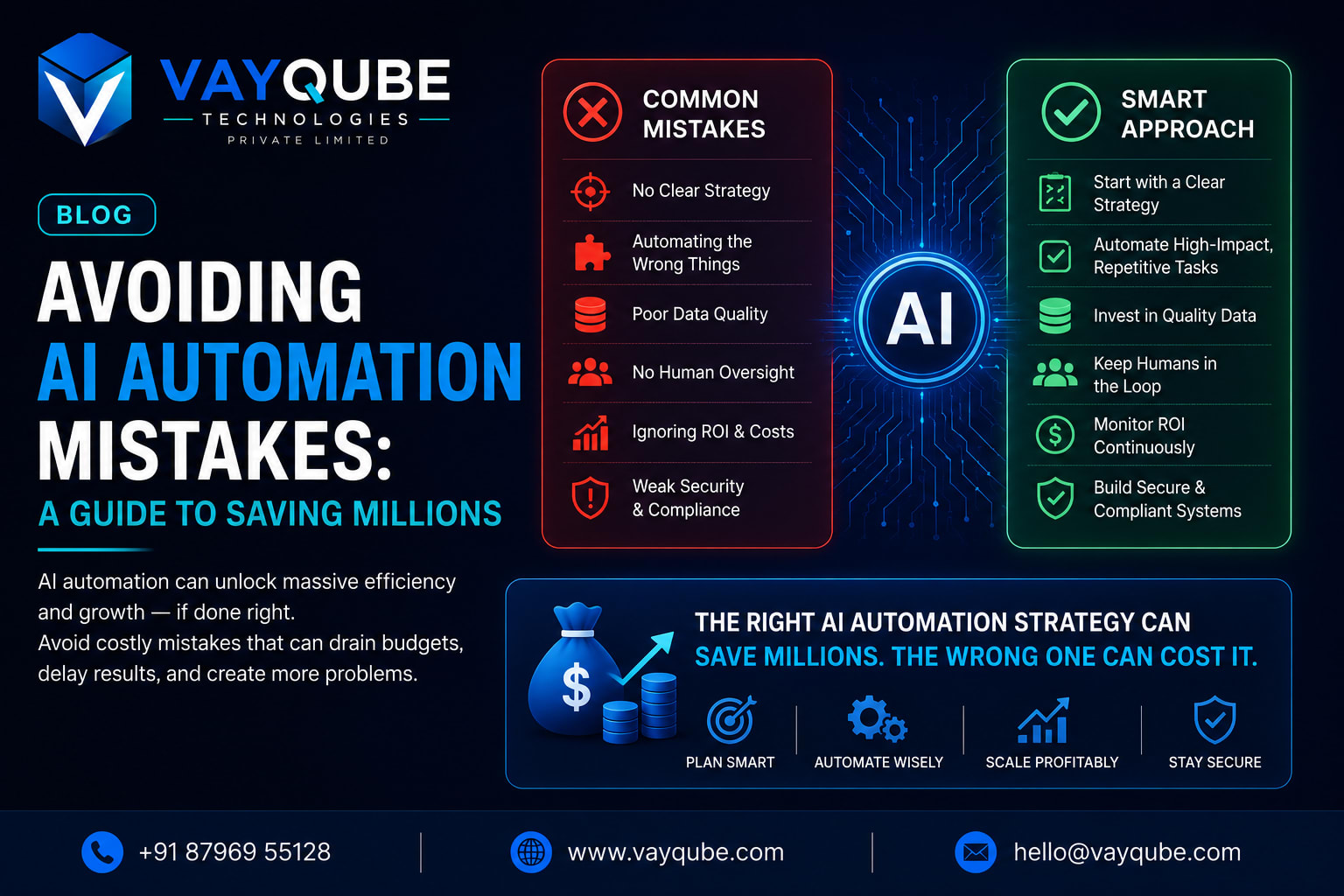
Avoiding AI Automation Mistakes: A Guide to Saving Millions
AI automation mistakes can have devastating financial consequences. Learn from real-world examples and expert advice to ensure your business avoids costly errors and achieves production readiness
Vayqube Team
Software architecture and product engineering
Introduction to AI Automation Mistakes
AI automation has become a crucial component in modern business operations, enabling companies to streamline processes, enhance efficiency, and reduce costs. The importance of AI automation cannot be overstated, as it has the potential to revolutionize industries and transform the way businesses operate. However, the implementation of AI automation is not without its challenges, and mistakes can be costly.
The Cost of Mistakes in AI Automation
Mistakes in AI automation can result in significant financial losses, damage to reputation, and decreased customer satisfaction. According to recent studies, companies that have implemented AI automation have reported losses in the millions due to errors and inefficiencies. These mistakes can be attributed to various factors, including inadequate planning, insufficient testing, and lack of expertise.
Overview of AI Automation
AI automation involves the use of artificial intelligence and machine learning algorithms to automate business processes, such as data processing, customer service, and decision-making. The goal of AI automation is to improve efficiency, reduce costs, and enhance customer experience. However, to achieve these benefits, companies must ensure that their AI automation systems are designed and implemented correctly.
Importance of Avoiding Mistakes
Avoiding mistakes in AI automation is critical to ensuring the success of business operations. Mistakes can lead to a range of negative consequences, including financial losses, decreased productivity, and damage to reputation. To avoid these mistakes, companies must take a strategic approach to AI automation, including careful planning, thorough testing, and ongoing monitoring. By doing so, companies can minimize the risks associated with AI automation and maximize its benefits.
Real-World Examples of AI Automation Mistakes
There are several real-world examples of companies that have made mistakes in AI automation, resulting in significant financial losses and damage to reputation. For example:
- A major bank implemented an AI-powered chatbot that was intended to provide customer support, but the chatbot was not properly tested and ended up providing incorrect information to customers.
- A retail company implemented an AI-powered inventory management system that was intended to optimize stock levels, but the system was not properly calibrated and ended up overstocking certain products, resulting in significant waste and financial losses.
These examples highlight the importance of careful planning, thorough testing, and ongoing monitoring in AI automation. By learning from these mistakes, companies can avoid similar errors and ensure the success of their AI automation initiatives.
Key Considerations for Avoiding AI Automation Mistakes
To avoid mistakes in AI automation, companies should consider the following key factors:
- Careful planning and design of AI automation systems
- Thorough testing and validation of AI automation systems
- Ongoing monitoring and maintenance of AI automation systems
- Ensuring that AI automation systems are aligned with business goals and objectives
- Providing adequate training and support to employees who will be working with AI automation systems.
Financial Implications
The financial implications of AI automation mistakes can be severe, resulting in significant losses for businesses. In fact, a single mistake can cost a company millions of dollars. This can happen in various ways, such as:
- Incorrect data analysis leading to poor decision-making
- Automated processes going awry, resulting in wasted resources
- Inadequate testing and quality assurance, causing system failures
These mistakes can also lead to a loss of productivity, as employees spend more time correcting errors than focusing on core business activities. Furthermore, the financial burden of AI automation mistakes can be long-lasting, affecting a company's bottom line for years to come.
Reputation and Customer Trust
In addition to financial implications, AI automation mistakes can also damage a company's reputation and erode customer trust. When automated systems fail or produce incorrect results, customers may lose confidence in the company's ability to deliver quality products or services. This can lead to a decline in sales, revenue, and ultimately, profitability.
The consequences of damaged reputation and customer trust can be far-reaching, affecting not only the company's financial performance but also its long-term sustainability. In today's digital age, news of AI automation mistakes can spread quickly, making it essential for businesses to prioritize transparency, accountability, and corrective action.
Real-World Examples
Real-world examples of AI automation mistakes abound, highlighting the importance of careful planning, testing, and implementation. For instance, a company may implement an AI-powered chatbot to handle customer inquiries, only to find that it is unable to understand the nuances of human language, leading to frustrated customers and negative reviews.
In other cases, AI automation mistakes can have more severe consequences, such as in healthcare or finance, where incorrect data analysis or automated decision-making can have life-altering or financially devastating effects. These examples underscore the need for businesses to approach AI automation with caution, carefully considering the potential risks and consequences of their actions.
Production Considerations
To avoid AI automation mistakes, businesses must prioritize production considerations, such as thorough testing, quality assurance, and ongoing monitoring. This includes:
- Developing and implementing robust testing protocols to identify potential errors or biases
- Establishing clear lines of communication and accountability among teams and stakeholders
- Continuously monitoring and evaluating AI automation systems to ensure they are functioning as intended
By taking a proactive and meticulous approach to AI automation, businesses can minimize the risk of mistakes, protect their reputation and customer trust, and ensure the long-term success of their operations.
Core Architecture
To build a reliable AI automation system, it's essential to understand the key components involved and the design principles that guide their implementation.
Key Components
The core components of AI automation systems include:
- Data ingestion and processing
- Machine learning models
- Automation workflows
- Integration with existing systems
- Monitoring and feedback mechanisms
These components work together to enable AI-driven automation, but their complexity can also introduce potential pitfalls if not designed and implemented correctly.
Design Principles
Design principles for reliable AI automation focus on scalability, flexibility, and maintainability. Key considerations include:
- Modular architecture to facilitate updates and changes
- Data quality and integrity to ensure accurate decision-making
- Transparency and explainability of AI-driven decisions
- Robust security measures to protect sensitive data and prevent unauthorized access
- Continuous monitoring and feedback to detect and correct errors or biases
By applying these design principles, organizations can minimize the risk of AI automation mistakes and ensure that their systems operate reliably and efficiently.
Implementation Considerations
When implementing AI automation systems, it's crucial to consider the production environment and the potential impact on existing operations. This includes:
- Assessing the scalability of the system to handle increased workload or data volume
- Ensuring seamless integration with existing systems and workflows
- Developing a comprehensive testing and validation strategy to identify and address potential issues
- Establishing clear governance and decision-making processes to oversee AI-driven automation
By carefully evaluating these factors, organizations can ensure a smooth and successful implementation of their AI automation systems.
Real-World Examples
In real-world scenarios, AI automation systems have been successfully implemented in various industries, such as:
- Financial services, where AI-driven automation has improved transaction processing and reduced errors
- Healthcare, where AI-powered systems have enhanced patient care and streamlined clinical workflows
- Manufacturing, where AI automation has optimized production processes and increased productivity
These examples demonstrate the potential benefits of AI automation, but also highlight the need for careful planning, design, and implementation to avoid costly mistakes.
Production Readiness
To ensure production readiness, organizations should focus on:
- Developing a robust testing and validation framework
- Establishing clear monitoring and feedback mechanisms
- Implementing robust security measures to protect sensitive data
- Ensuring scalability and flexibility to accommodate changing business needs
By prioritizing production readiness, organizations can minimize the risk of AI automation mistakes and ensure that their systems operate reliably and efficiently in real-world environments.
Business Benefits
The implementation of AI automation can have a significant impact on a company's bottom line. By leveraging AI, businesses can streamline processes, reduce manual errors, and free up resources for more strategic initiatives. Two key benefits of AI automation are increased efficiency and productivity, as well as enhanced decision-making capabilities.
Increased Efficiency and Productivity
AI automation can automate repetitive and mundane tasks, allowing employees to focus on higher-value tasks that require creativity, problem-solving, and innovation. This can lead to significant productivity gains, as employees are able to work more efficiently and effectively. For example, a company that automates its data entry process can reduce the time spent on this task by up to 90%, freeing up staff to focus on more strategic initiatives.
Some key benefits of increased efficiency and productivity include:
- Reduced labor costs
- Improved employee satisfaction and engagement
- Increased throughput and output
- Enhanced customer experience
Enhanced Decision-Making Capabilities
AI automation can also provide businesses with enhanced decision-making capabilities, by providing real-time insights and analytics. This can enable companies to make more informed decisions, and to respond quickly to changing market conditions. For example, a company that uses AI to analyze customer data can gain a deeper understanding of customer behavior and preferences, and use this information to develop more effective marketing campaigns.
Some key benefits of enhanced decision-making capabilities include:
- Improved forecasting and predictive analytics
- Enhanced risk management and mitigation
- Increased agility and responsiveness to changing market conditions
- Better allocation of resources and investments
By avoiding common AI automation mistakes, businesses can unlock these benefits and achieve significant returns on investment. This can include millions of dollars in cost savings, as well as improved competitiveness and market share. In the next section, we will explore the implementation strategy for AI automation, and provide guidance on how to get started with this technology.
Scalability
To ensure the long-term success of AI automation systems, scalability is a critical factor to consider. As businesses grow and evolve, their automation systems must be able to adapt and scale accordingly.
Challenges of Scaling AI Automation Systems
Scaling AI automation systems can be complex and challenging. Some common obstacles include:
- Data volume and velocity: As the amount of data being processed increases, the system must be able to handle the load without compromising performance.
- Model drift and updates: AI models require regular updates and maintenance to ensure they remain accurate and effective.
- Integration with existing systems: Scalable AI automation systems must be able to integrate seamlessly with existing infrastructure and applications.
Strategies for Ensuring Scalability
To overcome these challenges and ensure scalability, businesses can employ several strategies:
- Cloud-based infrastructure: Leveraging cloud-based infrastructure allows for greater flexibility and scalability, as resources can be easily scaled up or down as needed.
- Modular architecture: Designing AI automation systems with a modular architecture enables easier maintenance, updates, and scaling.
- Automated testing and monitoring: Implementing automated testing and monitoring enables businesses to quickly identify and address potential issues, reducing downtime and ensuring continuous operation.
- Data management: Effective data management is critical to ensuring scalability, as it enables businesses to handle large volumes of data and make informed decisions.
By implementing these strategies, businesses can ensure their AI automation systems are scalable, flexible, and able to adapt to changing needs and requirements. This, in turn, enables them to maximize the benefits of AI automation, including increased efficiency, reduced costs, and improved decision-making.
Real-World Examples
Real-world examples of scalable AI automation systems can be seen in industries such as finance, healthcare, and e-commerce. For instance, a large financial institution may implement an AI-powered chatbot to handle customer inquiries, which can be easily scaled up or down to meet changing demand. Similarly, a healthcare organization may use AI automation to analyze large volumes of medical data, which requires a scalable system to handle the data velocity and volume.
Production Considerations
When implementing scalable AI automation systems in production, businesses must consider several key factors, including:
- Security and compliance: Ensuring the system meets all relevant security and compliance requirements is critical to preventing data breaches and other security threats.
- Performance monitoring: Continuous performance monitoring enables businesses to quickly identify and address potential issues, reducing downtime and ensuring continuous operation.
- Maintenance and updates: Regular maintenance and updates are essential to ensuring the system remains accurate, effective, and secure.
Implementation Challenges
Implementing AI automation can be a complex process, and companies often encounter unexpected challenges that can derail even the most well-planned projects. Common pitfalls in AI automation implementation include:
- Insufficient data quality and availability, leading to biased or inaccurate models
- Inadequate testing and validation, resulting in unforeseen consequences or errors
- Poor integration with existing systems and infrastructure, causing disruptions to business operations
- Inadequate change management and training for employees, leading to resistance to adoption
- Failure to establish clear goals and metrics for success, making it difficult to measure the effectiveness of AI automation
Mitigation Strategies
To overcome these challenges, companies can employ several mitigation strategies. These include:
- Conducting thorough data audits and implementing data governance policies to ensure data quality and availability
- Developing comprehensive testing and validation protocols to identify and address potential issues
- Engaging in careful planning and execution of integration with existing systems and infrastructure
- Providing ongoing training and support for employees to ensure a smooth transition to AI automation
- Establishing clear goals and metrics for success, and continuously monitoring and evaluating the effectiveness of AI automation
Effective mitigation strategies require a deep understanding of the potential challenges and pitfalls associated with AI automation implementation. By being proactive and taking a structured approach to implementation, companies can minimize the risk of errors and maximize the benefits of AI automation.
Real-World Examples
Real-world examples of successful AI automation implementation can provide valuable insights and lessons learned. For instance, a leading financial services company implemented AI automation to streamline its customer service operations, resulting in a significant reduction in response times and improvement in customer satisfaction. However, the company had to overcome several challenges, including integrating the AI system with its existing infrastructure and training employees to work effectively with the new technology.
Production Considerations
When implementing AI automation in production environments, companies must consider several key factors, including scalability, security, and reliability. This includes ensuring that the AI system can handle large volumes of data and traffic, protecting sensitive data and preventing unauthorized access, and minimizing downtime and ensuring continuous operation. By carefully considering these production considerations, companies can ensure that their AI automation systems are robust, reliable, and effective in supporting business operations.
Overcoming Implementation Challenges
Overcoming implementation challenges requires a combination of technical expertise, business acumen, and strategic planning. Companies must be able to navigate the complex technical landscape of AI automation, while also understanding the business needs and goals that the technology is intended to support. By taking a holistic and integrated approach to implementation, companies can overcome the common pitfalls and challenges associated with AI automation, and achieve significant business benefits and cost savings.
Use Cases
Successful AI automation can be seen in various industries, with real-world examples showcasing its potential to save millions.
Industry-Specific Applications
AI automation is being applied in numerous sectors, including:
- Healthcare: automating patient data analysis and medical diagnosis, reducing errors and improving treatment outcomes
- Finance: automating trading, risk management, and compliance, resulting in increased efficiency and reduced costs
- Manufacturing: automating production lines, predictive maintenance, and quality control, leading to improved product quality and reduced downtime
Real-world examples of successful AI automation include:
- A leading bank that automated its credit risk assessment process, resulting in a 30% reduction in manual review time and a 25% decrease in false positives
- A healthcare provider that implemented an AI-powered chatbot to handle patient inquiries, resulting in a 40% reduction in call center volume and a 20% increase in patient satisfaction
Cross-Industry Applications
AI automation is not limited to specific industries, as its applications can be seen across various sectors, including:
- Customer service: automating support requests, improving response times, and enhancing customer experience
- Supply chain management: automating inventory management, demand forecasting, and logistics optimization, resulting in reduced costs and improved delivery times
- Human resources: automating recruitment, employee onboarding, and benefits administration, leading to increased efficiency and reduced administrative burdens
By examining these use cases, organizations can gain a deeper understanding of the potential benefits and challenges of AI automation, and develop effective strategies for implementation.
Implementation Strategies
To achieve successful AI automation, organizations should focus on:
- Identifying areas with high automation potential, such as repetitive tasks or processes with high error rates
- Developing a clear understanding of the business requirements and goals for automation
- Implementing a phased approach to automation, starting with small-scale pilots and gradually scaling up to larger deployments
- Ensuring ongoing monitoring and evaluation of automation performance, to identify areas for improvement and optimize results.
Production Readiness
To ensure production readiness, organizations should consider:
- Developing a comprehensive testing and validation plan, to ensure automation systems are functioning as intended
- Implementing robust security and compliance measures, to protect sensitive data and prevent potential risks
- Establishing clear governance and oversight structures, to ensure accountability and transparency in automation decision-making
- Providing ongoing training and support, to ensure that employees are equipped to work effectively with automated systems.
Best Practices
To ensure successful AI automation implementation, it's crucial to follow established guidelines and strategies. This section outlines key best practices for designing and implementing AI automation systems, as well as monitoring and maintenance strategies.
Designing AI Automation Systems
When designing AI automation systems, consider the following:
- Define clear goals and objectives to ensure alignment with business outcomes
- Develop a thorough understanding of the processes to be automated
- Choose the right AI technologies and tools for the task at hand
- Ensure seamless integration with existing systems and infrastructure
- Implement robust testing and validation procedures to guarantee accuracy and reliability
Monitoring and Maintenance Strategies
Effective monitoring and maintenance are critical to ensuring the long-term success of AI automation systems. Key considerations include:
- Implementing real-time monitoring and analytics to detect potential issues
- Developing a comprehensive maintenance schedule to prevent downtime and data loss
- Establishing clear escalation procedures for addressing errors or exceptions
- Continuously reviewing and refining AI models to ensure optimal performance
- Providing ongoing training and support for personnel responsible for managing AI automation systems
Implementation Considerations
When implementing AI automation systems, it's essential to consider the following factors:
- Change management: ensuring that all stakeholders are informed and prepared for the transition to automated processes
- Data quality: guaranteeing that the data used to train and operate AI models is accurate, complete, and relevant
- Security: implementing robust security measures to protect sensitive data and prevent unauthorized access
- Compliance: ensuring that AI automation systems meet all relevant regulatory and compliance requirements
- Scalability: designing systems that can adapt to changing business needs and volumes
Real-World Examples
Companies that have successfully implemented AI automation systems have seen significant benefits, including improved efficiency, reduced costs, and enhanced customer experiences. For example, a leading financial services firm used AI automation to streamline its customer onboarding process, reducing processing time by 75% and increasing customer satisfaction by 90%. Similarly, a major retailer implemented AI-powered chatbots to handle customer inquiries, resulting in a 50% reduction in support requests and a 25% increase in sales.
Frequently Asked Questions
To address common concerns and misconceptions about AI automation, we've compiled a list of frequently asked questions.
Addressing Common Concerns
The following are some of the most common questions asked about AI automation:
- What are the most significant risks associated with AI automation, and how can they be mitigated?
- How can organizations ensure that their AI automation systems are transparent and explainable?
- What role does human oversight play in AI automation, and how can it be effectively implemented?
- How can organizations balance the benefits of AI automation with the potential risks and challenges?
Misconceptions About AI Automation
Several misconceptions about AI automation can lead to poor implementation and significant financial losses. Some of these misconceptions include:
- The idea that AI automation can completely replace human workers, without considering the need for human oversight and intervention.
- The assumption that AI automation systems can be implemented without significant upfront investment in data quality and infrastructure.
- The belief that AI automation systems can be implemented without considering the potential risks and challenges, such as bias and errors.
Real-World Examples
Real-world examples of AI automation mistakes include:
- A company that implemented an AI automation system without proper testing and validation, resulting in significant errors and financial losses.
- An organization that failed to consider the potential risks and challenges of AI automation, resulting in reputational damage and regulatory issues.
- A business that invested heavily in AI automation without considering the need for human oversight and intervention, resulting in poor implementation and significant financial losses.
Implementation Considerations
When implementing AI automation, organizations should consider the following:
- The need for high-quality data and infrastructure to support AI automation systems.
- The importance of human oversight and intervention in AI automation systems.
- The potential risks and challenges associated with AI automation, such as bias and errors.
- The need for ongoing monitoring and evaluation of AI automation systems to ensure they are functioning as intended.
Production Readiness
To ensure production readiness, organizations should:
- Conduct thorough testing and validation of AI automation systems.
- Implement robust monitoring and evaluation processes to ensure AI automation systems are functioning as intended.
- Develop strategies for addressing potential risks and challenges, such as bias and errors.
- Establish clear policies and procedures for human oversight and intervention in AI automation systems.
Conclusion
In the quest to harness the power of AI automation, businesses often overlook critical considerations that can lead to costly mistakes. This guide has navigated through the essential aspects of avoiding such pitfalls, ensuring a smoother and more beneficial integration of AI automation into existing systems.
Recap of Key Takeaways
- Assessing Core Architecture: Understanding the foundational structure of your business and how AI automation can be seamlessly integrated without disrupting core operations.
- Scalability and Implementation: Planning for scale and implementing AI solutions with a focus on flexibility and adaptability to changing business needs.
- Business Benefits and Challenges: Recognizing the potential benefits of AI automation, such as enhanced efficiency and decision-making, while also addressing the challenges, including data quality issues and ethical considerations.
- Use Cases and Best Practices: Identifying suitable applications for AI automation within your business and adhering to best practices that ensure successful deployment and ongoing management.
Future Directions for AI Automation
As technology continues to evolve, the future of AI automation holds much promise. Key areas to watch include:
- Advancements in Machine Learning: More sophisticated ML algorithms that can handle complex, dynamic data sets, leading to more accurate predictions and decision-making.
- Ethical AI and Transparency: Growing emphasis on ensuring AI systems are transparent, fair, and unbiased, which will be crucial for maintaining trust and compliance with emerging regulations.
- Human-AI Collaboration: Developing systems that enhance human capabilities rather than replace them, focusing on augmenting productivity and creativity.
- Cybersecurity and AI: Integrating AI to bolster cybersecurity defenses, detecting and mitigating threats more effectively than traditional methods.
Production Considerations and Real-World Examples
In moving forward with AI automation, it's essential to consider real-world production environments. This includes:
- Pilot Projects: Starting with small, controlled pilot projects to test AI automation solutions before scaling up.
- Monitoring and Feedback: Implementing robust monitoring and feedback mechanisms to quickly identify and address any issues that arise.
- Training and Education: Providing comprehensive training and education to teams who will be working with AI automation systems, ensuring they understand both the capabilities and limitations of these technologies.
Embracing the Future of AI Automation
By understanding the potential pitfalls and taking a strategic approach to AI automation, businesses can unlock significant benefits, from improved operational efficiency to enhanced customer experiences. The key to success lies in careful planning, ongoing evaluation, and a commitment to leveraging AI in a way that complements and augments human capabilities. As the landscape of AI automation continues to evolve, staying informed and adaptable will be crucial for businesses aiming to remain at the forefront of innovation and competitiveness.
Related Vayqube Resources
- Why Most Ai Projects Fail Before Production
- How To Build Fintech Application Payments Security Scaling
- How To Build Scalable Nodejs Backend Production Guide
- Ai Agents Changing Customer Support Operations 2026
- Businesses Replacing Manual Workflows With Ai Agents 2026
- Best Mobile App Development Company In Singapore City
Next Step
If your systems are struggling with scalability, automation, architecture complexity, or operational efficiency, it's time to modernize your infrastructure and workflows.
👉 Talk to a Vayqube solution architect and build systems designed for long-term production growth: