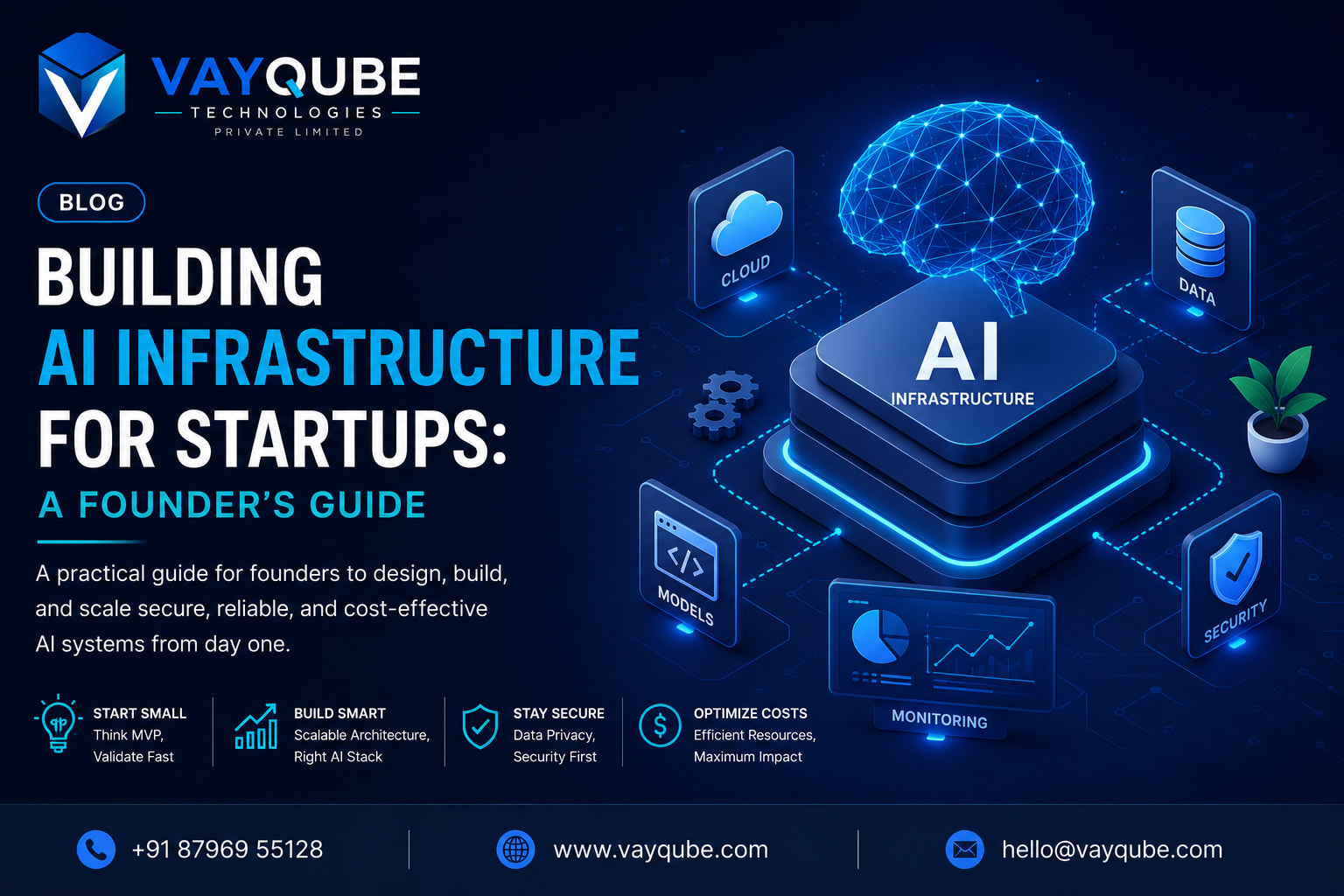
Building AI Infrastructure for Startups: A Founder's Guide
Learn how to build a robust AI infrastructure that supports your startup's growth, from planning to production readiness
Vayqube Team
Author


Introduction to AI Infrastructure for Startups
As a startup founder, building a robust AI infrastructure is crucial for driving business growth, improving operational efficiency, and gaining a competitive edge. AI infrastructure refers to the underlying systems, tools, and technologies that enable the development, deployment, and management of artificial intelligence and machine learning models.
Overview of AI Infrastructure
A well-designed AI infrastructure provides a scalable and secure foundation for startups to build, train, and deploy AI models. This includes data storage and management, computing resources, networking, and software frameworks that support AI workloads. With a solid AI infrastructure in place, startups can unlock new revenue streams, enhance customer experiences, and optimize business processes.
Importance for Startups
For startups, investing in AI infrastructure is essential for several reasons:
- Enhances competitiveness: AI-driven startups can innovate faster and respond to market changes more quickly.
- Improves operational efficiency: AI automates routine tasks, freeing up resources for strategic initiatives.
- Drives business growth: AI-powered insights and predictions help startups make informed decisions and identify new opportunities.
Brief Guide Outline
This guide provides a comprehensive overview of building AI infrastructure for startups, covering key aspects such as:
- Assessing AI readiness and defining infrastructure requirements
- Designing and implementing a scalable AI architecture
- Ensuring data quality, security, and compliance
- Selecting the right AI tools and technologies
- Implementing a robust AI governance framework
- Measuring AI infrastructure performance and ROI
By following this guide, startup founders can develop a tailored AI infrastructure strategy that meets their unique business needs and sets them up for long-term success.
Why It Matters
Building AI infrastructure is crucial for startups as it provides a competitive advantage in the market. By leveraging AI, startups can analyze vast amounts of data, identify patterns, and make informed decisions to stay ahead of the competition.
Gaining a Competitive Edge
A well-designed AI infrastructure enables startups to automate processes, optimize resources, and improve overall efficiency. This, in turn, allows them to focus on innovation and growth, rather than getting bogged down in manual tasks. Some key benefits of AI infrastructure include:
- Improved data analysis and insights
- Enhanced process automation
- Increased scalability and flexibility
Informing Business Decisions
AI infrastructure also plays a critical role in improving decision-making within startups. By providing access to real-time data and analytics, AI systems enable founders to make informed decisions about product development, marketing strategies, and resource allocation. This data-driven approach helps reduce the risk of costly mistakes and ensures that startups are well-positioned for success.
Delivering Enhanced Customer Experiences
Moreover, AI infrastructure can be used to create personalized and engaging customer experiences. By analyzing customer data and behavior, startups can develop targeted marketing campaigns, offer tailored recommendations, and provide exceptional customer support. This not only drives customer loyalty but also fosters long-term growth and revenue. Some examples of AI-powered customer experiences include:
- Chatbots and virtual assistants
- Personalized product recommendations
- Predictive maintenance and support
Real-World Applications
In real-world scenarios, AI infrastructure has been instrumental in driving business success for startups. For instance, companies like Netflix and Uber have leveraged AI to personalize customer experiences, optimize operations, and inform business decisions. By building similar AI infrastructure, startups can replicate this success and establish themselves as leaders in their respective markets.
Implementation Considerations
When implementing AI infrastructure, startups must consider several key factors, including data quality, scalability, and security. By prioritizing these elements, founders can ensure that their AI systems are reliable, efficient, and effective in driving business growth. Some essential considerations include:
- Data governance and management
- AI model training and validation
- Integration with existing systems and infrastructure
Production Readiness
Finally, startups must ensure that their AI infrastructure is production-ready and can handle the demands of a rapidly growing business. This involves testing and validating AI models, monitoring system performance, and making adjustments as needed. By taking a proactive approach to AI infrastructure development, startups can minimize downtime, reduce errors, and maximize the benefits of AI-powered innovation.
Core Architecture
To build a robust AI infrastructure, startups need to focus on three key components: data ingestion and processing, machine learning model development, and integration with existing systems.
Data Ingestion and Processing
Data is the foundation of any AI system, and startups need to design a data pipeline that can handle large volumes of data from various sources. This includes data collection, storage, and processing. Key considerations include:
- Data quality and validation
- Scalability and performance
- Data security and compliance
- Real-time data processing and analytics
Machine Learning Model Development
Machine learning models are the core of AI infrastructure, and startups need to develop models that can learn from data and make accurate predictions. This includes:
- Model selection and training
- Hyperparameter tuning and optimization
- Model deployment and monitoring
- Continuous learning and improvement
Integration with Existing Systems
AI infrastructure needs to integrate seamlessly with existing systems, including customer relationship management (CRM) software, enterprise resource planning (ERP) systems, and other business applications. Key considerations include:
- API-based integration
- Data mapping and transformation
- System compatibility and testing
- Change management and training
Startups need to consider the production readiness of their AI infrastructure, including factors such as scalability, reliability, and maintainability. This includes:
- Cloud-based infrastructure
- Containerization and orchestration
- Monitoring and logging
- Continuous integration and deployment
By focusing on these core components and considering production readiness, startups can build a robust AI infrastructure that drives business growth and innovation. Real-world examples include companies like Uber and Airbnb, which have leveraged AI to improve customer experience and optimize operations.
Implementation Strategy
To implement AI infrastructure, startups need to develop a strategic roadmap that aligns with their business goals and objectives. This includes:
- Defining AI use cases and requirements
- Assessing data quality and availability
- Evaluating machine learning models and algorithms
- Developing a change management plan
By following this structured approach, startups can ensure a successful implementation of their AI infrastructure and achieve tangible business benefits.
Business Benefits
Implementing AI infrastructure can have a significant impact on a startup's bottom line. By leveraging AI, startups can streamline operations, reduce costs, and unlock new revenue streams.
Key Advantages
Some of the key benefits of AI infrastructure for startups include:
- Increased efficiency: Automating routine tasks and processes allows startups to focus on high-value activities, such as product development and customer engagement.
- Cost savings: AI can help reduce labor costs, minimize waste, and optimize resource allocation, resulting in significant cost savings.
- Revenue growth opportunities: AI-powered solutions can help startups identify new business opportunities, improve customer experiences, and develop innovative products and services.
Real-World Applications
Startups can apply AI infrastructure in various ways, such as:
- Chatbots and virtual assistants to enhance customer support and engagement
- Predictive analytics to inform business decisions and identify new opportunities
- Automated marketing and sales tools to optimize campaigns and improve conversion rates
Implementation Considerations
When implementing AI infrastructure, startups should consider factors such as:
- Data quality and availability: AI algorithms require high-quality, relevant data to produce accurate results.
- Integration with existing systems: AI infrastructure should be integrated with existing systems and processes to maximize efficiency and minimize disruption.
- Scalability and flexibility: AI infrastructure should be designed to scale with the startup's growth and adapt to changing business needs.
Production Readiness
To ensure production readiness, startups should:
- Develop a clear understanding of their AI infrastructure requirements and goals
- Establish a robust testing and validation process to ensure AI systems are functioning as intended
- Continuously monitor and evaluate AI system performance to identify areas for improvement and optimize results.
Scalability
To ensure the AI infrastructure can handle increasing workloads and user demands, scalability is crucial. A well-designed infrastructure should be able to adapt to changing requirements without compromising performance.
Cloud-Based Infrastructure
Cloud-based infrastructure provides the foundation for scalability, offering on-demand access to computing resources, storage, and networking. This allows startups to quickly deploy and scale their AI applications without the need for expensive hardware investments. Cloud providers such as AWS, Google Cloud, and Microsoft Azure offer a range of services and tools to support scalable AI infrastructure, including machine learning frameworks, data storage, and analytics.
Auto-Scaling and Load Balancing
Auto-scaling and load balancing are essential components of a scalable AI infrastructure. Auto-scaling enables the infrastructure to automatically adjust the number of resources allocated to an application based on demand, ensuring that the application can handle changes in workload without interruption. Load balancing distributes incoming traffic across multiple resources, preventing any single resource from becoming overwhelmed and ensuring that the application remains responsive.
Flexible Resource Allocation
Flexible resource allocation is critical to ensuring that the AI infrastructure can adapt to changing requirements. This involves allocating resources such as computing power, memory, and storage based on the specific needs of the application, rather than allocating a fixed amount of resources. By using containerization and orchestration tools such as Kubernetes, startups can efficiently manage and allocate resources, ensuring that the infrastructure is optimized for performance and cost.
Key considerations for implementing scalable AI infrastructure include:
- Designing the infrastructure to handle peak workloads and unexpected spikes in demand
- Implementing monitoring and logging tools to track performance and identify bottlenecks
- Using automation tools to streamline resource allocation and scaling
- Ensuring that the infrastructure is secure and compliant with relevant regulations and standards
- Continuously testing and evaluating the infrastructure to ensure it meets the evolving needs of the startup.
By prioritizing scalability and implementing a cloud-based infrastructure with auto-scaling, load balancing, and flexible resource allocation, startups can ensure that their AI applications are always available, responsive, and able to handle increasing workloads and user demands.
Implementation Challenges
As startups embark on building AI infrastructure, they often encounter several challenges that can hinder the success of their projects.
Data Quality and Availability
One of the primary challenges is ensuring the quality and availability of data. AI models require large amounts of high-quality data to learn and make accurate predictions. However, many startups struggle to collect, process, and integrate data from various sources, which can lead to biased models and poor performance. To overcome this challenge, startups can implement data governance policies, invest in data quality tools, and develop strategies for data acquisition and integration.
Talent Acquisition and Retention
Another significant challenge is acquiring and retaining top talent in AI and machine learning. The demand for skilled AI professionals far exceeds the supply, making it difficult for startups to compete with larger companies for talent. To address this challenge, startups can develop strategic partnerships with universities and research institutions, offer competitive compensation and benefits packages, and provide opportunities for professional growth and development.
Regulatory Compliance
Startups must also navigate complex regulatory requirements when building AI infrastructure. Depending on the industry and application, AI systems may be subject to various regulations, such as data protection laws, anti-discrimination laws, and transparency requirements. To ensure compliance, startups can establish a compliance team, develop policies and procedures for data handling and AI development, and engage with regulatory experts to stay up-to-date on changing requirements.
Some key considerations for startups to keep in mind when addressing these challenges include:
- Developing a comprehensive data strategy that prioritizes quality, availability, and integration
- Building a diverse and skilled team with expertise in AI, machine learning, and data science
- Establishing a culture of compliance and transparency, with clear policies and procedures for data handling and AI development
- Staying up-to-date on changing regulatory requirements and industry standards
- Fostering strategic partnerships with universities, research institutions, and industry partners to stay ahead of the curve in AI innovation.
By understanding these implementation challenges and developing strategies to address them, startups can build a robust AI infrastructure that drives business success and scalability.
Use Cases
The potential applications of AI infrastructure for startups are vast and varied. By leveraging AI and machine learning, founders can drive business growth, improve customer satisfaction, and gain a competitive edge.
Predictive Maintenance
Predictive maintenance is a key use case for AI infrastructure in startups. By analyzing equipment sensor data, usage patterns, and other factors, AI algorithms can predict when maintenance is required, reducing downtime and increasing overall efficiency. For instance, a startup in the manufacturing sector can use AI-powered predictive maintenance to identify potential equipment failures, schedule maintenance, and minimize production disruptions.
Personalized Customer Service
AI-powered chatbots and virtual assistants can provide personalized customer service, helping startups to improve customer engagement and retention. By analyzing customer interactions, preferences, and behavior, AI algorithms can offer tailored recommendations, resolve issues, and enhance the overall customer experience. A startup in the e-commerce sector can use AI-driven chatbots to offer personalized product suggestions, helping to increase sales and customer satisfaction.
Automated Marketing Campaigns
Automated marketing campaigns are another significant use case for AI infrastructure in startups. By analyzing customer data, market trends, and other factors, AI algorithms can create targeted marketing campaigns, optimize ad spend, and improve conversion rates. For example, a startup in the fintech sector can use AI-powered marketing automation to create personalized email campaigns, social media ads, and other promotional materials, helping to acquire new customers and drive business growth.
Some of the benefits of these use cases include:
- Improved operational efficiency
- Enhanced customer experience
- Increased revenue and growth
- Better decision-making
- Competitive advantage
By implementing AI infrastructure and leveraging these use cases, startups can drive business success, improve customer satisfaction, and stay ahead of the competition.
Real-World Examples
Real-world examples of AI infrastructure in startups include companies like:
- Uber, which uses AI-powered predictive maintenance to optimize its fleet operations
- Netflix, which uses AI-driven personalized customer service to recommend content to its users
- HubSpot, which uses AI-powered automated marketing campaigns to drive lead generation and conversion
These examples demonstrate the potential of AI infrastructure to drive business growth, improve customer satisfaction, and gain a competitive edge.
Production Considerations
When implementing AI infrastructure for these use cases, startups should consider several production factors, including:
- Data quality and availability
- Algorithmic complexity and interpretability
- Scalability and reliability
- Security and compliance
- Integration with existing systems and infrastructure
By carefully considering these factors, startups can ensure successful implementation and maximize the benefits of AI infrastructure.
Best Practices
To ensure the successful implementation of AI infrastructure, startups should follow key best practices that facilitate scalability, collaboration, and continuous improvement.
Start Small and Iterate
Starting small allows founders to test and refine their AI infrastructure without over-investing in resources. This approach enables the identification of potential bottlenecks and areas for improvement, making it easier to iterate and adapt to changing business needs. By beginning with a minimal viable product (MVP), startups can validate their AI-driven solutions and make data-informed decisions about future development.
Collaboration and Stakeholder Engagement
Collaboration with stakeholders is crucial for the successful implementation of AI infrastructure. Founders should engage with cross-functional teams, including data scientists, engineers, and business leaders, to ensure that AI solutions align with business objectives and address real-world problems. This collaborative approach helps to identify potential roadblocks, ensures that solutions meet user needs, and fosters a culture of innovation and experimentation.
Monitoring and Evaluating Performance
Monitoring and evaluating the performance of AI infrastructure is essential for measuring its impact on business outcomes. Startups should establish clear key performance indicators (KPIs) and metrics to assess the effectiveness of their AI solutions, such as:
- Model accuracy and reliability
- Data quality and integrity
- User adoption and engagement
- Return on investment (ROI) and cost savings By regularly monitoring and evaluating performance, founders can identify areas for improvement, optimize their AI infrastructure, and make informed decisions about future investments.
Some key considerations for monitoring and evaluation include:
- Establishing a data-driven culture that emphasizes continuous learning and improvement
- Using agile methodologies to facilitate rapid iteration and adaptation
- Fostering a culture of transparency and accountability, where stakeholders are empowered to provide feedback and insights
- Leveraging cloud-based services and tools to streamline monitoring and evaluation processes, and reduce infrastructure costs.
By following these best practices, startups can build a robust and scalable AI infrastructure that drives business growth, improves operational efficiency, and enhances customer experiences.
Frequently Asked Questions
To address common concerns and provide clarity on building AI infrastructure for startups, we'll delve into key questions founders often ask.
Key Components of AI Infrastructure
The key components of AI infrastructure include:
- Data ingestion and processing pipelines
- Model training and deployment frameworks
- Data storage and management solutions
- Computing resources, such as GPUs or TPUs
- Security and access control measures These components work together to support the development, deployment, and maintenance of AI models.
Getting Started with AI Infrastructure
To get started with building AI infrastructure, founders should:
- Define their AI strategy and identify key use cases
- Assess their current data assets and infrastructure
- Develop a roadmap for AI infrastructure development
- Assemble a team with the necessary skills and expertise
- Establish partnerships with AI technology providers, if needed By taking a structured approach, founders can ensure their AI infrastructure meets their business needs.
Common Pitfalls to Avoid
When building AI infrastructure, common pitfalls to avoid include:
- Insufficient data quality and quantity
- Inadequate security and access controls
- Inefficient model training and deployment processes
- Lack of scalability and flexibility
- Inadequate monitoring and maintenance By being aware of these potential pitfalls, founders can take steps to mitigate them and ensure their AI infrastructure is robust and reliable.
Real-World Considerations
In real-world scenarios, AI infrastructure must be designed to support production-ready AI models. This requires careful consideration of factors such as:
- Data drift and concept drift
- Model interpretability and explainability
- Regulatory compliance and governance
- Integration with existing systems and infrastructure By taking a production-focused approach, founders can ensure their AI infrastructure supports the development of reliable and effective AI models.
Implementation Strategy
A well-planned implementation strategy is critical to the success of AI infrastructure development. This includes:
- Phased implementation to minimize disruption
- Continuous monitoring and evaluation
- Regular updates and maintenance
- Collaboration with stakeholders and team members By following a structured implementation approach, founders can ensure their AI infrastructure is developed and deployed efficiently and effectively.
Conclusion
In building AI infrastructure for startups, several key takeaways are crucial for founders to consider. These include understanding the core architecture of AI systems, recognizing the business benefits and scalability of AI, and navigating implementation challenges.
Key Takeaways
- Developing a robust AI infrastructure requires a deep understanding of the startup's specific needs and goals
- Founders must balance the benefits of AI with the potential challenges and limitations
- Scalability, security, and data quality are essential considerations in AI infrastructure development
- Real-world use cases, such as chatbots and predictive analytics, can help startups drive business value from AI
Call to Action
For founders looking to build AI infrastructure, it's essential to start by assessing their current capabilities and identifying areas for improvement. This includes evaluating data quality, talent acquisition, and technology stack. By taking a strategic and incremental approach to AI infrastructure development, startups can unlock significant business benefits and drive long-term growth.
Final Thoughts
Building AI infrastructure is a complex and ongoing process that requires careful planning, execution, and maintenance. As startups continue to evolve and grow, their AI infrastructure must also adapt to meet changing business needs. By prioritizing scalability, security, and data quality, founders can create a robust AI infrastructure that drives business value and supports long-term success. Ultimately, the key to successful AI infrastructure development is a deep understanding of the startup's unique needs and goals, combined with a willingness to iterate and improve over time.
Next Steps for Founders
To get started with building AI infrastructure, founders should consider the following steps:
- Conduct a thorough assessment of their current data capabilities and identify areas for improvement
- Develop a clear understanding of their AI goals and objectives
- Establish a cross-functional team to oversee AI infrastructure development and implementation
- Prioritize ongoing education and training to stay up-to-date with the latest AI trends and technologies.
Related Vayqube Resources
- How To Build Fintech Application Payments Security Scaling
- Best Fintech Software Development Company In Usa
- Best Fintech Software Development Company In New York
- How To Build Scalable Nodejs Backend Production Guide
- Top Fintech Software Development Company In Usa
- Top Fintech Software Development Company In New York
Next Step
If your systems are struggling with scalability, automation, architecture complexity, or operational efficiency, it's time to modernize your infrastructure and workflows.
👉 Talk to a Vayqube solution architect and build systems designed for long-term production growth: