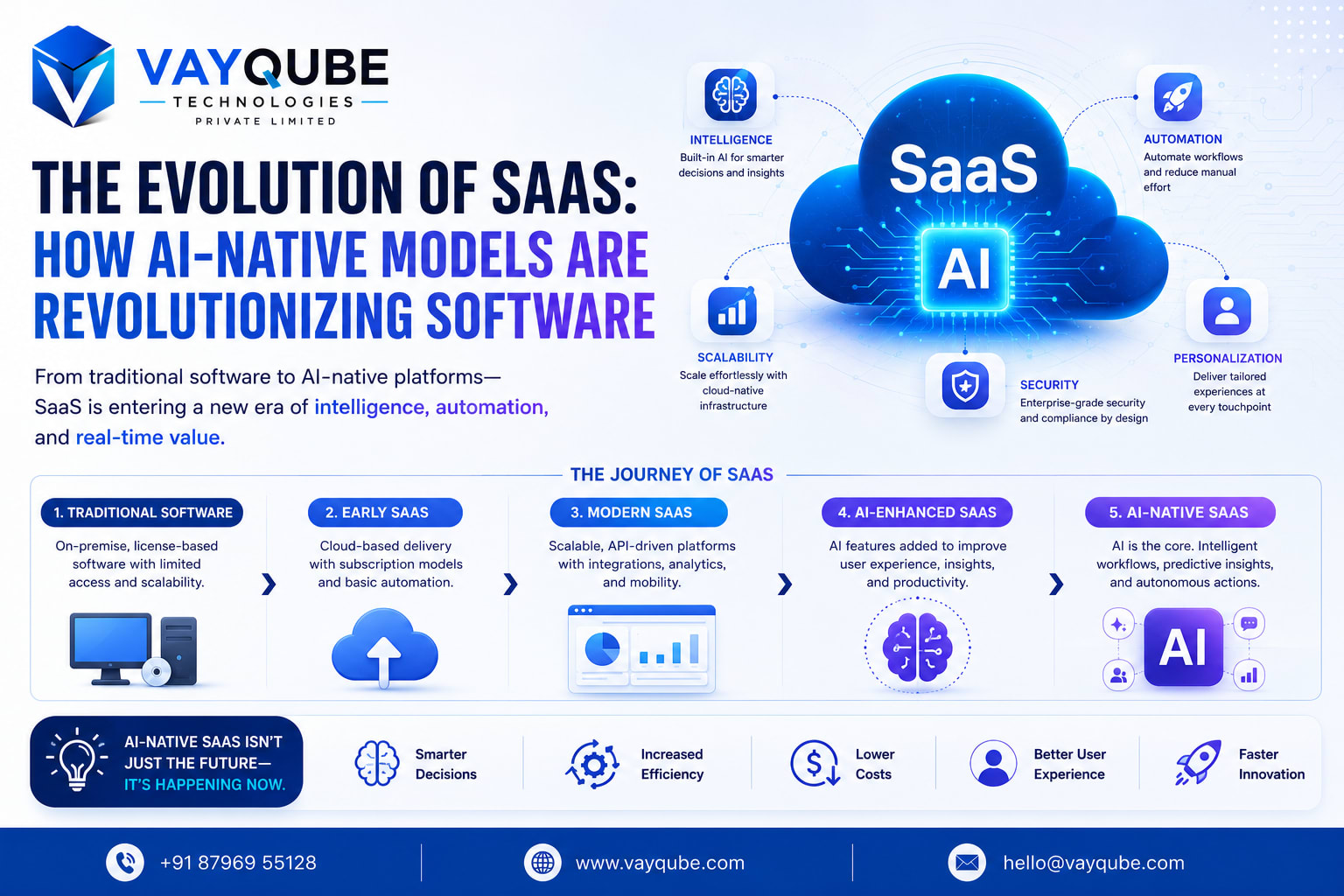
AI-Native SaaS
Software as a Service
Digital Transformation
Scalability

The Evolution of SaaS: How AI-Native Models Are Revolutionizing Software

The rise of AI-native SaaS is changing the way software is developed, deployed, and consumed. Find out what this means for your business and how to stay ahead of the curve.

V

Vayqube Team

Author

2026-06-07 13 min read
The Evolution of SaaS: How AI-Native Models Are Revolutionizing SoftwareThe Evolution of SaaS: How AI-Native Models Are Revolutionizing Software

The Evolution of SaaS: Key Drivers

The SaaS industry has undergone significant transformations since its inception, with a notable shift towards AI-native models. This evolution is driven by the need for more efficient, scalable, and intelligent software solutions.

Emergence of AI-Native Models

The emergence of AI-native models has been a key driver of this evolution. These models are designed to leverage artificial intelligence and machine learning from the ground up, enabling SaaS applications to be more intuitive, automated, and data-driven.

Impact on Software Development

The impact of AI-native models on software development is profound. They enable developers to create more sophisticated and dynamic applications, with capabilities such as predictive analytics, natural language processing, and automated decision-making. This, in turn, has led to the creation of more intelligent and responsive SaaS solutions, capable of adapting to changing user needs and preferences.

Implementation and Production Considerations

As SaaS companies adopt AI-native models, they must consider the implications for implementation and production. This includes ensuring that AI-driven applications are scalable, secure, and compliant with relevant regulations.

Real-World Examples and Use Cases

Real-world examples of AI-native SaaS applications include customer service chatbots, predictive sales analytics tools, and automated marketing platforms. These applications have the potential to revolutionize the way businesses operate, enabling them to be more agile, responsive, and customer-centric.

Business Impact and Scalability

The business impact of AI-native SaaS models is significant, with potential benefits including increased efficiency, improved customer engagement, and enhanced competitiveness. However, to realize these benefits, SaaS companies must ensure that their AI-driven applications are scalable, reliable, and aligned with their overall business strategy.

Future of SaaS and AI-Native Models

The future of SaaS will be shaped by the continued evolution of AI-native models. As these models become more advanced and ubiquitous, we can expect to see the development of even more sophisticated and intelligent SaaS applications.

Key Considerations for SaaS Companies

For SaaS companies, the key considerations will be how to harness the power of AI-native models to drive innovation, growth, and competitiveness. This will require a deep understanding of AI and machine learning, as well as the ability to integrate these technologies into their existing software development processes.

Production Readiness and Strategy

To ensure production readiness and a successful implementation strategy, SaaS companies must prioritize factors such as data quality, algorithmic transparency, and user experience. By doing so, they can unlock the full potential of AI-native models and create SaaS applications that are truly revolutionary.


Why It Matters

The integration of AI-native models in SaaS is not just a technological advancement, but a strategic move that can significantly impact a business's bottom line. By leveraging these models, companies can experience improved efficiency and productivity, leading to cost savings and increased revenue.

Enhanced Operational Efficiency

AI-native models can automate routine tasks, freeing up human resources for more complex and high-value tasks. This leads to enhanced productivity, as employees can focus on strategic initiatives rather than mundane operations. For instance, AI-powered chatbots can handle customer inquiries, allowing human customer support agents to focus on resolving complex issues.

Customer Experience Transformation

The incorporation of AI-native models enables SaaS companies to offer personalized and proactive customer experiences. By analyzing customer data and behavior, AI models can predict and address customer needs, leading to increased satisfaction and loyalty. For example, AI-driven recommendation engines can suggest relevant products or services, enhancing the overall customer experience.

Competitive Advantage

In a crowded SaaS market, companies that adopt AI-native models can gain a significant competitive advantage. By leveraging AI-driven insights and automation, businesses can respond faster to market changes, innovate more quickly, and deliver more value to customers. This can lead to increased market share, revenue growth, and long-term sustainability.

Some key benefits of AI-native models in SaaS include:

  • Improved forecasting and predictive analytics
  • Enhanced customer segmentation and targeting
  • Automated workflow optimization and streamlining
  • Real-time monitoring and anomaly detection
  • Personalized customer experiences and recommendations

As the SaaS landscape continues to evolve, companies that fail to adopt AI-native models risk being left behind. By embracing these technologies, businesses can stay ahead of the curve, drive innovation, and achieve long-term success. The implementation of AI-native models requires careful planning, strategic investment, and a deep understanding of the underlying technology and its applications.


Core Architecture

The core architecture of modern SaaS applications is undergoing a significant transformation, driven by the adoption of AI-native models. This shift is enabling businesses to build more scalable, efficient, and automated software systems.

Cloud-Based Infrastructure

At the foundation of this new architecture is a cloud-based infrastructure, which provides the necessary flexibility and scalability to support AI-driven workloads. Cloud providers such as AWS, Azure, and Google Cloud offer a range of services and tools that enable businesses to build, deploy, and manage SaaS applications with ease. Key benefits of cloud-based infrastructure include:

  • On-demand scalability
  • Reduced capital expenditures
  • Increased reliability and uptime

Microservices and Containerization

Microservices and containerization are also playing a critical role in the evolution of SaaS architecture. By breaking down monolithic applications into smaller, independent services, businesses can develop and deploy new features more quickly and efficiently. Containerization tools such as Docker and Kubernetes provide a consistent and reliable way to package, deploy, and manage microservices. This approach enables businesses to:

  • Develop and deploy new features more quickly
  • Improve application reliability and uptime
  • Reduce the complexity of software development and deployment

AI-Driven Automation and Scalability

AI-native models are being used to automate and optimize various aspects of SaaS applications, from customer support and marketing to sales and revenue forecasting. By leveraging machine learning algorithms and natural language processing, businesses can build more intelligent and automated systems that can scale to meet the needs of growing user bases. Key benefits of AI-driven automation and scalability include:

  • Improved customer engagement and support
  • Increased revenue and growth
  • Enhanced application reliability and uptime
  • Reduced operational costs and complexity

The combination of cloud-based infrastructure, microservices, and AI-driven automation is enabling businesses to build more scalable, efficient, and automated SaaS applications. As the demand for AI-native models continues to grow, we can expect to see even more innovative and disruptive solutions emerge in the SaaS market.


Business Benefits

The integration of AI-native models in SaaS applications has far-reaching implications for businesses, transforming the way they operate, make decisions, and drive growth.

Cost Optimization

One of the primary advantages of adopting AI-native SaaS models is the significant reduction in operational costs. By automating routine tasks, enhancing predictive maintenance, and optimizing resource allocation, businesses can substantially lower their expenditure. This, in turn, enables them to allocate more resources towards strategic initiatives and innovation, fostering a competitive edge in the market.

Revenue Growth

AI-native SaaS solutions also offer a pathway to increased revenue and growth. By leveraging AI-driven insights, businesses can better understand their customers' needs, preferences, and behaviors. This understanding allows for the development of more personalized and targeted marketing strategies, leading to improved customer engagement, retention, and ultimately, revenue expansion.

Data-Driven Decision Making

The use of AI-native models in SaaS enables businesses to make data-driven decisions, moving away from intuition-based strategies. AI can process vast amounts of data, identify patterns, and provide actionable insights that inform business decisions. This approach minimizes the risk of human bias and ensures that strategies are grounded in empirical evidence, leading to more effective and efficient operations.

Key benefits of AI-native SaaS models include:

  • Enhanced operational efficiency
  • Improved customer experience
  • Increased agility and adaptability
  • Better risk management
  • Scalability and flexibility

By embracing AI-native SaaS solutions, businesses can position themselves for success in a rapidly evolving digital landscape, leveraging the power of artificial intelligence to drive innovation, growth, and profitability.

Implementation Strategy

To fully realize the business benefits of AI-native SaaS models, organizations must develop a thoughtful implementation strategy. This involves assessing current infrastructure, identifying areas where AI can add the most value, and planning for the integration of AI-native solutions in a way that is seamless and minimally disruptive to existing operations.

Real-World Applications

In real-world scenarios, AI-native SaaS models are being used to revolutionize customer service, enhance product development, and streamline supply chain management. For instance, AI-powered chatbots are providing 24/7 customer support, while AI-driven analytics are helping businesses predict market trends and make informed decisions about product launches and marketing campaigns.

Production Readiness

As businesses move towards adopting AI-native SaaS solutions, it's crucial to consider production readiness. This includes ensuring that the AI models are trained on diverse and relevant data sets, that they can scale to meet the demands of the business, and that there are robust mechanisms in place for monitoring and updating the models to prevent drift and maintain accuracy over time.


Scalability

To ensure seamless growth and optimal performance, SaaS applications must be designed with scalability in mind. This involves implementing strategies that enable the system to handle increased traffic, data, and user demand without compromising performance.

Horizontal and Vertical Scaling

Scalability can be achieved through two primary approaches: horizontal and vertical scaling. Horizontal scaling involves adding more servers or instances to the existing infrastructure, allowing the system to distribute the workload and handle increased demand. Vertical scaling, on the other hand, involves increasing the power and capacity of individual servers or instances, enabling them to handle more workload without adding new resources.

Load Balancing and Autoscaling

Load balancing and autoscaling are critical components of a scalable SaaS architecture. Load balancing ensures that incoming traffic is distributed evenly across multiple servers, preventing any single server from becoming overwhelmed and reducing the risk of downtime. Autoscaling enables the system to automatically add or remove resources in response to changing demand, ensuring that the application always has the necessary capacity to perform optimally.

High Availability and Reliability

High availability and reliability are essential for SaaS applications, as downtime or performance issues can have significant consequences for businesses and users. To achieve high availability, SaaS providers can implement strategies such as:

  • Redundancy: duplicating critical components to ensure that the system remains operational even if one component fails
  • Failover: automatically switching to a backup system or server in the event of a failure
  • Disaster recovery: implementing procedures to quickly recover from disasters or major outages

By prioritizing scalability, load balancing, autoscaling, high availability, and reliability, SaaS providers can ensure that their applications are capable of handling growth and demand, while also delivering exceptional performance and user experience.

Implementation Considerations

When implementing scalable SaaS architectures, businesses must consider several key factors, including:

  • Cloud infrastructure: leveraging cloud-based services to provide on-demand scalability and flexibility
  • Containerization: using containerization technologies to simplify deployment and management
  • Monitoring and analytics: implementing robust monitoring and analytics tools to track performance and identify areas for optimization

By carefully considering these factors and implementing a well-designed scalability strategy, SaaS providers can create applications that are capable of handling rapid growth and changing demand, while also delivering exceptional performance, reliability, and user experience.


Implementation Challenges

As organizations embark on the journey to adopt AI-native SaaS models, they inevitably encounter a set of challenges that can make or break the success of the implementation. These challenges are multifaceted, touching on various aspects of the organization's operations, from technical infrastructure to human capital.

Integration with Existing Systems

One of the primary hurdles is integrating AI-native SaaS solutions with existing systems. This involves ensuring seamless communication and data exchange between new and legacy systems, which can be complex due to differences in data formats, APIs, and architectural designs. Key considerations include:

  • Assessing the compatibility of existing infrastructure with AI-native models
  • Developing or acquiring middleware solutions to facilitate integration
  • Ensuring that data privacy and security standards are upheld across all integrated systems

Data Migration and Security

Data migration and security are another set of critical challenges. AI-native models require access to vast amounts of data to learn and improve, but this data must be migrated from existing systems to the new platform securely. This process involves:

  • Evaluating the integrity and relevance of existing data sets
  • Implementing robust data migration strategies that minimize downtime and data loss
  • Enhancing security protocols to protect sensitive information from unauthorized access or breaches

Change Management and Training

Finally, the human element plays a significant role in the successful implementation of AI-native SaaS models. Change management and training are essential to ensure that employees can effectively use and benefit from the new technology. This includes:

  • Developing comprehensive training programs tailored to different user groups
  • Implementing change management processes that minimize disruption to ongoing operations
  • Fostering a culture of innovation and continuous learning to maximize the benefits of AI-native models

Effective navigation of these implementation challenges is crucial for organizations seeking to leverage AI-native SaaS models to drive innovation, efficiency, and growth. By understanding and addressing these challenges proactively, businesses can set themselves up for success in a rapidly evolving technological landscape.


Use Cases

The integration of AI-native models in SaaS applications has far-reaching implications across various business functions. As organizations continue to adopt and implement these models, several key use cases have emerged as particularly impactful.

Customer Service and Support

AI-native models are being leveraged to revolutionize customer service and support operations. By analyzing customer interactions and behavior, these models can help identify patterns and trends, enabling businesses to provide more personalized and proactive support. Some notable applications include:

  • Chatbots and virtual assistants that can handle routine inquiries and issues
  • Sentiment analysis tools that help gauge customer satisfaction and loyalty
  • Predictive analytics that enable businesses to anticipate and address potential issues before they escalate

Marketing and Sales Automation

AI-native models are also being used to automate and optimize marketing and sales processes. By analyzing customer data and behavior, these models can help businesses identify high-value targets, personalize marketing campaigns, and predict sales outcomes. Some key applications include:

  • Lead scoring and qualification tools that help identify high-potential prospects
  • Personalization engines that enable businesses to tailor marketing messages and offers
  • Predictive analytics that help forecast sales performance and identify areas for improvement

HR and Talent Management

Finally, AI-native models are being applied to HR and talent management functions, enabling businesses to optimize their workforce planning, recruitment, and development strategies. Some notable applications include:

  • Predictive analytics that help identify top performers and high-potential candidates
  • Talent management platforms that enable businesses to track employee skills and development
  • Diversity and inclusion tools that help identify and address biases in hiring and promotion practices

As businesses continue to explore and implement AI-native models, it's clear that the potential use cases are vast and varied. By leveraging these models to drive innovation and efficiency, organizations can unlock new levels of performance, productivity, and competitiveness in the market.

Implementation Considerations

When implementing AI-native models in these use cases, businesses must consider several key factors, including data quality, model transparency, and scalability. By carefully evaluating these factors and developing a strategic implementation plan, organizations can ensure that their AI-native models deliver maximum value and impact.

Real-World Examples

Several businesses have already achieved significant success with AI-native models in these use cases. For example, companies like Salesforce and Zendesk have leveraged AI-native models to drive customer service and support innovation, while businesses like HubSpot and Marketo have used these models to optimize marketing and sales automation. By studying these examples and applying the lessons learned, organizations can develop their own effective AI-native strategies and achieve similar success.


Best Practices

To successfully implement AI-native models in SaaS, it's crucial to follow best practices that ensure a smooth transition and maximize benefits.

Strategic Planning

Start with a clear strategy and roadmap that outlines the goals, objectives, and key performance indicators (KPIs) for AI adoption. This involves identifying areas where AI can bring the most value, such as automation, predictive analytics, or enhanced user experience. A well-defined strategy helps in allocating resources effectively, prioritizing initiatives, and ensuring alignment with business objectives.

User-Centric Approach

Focus on user experience and adoption by designing intuitive interfaces and providing comprehensive training to end-users. This is critical for driving user engagement, reducing resistance to change, and ensuring that the benefits of AI-native models are fully realized. Some key considerations include:

  • Simplifying complex AI-driven processes into user-friendly workflows
  • Providing real-time feedback and support mechanisms
  • Conducting regular user surveys to gather feedback and improve the overall experience

Performance Monitoring

Monitor and measure performance and ROI to assess the effectiveness of AI-native models in achieving business objectives. This involves tracking key metrics such as:

  • User adoption rates
  • Process automation efficiency
  • Predictive model accuracy
  • Revenue growth and cost savings By continuously monitoring performance, organizations can identify areas for improvement, optimize AI models, and make data-driven decisions to drive business growth.

Implementation Considerations

When implementing AI-native models, consider the following factors to ensure production readiness:

  • Data quality and availability
  • Integration with existing systems and infrastructure
  • Scalability and reliability
  • Security and compliance By carefully evaluating these factors, organizations can mitigate risks, ensure seamless integration, and maximize the benefits of AI-native models in SaaS.

Real-World Applications

In real-world scenarios, AI-native models have been successfully applied in various SaaS applications, such as:

  • Customer service platforms with AI-powered chatbots
  • Marketing automation tools with predictive analytics
  • Sales forecasting and pipeline management These applications demonstrate the potential of AI-native models to drive business impact, improve user experience, and enhance overall competitiveness in the SaaS market.

Production Readiness

To ensure production readiness, organizations should focus on:

  • Testing and validation of AI models
  • Continuous integration and deployment
  • Monitoring and maintenance of AI-driven systems By prioritizing production readiness, organizations can minimize downtime, ensure high availability, and deliver a seamless user experience, ultimately driving business success and scalability.

Frequently Asked Questions

The evolution of SaaS has led to the emergence of AI-native models, which are transforming the software industry. Here are some key questions and answers about AI-native SaaS:

What is AI-Native SaaS?

AI-native SaaS refers to software applications that are built from the ground up with artificial intelligence and machine learning capabilities. These applications are designed to leverage AI and ML to deliver more intuitive, automated, and data-driven experiences for users.

Key Differences from Traditional SaaS

AI-native SaaS differs from traditional SaaS in several ways:

  • Architecture: AI-native SaaS applications are built with AI and ML capabilities at their core, whereas traditional SaaS applications may have AI and ML capabilities added as an afterthought.
  • Functionality: AI-native SaaS applications can perform tasks such as predictive analytics, natural language processing, and automated decision-making, which are not typically found in traditional SaaS applications.
  • User Experience: AI-native SaaS applications provide a more personalized and adaptive user experience, whereas traditional SaaS applications may have a more static and rigid user interface.

Benefits and Challenges

The key benefits of AI-native SaaS include:

  • Improved Efficiency: AI-native SaaS applications can automate many tasks and processes, freeing up users to focus on higher-value activities.
  • Enhanced Decision-Making: AI-native SaaS applications can provide users with data-driven insights and recommendations, enabling them to make better decisions.
  • Personalized Experience: AI-native SaaS applications can provide a more personalized and adaptive user experience, leading to increased user engagement and satisfaction.

However, there are also challenges associated with AI-native SaaS, including:

  • Complexity: AI-native SaaS applications can be more complex and difficult to implement and maintain than traditional SaaS applications.
  • Data Quality: AI-native SaaS applications require high-quality data to function effectively, which can be a challenge for organizations with limited data management capabilities.
  • Explainability: AI-native SaaS applications can be difficult to interpret and understand, which can make it challenging to identify and address errors or biases.

Real-World Examples

AI-native SaaS applications are being used in a variety of industries, including:

  • Customer Service: AI-native SaaS applications are being used to power chatbots and virtual assistants, providing customers with 24/7 support and assistance.
  • Marketing: AI-native SaaS applications are being used to personalize marketing campaigns and improve customer engagement.
  • Finance: AI-native SaaS applications are being used to detect and prevent financial fraud, and to provide investors with data-driven insights and recommendations.

Implementation Considerations

When implementing AI-native SaaS applications, organizations should consider the following:

  • Data Management: Organizations should ensure that they have the necessary data management capabilities to support AI-native SaaS applications.
  • Integration: Organizations should consider how AI-native SaaS applications will integrate with existing systems and applications.
  • Security: Organizations should ensure that AI-native SaaS applications are secure and compliant with relevant regulations and standards.

Production Readiness

To ensure production readiness, organizations should:

  • Test Thoroughly: Organizations should thoroughly test AI-native SaaS applications to ensure that they are functioning as expected.
  • Monitor Performance: Organizations should monitor the performance of AI-native SaaS applications in real-time, to identify and address any issues that may arise.
  • Provide Ongoing Support: Organizations should provide ongoing support and maintenance for AI-native SaaS applications, to ensure that they continue to meet the evolving needs of users.

Conclusion

The evolution of SaaS has reached a pivotal point with the integration of AI-native models, transforming the software landscape.

Key Takeaways

To recap, the adoption of AI-native models in SaaS offers numerous benefits, including enhanced scalability, improved performance, and increased efficiency.

  • Enhanced decision-making capabilities through predictive analytics
  • Automated workflows and processes
  • Personalized user experiences
  • Real-time data analysis and insights

Future Outlook and Predictions

As AI technology continues to advance, we can expect even more sophisticated SaaS solutions to emerge. The future of SaaS will be shaped by the ability of businesses to harness the power of AI-native models, driving innovation and growth. Predictions include:

  • Widespread adoption of AI-powered SaaS solutions across industries
  • Increased focus on explainable AI and transparency
  • Greater emphasis on human-AI collaboration

Call to Action

For businesses and organizations looking to stay ahead of the curve, it's essential to start exploring the potential of AI-native models in SaaS. This involves:

  • Assessing current infrastructure and identifying areas for improvement
  • Developing a strategic roadmap for AI adoption
  • Investing in employee training and upskilling to ensure successful implementation
  • Fostering a culture of innovation and experimentation

By taking proactive steps to leverage AI-native models, businesses can unlock new opportunities, drive growth, and stay competitive in a rapidly evolving market. The time to act is now, and those who do will be well-positioned to reap the rewards of this SaaS revolution.

Real-World Applications

The implications of AI-native models in SaaS are far-reaching, with potential applications in:

  • Customer service and support
  • Sales and marketing automation
  • Financial analysis and planning
  • Healthcare and medical research

As the SaaS landscape continues to evolve, one thing is clear: AI-native models are here to stay, and businesses must adapt to thrive. By embracing this technology, organizations can unlock new levels of efficiency, innovation, and growth, setting themselves up for success in an increasingly competitive market.

Production Readiness

To ensure production readiness, businesses must prioritize:

  • Scalability and reliability
  • Security and compliance
  • Performance monitoring and optimization
  • Continuous testing and iteration

By focusing on these key areas, organizations can ensure a seamless transition to AI-native SaaS solutions, minimizing downtime and maximizing ROI. The future of SaaS is exciting, and with the right strategy and implementation, businesses can harness the power of AI-native models to drive success.


Related Vayqube Resources


Next Step

If your systems are struggling with scalability, automation, architecture complexity, or operational efficiency, it's time to modernize your infrastructure and workflows.

👉 Talk to a Vayqube solution architect and build systems designed for long-term production growth:

Contact Vayqube Technologies

Ready to build something powerful?

Book a free 30-minute strategy call.