
The AI Project Paradox: Why Most Initiatives Fail to Reach Production
Despite significant investments, many AI projects never make it to production. Explore the common pitfalls and expert advice on how to overcome them.
Vayqube Team
Software architecture and product engineering
Understanding the Paradox
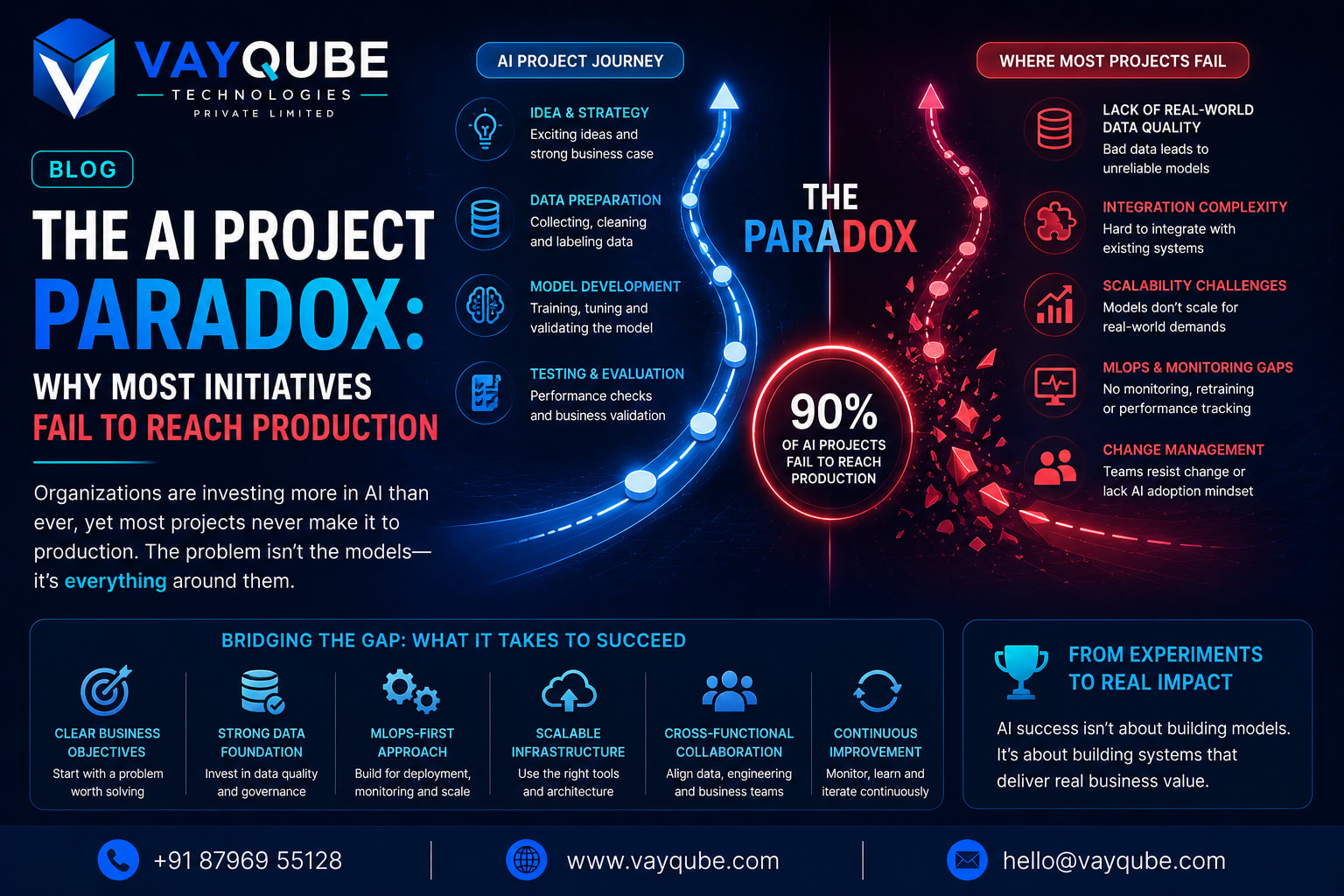
The AI project paradox refers to the disconnect between the initial enthusiasm and investment in artificial intelligence initiatives and the eventual failure to deploy these projects into production. This paradox is prevalent in many organizations, where AI projects often start with high expectations but ultimately stall or fail to deliver tangible business value.
Prevalence of Failed Initiatives
Studies have shown that a significant majority of AI projects fail to reach production, with some estimates suggesting that up to 80% of AI initiatives are abandoned or stalled. This is a staggering statistic, especially considering the significant resources and investments that organizations pour into these projects. The reasons for this failure are complex and multifaceted, but they often boil down to a combination of technical, operational, and strategic challenges.
Importance of Understanding the Paradox
Understanding the AI project paradox is crucial for organizations that want to unlock the true potential of artificial intelligence. By recognizing the common pitfalls and challenges that lead to failed AI initiatives, organizations can develop more effective strategies for implementing and deploying AI solutions. This requires a deep understanding of the technical, operational, and strategic factors that contribute to the paradox, as well as a willingness to adapt and evolve in response to changing circumstances.
Key Factors Contributing to the Paradox
Some of the key factors that contribute to the AI project paradox include:
- Lack of clear business objectives and outcomes
- Insufficient data quality and availability
- Inadequate technical infrastructure and resources
- Poor change management and stakeholder engagement
- Inability to scale and deploy AI models into production
Real-World Implications
The AI project paradox has significant implications for organizations that are seeking to leverage artificial intelligence to drive business value. By failing to deploy AI projects into production, organizations are missing out on opportunities to improve efficiency, reduce costs, and drive innovation. Furthermore, the paradox can also lead to wasted resources, damaged reputations, and decreased confidence in the ability of AI to deliver business value.
Moving Forward
To overcome the AI project paradox, organizations need to take a more nuanced and multi-faceted approach to AI implementation. This requires a deep understanding of the technical, operational, and strategic factors that contribute to the paradox, as well as a willingness to adapt and evolve in response to changing circumstances. By developing more effective strategies for implementing and deploying AI solutions, organizations can unlock the true potential of artificial intelligence and drive tangible business value.
Why It Matters
The consequences of failed AI projects can be severe, with far-reaching impacts on a company's reputation and revenue. When AI initiatives fail to reach production, it not only results in wasted resources but also erodes stakeholder confidence in the organization's ability to innovate and adapt to changing market conditions.
Consequences of Failure
Failed AI projects can lead to:
- Missed business opportunities and lost revenue
- Damage to the company's reputation and brand
- Decreased investor confidence and reduced funding
- Inefficient allocation of resources, resulting in wasted time and money
- Demotivated teams and decreased morale among employees
Impact on Business Reputation and Revenue
The failure of AI projects can have a significant impact on a company's reputation, making it challenging to attract new customers, partners, and top talent. Moreover, the financial consequences of failed AI initiatives can be substantial, with the average cost of an AI project ranging from hundreds of thousands to millions of dollars. When these projects fail to deliver, the return on investment (ROI) is zero, resulting in a significant loss of revenue and a decrease in competitiveness.
Need for a Strategic Approach
To avoid the pitfalls of failed AI projects, organizations need to adopt a strategic approach to AI implementation. This involves:
- Defining clear business objectives and outcomes
- Conducting thorough feasibility studies and risk assessments
- Developing a robust implementation roadmap and timeline
- Ensuring adequate resource allocation and budgeting
- Establishing a culture of innovation and experimentation, with a focus on continuous learning and improvement
By taking a strategic approach to AI implementation, organizations can minimize the risks associated with AI projects and increase the likelihood of successful outcomes. This requires a deep understanding of the business, the market, and the technology, as well as a willingness to invest in the necessary resources and expertise.
Core Architecture
To overcome the AI project paradox, it's essential to focus on building a robust core architecture. This foundation is critical in supporting the entire AI project lifecycle, from development to production.
Key Components
A successful AI project consists of several key components, including:
- Data ingestion and processing pipelines
- Model training and validation frameworks
- Deployment and serving infrastructure
- Monitoring and feedback mechanisms These components must work in harmony to ensure the AI system functions as intended and delivers business value.
Data Quality and Infrastructure
Data quality and infrastructure play a vital role in the success of an AI project. High-quality data is essential for training accurate models, while a robust infrastructure ensures that data is properly processed, stored, and retrieved. Investing in data quality and infrastructure can help mitigate common issues such as data silos, inconsistent formatting, and inadequate storage.
Scalable and Flexible Architecture
A scalable and flexible architecture is crucial for supporting the growth and evolution of an AI project. This type of architecture allows for:
- Easy integration of new data sources and models
- Seamless scaling to meet changing demand
- Rapid adaptation to emerging trends and technologies By prioritizing scalability and flexibility, organizations can future-proof their AI projects and ensure they remain relevant and effective over time.
Implementation Considerations
When designing and implementing a core architecture for an AI project, several factors must be considered, including:
- Production readiness and deployment strategies
- Model interpretability and explainability
- Data security and governance
- Collaboration and communication between stakeholders By carefully evaluating these factors, organizations can create a robust and effective core architecture that supports the success of their AI projects.
Real-World Examples
Many organizations have successfully implemented AI projects by focusing on core architecture and key components. For instance, a leading retail company developed an AI-powered recommendation engine that increased sales by 15%. The company's success can be attributed to its investment in data quality, scalable infrastructure, and a flexible architecture that allowed for easy integration of new models and data sources.
Production Readiness
To ensure production readiness, organizations must prioritize testing, validation, and deployment strategies. This includes:
- Developing automated testing frameworks
- Conducting thorough model validation and evaluation
- Implementing robust deployment and serving infrastructure By prioritizing production readiness, organizations can ensure their AI projects are reliable, efficient, and deliver business value.
Business Benefits
The successful implementation of AI can bring numerous benefits to an organization, making it a crucial investment for businesses looking to stay ahead of the curve.
Enhanced Decision-Making and Efficiency
One of the primary advantages of AI is its ability to analyze vast amounts of data, identify patterns, and provide insights that can inform decision-making. This can lead to increased efficiency, as automated processes can reduce manual errors and free up staff to focus on higher-value tasks. For instance, AI-powered predictive maintenance can help companies anticipate equipment failures, reducing downtime and increasing overall productivity.
Some key benefits of enhanced decision-making and efficiency include:
- Improved forecasting and planning
- Enhanced customer experience through personalized recommendations
- Streamlined operations and reduced costs
Competitive Advantage and Innovation
AI can also be a key driver of innovation, enabling companies to develop new products, services, and business models that can disrupt markets and create new opportunities. By leveraging AI, businesses can gain a competitive advantage, staying ahead of rivals and attracting new customers. For example, companies like Netflix and Amazon have used AI to create personalized recommendation engines, driving customer engagement and loyalty.
Some examples of AI-driven innovation include:
- Developing new products and services, such as chatbots and virtual assistants
- Creating new business models, such as subscription-based services and freemium models
- Enhancing customer experience through AI-powered customer service and support
By understanding the potential benefits of AI implementation, businesses can better navigate the challenges and complexities of deploying AI in production, and create a roadmap for success that drives real-world impact and value.
Real-World Examples
Real-world examples of successful AI implementation can be seen in companies like Google, Microsoft, and Salesforce, which have leveraged AI to drive innovation and growth. These companies have developed AI-powered products and services that have disrupted markets and created new opportunities, demonstrating the potential of AI to drive business success.
Some key takeaways from these examples include:
- The importance of a clear AI strategy and roadmap
- The need for a strong data foundation and infrastructure
- The role of AI in driving innovation and growth
By learning from these examples and understanding the potential benefits of AI, businesses can create a strong foundation for AI implementation and drive real-world impact and value.
Production Considerations
When implementing AI in production, businesses must consider a range of factors, including data quality, model accuracy, and scalability. This requires a deep understanding of the technical and operational requirements of AI, as well as the ability to integrate AI with existing systems and processes. By carefully considering these factors, businesses can ensure that their AI implementations are successful and drive real-world impact and value.
Some key production considerations include:
- Ensuring data quality and integrity
- Monitoring and maintaining model accuracy and performance
- Scaling AI implementations to meet growing demand and requirements
By understanding these production considerations, businesses can create a robust and scalable AI implementation that drives real-world impact and value, and helps to achieve their business goals and objectives.
Scalability
Scalability is a critical aspect of AI projects, as it determines their ability to handle increased traffic, data, and complexity. However, many AI initiatives struggle to scale, leading to bottlenecks, inefficiencies, and ultimately, failure to reach production.
Challenges of Scaling AI Projects
The challenges of scaling AI projects are multifaceted. Some of the key issues include:
- Data volume and velocity: As AI models process larger amounts of data, they require more computational resources, storage, and network bandwidth.
- Model complexity: Increasingly complex models require more powerful hardware, specialized software, and expertise to manage and optimize.
- Integration with existing infrastructure: AI projects often need to integrate with legacy systems, which can be difficult to scale and may require significant modifications.
Importance of Flexible and Adaptable Architecture
To overcome these challenges, it's essential to design a flexible and adaptable architecture that can evolve with the project's needs. This includes:
- Modular design: Breaking down the architecture into smaller, independent components that can be easily scaled, updated, or replaced.
- Cloud-based infrastructure: Leveraging cloud-based services that offer scalability, on-demand resources, and reduced maintenance costs.
- Microservices architecture: Using a microservices approach to develop and deploy AI models, allowing for greater flexibility, scalability, and fault tolerance.
Strategies for Ensuring Scalability
To ensure scalability, AI project teams should consider the following strategies:
- Horizontal scaling: Adding more resources, such as servers or containers, to handle increased traffic or data.
- Vertical scaling: Increasing the power of individual resources, such as upgrading to more powerful hardware or optimizing software configurations.
- Auto-scaling: Implementing automated scaling mechanisms that adjust resources based on demand, ensuring optimal performance and cost efficiency.
- Monitoring and feedback: Continuously monitoring the project's performance, gathering feedback, and making data-driven decisions to optimize and improve scalability.
By adopting these strategies and designing a flexible architecture, AI project teams can overcome the challenges of scalability and increase their chances of successfully deploying AI models in production.
Implementation Challenges
Implementing AI projects can be a complex and daunting task, with several obstacles that can hinder success. Two of the most significant challenges that organizations face are data quality and availability issues, and talent acquisition and retention challenges.
Data Quality and Availability
Data is the lifeblood of any AI project, and poor data quality or availability can be a major roadblock to success. Some common data-related challenges include:
- Inconsistent or incomplete data
- Poor data governance and management
- Insufficient data storage and processing capabilities
- Difficulty in integrating data from multiple sources
These challenges can lead to biased or inaccurate models, which can have serious consequences in production environments. For example, a model that is trained on incomplete or inaccurate data may not generalize well to new, unseen data, leading to poor performance and potentially even safety issues.
Talent Acquisition and Retention
Another significant challenge that organizations face is acquiring and retaining the talent needed to implement and maintain AI projects. Some common talent-related challenges include:
- Difficulty in finding and hiring skilled data scientists and engineers
- High turnover rates among AI talent, leading to loss of knowledge and expertise
- Insufficient training and development opportunities for existing staff
- Difficulty in integrating AI talent into existing organizational structures and processes
These challenges can lead to delays, cost overruns, and poor project outcomes, as well as a lack of institutional knowledge and expertise. For example, a company that loses a key data scientist may struggle to maintain and update their AI models, leading to a decline in performance and competitiveness.
To overcome these challenges, organizations need to develop a comprehensive implementation strategy that addresses data quality and availability, as well as talent acquisition and retention. This may involve investing in data governance and management, developing training and development programs for staff, and creating a culture that attracts and retains top AI talent.
Use Cases
Successful AI implementation can be seen in various industries, with real-world examples showcasing the potential of AI to drive business impact.
Industry-Specific Applications
Some notable examples include:
- Healthcare: AI-powered diagnosis and patient outcome prediction, such as IBM's Watson for Oncology, which helps doctors identify the most effective cancer treatments.
- Finance: AI-driven risk management and portfolio optimization, such as BlackRock's Aladdin platform, which uses AI to analyze and manage investment portfolios.
- Retail: AI-powered customer service chatbots and personalized product recommendations, such as Amazon's Alexa, which uses AI to provide personalized shopping experiences.
Lessons Learned
From these successful projects, several key lessons can be learned:
- Start small: Begin with a specific, well-defined problem and scale up gradually.
- Collaborate with stakeholders: Ensure that all relevant teams and stakeholders are involved in the AI project to guarantee alignment and effective implementation.
- Monitor and evaluate: Continuously monitor the AI system's performance and evaluate its impact on the business to identify areas for improvement.
Real-World Examples
For instance, a leading insurance company used AI to automate its claims processing system, resulting in a 30% reduction in processing time and a 25% decrease in costs. Similarly, a major retailer implemented an AI-powered supply chain management system, which led to a 15% reduction in inventory costs and a 10% increase in supply chain efficiency.
Implementation Strategy
To achieve successful AI implementation, it's essential to develop a clear implementation strategy that takes into account the specific needs and goals of the organization. This includes:
- Defining project scope and objectives: Clearly outline the project's goals, timelines, and deliverables.
- Assembling a skilled team: Ensure that the project team has the necessary skills and expertise to design, develop, and deploy the AI system.
- Selecting appropriate technologies: Choose the most suitable AI technologies and tools for the project, considering factors such as scalability, security, and integration with existing systems.
Production Readiness
To ensure production readiness, it's crucial to consider factors such as:
- Scalability: Design the AI system to handle increasing volumes of data and traffic.
- Security: Implement robust security measures to protect sensitive data and prevent potential threats.
- Maintenance: Develop a maintenance plan to ensure the AI system remains up-to-date and continues to perform optimally over time.
Best Practices
To overcome the AI project paradox, organizations must adopt strategic best practices that address common challenges and ensure successful implementation.
Overcoming Common Challenges
Strategies for overcoming common challenges include:
- Identifying and addressing data quality issues
- Developing a robust testing and validation framework
- Implementing a continuous integration and deployment pipeline
- Fostering collaboration between data scientists, engineers, and business stakeholders
- Establishing clear goals, metrics, and evaluation criteria
Continuous Monitoring and Evaluation
Continuous monitoring and evaluation are crucial to ensuring the long-term success of AI projects. This involves:
- Tracking key performance indicators (KPIs) and metrics
- Conducting regular model audits and updates
- Gathering feedback from stakeholders and end-users
- Refining and adjusting the AI system as needed
Change Management and Stakeholder Engagement
Effective change management and stakeholder engagement are essential for driving adoption and ensuring the AI project meets business objectives. This includes:
- Developing a comprehensive change management plan
- Communicating the benefits and value of the AI project to stakeholders
- Engaging with stakeholders throughout the project lifecycle
- Addressing concerns and feedback in a timely and transparent manner
By adopting these best practices, organizations can increase the likelihood of successful AI project implementation and achieve tangible business benefits.
Implementation Considerations
When implementing AI projects, organizations must consider the production readiness of the solution. This involves:
- Ensuring scalability and reliability
- Developing a robust security framework
- Establishing data governance and compliance protocols
- Providing ongoing support and maintenance
By prioritizing these considerations, organizations can ensure their AI projects are well-positioned for long-term success and can drive meaningful business impact.
Real-World Examples
Real-world examples of successful AI project implementation can provide valuable insights and lessons learned. For instance:
- A leading retail company implemented an AI-powered recommendation engine, resulting in a significant increase in sales and customer engagement
- A major healthcare organization developed an AI-driven predictive analytics platform, enabling earlier disease detection and improved patient outcomes
- A financial services firm implemented an AI-based risk management system, reducing risk exposure and improving regulatory compliance
These examples demonstrate the potential of AI to drive business value and improve outcomes, and highlight the importance of adopting best practices and considering production readiness.
Frequently Asked Questions
To address common concerns and misconceptions surrounding AI project implementation, we will delve into the most frequently asked questions. This section aims to provide clarity on the implementation process and offer guidance on getting started with AI initiatives.
Common Misconceptions
Some of the most common misconceptions about AI projects include:
- Overestimating the complexity of AI implementation
- Underestimating the resources required for successful deployment
- Believing that AI projects are a one-time effort, rather than an ongoing process
- Assuming that AI will completely replace human decision-making
Addressing Concerns
Addressing these concerns is crucial to the success of AI projects. By understanding the true nature of AI implementation, businesses can better prepare themselves for the challenges and opportunities that come with it. This includes:
- Developing a clear understanding of the business problems that AI can solve
- Establishing a strong foundation in data quality and management
- Building a skilled team with expertise in AI and machine learning
- Fostering a culture of innovation and experimentation
Getting Started with AI Initiatives
For businesses looking to get started with AI initiatives, the first step is to identify areas where AI can have the most impact. This may include:
- Automating repetitive tasks and processes
- Enhancing customer experience through personalized recommendations
- Improving predictive maintenance and quality control
- Optimizing supply chain management and logistics
Implementation Guidance
When implementing AI projects, it's essential to consider the following factors:
- Data quality and availability
- Model interpretability and explainability
- Integration with existing systems and infrastructure
- Ongoing monitoring and maintenance
Real-World Examples
Real-world examples of successful AI implementation can provide valuable insights and lessons learned. For instance:
- A retail company using AI-powered chatbots to improve customer service
- A manufacturing company using predictive maintenance to reduce downtime and increase productivity
- A financial institution using AI-driven risk assessment to improve lending decisions
Production Considerations
When moving AI projects to production, businesses must consider factors such as:
- Scalability and performance
- Security and compliance
- Integration with existing workflows and processes
- Ongoing monitoring and evaluation
By addressing common concerns and misconceptions, providing clarity on AI project implementation, and offering guidance on getting started with AI initiatives, businesses can set themselves up for success and avoid the pitfalls that often lead to failed AI projects.
Conclusion
The AI project paradox is a pervasive issue that affects many organizations, resulting in a significant gap between the promise of AI and its actual implementation in production environments. To overcome this paradox, it's essential to recap the key takeaways from our discussion.
Key Takeaways
- AI projects often fail to reach production due to inadequate planning, insufficient data quality, and lack of scalability.
- A well-designed core architecture is crucial for successful AI implementation, considering factors such as data ingestion, processing, and model deployment.
- Businesses must prioritize scalability, implementation, and production readiness to ensure their AI initiatives yield tangible benefits.
- Real-world use cases and best practices can provide valuable insights into overcoming common challenges and achieving production-ready AI solutions.
Overcoming the Paradox
To overcome the AI project paradox, businesses must reassess their AI strategies and prioritize a production-ready approach. This involves:
- Focusing on scalable and flexible architecture designs
- Ensuring high-quality data and robust data management practices
- Implementing continuous monitoring and testing to guarantee model performance and reliability
- Encouraging collaboration between data scientists, engineers, and business stakeholders to ensure alignment and effective communication
Call to Action
As businesses continue to invest in AI, it's crucial to recognize the importance of production readiness and scalability. By acknowledging the AI project paradox and taking proactive steps to address it, organizations can unlock the true potential of AI and drive meaningful business impact. We encourage businesses to reassess their AI strategies, prioritize production readiness, and explore new approaches to overcome the challenges that have held them back in the past. By doing so, they can ensure their AI initiatives yield tangible benefits and drive long-term success.
Final Thoughts
The AI project paradox is a complex issue, but by understanding its root causes and prioritizing production readiness, businesses can overcome the challenges that have hindered their AI initiatives. By focusing on scalable architecture, high-quality data, and collaboration, organizations can ensure their AI projects reach production and drive meaningful business impact. As the AI landscape continues to evolve, it's essential for businesses to stay ahead of the curve and prioritize production-ready AI solutions that can drive long-term success and competitiveness.
Related Vayqube Resources
- Why Most Ai Projects Fail Before Production
- Best Software Development Company In Singapore City
- Best Fintech Software Development Company In Singapore City
- Healthcare Software Development Company Singapore City
- Logistics Software Development Company Singapore City
- Best Software Development Company In Usa
Next Step
If your systems are struggling with scalability, automation, architecture complexity, or operational efficiency, it's time to modernize your infrastructure and workflows.
👉 Talk to a Vayqube solution architect and build systems designed for long-term production growth: