
AI Workflow Automation for SaaS Success
AI workflow automation for SaaS can revolutionize your business by increasing efficiency and reducing manual errors. By implementing AI-powered automation, you can focus on high-value tasks and drive growth.
Vayqube Team
Software architecture and product engineering
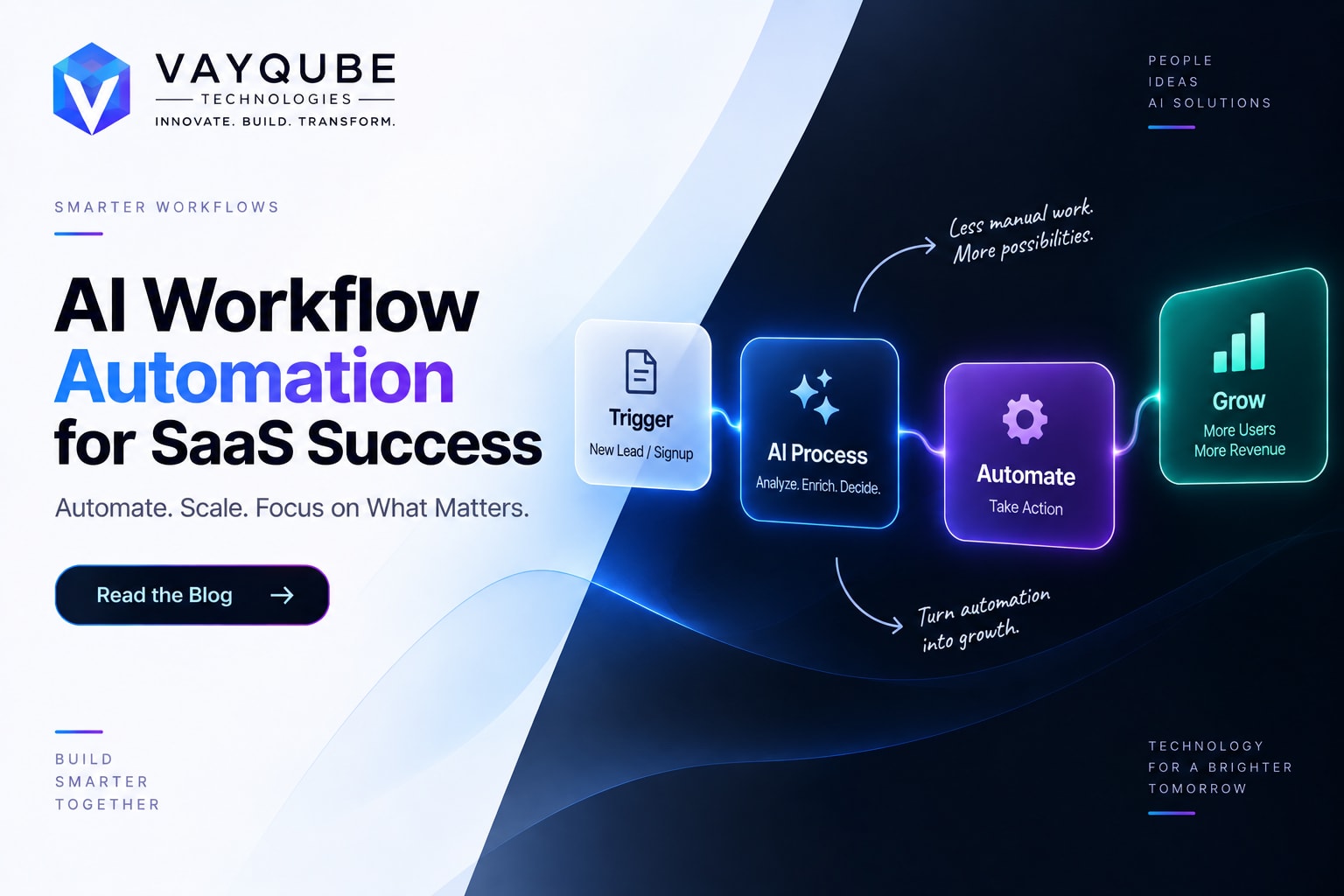
Introduction to AI Workflow Automation
AI workflow automation is a crucial component in the success of modern SaaS companies. It involves the use of artificial intelligence and machine learning to automate repetitive, mundane tasks, freeing up human resources to focus on higher-value activities. This technology has the potential to revolutionize the way SaaS businesses operate, making them more efficient, scalable, and competitive.
Overview of AI Workflow Automation
At its core, AI workflow automation is about streamlining business processes by identifying areas where tasks can be automated, and then implementing AI-powered solutions to handle these tasks. This can range from automating customer support queries, to streamlining data entry and processing, to enhancing the overall customer experience through personalized interactions. The key is to leverage AI in a way that complements human capabilities, rather than replacing them.
Importance in SaaS
The importance of AI workflow automation in SaaS cannot be overstated. SaaS companies operate in a highly competitive and fast-paced environment, where the ability to innovate, adapt, and scale quickly is paramount. AI workflow automation offers a way for these companies to achieve these goals by:
- Enhancing operational efficiency
- Improving customer satisfaction through faster response times and personalized service
- Reducing operational costs by minimizing the need for manual intervention in repetitive tasks
- Facilitating data-driven decision making by providing real-time insights into business operations
By embracing AI workflow automation, SaaS companies can position themselves for long-term success, differentiate themselves from competitors, and build a strong foundation for sustainable growth and innovation. The integration of AI into workflow automation is not just a trend, but a strategic imperative for businesses aiming to lead in the digital age.
Why It Matters
AI workflow automation is crucial for SaaS success, and its impact is multifaceted. By streamlining processes and minimizing manual intervention, businesses can achieve significant benefits.
Key Benefits
The advantages of AI workflow automation can be seen in several areas, including:
- Increased efficiency: Automating repetitive and mundane tasks frees up resources, allowing teams to focus on high-value activities that drive growth and innovation.
- Enhanced customer experience: By ensuring timely and accurate responses to customer inquiries, businesses can build trust and loyalty, leading to increased retention and advocacy.
- Competitive advantage: Organizations that adopt AI workflow automation can respond more quickly to changing market conditions, stay ahead of the competition, and capitalize on new opportunities.
Real-World Impact
In real-world scenarios, AI workflow automation can have a profound impact on business operations. For instance, a SaaS company can use automation to streamline its customer onboarding process, reducing the time it takes for new customers to get up and running with the product. This, in turn, can lead to increased customer satisfaction, reduced churn, and improved revenue growth.
Implementation Considerations
When implementing AI workflow automation, businesses should consider several factors, including the complexity of their workflows, the availability of data, and the need for integration with existing systems. By carefully evaluating these factors and selecting the right automation tools, organizations can ensure a smooth and successful implementation that drives meaningful business outcomes.
Production Readiness
To ensure production readiness, businesses should focus on developing a robust and scalable automation framework that can handle large volumes of data and transactions. This involves careful planning, testing, and validation to guarantee that automated workflows perform as expected, without introducing errors or bottlenecks that can impact customer experience or business operations.
Core Architecture
The core architecture of AI-powered workflow automation tools is designed to streamline and optimize business processes. These tools utilize artificial intelligence and machine learning algorithms to automate repetitive and mundane tasks, freeing up resources for more strategic and creative work.
Key Components
Some key components of AI-powered workflow automation tools include:
- Automated task assignment and management
- Real-time monitoring and analytics
- Integration with existing systems and tools
- Scalable design to accommodate growing business needs
A well-designed core architecture should be able to integrate seamlessly with existing systems, such as CRM, ERP, and marketing automation platforms. This integration enables the automation tool to access and leverage data from these systems, making it possible to automate complex workflows and business processes.
Integration with Existing Systems
Effective integration with existing systems is critical to the success of AI-powered workflow automation tools. This integration can be achieved through APIs, webhooks, or other integration methods, depending on the specific requirements of the business. By integrating with existing systems, businesses can unlock the full potential of their automation tools and achieve greater efficiency, productivity, and scalability.
Scalable Design
A scalable design is essential for AI-powered workflow automation tools, as it enables businesses to grow and evolve without being constrained by their automation systems. A scalable design should be able to handle increasing volumes of data, users, and automation tasks, without compromising performance or reliability. This can be achieved through cloud-based infrastructure, distributed architectures, and other scalable technologies.
By incorporating AI-powered workflow automation tools with a strong core architecture, businesses can achieve significant improvements in efficiency, productivity, and scalability. These tools can help businesses to automate complex workflows, optimize business processes, and make data-driven decisions, ultimately driving business success and competitiveness.
Some real-world examples of AI-powered workflow automation tools include:
- Automated customer onboarding processes
- AI-driven lead qualification and routing
- Automated accounting and invoicing processes
- AI-powered employee onboarding and training programs
These examples demonstrate the potential of AI-powered workflow automation tools to transform business processes and drive success in various industries and domains.
Business Benefits
The integration of AI workflow automation in SaaS solutions offers numerous benefits that can significantly impact a business's bottom line.
Cost Savings
One of the primary advantages of AI workflow automation is the potential for substantial cost savings. By automating repetitive and mundane tasks, businesses can reduce the need for manual labor, thereby decreasing labor costs. Additionally, automation can help minimize errors, which can lead to costly rework and delays. For instance, automated workflows can streamline invoice processing, reducing the time and resources required to manage accounts payable.
Improved Productivity
AI workflow automation can also greatly improve productivity within an organization. By freeing employees from tedious tasks, businesses can redirect resources towards more strategic and creative endeavors. This can lead to increased innovation, better customer engagement, and enhanced competitiveness in the market. For example, marketing teams can leverage automation to personalize customer interactions, allowing them to focus on developing targeted campaigns that drive real results.
Data-Driven Decision Making
Furthermore, AI workflow automation provides businesses with real-time insights and data, enabling more informed decision-making. Automated workflows can collect and analyze large datasets, identifying trends and patterns that may not be apparent through manual analysis. This data can then be used to optimize business processes, predict customer behavior, and identify new opportunities for growth. For instance, automated workflows can analyze customer feedback, allowing businesses to pinpoint areas for improvement and make data-driven decisions to enhance the customer experience.
Key benefits of AI workflow automation include:
- Reduced labor costs through automation of repetitive tasks
- Increased productivity by redirecting resources towards strategic endeavors
- Enhanced decision-making capabilities through real-time data insights
- Improved customer engagement and personalization
- Increased competitiveness in the market through innovation and efficiency gains
By leveraging AI workflow automation, SaaS businesses can unlock these benefits and drive significant improvements in their operations, customer satisfaction, and ultimately, their bottom line.
Scalability
To achieve SaaS success, it's crucial to ensure that AI workflow automation systems can handle increased workflow volumes and adapt to changing business needs. This involves designing a scalable architecture that can efficiently process large volumes of data and transactions.
Handling Increased Workflow Volumes
As the volume of workflows increases, the system must be able to handle the additional load without compromising performance. This can be achieved by:
- Implementing load balancing and autoscaling mechanisms to distribute the workload across multiple servers
- Optimizing database queries and indexing to improve data retrieval and processing efficiency
- Utilizing cloud-based infrastructure to leverage on-demand computing resources and reduce costs
Adapting to Changing Business Needs
Business needs can change rapidly, and the AI workflow automation system must be able to adapt to these changes quickly. This can be achieved by:
- Implementing a modular architecture that allows for easy integration of new workflows and processes
- Utilizing low-code or no-code development tools to enable business users to create and modify workflows without requiring extensive technical expertise
- Establishing a continuous monitoring and feedback loop to identify areas for improvement and optimize workflows accordingly
Ensuring System Reliability
System reliability is critical to ensuring that workflows are executed correctly and consistently. This can be achieved by:
- Implementing robust error handling and logging mechanisms to identify and resolve issues quickly
- Conducting regular system maintenance and updates to ensure that the system remains secure and performant
- Utilizing redundancy and failover mechanisms to minimize downtime and ensure business continuity
By focusing on scalability, adaptability, and reliability, organizations can ensure that their AI workflow automation systems are well-equipped to handle the demands of a rapidly changing business environment. This, in turn, can help to drive SaaS success by improving efficiency, reducing costs, and enhancing customer satisfaction.
Implementation Challenges
Implementing AI workflow automation in SaaS environments can be complex and fraught with challenges. Several key issues can hinder the success of such implementations, including data quality issues, system integration complexities, and change management.
Data Quality Issues
Data quality is a critical factor in AI workflow automation. If the data used to train and operate the AI models is inaccurate, incomplete, or inconsistent, the automation workflows will not function as intended. This can lead to incorrect decisions, inefficient processes, and ultimately, a failed implementation. Common data quality issues include:
- Inconsistent data formatting
- Missing or duplicate data
- Outdated or stale data
- Biased data
System Integration Complexities
AI workflow automation often requires integrating with multiple systems, including CRM, ERP, and other SaaS applications. This can be a complex and time-consuming process, especially when dealing with legacy systems or systems with proprietary APIs. Some common system integration challenges include:
- API compatibility issues
- Data mapping and transformation complexities
- Authentication and authorization challenges
- Ensuring data consistency across systems
Change Management
Implementing AI workflow automation can also require significant changes to business processes and employee workflows. This can be a challenging aspect of implementation, as it requires careful planning, communication, and training to ensure a smooth transition. Some key change management considerations include:
- Developing a comprehensive change management plan
- Communicating the benefits and value of AI workflow automation to stakeholders
- Providing training and support to employees affected by the changes
- Monitoring and addressing any resistance to change
Effective management of these implementation challenges is crucial to the success of AI workflow automation in SaaS environments. By understanding and addressing these challenges, organizations can ensure a smoother implementation process and maximize the benefits of AI workflow automation.
Use Cases
AI workflow automation can be applied to various areas of a SaaS business to drive efficiency and growth. Here are some key use cases:
Automating Customer Onboarding
Automating customer onboarding is a crucial use case for AI workflow automation in SaaS. By leveraging AI, businesses can streamline the onboarding process, reducing the time it takes for new customers to get started with the product. This can include automated email workflows, personalized tutorials, and dynamic feedback mechanisms. For instance, a SaaS company can use AI to automatically assign a dedicated onboarding specialist to new customers, ensuring they receive timely and relevant support.
Streamlining Invoice Processing
Invoice processing is another area where AI workflow automation can bring significant benefits. By automating tasks such as invoice generation, payment tracking, and follow-up notifications, businesses can reduce manual errors, increase processing speed, and improve cash flow. For example, an AI-powered system can automatically generate invoices based on usage data, send reminders to customers, and update payment records in real-time.
Enhancing Customer Support
AI workflow automation can also be used to enhance customer support by automating routine tasks, such as responding to common queries, routing complex issues to human support agents, and providing personalized solutions. This can include using natural language processing (NLP) to analyze customer feedback, identify patterns, and improve support processes. By automating these tasks, businesses can free up human support agents to focus on more complex and high-value issues, leading to improved customer satisfaction and loyalty.
Some of the benefits of these use cases include:
- Improved customer experience
- Increased operational efficiency
- Enhanced scalability
- Better decision-making through data-driven insights
- Reduced manual errors and costs
These use cases demonstrate the potential of AI workflow automation to transform various aspects of a SaaS business, from customer onboarding to support and invoicing. By implementing AI-powered automation, businesses can unlock new levels of efficiency, scalability, and growth.
Best Practices
To achieve successful AI workflow automation, it's essential to follow a set of best practices. These guidelines will help ensure that your automation efforts are effective, efficient, and aligned with your business goals.
Clear Strategy
Starting with a clear strategy is crucial. This involves defining what workflows to automate, identifying the key performance indicators (KPIs) to measure, and establishing a roadmap for implementation. A well-defined strategy will help you focus on the most critical workflows and ensure that your automation efforts are aligned with your business objectives.
Some key considerations when developing your strategy include:
- Identifying areas where automation can have the most significant impact
- Assessing the complexity of the workflows to be automated
- Evaluating the potential return on investment (ROI) of automation
Monitoring and Optimization
Once your workflows are automated, it's essential to monitor their performance and optimize as needed. This involves tracking KPIs, identifying bottlenecks, and making adjustments to improve efficiency and effectiveness. Continuous monitoring and optimization will help you ensure that your automated workflows are operating at peak performance and delivering the expected benefits.
Some key monitoring and optimization considerations include:
- Tracking workflow throughput and cycle time
- Analyzing error rates and exception handling
- Identifying opportunities for process improvements
Continuous Training
AI models require continuous training to maintain their accuracy and effectiveness. This involves providing your models with new data, updating their algorithms, and retraining them as needed. Continuous training will help you ensure that your automated workflows remain accurate and effective over time.
Some key continuous training considerations include:
- Developing a data management strategy to support model training
- Establishing a model validation and testing process
- Creating a feedback loop to identify areas for model improvement
By following these best practices, you can ensure that your AI workflow automation efforts are successful and deliver the expected benefits to your business.
FAQ
To address common questions about AI workflow automation, let's dive into the details.
What is AI Workflow Automation?
AI workflow automation refers to the use of artificial intelligence and machine learning to automate and optimize business processes, particularly in SaaS companies. This technology enables organizations to streamline their operations, reduce manual errors, and increase productivity. By automating repetitive and mundane tasks, businesses can focus on high-value activities that drive growth and innovation.
How Does it Improve SaaS Success?
AI workflow automation improves SaaS success in several ways:
- Enhances customer experience through personalized and efficient service
- Increases operational efficiency, reducing costs and improving profitability
- Enables data-driven decision-making, allowing businesses to respond quickly to changing market conditions
- Supports scalability, as automated workflows can handle increased volumes of transactions and customer interactions
Key Implementation Considerations
When implementing AI workflow automation, SaaS companies should consider the following key factors:
- Process selection: Identify the most critical and time-consuming workflows that would benefit from automation
- Technology integration: Ensure seamless integration with existing systems and infrastructure
- Data quality and security: Guarantee the accuracy, completeness, and security of data used in automated workflows
- Change management: Develop a strategy to manage the organizational and cultural changes resulting from automation
- Monitoring and evaluation: Establish metrics and benchmarks to measure the effectiveness and efficiency of automated workflows, making adjustments as needed to optimize performance.
Conclusion
AI workflow automation is a game-changer for SaaS businesses, offering numerous benefits that can drive success. By automating repetitive and mundane tasks, SaaS companies can free up resources, improve efficiency, and enhance customer experiences. The core architecture of AI workflow automation involves integrating AI technologies with existing workflows, enabling businesses to streamline processes and make data-driven decisions.
Key Takeaways
The benefits of AI workflow automation for SaaS businesses include:
- Improved efficiency and productivity
- Enhanced customer experiences
- Increased revenue and competitiveness
- Better decision-making with data-driven insights
- Scalability and flexibility to adapt to changing market conditions
Call to Action
To stay ahead of the competition, SaaS businesses should consider implementing AI workflow automation solutions. This involves assessing current workflows, identifying areas for automation, and selecting the right AI technologies to integrate with existing systems. By taking the first step towards AI workflow automation, SaaS companies can unlock new opportunities for growth and success.
Future Outlook
The future of AI-powered workflow automation looks promising, with advancements in machine learning, natural language processing, and computer vision expected to drive further innovation. As AI technologies continue to evolve, SaaS businesses can expect to see even more sophisticated automation capabilities, enabling them to drive greater efficiency, productivity, and innovation. With the right implementation strategy and production considerations, AI workflow automation can help SaaS companies achieve their goals and stay competitive in a rapidly changing market.
Next Steps for SaaS Businesses
To get started with AI workflow automation, SaaS businesses should:
- Assess their current workflows and identify areas for automation
- Research and select the right AI technologies to integrate with existing systems
- Develop a comprehensive implementation strategy that addresses production considerations and scalability
- Monitor and evaluate the effectiveness of AI workflow automation solutions to ensure they are driving the desired business outcomes.
Related Vayqube Resources
- Businesses Replacing Manual Workflows With Ai Agents 2026
- Ai Powered Crm Systems Future Of Customer Management
- Modern Cloud Security Best Practices
- Ai Agents Changing Customer Support Operations 2026
- Best Saas Development Company In Usa
- Best Saas Development Company In New York
Next Step
If your systems are struggling with scalability, automation, architecture complexity, or operational efficiency, it's time to modernize your infrastructure and workflows.
👉 Talk to a Vayqube solution architect and build systems designed for long-term production growth: