
Revolutionizing Customer Management: AI-Powered CRM Systems
Learn how AI-driven CRM solutions can help you streamline customer interactions, predict behavior, and drive revenue growth
Vayqube Team
Author
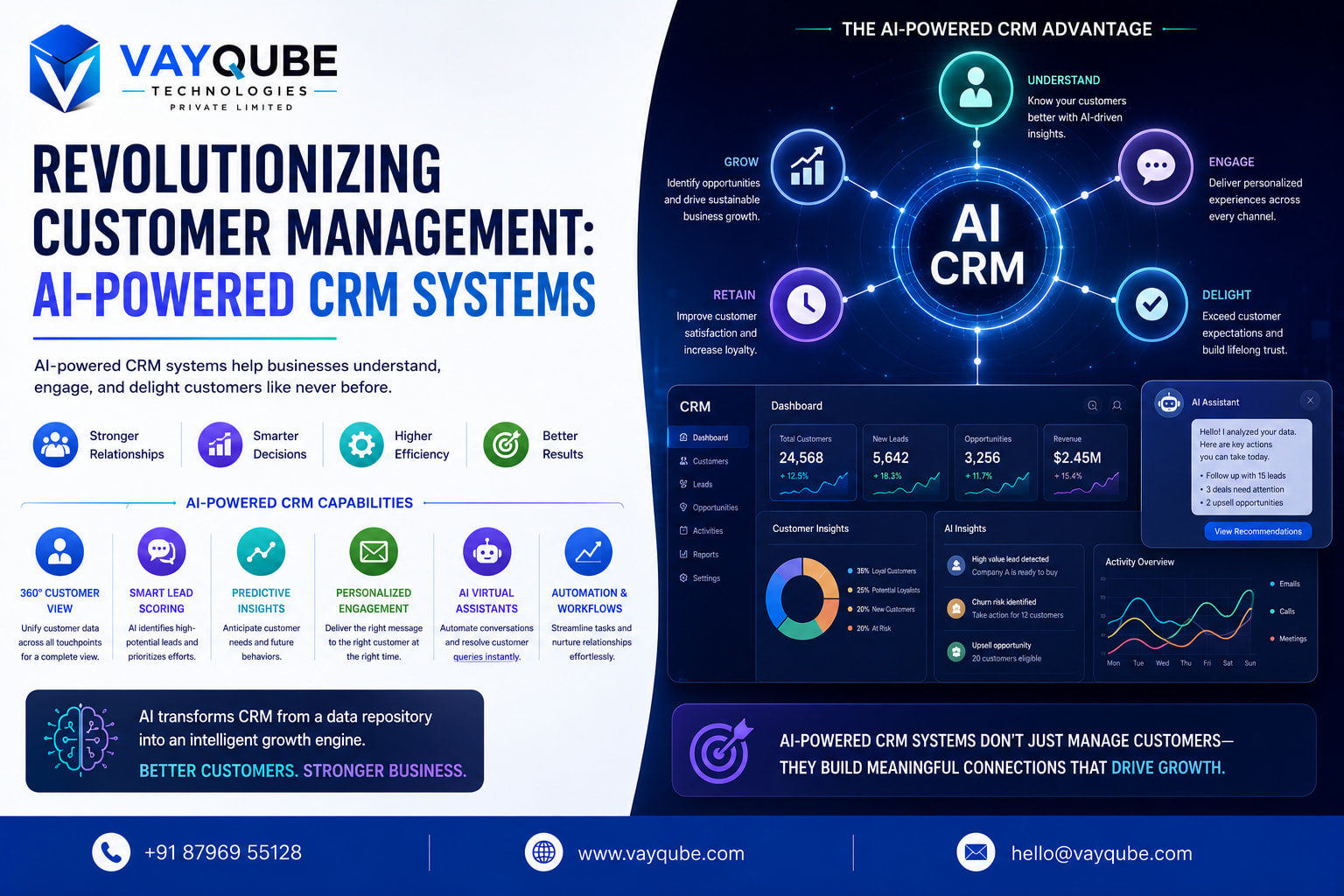
Introduction to AI-Powered CRM Systems
The advent of AI-powered CRM systems has revolutionized the way businesses manage their customer relationships. By leveraging artificial intelligence and machine learning algorithms, these systems enable companies to analyze customer data, predict behavior, and personalize interactions. This shift towards AI-powered CRM systems marks a significant evolution in customer management, as businesses seek to adopt innovative solutions to stay competitive.
Evolution of Customer Management
Traditional customer management approaches relied heavily on manual data entry, spreadsheets, and basic automation. However, with the exponential growth of customer data, these methods have become inefficient and prone to errors. The evolution of customer management has led to the development of more sophisticated CRM systems, which can handle vast amounts of data, provide real-time insights, and automate routine tasks. AI-powered CRM systems represent the next frontier in this evolution, offering unparalleled capabilities for customer analysis, segmentation, and engagement.
Importance of Adopting Innovative Solutions
In today's fast-paced business landscape, adopting innovative solutions is crucial for staying ahead of the competition. AI-powered CRM systems offer numerous benefits, including:
- Enhanced customer experience through personalized interactions
- Improved sales forecasting and pipeline management
- Increased efficiency and productivity through automation
- Deeper customer insights and analytics
- Better decision-making through data-driven recommendations By embracing AI-powered CRM systems, businesses can unlock new opportunities for growth, improve customer satisfaction, and drive revenue expansion. The importance of adopting these innovative solutions cannot be overstated, as companies that fail to adapt risk being left behind in an increasingly competitive market.
Real-World Applications and Production Considerations
As businesses consider implementing AI-powered CRM systems, it's essential to examine real-world applications and production considerations. This includes evaluating the system's scalability, integration with existing infrastructure, and potential ROI. By carefully assessing these factors, companies can ensure a seamless transition to AI-powered CRM systems and maximize their benefits. The production considerations also involve data quality, security, and compliance, which are critical for maintaining customer trust and avoiding potential pitfalls.
Why It Matters
The implementation of AI-powered CRM systems has a significant impact on businesses, driving growth and improvement in various areas.
Enhanced Customer Experience
A key benefit of AI-powered CRM systems is the ability to provide a personalized and enhanced customer experience. By analyzing customer data and behavior, businesses can tailor their interactions to meet individual needs, resulting in increased satisfaction and loyalty. This is achieved through features such as automated chatbots, sentiment analysis, and predictive analytics.
Improved Sales and Marketing Efficiency
AI-powered CRM systems also improve sales and marketing efficiency by automating routine tasks, providing real-time insights, and enabling data-driven decision-making. Sales teams can focus on high-value activities, such as building relationships and closing deals, while marketing teams can optimize their campaigns and targeting strategies. This leads to increased productivity, reduced costs, and improved conversion rates.
Competitive Advantage in the Market
In today's competitive market, businesses that adopt AI-powered CRM systems can gain a significant advantage over their rivals. By leveraging AI-driven insights and automation, companies can respond faster to changing market conditions, identify new opportunities, and stay ahead of the competition. This enables them to build strong relationships with customers, drive revenue growth, and maintain a leadership position in their industry.
Some key benefits of AI-powered CRM systems include:
- Improved customer segmentation and targeting
- Enhanced customer service and support
- Increased sales forecasting accuracy
- Better marketing campaign optimization
- Reduced customer churn and improved retention
By adopting AI-powered CRM systems, businesses can drive significant improvements in customer experience, sales and marketing efficiency, and competitive advantage, ultimately leading to increased revenue and growth.
Core Architecture
The core architecture of AI-powered CRM systems is designed to provide a scalable and efficient foundation for managing customer relationships.
Key Components
The core architecture consists of several key components, including:
- Machine learning algorithms that enable predictive analytics and automation
- Data analytics and integration capabilities that provide a unified view of customer interactions
- Cloud-based infrastructure that supports scalability and flexibility
Machine Learning Algorithms
Machine learning algorithms play a critical role in AI-powered CRM systems, enabling businesses to analyze customer data and behavior, and make informed decisions. These algorithms can be used to predict customer churn, identify new sales opportunities, and personalize customer interactions.
Data Analytics and Integration
Data analytics and integration are also essential components of AI-powered CRM systems. By integrating data from various sources, businesses can gain a comprehensive understanding of customer interactions and preferences. This data can be used to inform sales and marketing strategies, and improve customer engagement.
Cloud-Based Infrastructure
The cloud-based infrastructure of AI-powered CRM systems provides a scalable and flexible foundation for managing customer relationships. This infrastructure enables businesses to quickly deploy and configure CRM systems, and scale up or down to meet changing business needs. With cloud-based infrastructure, businesses can also reduce IT costs and improve system reliability.
Implementation Considerations
When implementing AI-powered CRM systems, businesses should consider several key factors, including:
- Data quality and integration
- Algorithm training and validation
- System scalability and reliability
- User adoption and training By carefully considering these factors, businesses can ensure a successful implementation and maximize the benefits of AI-powered CRM systems.
Real-World Applications
AI-powered CRM systems have a wide range of real-world applications, from sales and marketing automation to customer service and support. For example, businesses can use AI-powered CRM systems to:
- Automate lead scoring and qualification
- Personalize customer interactions and recommendations
- Analyze customer sentiment and feedback
- Improve customer retention and loyalty.
Production Readiness
To ensure production readiness, businesses should carefully evaluate the scalability, reliability, and security of AI-powered CRM systems. This includes testing system performance under various loads, evaluating data security and compliance, and ensuring seamless integration with existing systems and processes. By doing so, businesses can ensure a smooth transition to AI-powered CRM systems and maximize the benefits of these systems in production environments.
Business Benefits
The implementation of AI-powered CRM systems can have a significant impact on a business's bottom line. By leveraging the power of artificial intelligence, companies can experience increased revenue and growth, improved customer retention and loyalty, and data-driven decision making.
Revenue Growth
AI-powered CRM systems can help businesses identify new sales opportunities and improve their conversion rates. By analyzing customer data and behavior, companies can create targeted marketing campaigns and personalized sales approaches, leading to increased revenue and growth. For example, a company can use AI-powered CRM to analyze customer purchase history and recommend relevant products, resulting in increased average order value and customer lifetime value.
Customer Retention and Loyalty
AI-powered CRM systems can also help businesses improve customer retention and loyalty. By analyzing customer data and behavior, companies can identify potential churn risks and take proactive measures to address them. For instance, a company can use AI-powered CRM to detect changes in customer behavior and send personalized retention offers, resulting in improved customer satisfaction and loyalty.
Data-Driven Decision Making
AI-powered CRM systems provide businesses with real-time insights and analytics, enabling data-driven decision making. By analyzing customer data and behavior, companies can gain a deeper understanding of their customers' needs and preferences, and make informed decisions about their sales and marketing strategies. Key benefits of data-driven decision making include:
- Improved forecasting and planning
- Enhanced customer segmentation and targeting
- More effective resource allocation and optimization
- Better measurement and evaluation of sales and marketing performance
The use of AI-powered CRM systems can have a significant impact on a business's ability to make data-driven decisions, driving growth, improving customer satisfaction, and increasing revenue. By leveraging the power of artificial intelligence, companies can stay ahead of the competition and achieve their business goals.
Implementation Considerations
When implementing an AI-powered CRM system, businesses should consider several key factors, including:
- Data quality and integration
- System scalability and flexibility
- User adoption and training
- Ongoing maintenance and support
- Integration with existing sales and marketing systems
By carefully considering these factors, businesses can ensure a successful implementation and maximize the benefits of their AI-powered CRM system.
Scalability
To ensure the long-term success of an AI-powered CRM system, scalability is a critical factor to consider. As businesses grow and evolve, their customer management needs will inevitably change, requiring a system that can adapt and handle increasing volumes of data.
Handling Large Volumes of Customer Data
A scalable AI-powered CRM system should be able to handle large volumes of customer data without compromising performance. This can be achieved through:
- Distributed database architectures that allow for horizontal scaling
- Data compression and encryption techniques to reduce storage requirements
- Advanced data processing algorithms that can handle high volumes of data in real-time
Adapting to Changing Business Needs
As businesses grow and evolve, their customer management needs will change. A scalable AI-powered CRM system should be able to adapt to these changing needs by:
- Providing flexible and customizable workflows that can be easily modified
- Offering integration with other business systems and applications
- Allowing for easy deployment of new features and functionalities
Ensuring System Performance and Reliability
To ensure system performance and reliability, a scalable AI-powered CRM system should:
- Be built on a robust and fault-tolerant infrastructure
- Have built-in redundancy and failover capabilities to minimize downtime
- Provide real-time monitoring and analytics to identify and resolve performance issues before they impact the business
In real-world scenarios, scalable AI-powered CRM systems have been instrumental in helping businesses manage large volumes of customer data and adapt to changing business needs. For example, a large retail company may use an AI-powered CRM system to manage customer interactions across multiple channels, including social media, email, and phone. As the company grows and expands into new markets, the CRM system can scale to handle increasing volumes of customer data and provide real-time insights to inform business decisions.
By prioritizing scalability, businesses can ensure that their AI-powered CRM system can handle the demands of a growing and evolving customer base, and provide a solid foundation for long-term success.
Implementation Challenges
When implementing an AI-powered CRM system, several challenges can arise that may hinder the success of the project. These challenges can be broadly categorized into three key areas: data quality and integration, change management and training, and security and compliance.
Data Quality and Integration Issues
Data quality and integration are critical components of a successful AI-powered CRM system. Poor data quality can lead to inaccurate insights and decision-making, while integration issues can hinder the flow of data between different systems. Some common data quality issues include:
- Inconsistent or incomplete data
- Duplicate or redundant data
- Outdated or stale data To overcome these challenges, it's essential to implement a robust data governance framework that ensures data quality, integrity, and consistency. This can be achieved by:
- Implementing data validation and cleansing processes
- Establishing data standards and protocols
- Conducting regular data audits and quality checks
Change Management and Training
Change management and training are critical components of a successful AI-powered CRM implementation. The introduction of new technology can be daunting for employees, and inadequate training can lead to resistance and decreased adoption. To overcome these challenges, it's essential to:
- Develop a comprehensive change management strategy that communicates the benefits and value of the new system
- Provide ongoing training and support to ensure employees are comfortable using the new system
- Encourage feedback and continuous improvement to ensure the system meets the evolving needs of the business
Ensuring Security and Compliance
Ensuring the security and compliance of an AI-powered CRM system is critical to protecting sensitive customer data and maintaining regulatory compliance. Some common security and compliance challenges include:
- Data breaches and cyber attacks
- Non-compliance with regulatory requirements
- Inadequate access controls and authentication To overcome these challenges, it's essential to:
- Implement robust security measures such as encryption, firewalls, and access controls
- Conduct regular security audits and risk assessments
- Ensure compliance with relevant regulatory requirements such as GDPR and CCPA
By understanding and addressing these implementation challenges, businesses can ensure a successful AI-powered CRM implementation that drives real business value and improves customer management.
Use Cases
The implementation of AI-powered CRM systems has numerous benefits, and several use cases demonstrate their value.
Personalized Customer Service
AI-powered CRM systems enable businesses to provide personalized customer service, resulting in increased customer satisfaction and loyalty. By analyzing customer data and behavior, AI algorithms can help businesses tailor their interactions to individual customers, creating a more humanized experience. For instance, AI-powered chatbots can be used to offer 24/7 support, answering frequent questions and routing complex issues to human representatives.
Predictive Sales Forecasting
Predictive sales forecasting is another significant use case for AI-powered CRM systems. By analyzing historical sales data, market trends, and customer behavior, AI algorithms can predict future sales performance, enabling businesses to make informed decisions about resource allocation and strategy. This can help businesses optimize their sales processes, reduce the risk of missed opportunities, and improve overall revenue growth.
Automated Marketing Campaigns
AI-powered CRM systems can also be used to automate marketing campaigns, making them more efficient and effective. By analyzing customer data and behavior, AI algorithms can help businesses identify the most effective marketing channels and tactics, and automate the execution of campaigns. For example, AI-powered systems can be used to send personalized email campaigns, social media messages, and other targeted communications, increasing the likelihood of conversion and reducing the risk of customer churn.
Some key benefits of automated marketing campaigns include:
- Increased efficiency and productivity
- Improved targeting and personalization
- Enhanced customer engagement and conversion
- Reduced risk of customer churn and improved retention
By leveraging AI-powered CRM systems, businesses can unlock these benefits and create a more streamlined, efficient, and effective customer management process.
Real-World Examples
Real-world examples of AI-powered CRM systems in action include companies like Salesforce, HubSpot, and Zoho. These companies have developed AI-powered CRM platforms that enable businesses to provide personalized customer service, predict sales performance, and automate marketing campaigns. For instance, Salesforce's Einstein platform uses AI to analyze customer data and provide predictive insights, while HubSpot's AI-powered CRM platform helps businesses automate marketing and sales processes.
By examining these real-world examples, businesses can gain a deeper understanding of the benefits and challenges of implementing AI-powered CRM systems, and develop a strategy for leveraging these technologies to drive growth and success.
Production Considerations
When implementing AI-powered CRM systems, businesses must consider several production factors, including data quality, integration, and scalability. For example, AI algorithms require high-quality data to function effectively, so businesses must ensure that their customer data is accurate, complete, and well-maintained. Additionally, AI-powered CRM systems must be integrated with existing systems and processes, requiring careful planning and execution to avoid disruptions and ensure seamless functionality.
By carefully considering these production factors, businesses can ensure a successful implementation of AI-powered CRM systems, and unlock the benefits of personalized customer service, predictive sales forecasting, and automated marketing campaigns.
Best Practices
To maximize the potential of AI-powered CRM systems, it's essential to follow best practices that ensure seamless integration and optimal performance.
Defining Clear Business Objectives
Defining clear business objectives is crucial for the successful implementation of AI-powered CRM systems. This involves identifying key performance indicators (KPIs) and establishing measurable goals that align with the organization's overall strategy. By doing so, businesses can ensure that their AI-powered CRM system is tailored to meet specific needs and drive meaningful outcomes. Some key considerations include:
- Aligning CRM objectives with overall business strategy
- Establishing measurable KPIs to track progress
- Identifying potential roadblocks and developing contingency plans
Choosing the Right AI-Powered CRM Solution
Choosing the right AI-powered CRM solution is critical for achieving desired business outcomes. This involves evaluating various solutions based on factors such as scalability, functionality, and integration capabilities. Businesses should consider the following:
- Assessing the solution's ability to integrate with existing systems and infrastructure
- Evaluating the solution's AI and machine learning capabilities
- Considering the solution's user experience and adoption potential
Monitoring and Evaluating System Performance
Monitoring and evaluating system performance is essential for ensuring that the AI-powered CRM system is operating optimally and driving desired business outcomes. This involves tracking key metrics and KPIs, as well as conducting regular system audits to identify areas for improvement. Some key considerations include:
- Establishing a robust monitoring and evaluation framework
- Tracking key metrics and KPIs to measure system performance
- Conducting regular system audits to identify areas for improvement and optimize system configuration
By following these best practices, businesses can unlock the full potential of AI-powered CRM systems and drive meaningful improvements in customer management and overall business performance.
Frequently Asked Questions
To address common queries and concerns, we've compiled a list of key points to consider when evaluating AI-powered CRM systems.
Key Features of AI-Powered CRM Systems
The primary features of AI-powered CRM systems include:
- Advanced data analytics and predictive modeling
- Automated lead scoring and qualification
- Personalized customer engagement and recommendation engines
- Integration with popular sales and marketing tools
- Real-time reporting and performance metrics
These features enable businesses to streamline customer management, improve sales forecasting, and enhance overall customer experience.
Implementing an AI-Powered CRM System
To implement an AI-powered CRM system, consider the following steps:
- Assess your current customer management processes and identify areas for improvement
- Evaluate AI-powered CRM vendors and their offerings
- Develop a tailored implementation strategy and roadmap
- Provide comprehensive training to your sales and customer support teams
- Monitor and adjust the system as needed to ensure optimal performance
A well-planned implementation strategy is crucial to maximizing the benefits of an AI-powered CRM system.
Potential Risks and Limitations
While AI-powered CRM systems offer numerous benefits, there are potential risks and limitations to be aware of, including:
- Data quality and integration challenges
- Dependence on accurate and comprehensive customer data
- Potential biases in AI-driven decision-making
- Cybersecurity risks and data protection concerns
- Initial investment and potential ROI considerations
By understanding these potential risks and limitations, businesses can take proactive steps to mitigate them and ensure a successful AI-powered CRM system deployment.
Real-World Considerations
In real-world scenarios, AI-powered CRM systems can have a significant impact on business operations and customer relationships. For example, a company can use AI-powered CRM to analyze customer interactions and preferences, enabling personalized marketing campaigns and improved customer engagement. Additionally, AI-powered CRM can help businesses to identify and address potential customer churn, reducing the risk of lost revenue and improving overall customer retention.
Production Readiness
To ensure production readiness, businesses should focus on developing a comprehensive testing and validation strategy, as well as a robust change management process. This includes testing the AI-powered CRM system with real-world data, validating its performance and accuracy, and ensuring that all stakeholders are properly trained and supported. By prioritizing production readiness, businesses can minimize the risk of disruptions and ensure a seamless transition to an AI-powered CRM system.
Conclusion
In revolutionizing customer management, AI-powered CRM systems have emerged as a game-changer for businesses. The key takeaways from this discussion include the significance of a robust core architecture, the numerous business benefits such as enhanced customer insights and personalized experiences, and the importance of scalability and best practices in implementation.
Summary of Key Takeaways
- AI-powered CRM systems offer advanced customer insights and predictive analytics
- Personalized customer experiences can be achieved through automation and machine learning
- Scalability and flexibility are crucial for successful implementation
- Real-world use cases demonstrate significant improvements in customer satisfaction and retention
Future of Customer Management
The future of customer management lies in the innovative application of AI and machine learning technologies. As these technologies continue to evolve, businesses can expect even more sophisticated CRM systems that can handle complex customer data, provide real-time insights, and automate routine tasks. The integration of AI-powered chatbots, for instance, can revolutionize customer support by offering 24/7 assistance and quick resolution of queries.
Call to Action
For businesses looking to stay ahead of the curve, adopting an AI-powered CRM system is no longer a choice but a necessity. By leveraging the power of AI and machine learning, businesses can transform their customer management strategies, leading to enhanced customer satisfaction, improved retention, and ultimately, increased revenue. It is essential for businesses to assess their current customer management systems, identify areas of improvement, and invest in innovative solutions that can help them achieve their goals in today's competitive market.
Production Readiness and Real-World Applications
In terms of production readiness, AI-powered CRM systems have already demonstrated their capabilities in various real-world applications. From healthcare to finance, and from e-commerce to telecommunications, these systems have been successfully implemented to improve customer engagement, streamline operations, and reduce costs. Businesses should focus on finding the right implementation strategy, one that aligns with their specific needs and goals, to ensure a smooth transition to an AI-powered CRM system. By doing so, they can unlock the full potential of these innovative solutions and reap the benefits of revolutionized customer management.
Related Vayqube Resources
- Startups Building Ai Products Without Large Teams
- The Real Cost Of Building Ai Products
- Why Most Ai Projects Fail Before Production
- How To Build Fintech Application Payments Security Scaling
- Best Mobile App Development Company In New York
- Real Time Application Development
Next Step
If your systems are struggling with scalability, automation, architecture complexity, or operational efficiency, it's time to modernize your infrastructure and workflows.
👉 Talk to a Vayqube solution architect and build systems designed for long-term production growth: