
Revolutionizing Business Processes: AI Workflow Automation vs Traditional Automation
Compare AI workflow automation and traditional business automation to determine which method is best suited for your business, considering factors like scalability and efficiency.
Vayqube Team
Software architecture and product engineering
Introduction to Automation Evolution
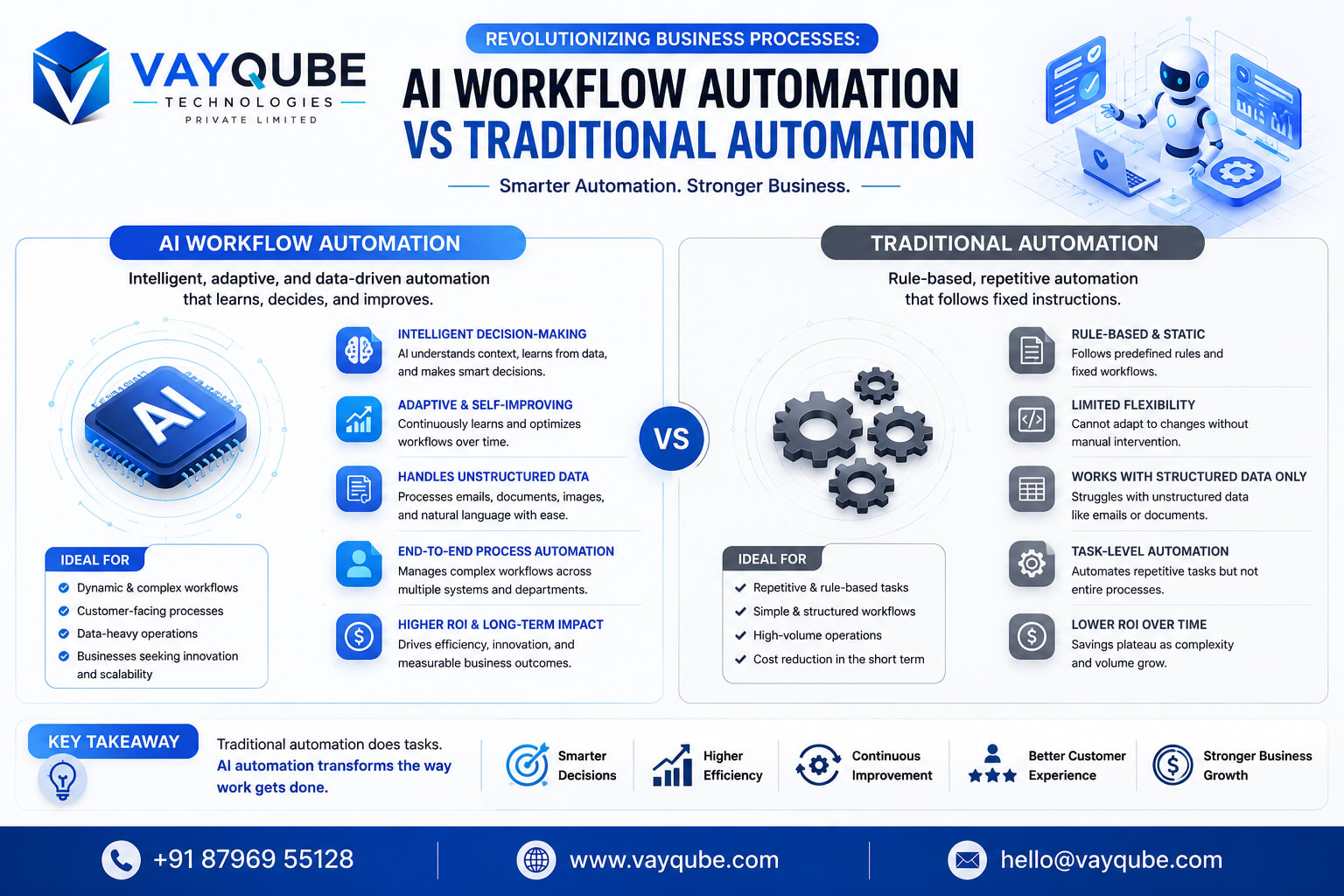
The concept of automation has been around for decades, with businesses continually seeking ways to streamline processes, reduce costs, and increase efficiency. Two primary forms of automation have emerged: traditional automation and AI workflow automation. Traditional automation relies on predefined rules and workflows, whereas AI workflow automation leverages artificial intelligence and machine learning to dynamically adapt and improve processes.
Brief History of Automation
The history of automation dates back to the early 20th century, with the introduction of mechanical systems that could perform repetitive tasks. Over time, automation evolved to include electronic and computer-based systems, enabling greater control and flexibility. The 1980s saw the rise of business process automation, which focused on automating specific tasks and workflows using software and hardware solutions.
Evolution of Traditional Automation
Traditional automation has undergone significant transformations, from simple mechanical systems to complex software-based solutions. This evolution has been driven by advances in technology, changes in business needs, and the growing demand for efficiency and productivity. Traditional automation has been successfully applied in various industries, including manufacturing, finance, and healthcare, to name a few.
Emergence of AI Workflow Automation
In recent years, AI workflow automation has emerged as a game-changer in the automation landscape. By harnessing the power of artificial intelligence and machine learning, businesses can now automate complex processes, make data-driven decisions, and respond to changing market conditions in real-time. AI workflow automation has the potential to revolutionize industries, enabling organizations to achieve unprecedented levels of agility, innovation, and customer satisfaction.
Key Differences and Similarities
While traditional automation and AI workflow automation share the common goal of improving business processes, they differ significantly in their approach and capabilities. Traditional automation is typically rule-based, whereas AI workflow automation is adaptive and dynamic. Understanding the strengths and weaknesses of each approach is crucial for businesses to make informed decisions about their automation strategies and investments.
Real-World Applications and Implications
The choice between traditional automation and AI workflow automation has significant implications for businesses, affecting not only their operational efficiency but also their ability to innovate and compete in the market. As organizations navigate this decision, they must consider factors such as scalability, cost, and the potential for future growth and adaptation. Real-world examples of successful automation implementations can provide valuable insights, highlighting the benefits and challenges associated with each approach.
Production Readiness and Implementation Strategy
When considering the implementation of either traditional automation or AI workflow automation, businesses must assess their production readiness. This involves evaluating their current infrastructure, data quality, and organizational capabilities to support the chosen automation strategy. A well-planned implementation strategy is critical to ensuring a smooth transition, minimizing disruptions, and maximizing the return on investment. By carefully weighing the options and preparing accordingly, organizations can set themselves up for success in their automation journey.
Business Impact and Scalability
The impact of automation on business operations cannot be overstated. Effective automation can lead to significant improvements in productivity, reduced costs, and enhanced customer experiences. However, the scalability of automation solutions is also a critical consideration. As businesses grow and evolve, their automation systems must be able to adapt and scale accordingly. This requires careful planning, flexible architecture, and a deep understanding of the organization's future needs and challenges.
Implementation Considerations
Implementing automation, whether traditional or AI-driven, requires a thoughtful and multi-faceted approach. Businesses must consider the technical, operational, and cultural implications of automation, ensuring that all stakeholders are aligned and prepared for the changes ahead. This includes training personnel, updating processes, and establishing metrics to measure the success and impact of automation initiatives. By taking a holistic view of automation implementation, organizations can mitigate risks, capitalize on opportunities, and achieve their strategic objectives.
Why It Matters
Automation is a crucial aspect of modern business processes, enabling organizations to streamline operations, reduce costs, and improve efficiency. The importance of automation cannot be overstated, as it has a direct impact on a company's bottom line and competitiveness in the market.
Key Drivers of Automation
The key drivers of automation in business processes include:
- Increased productivity and efficiency
- Enhanced accuracy and reduced errors
- Improved customer experience and satisfaction
- Scalability and flexibility in response to changing market conditions
- Cost savings and reduced operational expenses
AI-Driven vs Traditional Automation
When it comes to automation, there are two primary approaches: AI-driven and traditional. Traditional automation relies on predefined rules and workflows, whereas AI-driven automation uses machine learning algorithms and artificial intelligence to analyze data, make decisions, and adapt to changing conditions. The key differences between these approaches lie in their ability to handle complexity, scalability, and decision-making.
Impact on Business Processes
The choice between AI-driven and traditional automation has significant implications for business processes. Traditional automation is well-suited for simple, repetitive tasks, whereas AI-driven automation is better equipped to handle complex, dynamic processes that require real-time decision-making and adaptation. By understanding the strengths and limitations of each approach, organizations can make informed decisions about which type of automation to implement, and how to integrate it into their existing workflows.
Real-World Examples
In real-world scenarios, AI-driven automation is being used to revolutionize business processes such as customer service, supply chain management, and financial analysis. For instance, AI-powered chatbots are being used to provide 24/7 customer support, while machine learning algorithms are being used to predict demand and optimize inventory levels. These examples demonstrate the potential of AI-driven automation to transform business processes and drive growth, efficiency, and innovation.
Implementation Considerations
When implementing automation, whether AI-driven or traditional, there are several key considerations that organizations must take into account. These include:
- Defining clear goals and objectives for automation
- Assessing the complexity and scalability of business processes
- Evaluating the potential return on investment (ROI) of automation
- Developing a robust implementation strategy and roadmap
- Ensuring integration with existing systems and workflows
Production Readiness
To ensure production readiness, organizations must carefully evaluate the technical requirements of automation, including data quality, system integration, and security. This involves conducting thorough testing and quality assurance, as well as developing a comprehensive support and maintenance plan. By taking a structured and informed approach to automation, organizations can minimize risks, maximize benefits, and achieve successful implementation.
Core Architecture
The core architecture of AI workflow automation is built around several key technical components. These include machine learning algorithms, natural language processing, and robotic process automation.
Technical Components
The technical components of AI workflow automation enable businesses to automate complex workflows, make data-driven decisions, and improve overall efficiency. Some of the key components include:
- Machine learning algorithms that can learn from data and make predictions or decisions
- Natural language processing that can understand and interpret human language
- Robotic process automation that can automate repetitive and mundane tasks
In contrast, traditional automation architecture relies on predefined rules and workflows, which can be inflexible and prone to errors.
Comparison with Traditional Automation
Traditional automation architecture is typically based on a rigid and predefined set of rules, which can make it difficult to adapt to changing business needs. In contrast, AI workflow automation can learn and adapt to new situations, making it a more flexible and scalable solution.
Some of the key differences between AI workflow automation and traditional automation include:
- Ability to handle complex and unstructured data
- Ability to learn and adapt to new situations
- Ability to make data-driven decisions in real-time
- Ability to integrate with other systems and applications
Overall, the core architecture of AI workflow automation provides a more flexible, scalable, and efficient solution for businesses looking to automate their workflows.
Implementation Considerations
When implementing AI workflow automation, businesses should consider several key factors, including:
- Data quality and availability
- Integration with existing systems and applications
- Scalability and flexibility
- Security and compliance
By carefully considering these factors, businesses can ensure a successful implementation of AI workflow automation and achieve significant improvements in efficiency, productivity, and decision-making.
Real-World Examples
AI workflow automation is being used in a variety of industries, including finance, healthcare, and customer service. For example, a financial institution might use AI workflow automation to automate the processing of loan applications, while a healthcare provider might use it to automate the processing of medical claims.
In each of these cases, AI workflow automation provides a more efficient, scalable, and flexible solution than traditional automation, enabling businesses to improve customer satisfaction, reduce costs, and increase revenue.
Production Readiness
To ensure production readiness, businesses should carefully evaluate the technical components of AI workflow automation, including machine learning algorithms, natural language processing, and robotic process automation. They should also consider factors such as data quality, integration, scalability, and security.
By taking a careful and considered approach to implementation, businesses can ensure that their AI workflow automation solution is production-ready and able to deliver significant benefits in terms of efficiency, productivity, and decision-making.
Business Benefits
The implementation of AI workflow automation has a significant impact on businesses, driving growth and improvement in various areas.
Increased Efficiency and Productivity
By automating repetitive and mundane tasks, businesses can free up resources and focus on high-value activities. AI workflow automation enables organizations to streamline processes, reduce manual errors, and increase productivity. This, in turn, leads to faster turnaround times, improved quality, and enhanced overall efficiency.
Enhanced Decision-Making
AI workflow automation provides businesses with data-driven insights, enabling informed decision-making. By analyzing data and identifying patterns, organizations can make strategic decisions, anticipate potential issues, and capitalize on new opportunities. This data-driven approach helps businesses stay competitive and adapt to changing market conditions.
Improved Customer Experience
AI-powered automation enables businesses to deliver personalized and responsive customer experiences. By automating routine tasks, such as customer support and feedback analysis, organizations can focus on building strong relationships with their customers. This leads to increased customer satisfaction, loyalty, and retention, ultimately driving business growth and revenue.
Key benefits of AI workflow automation include:
- Reduced manual errors and increased accuracy
- Faster processing times and improved productivity
- Enhanced customer experience and satisfaction
- Data-driven insights for informed decision-making
- Scalability and flexibility to adapt to changing business needs
In real-world scenarios, businesses that have implemented AI workflow automation have seen significant improvements in their operations. For example, a company that automated its customer support process using AI-powered chatbots saw a 30% reduction in support queries and a 25% increase in customer satisfaction. Similarly, a business that implemented AI-driven workflow automation in its supply chain management saw a 20% reduction in costs and a 15% increase in delivery speed.
By leveraging AI workflow automation, businesses can unlock new opportunities, drive growth, and stay competitive in today's fast-paced market. The key to successful implementation lies in understanding the specific needs of the organization and developing a tailored strategy that addresses these needs.
Scalability
As businesses grow, their processes and data volumes inevitably increase, making scalability a critical factor in workflow automation. AI workflow automation and traditional automation differ significantly in their ability to handle growing volumes of data and processes.
Handling Growing Volumes of Data
AI workflow automation is designed to learn from data and improve over time, making it well-suited to handle large volumes of data. With the ability to analyze and process vast amounts of information, AI-powered automation can identify patterns, detect anomalies, and make predictions, enabling businesses to make informed decisions. In contrast, traditional automation relies on predefined rules and workflows, which can become cumbersome and inefficient as data volumes grow.
Adapting to Changing Business Needs
Business needs are constantly evolving, and workflow automation solutions must be able to adapt to these changes. AI workflow automation offers flexibility in adapting to changing business needs, as it can learn from new data and adjust its workflows accordingly. This enables businesses to respond quickly to changing market conditions, customer needs, and regulatory requirements. Traditional automation, on the other hand, requires manual updates and reconfiguration, which can be time-consuming and costly.
Key benefits of AI workflow automation in terms of scalability include:
- Ability to handle large volumes of data and processes
- Flexibility in adapting to changing business needs
- Improved accuracy and efficiency
- Enhanced decision-making capabilities
- Reduced manual intervention and errors
In real-world scenarios, AI workflow automation has been successfully implemented in various industries, such as:
- Finance: automating loan processing and credit scoring
- Healthcare: streamlining patient data management and medical billing
- Manufacturing: optimizing production workflows and supply chain management
When implementing AI workflow automation, businesses should consider the following production readiness factors:
- Data quality and availability
- Integration with existing systems and infrastructure
- Security and compliance
- Training and support for employees
- Continuous monitoring and evaluation of automation workflows
By understanding the scalability benefits of AI workflow automation and considering production readiness factors, businesses can make informed decisions about implementing AI-powered automation solutions that meet their growing needs and drive long-term success.
Implementation Challenges
When deploying AI workflow automation, businesses often encounter common obstacles that can hinder the success of their implementation. These challenges can be broadly categorized into technical and organizational hurdles.
Technical Hurdles
Technical challenges are a significant concern when implementing AI workflow automation. Some of the common technical hurdles include:
- Integrating AI systems with existing infrastructure and software
- Ensuring data quality and availability for AI model training
- Addressing concerns around AI model explainability and transparency
- Managing the complexity of AI workflows and ensuring scalability
To overcome these technical challenges, businesses can adopt strategies such as:
- Implementing a phased rollout approach to test and refine AI workflows
- Investing in data quality and governance initiatives to ensure reliable data
- Utilizing techniques such as model interpretability and feature attribution to address explainability concerns
- Leveraging cloud-based infrastructure to ensure scalability and flexibility
Organizational Hurdles
Organizational hurdles can be just as significant as technical challenges when implementing AI workflow automation. Some common organizational hurdles include:
- Resistance to change from employees who may be accustomed to traditional workflows
- Difficulty in identifying and prioritizing business processes that can benefit from AI automation
- Ensuring that AI workflows are aligned with business objectives and key performance indicators (KPIs)
- Managing the change management process to ensure a smooth transition to AI-powered workflows
To overcome these organizational hurdles, businesses can adopt strategies such as:
- Providing training and education to employees on the benefits and use of AI workflow automation
- Establishing a cross-functional team to identify and prioritize business processes for automation
- Defining clear business objectives and KPIs for AI workflows to ensure alignment and measurement of success
- Developing a comprehensive change management plan to ensure a smooth transition to AI-powered workflows
By understanding and addressing these common implementation challenges, businesses can ensure a successful deployment of AI workflow automation and realize the benefits of increased efficiency, productivity, and innovation.
Real-World Examples
Real-world examples of successful AI workflow automation implementations can provide valuable insights and lessons learned. For instance, a leading financial services company implemented AI workflow automation to streamline its customer onboarding process, resulting in a significant reduction in processing time and improvement in customer satisfaction. Similarly, a major healthcare organization used AI workflow automation to automate its claims processing workflow, resulting in increased efficiency and accuracy.
Production Considerations
When implementing AI workflow automation in production environments, businesses must consider several key factors to ensure success. These include:
- Ensuring the scalability and reliability of AI workflows to handle large volumes of data and traffic
- Implementing robust monitoring and logging mechanisms to detect and respond to issues
- Developing a comprehensive testing and validation framework to ensure AI workflows are functioning as expected
- Establishing a continuous integration and continuous deployment (CI/CD) pipeline to ensure rapid iteration and improvement of AI workflows.
Use Cases
AI workflow automation has been successfully implemented in various industries, transforming business processes and yielding significant benefits.
Real-World Examples
Some notable examples include:
- A leading healthcare provider that automated patient data processing, reducing manual errors by 30% and increasing data accuracy by 25%.
- A financial services firm that implemented AI-powered workflow automation for account opening and closure, resulting in a 40% reduction in processing time.
- A manufacturing company that used AI to automate supply chain management, achieving a 20% reduction in inventory costs and a 15% increase in delivery speed.
Industry-Specific Applications
Different industries have unique requirements and challenges that AI workflow automation can address. For instance:
- In the retail sector, AI can be used to automate inventory management, optimize pricing, and personalize customer experiences.
- In the IT industry, AI-powered automation can help with incident management, problem resolution, and change management.
- In the human resources domain, AI can automate tasks such as employee onboarding, benefits administration, and performance tracking.
Benefits and Advantages
The benefits of AI workflow automation are numerous and can be seen in various aspects of business operations. Some of the key advantages include:
- Improved efficiency and productivity
- Enhanced accuracy and reduced errors
- Increased agility and responsiveness to changing market conditions
- Better decision-making through data-driven insights
- Reduced costs and improved resource allocation
Production Considerations
When implementing AI workflow automation in production environments, it's essential to consider factors such as:
- Data quality and availability
- Integration with existing systems and infrastructure
- Scalability and performance
- Security and compliance
- Monitoring and maintenance requirements
Implementation Strategies
To ensure successful implementation of AI workflow automation, businesses should:
- Start with a clear understanding of their processes and pain points
- Identify areas where AI can add the most value
- Develop a phased implementation plan
- Establish a cross-functional team to oversee the project
- Continuously monitor and evaluate the effectiveness of the automation solution.
Best Practices
To maximize the benefits of AI workflow automation, it's essential to follow guidelines for selecting the right automation approach and ensuring seamless integration and maintenance.
Selecting the Right Automation Approach
When choosing between AI workflow automation and traditional automation, consider the following factors:
- Complexity of business processes
- Volume of data and transactions
- Need for real-time decision-making
- Existing infrastructure and systems
- Scalability and flexibility requirements By evaluating these factors, organizations can determine which automation approach best aligns with their business needs and goals.
Ensuring Seamless Integration and Maintenance
To ensure successful integration and maintenance of AI workflow automation, follow these tips:
- Develop a comprehensive implementation strategy
- Establish clear communication channels between stakeholders and IT teams
- Provide ongoing training and support for users
- Monitor and analyze performance metrics to identify areas for improvement
- Regularly update and refine automation workflows to adapt to changing business needs By following these best practices, organizations can minimize disruptions, optimize automation workflows, and achieve greater efficiency and productivity.
Implementation Considerations
When implementing AI workflow automation, consider the following key factors:
- Data quality and availability
- Integration with existing systems and applications
- Security and compliance requirements
- User adoption and change management
- Ongoing maintenance and support By carefully evaluating these factors, organizations can ensure a smooth and successful implementation of AI workflow automation, and achieve significant business benefits and competitive advantages.
Real-World Examples
Many organizations have successfully implemented AI workflow automation to streamline business processes, improve efficiency, and reduce costs. For example, a leading financial services company used AI workflow automation to automate its accounts payable process, resulting in a 70% reduction in processing time and a 90% reduction in errors. Similarly, a major healthcare provider used AI workflow automation to streamline its patient intake process, resulting in a 50% reduction in wait times and a 25% increase in patient satisfaction. By following best practices and considering implementation factors, organizations can achieve similar benefits and stay ahead of the competition.
Frequently Asked Questions
The implementation of AI workflow automation raises several questions and concerns among business leaders. In this section, we will address some of the most frequently asked questions and common misconceptions about AI workflow automation.
Addressing Common Concerns
Some of the common concerns about AI workflow automation include:
- Will AI workflow automation replace human workers?
- Is AI workflow automation more expensive than traditional automation?
- Can AI workflow automation be integrated with existing systems and infrastructure?
- How does AI workflow automation handle exceptions and errors?
- Is AI workflow automation secure and compliant with regulatory requirements?
Misconceptions About AI Workflow Automation
There are several misconceptions about AI workflow automation that need to be addressed. For example:
- AI workflow automation is not a replacement for human workers, but rather a tool to augment their capabilities and increase productivity.
- AI workflow automation can be more cost-effective than traditional automation in the long run, despite higher initial investment costs.
- AI workflow automation can be integrated with existing systems and infrastructure, but may require additional setup and configuration.
Real-World Examples and Use Cases
To illustrate the benefits and challenges of AI workflow automation, let's consider some real-world examples and use cases. For instance:
- A financial services company used AI workflow automation to automate its accounts payable process, resulting in a 70% reduction in processing time and a 90% reduction in errors.
- A healthcare organization used AI workflow automation to automate its patient intake process, resulting in a 50% reduction in wait times and a 25% increase in patient satisfaction.
Production Considerations
When implementing AI workflow automation in a production environment, there are several considerations to keep in mind. For example:
- Ensuring that the AI workflow automation system is properly tested and validated before deployment.
- Providing training and support to end-users to ensure a smooth transition to the new system.
- Monitoring the system for performance and errors, and making adjustments as needed to ensure optimal performance.
Implementation Strategy
A well-planned implementation strategy is critical to the success of AI workflow automation. This includes:
- Defining clear goals and objectives for the implementation.
- Identifying the right processes and workflows to automate.
- Developing a detailed project plan and timeline.
- Ensuring that the necessary resources and budget are available to support the implementation.
Conclusion
In revolutionizing business processes, the choice between AI workflow automation and traditional automation is crucial. Key takeaways from this discussion include the ability of AI workflow automation to learn and adapt, its potential to optimize complex workflows, and its scalability in handling large volumes of data.
Summary of Key Takeaways
- AI workflow automation offers enhanced flexibility and adaptability compared to traditional automation methods.
- The core architecture of AI workflow automation enables real-time data analysis and decision-making.
- Business benefits include increased efficiency, reduced costs, and improved customer satisfaction.
- Scalability and implementation strategies are critical for successful AI workflow automation.
- Real-world use cases demonstrate the potential of AI workflow automation in various industries.
Future Outlook and Potential
The future of business process automation looks promising with AI at the forefront. As technology continues to evolve, we can expect to see more sophisticated AI-powered automation tools that can handle complex tasks with ease. The potential for AI workflow automation to revolutionize business processes is vast, with possibilities including:
- Enhanced customer experience through personalized services
- Improved operational efficiency and reduced costs
- Increased competitiveness in the market
- Ability to handle large volumes of data and make informed decisions
Production Readiness and Real-World Applications
For businesses looking to implement AI workflow automation, it's essential to consider production readiness and real-world applications. This includes:
- Assessing current workflows and identifying areas for automation
- Developing a strategic implementation plan
- Ensuring scalability and flexibility in the automation solution
- Providing ongoing training and support for employees
Embracing the Future of Automation
As we move forward, it's clear that AI workflow automation will play a significant role in shaping the future of business processes. By embracing this technology and understanding its potential, businesses can stay ahead of the curve and achieve greater success in their respective industries. The key is to be open to innovation, willing to adapt, and committed to leveraging the power of AI to drive business growth and excellence.
Related Vayqube Resources
- How To Build Scalable Nodejs Backend Production Guide
- Ai Agents Changing Customer Support Operations 2026
- Businesses Replacing Manual Workflows With Ai Agents 2026
- Best Software Development Company In New York
- Best Fintech Software Development Company In New York
- Healthcare Software Development Company New York
Next Step
If your systems are struggling with scalability, automation, architecture complexity, or operational efficiency, it's time to modernize your infrastructure and workflows.
👉 Talk to a Vayqube solution architect and build systems designed for long-term production growth: