
Revolutionizing SaaS: The Rise of Autonomous AI Workflows
Autonomous AI workflows are revolutionizing the SaaS industry, enabling companies to automate complex processes, improve decision-making, and drive business growth.
Vayqube Team
Software architecture and product engineering
Introduction to Autonomous AI Workflows
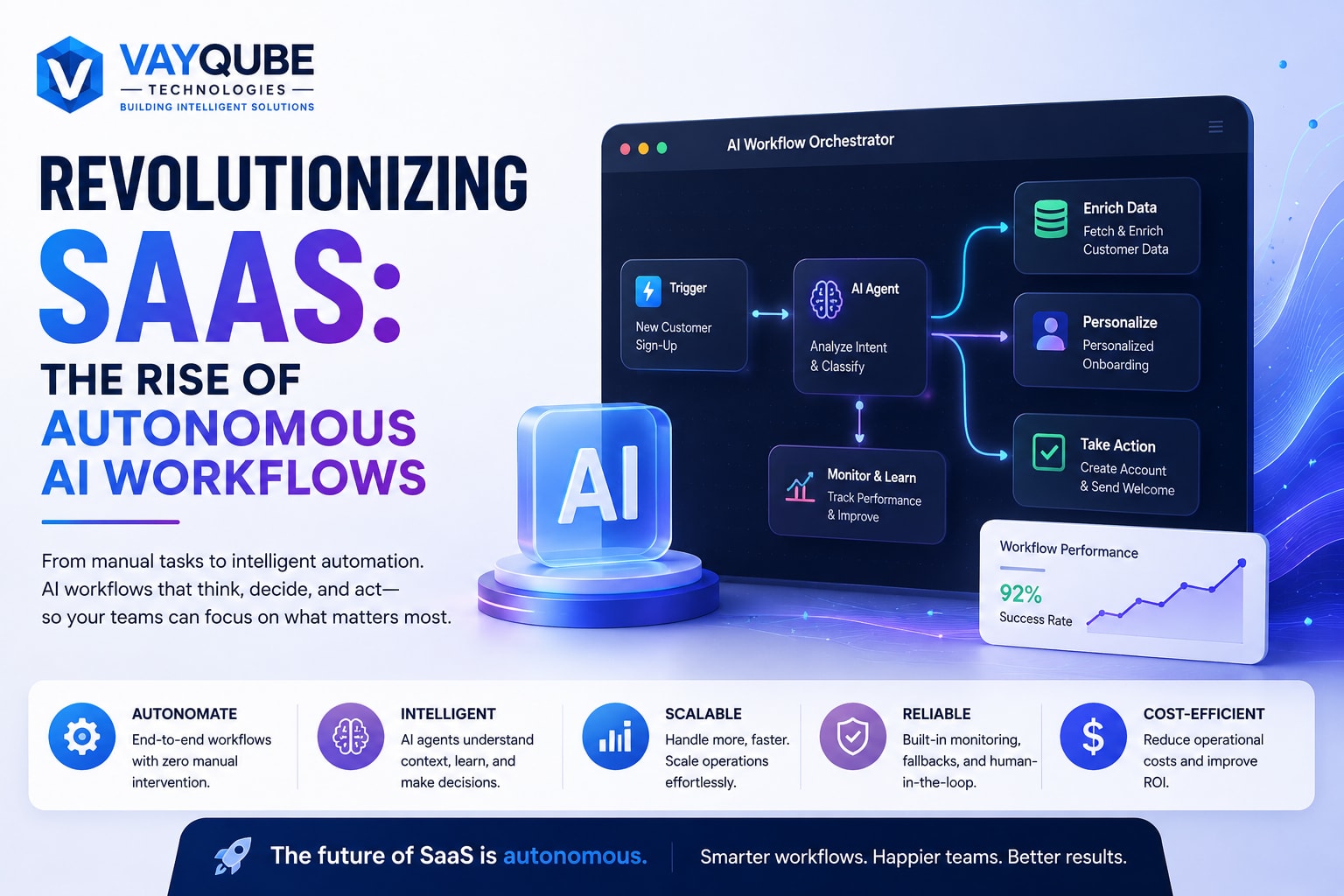
Autonomous AI workflows are revolutionizing the SaaS industry by enabling businesses to automate complex processes, improve efficiency, and reduce costs. At its core, an autonomous AI workflow is a self-managing system that uses artificial intelligence and machine learning to execute tasks without human intervention.
Key Concepts and Definitions
To understand the power of autonomous AI workflows, it's essential to grasp the key concepts and definitions. Autonomous AI workflows involve the use of:
- Artificial intelligence (AI) to analyze data and make decisions
- Machine learning (ML) to improve the accuracy of predictions and actions
- Automation to execute tasks without human intervention
- Real-time data processing to enable swift decision-making
The combination of these technologies enables autonomous AI workflows to learn from data, adapt to changing conditions, and optimize processes in real-time. This results in significant improvements in efficiency, productivity, and customer satisfaction.
Real-World Applications and Benefits
Autonomous AI workflows have numerous real-world applications, including:
- Customer service automation
- Sales and marketing optimization
- Supply chain management
- Financial analysis and forecasting
- IT service management
By implementing autonomous AI workflows, businesses can:
- Reduce manual errors and improve accuracy
- Increase productivity and efficiency
- Enhance customer experiences and satisfaction
- Gain real-time insights and make data-driven decisions
- Stay ahead of the competition and drive innovation
The rise of autonomous AI workflows is transforming the SaaS industry, enabling businesses to achieve unprecedented levels of automation, efficiency, and innovation. As we delve deeper into the world of autonomous AI workflows, it's essential to explore the implementation strategies, production considerations, and real-world use cases that are driving this revolution.
Implementation Strategies and Production Considerations
When implementing autonomous AI workflows, businesses must consider several key factors, including:
- Data quality and availability
- Algorithmic complexity and explainability
- Integration with existing systems and infrastructure
- Scalability and reliability
- Security and compliance
By carefully evaluating these factors and developing a comprehensive implementation strategy, businesses can ensure the successful deployment of autonomous AI workflows and maximize their benefits.
Scalability and Reliability
Autonomous AI workflows must be designed to scale with the needs of the business, handling increasing volumes of data and traffic without compromising performance. This requires careful consideration of:
- Infrastructure and resource allocation
- Load balancing and traffic management
- Data storage and processing
- Monitoring and maintenance
By prioritizing scalability and reliability, businesses can ensure that their autonomous AI workflows remain efficient, effective, and responsive, even in the face of rapid growth and changing conditions.
Real-World Use Cases and Examples
To illustrate the power and potential of autonomous AI workflows, let's consider a few real-world use cases and examples. For instance, a leading e-commerce company might use autonomous AI workflows to:
- Automate customer service inquiries and responses
- Optimize product recommendations and personalized marketing
- Streamline supply chain management and logistics
By examining these use cases and examples, we can gain a deeper understanding of the benefits and challenges of autonomous AI workflows, as well as the strategies and best practices for successful implementation.
Why It Matters
The rise of autonomous AI workflows is revolutionizing the way businesses operate and make decisions. By automating repetitive and mundane tasks, organizations can free up resources and focus on high-value activities that drive growth and innovation.
Business Operations and Decision-Making
Autonomous AI workflows have a significant impact on business operations, enabling companies to:
- Streamline processes and improve efficiency
- Enhance accuracy and reduce errors
- Increase productivity and reduce costs
- Make data-driven decisions with real-time insights
This, in turn, enables businesses to respond quickly to changing market conditions, customer needs, and competitor activity, ultimately driving better decision-making and improved outcomes.
Driving Innovation and Competitiveness
The role of autonomous AI workflows in driving innovation and competitiveness cannot be overstated. By leveraging AI and machine learning, organizations can:
- Identify new business opportunities and revenue streams
- Develop innovative products and services that meet evolving customer needs
- Improve customer experiences and build loyalty
- Stay ahead of the competition and maintain a competitive edge
Real-world examples of autonomous AI workflows in action include automated customer service chatbots, predictive maintenance in manufacturing, and personalized marketing campaigns. These use cases demonstrate the potential of autonomous AI workflows to transform business operations, drive innovation, and improve competitiveness.
Implementation and Production Considerations
As businesses consider implementing autonomous AI workflows, they must also think about the production implications. This includes:
- Ensuring data quality and integrity
- Developing and training AI models that are accurate and reliable
- Integrating AI workflows with existing systems and infrastructure
- Monitoring and maintaining AI workflows to ensure optimal performance
By carefully considering these factors, organizations can unlock the full potential of autonomous AI workflows and achieve significant business benefits, from improved efficiency and productivity to enhanced innovation and competitiveness.
Core Architecture
The core architecture of autonomous AI workflows is built around several key components and technologies. These include machine learning algorithms, natural language processing, and robotic process automation.
Components and Technologies
The main components involved in autonomous AI workflows are:
- Machine learning models for predictive analytics and decision-making
- Integration platforms for connecting with existing systems and applications
- Workflow orchestration tools for automating and managing business processes
- Data storage and management systems for handling large volumes of data
These components work together to enable autonomous AI workflows to learn from data, make decisions, and take actions without human intervention.
Integration with Existing Systems
Autonomous AI workflows integrate with existing systems through APIs, messaging queues, and other integration protocols. This allows them to access and manipulate data from various sources, such as customer relationship management systems, enterprise resource planning systems, and databases.
The integration process typically involves:
- Data ingestion and processing to extract relevant information
- API-based integration with existing systems to access and update data
- Workflow orchestration to automate business processes and decisions
- Continuous monitoring and feedback to improve the accuracy and efficiency of autonomous AI workflows
By integrating with existing systems, autonomous AI workflows can leverage the power of AI and machine learning to automate and optimize business processes, improve decision-making, and enhance customer experiences.
Implementation Considerations
When implementing autonomous AI workflows, it's essential to consider the production readiness of the solution. This includes:
- Ensuring scalability and reliability to handle large volumes of data and traffic
- Implementing security measures to protect sensitive data and prevent unauthorized access
- Developing a robust testing and validation framework to ensure accuracy and efficiency
- Providing ongoing maintenance and support to ensure continuous improvement and optimization
By carefully evaluating these factors, organizations can ensure a successful implementation of autonomous AI workflows and achieve significant business benefits, including improved efficiency, reduced costs, and enhanced competitiveness.
Business Benefits
The integration of autonomous AI workflows in SaaS solutions has a profound impact on businesses, driving growth, and competitiveness.
Key Advantages
Autonomous AI workflows bring numerous benefits, including:
- Increased efficiency and productivity: By automating repetitive and mundane tasks, businesses can free up resources and focus on high-value activities.
- Enhanced customer experience and engagement: AI-driven workflows enable personalized interactions, timely responses, and seamless issue resolution, leading to increased customer satisfaction.
- Improved data-driven insights and decision-making: Autonomous AI workflows can analyze vast amounts of data, providing actionable insights that inform strategic decisions and drive business outcomes.
Operational Efficiency
The increased efficiency and productivity resulting from autonomous AI workflows have a direct impact on a company's bottom line. By streamlining processes and reducing manual errors, businesses can achieve significant cost savings and improve overall performance.
Customer-Centric Approach
The enhanced customer experience and engagement facilitated by autonomous AI workflows are critical in today's competitive market. By providing personalized and responsive interactions, businesses can build strong relationships with their customers, driving loyalty and retention.
Data-Driven Decision Making
The improved data-driven insights and decision-making enabled by autonomous AI workflows are essential for businesses to stay ahead of the curve. By leveraging AI-driven analytics, companies can uncover new opportunities, identify potential risks, and make informed decisions that drive growth and success.
Real-World Applications
Autonomous AI workflows have numerous real-world applications, from automating customer support and sales processes to enhancing marketing and product development efforts. By embracing this technology, businesses can unlock new levels of efficiency, innovation, and competitiveness, ultimately revolutionizing the way they operate and interact with customers.
Implementation Considerations
When implementing autonomous AI workflows, businesses must consider several key factors, including data quality, integration with existing systems, and ongoing maintenance and updates. By carefully planning and executing the implementation process, companies can ensure a seamless transition and maximize the benefits of this technology.
Scalability and Flexibility
Autonomous AI workflows offer unparalleled scalability and flexibility, enabling businesses to adapt quickly to changing market conditions and customer needs. By leveraging this technology, companies can stay agile and responsive, driving long-term success and growth in an increasingly competitive landscape.
Scalability
To ensure the long-term success of autonomous AI workflows in SaaS, scalability is a critical factor. As the volume of data and traffic grows, the system must be able to handle the increased load without compromising performance.
Handling Growing Volumes of Data
Autonomous AI workflows must be designed to scale horizontally, allowing for the addition of new nodes or instances as needed. This enables the system to process large amounts of data in parallel, reducing processing time and improving overall efficiency. Key considerations include:
- Data storage solutions that can handle growing volumes of data
- Distributed computing architectures that can scale to meet increasing demand
- Load balancing techniques to ensure efficient traffic distribution
Adapting to Changing Business Needs
Flexibility is essential in autonomous AI workflows, as business needs can change rapidly. The system must be able to adapt to new requirements, such as changes in data sources, workflows, or user behavior. This can be achieved through:
- Modular architecture that allows for easy integration of new components or services
- Configurable workflows that can be adjusted to meet changing business needs
- Real-time monitoring and analytics to identify areas for improvement and optimize system performance
Implementation Considerations
When implementing autonomous AI workflows, scalability must be a top priority. This includes:
- Selecting cloud-based infrastructure that can scale to meet growing demand
- Designing workflows that can be easily replicated or modified as needed
- Implementing automation and orchestration tools to streamline workflow management and reduce manual intervention
Real-World Examples
Companies like Salesforce and HubSpot have successfully implemented autonomous AI workflows to improve customer engagement and personalize user experiences. By leveraging scalable architecture and flexible workflows, these companies have been able to handle growing volumes of data and traffic, while adapting to changing business needs and improving overall efficiency.
Production Readiness
To ensure production readiness, autonomous AI workflows must be thoroughly tested and validated. This includes:
- Conducting scalability tests to ensure the system can handle growing volumes of data and traffic
- Performing stress tests to identify potential bottlenecks and areas for improvement
- Implementing monitoring and logging tools to detect and respond to issues in real-time.
Implementation Challenges
As organizations embark on implementing autonomous AI workflows, they often encounter a range of technical hurdles and potential roadblocks. These challenges can be significant, and if not addressed, can hinder the successful deployment of AI-powered workflows.
Technical Hurdles
Some of the key technical challenges include:
- Integrating AI models with existing systems and infrastructure
- Ensuring data quality and availability to support AI-driven decision-making
- Developing and maintaining robust security protocols to protect sensitive data
- Addressing potential biases in AI algorithms and ensuring fairness in decision-making
- Scaling AI workflows to meet the needs of growing organizations
Overcoming Common Obstacles
To overcome these challenges, organizations can employ several strategies, including:
- Developing a comprehensive implementation roadmap that outlines key milestones and timelines
- Establishing a cross-functional team with expertise in AI, data science, and business operations
- Investing in employee training and development to ensure that staff have the necessary skills to work with AI-powered workflows
- Fostering a culture of innovation and experimentation, where employees are encouraged to explore new ideas and approaches
- Continuously monitoring and evaluating the performance of AI workflows, and making adjustments as needed to optimize results
Real-World Examples
In real-world scenarios, organizations have successfully overcome implementation challenges by taking a phased approach to deployment, starting with small pilot projects and gradually scaling up to larger, more complex workflows. For example, a leading financial services firm used this approach to implement an AI-powered workflow for fraud detection, resulting in a significant reduction in false positives and improved customer satisfaction.
Production Considerations
When implementing autonomous AI workflows in production environments, organizations must also consider factors such as:
- Ensuring high availability and reliability of AI-powered systems
- Implementing robust monitoring and logging mechanisms to detect and respond to issues
- Developing strategies for handling edge cases and exceptions
- Establishing clear policies and procedures for AI-driven decision-making and escalation
- Continuously evaluating and improving the performance of AI workflows to ensure they remain aligned with business objectives.
Use Cases
Autonomous AI workflows are being leveraged across various industries to drive innovation and efficiency.
Real-World Examples
Real-world examples of autonomous AI workflows in action include:
- Automated customer service platforms that utilize natural language processing to provide 24/7 support
- Predictive maintenance systems that use machine learning algorithms to detect potential equipment failures
- Intelligent supply chain management systems that optimize logistics and inventory management
Industry-Specific Applications
Industry-specific applications of autonomous AI workflows include:
- Healthcare: AI-powered diagnosis and treatment recommendations
- Finance: Automated trading platforms and risk management systems
- Manufacturing: Predictive quality control and autonomous production planning
Success Stories
Companies like Netflix and Amazon are already leveraging autonomous AI workflows to drive business success. For instance, Netflix uses AI-powered content recommendation engines to personalize user experiences, resulting in increased user engagement and retention. Similarly, Amazon uses autonomous AI workflows to optimize its supply chain and logistics operations, resulting in faster and more efficient delivery of products.
Implementation in Various Sectors
Autonomous AI workflows can be implemented in various sectors, including:
- Marketing: AI-powered campaign optimization and automation
- Human Resources: AI-powered recruitment and talent management
- Sales: AI-powered lead generation and sales forecasting
Production Considerations
When implementing autonomous AI workflows in production environments, it's essential to consider factors such as:
- Data quality and availability
- Model training and validation
- Integration with existing systems and infrastructure
- Monitoring and maintenance of AI models
Real-World Benefits
The benefits of autonomous AI workflows in real-world scenarios include:
- Increased efficiency and productivity
- Improved accuracy and decision-making
- Enhanced customer experiences
- Reduced costs and improved profitability
Industry-Specific Challenges
However, industry-specific challenges may arise when implementing autonomous AI workflows, such as:
- Regulatory compliance in highly regulated industries like healthcare and finance
- Data privacy and security concerns
- Integration with legacy systems and infrastructure
- Change management and workforce training
Overcoming Challenges
To overcome these challenges, organizations can:
- Develop a clear understanding of their industry-specific challenges and requirements
- Collaborate with AI experts and industry specialists to design and implement autonomous AI workflows
- Invest in ongoing training and education to ensure that their workforce is equipped to work with AI systems
- Develop a robust governance framework to ensure regulatory compliance and data privacy.
Best Practices
To fully leverage the potential of autonomous AI workflows, it's essential to follow established guidelines for designing and deploying effective workflows. This involves a deep understanding of the underlying architecture and the ability to integrate various components seamlessly.
Designing Effective Workflows
When designing autonomous AI workflows, consider the following key points:
- Define clear objectives and outcomes to ensure the workflow is aligned with business goals
- Identify and prioritize tasks that can be automated, focusing on high-impact, high-frequency processes
- Develop a robust testing strategy to validate workflow performance and accuracy
- Implement continuous monitoring and feedback mechanisms to enable real-time optimization
Ensuring Seamless Integration
Seamless integration is critical to the success of autonomous AI workflows. To achieve this, consider the following tips:
- Adopt a modular architecture that allows for easy integration of new components and services
- Utilize standardized APIs and data formats to facilitate communication between different systems
- Implement robust data governance policies to ensure data quality, security, and compliance
- Develop a comprehensive change management strategy to minimize disruptions during updates or maintenance
Optimizing Performance
Optimizing performance is crucial to ensuring the long-term success of autonomous AI workflows. Key considerations include:
- Implementing scalable infrastructure that can adapt to changing workload demands
- Utilizing advanced analytics and monitoring tools to identify bottlenecks and areas for improvement
- Developing a culture of continuous learning and improvement, with a focus on refining workflow performance over time
- Establishing clear key performance indicators (KPIs) to measure workflow effectiveness and guide optimization efforts
Real-World Examples
In real-world scenarios, autonomous AI workflows have been successfully deployed in a variety of industries, including finance, healthcare, and manufacturing. For example, a leading financial services firm used autonomous AI workflows to automate account opening and processing, resulting in significant reductions in processing time and error rates. Similarly, a major healthcare provider leveraged autonomous AI workflows to streamline clinical trial management, improving patient outcomes and reducing costs.
Production Considerations
When deploying autonomous AI workflows in production environments, it's essential to consider the following factors:
- Security and compliance, including data encryption, access controls, and regulatory adherence
- Scalability and reliability, including the ability to handle high volumes of data and traffic
- Maintenance and support, including ongoing monitoring, updates, and troubleshooting
- Change management, including strategies for minimizing disruptions and ensuring seamless transitions during updates or maintenance.
Frequently Asked Questions
Autonomous AI workflows are transforming the SaaS landscape, but they also raise important questions and concerns. In this section, we will address some of the most common queries and provide answers and clarifications from industry experts.
What are Autonomous AI Workflows?
Autonomous AI workflows refer to the automation of business processes using artificial intelligence and machine learning algorithms. These workflows can learn, adapt, and make decisions without human intervention, enabling organizations to streamline operations, improve efficiency, and reduce costs.
How Do Autonomous AI Workflows Impact Employee Roles?
Industry experts agree that autonomous AI workflows will augment human capabilities, rather than replace them. While some tasks may become automated, new roles and opportunities will emerge, requiring employees to develop skills that complement AI, such as critical thinking, creativity, and problem-solving.
What are the Key Benefits of Autonomous AI Workflows?
Some of the key benefits of autonomous AI workflows include:
- Improved accuracy and consistency
- Enhanced customer experiences
- Increased productivity and efficiency
- Better decision-making and forecasting
- Reduced operational costs and risks
How Can Organizations Ensure the Security and Integrity of Autonomous AI Workflows?
To ensure the security and integrity of autonomous AI workflows, organizations should:
- Implement robust data governance and validation processes
- Use secure and transparent AI algorithms
- Establish clear policies and guidelines for AI decision-making
- Continuously monitor and audit AI workflows for potential biases and errors
What are the Most Significant Challenges in Implementing Autonomous AI Workflows?
Industry experts identify the following challenges in implementing autonomous AI workflows:
- Data quality and availability
- Algorithmic complexity and explainability
- Integration with existing systems and infrastructure
- Change management and employee adoption
- Regulatory compliance and risk management
How Can Organizations Measure the Success of Autonomous AI Workflows?
To measure the success of autonomous AI workflows, organizations should track key performance indicators (KPIs) such as:
- Process automation rates
- Error reduction rates
- Customer satisfaction scores
- Revenue growth and cost savings
- Return on investment (ROI) and payback period
What is the Future of Autonomous AI Workflows in SaaS?
The future of autonomous AI workflows in SaaS is promising, with potential applications in areas such as:
- Predictive maintenance and support
- Personalized customer experiences
- Intelligent sales and marketing automation
- Automated compliance and risk management
- Real-time analytics and decision-making
Conclusion
The rise of autonomous AI workflows is revolutionizing the SaaS industry, enabling businesses to streamline processes, improve efficiency, and drive innovation.
Key Takeaways
The main points to consider are:
- Autonomous AI workflows have the potential to transform the way businesses operate, making them more agile and responsive to changing market conditions.
- A well-designed core architecture is crucial for implementing autonomous AI workflows, ensuring scalability, security, and reliability.
- The business benefits of autonomous AI workflows are significant, including improved productivity, enhanced customer experiences, and increased competitiveness.
- Successful implementation requires careful planning, execution, and ongoing monitoring to ensure seamless integration with existing systems and processes.
Future Outlook
As autonomous AI workflows continue to evolve, we can expect to see significant advancements in areas such as:
- Edge AI, enabling real-time processing and decision-making at the edge of the network.
- Explainable AI, providing greater transparency and accountability in AI-driven decision-making.
- Human-AI collaboration, enabling businesses to leverage the strengths of both humans and AI systems to drive innovation and growth.
Potential Developments
In the future, we may see autonomous AI workflows being applied in a wide range of industries and use cases, including:
- Healthcare, where AI-powered workflows can help improve patient outcomes and streamline clinical decision-making.
- Finance, where autonomous AI workflows can help detect and prevent fraud, and improve risk management.
- Manufacturing, where AI-powered workflows can help optimize production processes, improve product quality, and reduce waste.
Production Readiness
As businesses consider implementing autonomous AI workflows, it's essential to focus on production readiness, ensuring that systems and processes are designed to meet the demands of real-world deployment. This includes considerations such as scalability, security, and reliability, as well as the need for ongoing monitoring and maintenance to ensure optimal performance.
Real-World Examples
Companies like Salesforce, Amazon, and Google are already leveraging autonomous AI workflows to drive innovation and growth. These businesses are using AI-powered workflows to improve customer experiences, streamline processes, and gain a competitive edge in their respective markets.
Implementation Strategy
To implement autonomous AI workflows effectively, businesses should focus on developing a clear implementation strategy, one that takes into account their unique needs and requirements. This includes identifying areas where AI can add the most value, designing and testing AI-powered workflows, and ensuring seamless integration with existing systems and processes.
Business Impact
The business impact of autonomous AI workflows will be significant, enabling businesses to drive innovation, improve efficiency, and gain a competitive edge in their respective markets. As the technology continues to evolve, we can expect to see widespread adoption across a wide range of industries, driving growth, and transformation on a global scale.
Related Vayqube Resources
- Why Most Ai Projects Fail Before Production
- How To Build Fintech Application Payments Security Scaling
- How To Build Scalable Nodejs Backend Production Guide
- Real Time Application Development
- Event Driven Architecture Development
- Saas Product Development Company
Next Step
If your systems are struggling with scalability, automation, architecture complexity, or operational efficiency, it's time to modernize your infrastructure and workflows.
👉 Talk to a Vayqube solution architect and build systems designed for long-term production growth: