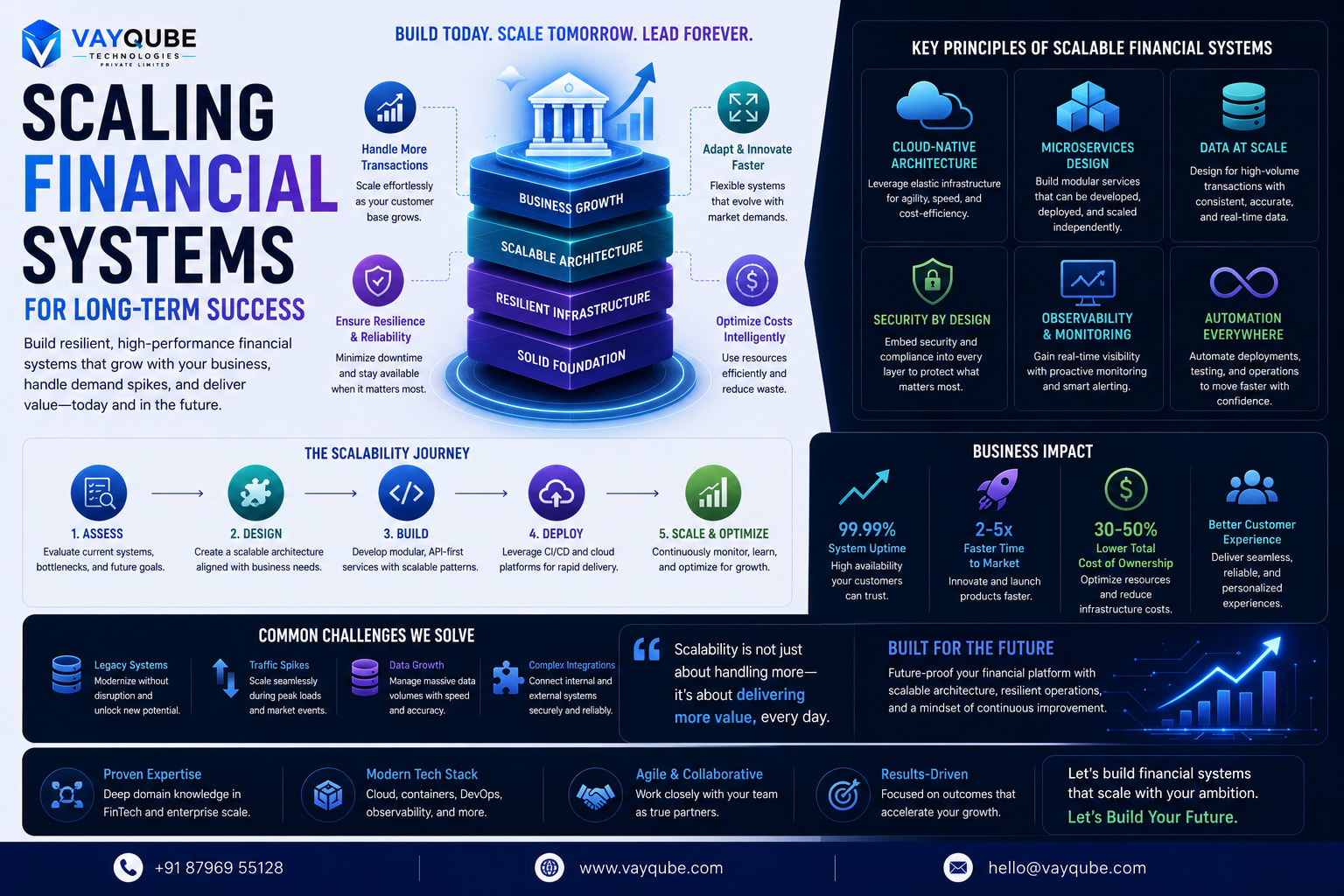
Financial Systems
Scalability
Business Growth
Implementation Strategy

Scaling Financial Systems for Long-Term Success

Developing scalable financial systems is crucial for businesses to achieve long-term success. This involves designing systems that can adapt to growing demands, reduce costs, and improve efficiency.

V

Vayqube Team

Author

2026-06-22 13 min read
Scaling Financial Systems for Long-Term SuccessScaling Financial Systems for Long-Term Success

Introduction to Scaling Financial Systems

Scaling financial systems is a critical aspect of ensuring long-term success in the financial industry. As businesses grow, their financial systems must be able to adapt to increasing complexity, transaction volumes, and regulatory requirements. A well-designed financial system can provide a competitive advantage, while a poorly scaled system can lead to inefficiencies, errors, and ultimately, financial losses.

The Importance of Long-Term Success

Long-term success in financial systems is not just about short-term gains, but about building a sustainable foundation for future growth. This requires careful planning, strategic investment, and a deep understanding of the business's financial needs. A long-term approach to financial system scaling enables businesses to make informed decisions, manage risk, and optimize resources.

Key considerations for long-term success include:

  • Developing a scalable financial infrastructure
  • Implementing robust risk management and compliance frameworks
  • Ensuring data quality and integrity
  • Fostering a culture of continuous improvement and innovation

Overview of Financial System Scaling

Financial system scaling involves a range of activities, from upgrading existing systems to implementing new technologies and processes. This can include:

  • Migrating to cloud-based financial platforms
  • Implementing automated accounting and reporting systems
  • Integrating with external systems and services
  • Developing custom financial applications and tools

Effective financial system scaling requires a deep understanding of the business's financial needs, as well as the technical capabilities of the systems being used. By taking a strategic and long-term approach to financial system scaling, businesses can position themselves for success in an increasingly complex and competitive financial landscape.

Real-World Implications

In real-world scenarios, the importance of scaling financial systems cannot be overstated. For example, a rapidly growing business may need to quickly scale its financial systems to accommodate increasing transaction volumes and revenue growth. Failure to do so can result in delayed financial reporting, inaccurate accounting, and missed business opportunities. By prioritizing long-term success and scaling financial systems accordingly, businesses can avoid these pitfalls and achieve sustained growth and profitability.


Why It Matters

Inefficient financial systems can have a profound impact on a business, affecting everything from daily operations to long-term growth. When financial systems are not scaled to meet the needs of a growing organization, it can lead to a range of consequences that can be detrimental to the business.

Consequences of Inaction

The consequences of not scaling financial systems can be severe, including:

  • Reduced productivity and efficiency, as manual processes and workarounds become necessary to compensate for inadequate systems
  • Increased risk of errors and inaccuracies, which can lead to financial losses and damage to the company's reputation
  • Inability to make informed decisions, due to lack of visibility into financial performance and limited analytics capabilities
  • Difficulty in complying with regulatory requirements, which can result in fines and penalties
  • Limited ability to adapt to changing market conditions, making it harder to stay competitive

Impact on Business Operations

The impact of inefficient financial systems on business operations can be far-reaching. For example, a company may struggle to manage cash flow, leading to difficulties in paying suppliers or investing in growth initiatives. Inefficient financial systems can also make it challenging to track and manage expenses, leading to wasted resources and missed opportunities for cost savings.

Long-Term Consequences

In the long term, the consequences of not scaling financial systems can be even more severe. A company that fails to invest in scalable financial systems may find it difficult to attract investors or secure funding for growth initiatives. Additionally, the lack of visibility into financial performance can make it challenging to identify areas for improvement, leading to stagnation and missed opportunities for innovation and growth.

Real-World Examples

Many companies have learned the hard way about the importance of scaling financial systems. For instance, a fast-growing startup may find that its initial financial systems are no longer adequate as the company expands, leading to delays in financial reporting and difficulties in managing cash flow. By prioritizing the development of scalable financial systems, businesses can avoid these pitfalls and set themselves up for long-term success.

Production Considerations

When implementing financial systems, it's essential to consider production readiness and the ability to scale. This includes evaluating the system's ability to handle increased traffic, data volume, and user growth, as well as its capacity for integration with other systems and tools. By taking a proactive approach to scaling financial systems, businesses can ensure that their financial infrastructure is equipped to support growth and drive long-term success.


Core Architecture

To build a scalable financial system, it's essential to understand the key components that enable long-term success. A well-designed core architecture is critical in supporting growing transaction volumes, increasing user bases, and evolving regulatory requirements.

Key Components

The core architecture of a scalable financial system consists of several key components, including:

  • A modular and microservices-based design, allowing for flexibility and ease of maintenance
  • A robust and scalable database management system, capable of handling large volumes of data
  • A secure and reliable payment processing system, ensuring timely and accurate transactions
  • A comprehensive and integrated risk management system, providing real-time monitoring and alerts

Role of Cloud Computing

Cloud computing plays a vital role in scaling financial systems, offering numerous benefits, including:

  • On-demand scalability, allowing for rapid adaptation to changing business needs
  • Enhanced security and compliance, through built-in security features and regular updates
  • Reduced infrastructure costs, through pay-as-you-go pricing models and minimized hardware requirements
  • Increased agility and flexibility, enabling faster deployment of new services and features

Automation and Efficiency

Automation is critical in scaling financial systems, enabling organizations to streamline processes, reduce manual errors, and increase efficiency. By leveraging automation technologies, such as robotic process automation (RPA) and machine learning (ML), financial institutions can:

  • Automate routine tasks and processes, freeing up staff to focus on higher-value activities
  • Improve data quality and accuracy, through automated data validation and reconciliation
  • Enhance customer experience, through personalized and timely communications and services

Implementation Considerations

When implementing a scalable financial system, organizations should consider several key factors, including:

  • Business requirements and goals, ensuring alignment with overall strategy and objectives
  • Technical infrastructure and architecture, ensuring scalability, security, and reliability
  • Change management and training, ensuring smooth transition and adoption of new systems and processes
  • Ongoing monitoring and maintenance, ensuring continuous improvement and optimization of the system.

Business Benefits

Implementing a scalable financial system can have a significant impact on an organization's bottom line. By leveraging modern technologies and architectures, businesses can unlock a range of benefits that drive long-term success.

Improved Financial Reporting and Analysis

With a scalable financial system, organizations can gain real-time insights into their financial performance. This enables them to make data-driven decisions, identify areas for improvement, and optimize their financial strategies. Improved financial reporting and analysis also facilitate compliance with regulatory requirements, reducing the risk of non-compliance and associated penalties.

Enhanced Decision-Making Capabilities

A scalable financial system provides businesses with the agility to respond quickly to changing market conditions. By leveraging advanced analytics and machine learning capabilities, organizations can forecast revenue, predict expenses, and identify new opportunities for growth. This enables them to make informed decisions, mitigate risks, and drive business expansion.

Increased Efficiency and Reduced Costs

Automating financial processes and leveraging cloud-based infrastructure can significantly reduce operational costs. A scalable financial system also enables organizations to streamline their financial workflows, eliminating manual errors and minimizing the need for manual intervention. This results in increased productivity, reduced labor costs, and improved profitability.

Some key advantages of a scalable financial system include:

  • Improved financial visibility and transparency
  • Enhanced collaboration and communication among stakeholders
  • Increased agility and responsiveness to changing market conditions
  • Reduced risk and improved compliance with regulatory requirements
  • Improved forecasting and predictive analytics capabilities

By implementing a scalable financial system, organizations can position themselves for long-term success, drive business growth, and stay ahead of the competition.


Scalability

To achieve long-term success, financial systems must be designed with scalability in mind. This involves considering two primary approaches: horizontal and vertical scaling.

Horizontal vs. Vertical Scaling

Horizontal scaling, also known as scaling out, involves adding more machines or nodes to the system to increase its overall capacity. This approach is particularly useful for handling increased traffic or workload, as it allows the system to distribute the load across multiple nodes. On the other hand, vertical scaling, or scaling up, involves increasing the power of individual nodes, such as by upgrading hardware or allocating more resources.

While vertical scaling can provide a quick fix, it is often limited by the maximum capacity of individual nodes. In contrast, horizontal scaling offers greater flexibility and can be more cost-effective in the long run. However, it also requires more complex management and coordination between nodes.

Importance of Flexibility and Adaptability

In today's fast-paced financial landscape, flexibility and adaptability are crucial for scalability. Financial systems must be able to respond quickly to changing market conditions, regulatory requirements, and customer needs. This requires a modular and microservices-based architecture that allows for easy integration of new components and services.

Some key considerations for achieving flexibility and adaptability include:

  • Using cloud-based infrastructure to enable rapid deployment and scaling
  • Implementing containerization and orchestration tools to streamline management and deployment
  • Adopting agile development methodologies to facilitate rapid iteration and response to changing requirements
  • Fostering a culture of innovation and experimentation to encourage the development of new solutions and services

By prioritizing scalability, flexibility, and adaptability, financial institutions can position themselves for long-term success and stay ahead of the competition in an increasingly complex and dynamic market.

Real-World Examples

Several financial institutions have successfully implemented scalable financial systems, achieving significant benefits such as increased efficiency, reduced costs, and improved customer satisfaction. For example:

  • A leading retail bank used horizontal scaling to increase its online banking capacity, resulting in a 30% increase in customer engagement and a 25% reduction in downtime.
  • A global investment firm adopted a microservices-based architecture, enabling it to launch new services and features 50% faster than before and reducing its time-to-market by 30%.

These examples demonstrate the potential of scalable financial systems to drive business growth, improve customer experience, and stay competitive in a rapidly evolving market.


Implementation Challenges

When scaling financial systems, organizations often encounter a range of implementation challenges that can hinder their progress and impact their bottom line. These challenges can be complex and multifaceted, requiring careful consideration and strategic planning to overcome.

Common Obstacles

Some common obstacles to scaling financial systems include:

  • Inadequate infrastructure, leading to performance bottlenecks and downtime
  • Insufficient data management, resulting in poor decision-making and compliance issues
  • Incompatible systems, causing integration headaches and data silos
  • Lack of skilled resources, leading to knowledge gaps and implementation delays
  • Ineffective change management, resulting in user resistance and adoption issues

Strategies for Overcoming Hurdles

To overcome these implementation hurdles, organizations can employ several strategies, including:

  • Conducting thorough assessments of their current infrastructure and systems to identify areas for improvement
  • Developing a robust data management strategy that ensures data quality, integrity, and compliance
  • Implementing a phased approach to system integration, allowing for gradual testing and validation
  • Investing in ongoing training and development programs to build the necessary skills and expertise
  • Establishing a clear change management plan that communicates the benefits and value of the scaled financial system to all stakeholders

Real-World Examples

In real-world scenarios, organizations that have successfully scaled their financial systems have often done so by prioritizing flexibility, scalability, and usability. For example, a large retail bank may implement a cloud-based financial management system to improve its ability to handle high volumes of transactions and customer data. Similarly, a fast-growing fintech company may leverage a microservices-based architecture to enable rapid innovation and deployment of new financial products and services.

Production Considerations

When implementing scaled financial systems, it is essential to consider production readiness and the potential impact on business operations. This includes ensuring that the system is thoroughly tested and validated, that all necessary security and compliance measures are in place, and that the organization has a clear plan for ongoing maintenance and support. By taking a proactive and strategic approach to implementation, organizations can minimize the risk of disruption and ensure a smooth transition to their scaled financial system.


Use Cases

Successful financial system scaling can be observed in various industries, each with its unique challenges and requirements.

Real-World Examples

Real-world examples of financial system scaling include:

  • A multinational bank that expanded its operations to new markets, requiring a scalable financial system to handle increased transaction volumes and regulatory compliance.
  • A fintech company that developed a mobile payment platform, needing to scale its financial system to accommodate rapid user growth and high transaction frequencies.
  • A retail company that implemented a scalable financial system to manage its e-commerce platform, handling large volumes of transactions and providing real-time financial insights.

Industry-Specific Applications

Different industries have distinct requirements for financial system scaling. For instance:

  • In the banking sector, scalability is crucial for handling large transaction volumes, ensuring regulatory compliance, and providing real-time financial reporting.
  • In the e-commerce industry, scalable financial systems are necessary for managing high volumes of transactions, handling multiple payment methods, and providing real-time inventory management.
  • In the insurance sector, scalable financial systems are required for handling complex policy management, claims processing, and risk assessment.

Best Practices

To achieve successful financial system scaling, organizations should follow best practices such as:

  • Implementing cloud-based financial systems to ensure scalability, flexibility, and cost-effectiveness.
  • Utilizing automation and artificial intelligence to streamline financial processes, reduce manual errors, and improve efficiency.
  • Ensuring regulatory compliance and security through robust risk management and audit trails.
  • Providing real-time financial insights and analytics to support informed decision-making.
  • Continuously monitoring and evaluating financial system performance to identify areas for improvement and optimize scalability.

Production Considerations

When implementing scalable financial systems, organizations should consider production factors such as:

  • System uptime and availability to ensure continuous financial operations.
  • Data backup and recovery procedures to prevent financial data loss.
  • Security and access controls to protect sensitive financial information.
  • Integration with existing financial systems and applications to ensure seamless data exchange.
  • Ongoing maintenance and support to ensure optimal system performance and scalability.

Best Practices

To ensure the long-term success of financial systems, it's essential to follow key principles for designing and implementing scalable solutions. A well-designed system can help organizations adapt to changing market conditions, increasing regulatory requirements, and evolving customer needs.

Key Principles

Some key principles for designing scalable financial systems include:

  • Modular architecture to facilitate easy integration and updates
  • Automated workflows to reduce manual errors and increase efficiency
  • Real-time data analytics to inform business decisions
  • Flexible data storage to accommodate growing volumes of data
  • Robust security measures to protect sensitive financial information

Ongoing Monitoring and Maintenance

Ongoing monitoring and maintenance are crucial to ensuring the continued scalability and performance of financial systems. This includes:

  • Regular system updates and patches to prevent security vulnerabilities
  • Performance monitoring to identify bottlenecks and areas for optimization
  • Data backups and disaster recovery plans to minimize downtime and data loss
  • Continuous testing and quality assurance to ensure system reliability

Implementation Considerations

When implementing scalable financial systems, organizations should consider the following factors:

  • Business requirements and growth projections
  • Technical infrastructure and resource constraints
  • Regulatory compliance and risk management
  • Change management and training for end-users
  • Integration with existing systems and third-party services

Real-World Examples

Real-world examples of scalable financial systems include:

  • Cloud-based accounting and invoicing platforms
  • Automated payment processing and reconciliation systems
  • Real-time financial reporting and dashboard tools
  • Machine learning-based fraud detection and prevention systems
  • Blockchain-based supply chain finance and trade finance platforms

Production Readiness

To ensure production readiness, organizations should focus on:

  • Testing and quality assurance to identify and fix defects
  • Performance optimization to ensure system scalability and reliability
  • Security and compliance testing to protect sensitive financial information
  • Training and support for end-users to ensure smooth adoption and usage
  • Ongoing monitoring and maintenance to ensure continued system performance and scalability

Frequently Asked Questions

Scaling financial systems can be a complex and daunting task, and it's natural to have questions and concerns. In this section, we'll address some of the most frequently asked questions about scaling financial systems, providing answers and insights from industry experts.

What are the key indicators that a financial system needs to be scaled?

When a financial system is struggling to keep up with growing demand, it's likely time to consider scaling. Some key indicators include:

  • Increasing transaction volumes
  • Rising latency or processing times
  • Insufficient data storage or processing capacity
  • Inadequate security or compliance measures
  • Limited scalability or flexibility in existing infrastructure

How do I ensure a scalable financial system is also secure and compliant?

Ensuring the security and compliance of a scalable financial system requires careful planning and implementation. This includes:

  • Implementing robust security protocols and encryption
  • Conducting regular audits and risk assessments
  • Ensuring compliance with relevant regulations and standards
  • Providing ongoing training and support for staff and stakeholders
  • Continuously monitoring and evaluating system performance and security

What are the most common challenges faced when scaling financial systems?

Some of the most common challenges faced when scaling financial systems include:

  • Managing increasing complexity and technical debt
  • Ensuring seamless integration with existing systems and infrastructure
  • Balancing scalability with security and compliance requirements
  • Managing costs and resource allocation
  • Ensuring effective communication and collaboration among stakeholders

How can I measure the success of a scaled financial system?

Measuring the success of a scaled financial system requires a combination of quantitative and qualitative metrics, including:

  • Transaction processing times and volumes
  • System uptime and availability
  • Security and compliance metrics
  • User adoption and satisfaction rates
  • Return on investment (ROI) and cost savings

What role does cloud computing play in scaling financial systems?

Cloud computing can play a significant role in scaling financial systems, offering benefits such as:

  • Increased scalability and flexibility
  • Reduced infrastructure and maintenance costs
  • Improved security and compliance
  • Enhanced collaboration and accessibility
  • Faster deployment and time-to-market

How can I ensure a smooth implementation process when scaling financial systems?

Ensuring a smooth implementation process when scaling financial systems requires careful planning, execution, and testing. This includes:

  • Developing a comprehensive project plan and timeline
  • Conducting thorough risk assessments and mitigation strategies
  • Providing ongoing training and support for staff and stakeholders
  • Continuously monitoring and evaluating system performance and security
  • Ensuring effective communication and collaboration among stakeholders

Conclusion

In scaling financial systems for long-term success, several key elements must be considered to ensure that the infrastructure can support growing demands without compromising performance or security.

Summary of Key Takeaways

The journey to achieving scalable financial systems involves understanding the core architecture, recognizing the business benefits, and addressing scalability and implementation challenges. Key takeaways include:

  • Designing a core architecture that is modular, flexible, and integrates well with existing systems
  • Leveraging cloud computing for scalability, reliability, and cost-effectiveness
  • Implementing robust security measures to protect sensitive financial data
  • Adopting best practices that prioritize simplicity, automation, and continuous monitoring
  • Learning from real-world use cases to inform strategic decisions

Final Thoughts on Achieving Long-Term Success

Achieving long-term success with scalable financial systems requires a strategic approach that balances immediate needs with future growth potential. It involves not just the implementation of technology, but also a cultural shift towards embracing innovation, risk management, and continuous improvement. By focusing on scalability, security, and efficiency, organizations can position themselves for sustained growth and competitiveness in the financial sector.

The importance of scalability cannot be overstated, as it directly impacts an organization's ability to adapt to changing market conditions, regulatory requirements, and customer expectations. Scalable financial systems enable businesses to respond quickly to opportunities and challenges, ensuring they remain agile and competitive.

In the real world, the implementation of scalable financial systems is not a one-time project but an ongoing process. It requires continuous assessment of current systems, identification of bottlenecks, and strategic planning for future upgrades and expansions. By prioritizing scalability and adopting a forward-thinking approach, financial institutions can navigate the complexities of the modern financial landscape with confidence and poise.

Ultimately, the path to long-term success in the financial sector is paved with strategic investments in scalable, secure, and efficient systems. As technology continues to evolve and play an increasingly critical role in financial operations, the ability to scale and adapt will become ever more crucial. By laying the groundwork for scalable financial systems today, organizations can secure their position as leaders in the market tomorrow.


Related Vayqube Resources


Next Step

If your systems are struggling with scalability, automation, architecture complexity, or operational efficiency, it's time to modernize your infrastructure and workflows.

👉 Talk to a Vayqube solution architect and build systems designed for long-term production growth:

Contact Vayqube Technologies

Ready to build something powerful?

Book a free 30-minute strategy call.