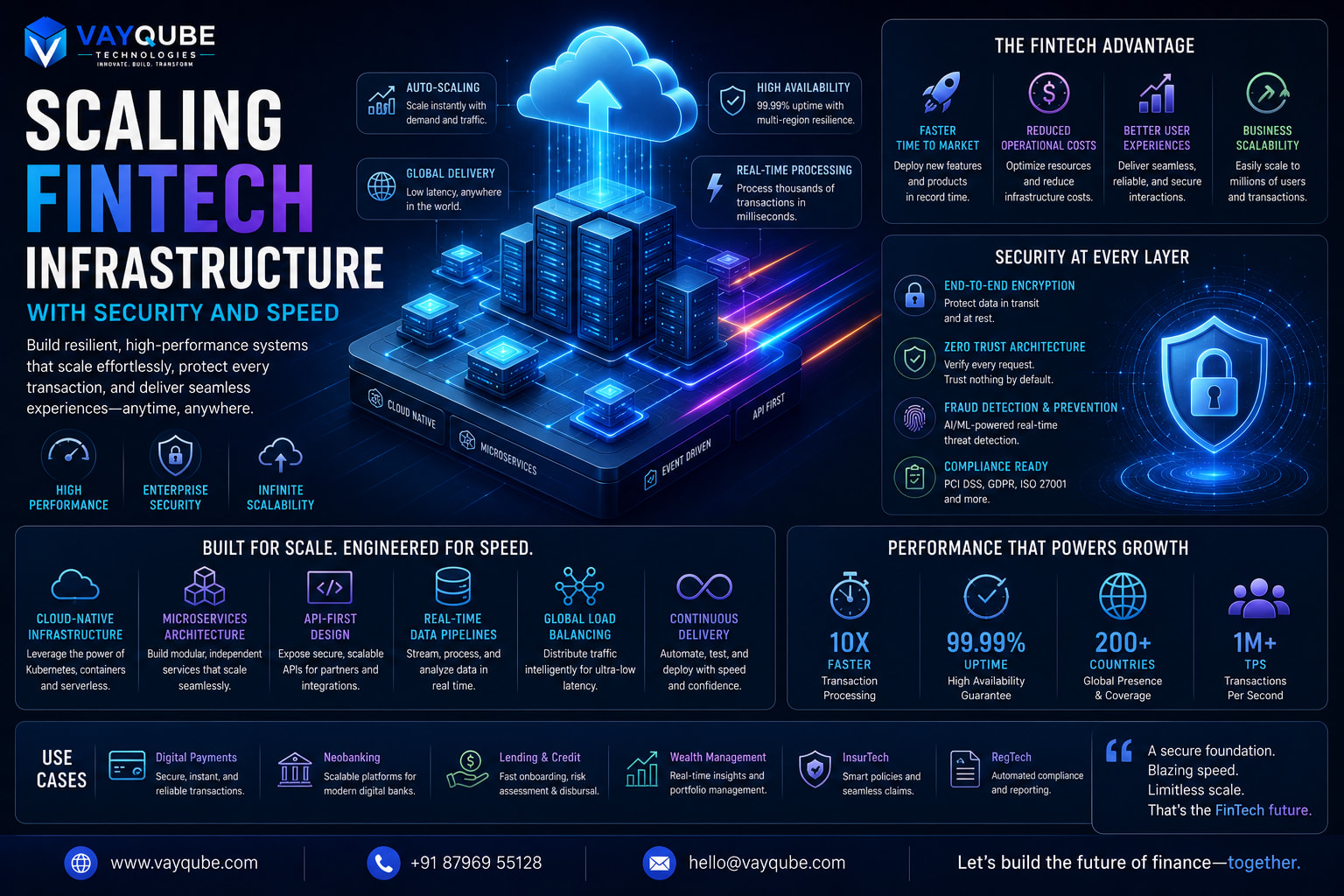
Scaling FinTech Infrastructure with Security and Speed
Learn the key strategies for securely scaling FinTech infrastructure, from cloud security to compliance and risk management
Vayqube Team
Author


Introduction to Scaling FinTech Infrastructure
The FinTech industry has experienced rapid growth in recent years, driven by the increasing demand for digital payment systems, online banking, and other financial services. As a result, FinTech companies are facing significant challenges in scaling their infrastructure to meet the growing demand while ensuring the security and speed of their services.
The importance of security in FinTech cannot be overstated. Financial transactions involve sensitive data, and any breach can have severe consequences, including financial losses and damage to reputation. Therefore, FinTech companies must prioritize security when scaling their infrastructure.
Speed is also a critical factor in FinTech, as slow transaction processing times can lead to lost business and customer dissatisfaction. FinTech companies must ensure that their infrastructure can handle high volumes of transactions quickly and efficiently.
Overview of FinTech Infrastructure
FinTech infrastructure typically consists of a combination of hardware, software, and network components. This includes data centers, cloud services, databases, and application servers. As FinTech companies grow, their infrastructure must be able to scale to handle increased traffic, data storage, and processing demands.
Importance of Security and Speed
Security and speed are intertwined in FinTech infrastructure. A secure infrastructure is essential for protecting sensitive data, but it can also impact performance. For example, implementing robust security measures, such as encryption and firewalls, can add latency to transaction processing times. Therefore, FinTech companies must strike a balance between security and speed when scaling their infrastructure.
Brief Introduction to Scaling FinTech Infrastructure
Scaling FinTech infrastructure requires a strategic approach that takes into account the unique challenges of the industry. This includes ensuring the security and integrity of financial data, complying with regulatory requirements, and providing fast and reliable transaction processing. In the following sections, we will explore the key considerations and strategies for scaling FinTech infrastructure with security and speed.
Some key considerations for scaling FinTech infrastructure include:
- Ensuring compliance with regulatory requirements, such as PCI-DSS and GDPR
- Implementing robust security measures, such as encryption and access controls
- Optimizing database and application performance for fast transaction processing
- Selecting scalable and reliable infrastructure components, such as cloud services and data centers
- Monitoring and analyzing performance metrics to identify areas for improvement
By understanding these considerations and implementing effective scaling strategies, FinTech companies can ensure the security and speed of their infrastructure, even as they experience rapid growth and increasing demand.
Why It Matters
Inadequate FinTech infrastructure can have severe consequences, including data breaches, system downtime, and failed transactions. These incidents can lead to significant financial losses, damage to customer trust, and erosion of business reputation.
Consequences of Inadequate Infrastructure
The consequences of inadequate infrastructure can be far-reaching, including:
- Financial losses due to system downtime and failed transactions
- Damage to customer trust and loyalty
- Erosion of business reputation and loss of competitive advantage
- Regulatory non-compliance and potential fines
- Increased risk of cyber attacks and data breaches
Benefits of Prioritizing Security and Speed
Prioritizing security and speed in FinTech infrastructure can have numerous benefits, including:
- Enhanced customer trust and loyalty
- Improved business reputation and competitive advantage
- Increased operational efficiency and reduced costs
- Better regulatory compliance and reduced risk of fines
- Improved ability to adapt to changing market conditions and customer needs
Impact on Customer Trust and Business Reputation
The impact of inadequate infrastructure on customer trust and business reputation cannot be overstated. Customers expect fast, secure, and reliable transactions, and any failure to deliver can lead to a loss of trust and loyalty. In contrast, prioritizing security and speed can enhance customer trust and loyalty, leading to increased customer retention and acquisition.
Real-World Examples
Real-world examples of FinTech companies that have prioritized security and speed include:
- Implementing robust security protocols to prevent data breaches and cyber attacks
- Investing in scalable infrastructure to support high volumes of transactions
- Utilizing cloud-based services to improve operational efficiency and reduce costs
- Implementing artificial intelligence and machine learning to improve transaction processing and reduce risk
Production Considerations
When implementing FinTech infrastructure, production considerations are critical. This includes:
- Ensuring scalability and reliability to support high volumes of transactions
- Implementing robust security protocols to prevent data breaches and cyber attacks
- Utilizing monitoring and analytics tools to detect and respond to potential issues
- Ensuring regulatory compliance and adherence to industry standards.
Core Architecture
To achieve scalability and speed in FinTech infrastructure, a well-designed core architecture is crucial. This involves leveraging cloud-based infrastructure, which provides the flexibility and on-demand resources needed to handle fluctuating workloads. Cloud infrastructure allows FinTech companies to scale up or down as required, reducing the need for upfront capital expenditures and minimizing the risk of resource underutilization.
Cloud-Based Infrastructure
Cloud-based infrastructure offers numerous benefits, including reduced maintenance costs, enhanced collaboration, and improved disaster recovery capabilities. By hosting applications and data in the cloud, FinTech companies can ensure high availability and reliability, which are essential for maintaining customer trust and satisfaction. Moreover, cloud providers offer a range of security features and compliance tools, helping to alleviate some of the regulatory burdens associated with financial services.
Microservices and Containerization
The role of microservices and containerization in FinTech infrastructure cannot be overstated. Microservices architecture allows for the development of applications as a collection of small, independent services, each with its own repository and deployment schedule. This approach enables faster time-to-market, improved fault tolerance, and more efficient resource utilization. Containerization, using tools like Docker, provides a lightweight and portable way to deploy applications, ensuring consistency across different environments and reducing the complexity associated with traditional virtualization techniques.
Robust Security Protocols
Robust security protocols are essential for protecting sensitive financial data and preventing cyber threats. This includes implementing encryption, firewalls, and access controls to ensure that only authorized personnel can access and manipulate data. Additionally, FinTech companies must adhere to relevant regulatory requirements, such as PCI-DSS, GDPR, and SOC 2, to maintain the trust of their customers and partners. Some key security considerations include:
- Data encryption at rest and in transit
- Regular security audits and penetration testing
- Implementation of incident response plans
- Continuous monitoring of network activity and system logs
- Training and awareness programs for employees and stakeholders
By prioritizing security and leveraging the benefits of cloud-based infrastructure, microservices, and containerization, FinTech companies can build a scalable and resilient core architecture that supports their growth and innovation goals. This foundation is critical for delivering high-quality financial services, ensuring customer satisfaction, and maintaining a competitive edge in the market.
Business Benefits
The FinTech infrastructure plays a critical role in driving business success. By scaling this infrastructure with security and speed, organizations can reap numerous benefits that impact their bottom line.
Enhanced Customer Experience
A scalable FinTech infrastructure enables organizations to provide a seamless and responsive customer experience. This is achieved through faster transaction processing, reduced latency, and increased uptime. As a result, customers can enjoy uninterrupted services, leading to increased satisfaction and loyalty. For instance, a mobile payment platform can process transactions quickly, allowing users to make payments on-the-go without any delays.
Increased Operational Efficiency
Scaling FinTech infrastructure also leads to increased operational efficiency. Automated processes, streamlined workflows, and real-time monitoring enable organizations to reduce manual errors, minimize downtime, and optimize resource allocation. This, in turn, allows organizations to focus on high-value tasks, such as developing new services and improving customer engagement. Key benefits include:
- Reduced operational costs
- Improved resource utilization
- Enhanced risk management
Competitive Advantage
In today's competitive FinTech landscape, organizations that can scale their infrastructure with security and speed gain a significant competitive advantage. By leveraging advanced technologies, such as cloud computing, artificial intelligence, and blockchain, organizations can innovate faster, respond to market changes quickly, and stay ahead of the competition. This enables them to attract new customers, expand into new markets, and increase their market share. Real-world examples include:
- Digital banks that offer personalized services and instant account opening
- Payment processors that provide fast and secure transaction processing
- Investment platforms that offer real-time portfolio management and analytics
By focusing on these business benefits, organizations can create a robust and scalable FinTech infrastructure that drives growth, improves customer satisfaction, and enhances competitiveness in the market.
Scalability
To achieve scalability in FinTech infrastructure, organizations must consider two primary approaches: horizontal and vertical scaling. Horizontal scaling involves adding more servers or instances to distribute the workload, while vertical scaling focuses on increasing the power of existing servers.
Horizontal vs Vertical Scaling
Horizontal scaling is often preferred in cloud-based environments, as it allows for easier addition and removal of resources as needed. This approach also provides better fault tolerance, as the failure of one server does not significantly impact the overall system. On the other hand, vertical scaling can lead to increased costs and complexity, as more powerful servers may be required to handle growing workloads.
Auto-Scaling and Load Balancing Strategies
Implementing auto-scaling and load balancing strategies is crucial for ensuring seamless scalability. Auto-scaling enables the automatic addition or removal of resources based on demand, while load balancing distributes incoming traffic across multiple servers to prevent overload. By leveraging these strategies, FinTech organizations can ensure their infrastructure scales efficiently and effectively, even during periods of high traffic or demand.
Monitoring and Optimizing Performance
To optimize scalability, FinTech organizations must also prioritize monitoring and performance optimization. This involves tracking key performance indicators (KPIs) such as response times, latency, and throughput, and using this data to identify areas for improvement. Some key considerations include:
- Implementing robust monitoring tools to track system performance
- Analyzing performance data to identify bottlenecks and areas for optimization
- Optimizing database queries and indexing for improved performance
- Leveraging caching and content delivery networks (CDNs) to reduce latency and improve response times
By taking a proactive approach to scalability, FinTech organizations can ensure their infrastructure is equipped to handle growing demands and provide a seamless user experience. This, in turn, can help drive business growth, improve customer satisfaction, and maintain a competitive edge in the market.
Real-World Examples
In real-world scenarios, FinTech organizations have successfully implemented scalable infrastructure to support their growth. For example, a digital payments platform may use a combination of horizontal scaling and auto-scaling to handle increased traffic during peak periods, while a mobile banking app may leverage load balancing and caching to ensure fast and reliable performance. By studying these examples and applying the principles of scalability, FinTech organizations can develop infrastructure that is both secure and high-performing.
Production Considerations
When implementing scalable infrastructure in production environments, FinTech organizations must also consider factors such as security, compliance, and reliability. This includes ensuring that all components of the infrastructure are secure and up-to-date, as well as implementing robust backup and disaster recovery procedures to minimize downtime and data loss. By prioritizing these considerations, FinTech organizations can ensure their scalable infrastructure is both high-performing and reliable, even in the most demanding production environments.
Implementation Challenges
When implementing FinTech infrastructure, several challenges can arise if not properly addressed. These challenges can hinder the scalability, security, and overall performance of the system.
Common Pitfalls in Infrastructure Design
Common pitfalls in infrastructure design include inadequate planning, insufficient testing, and poor resource allocation. These oversights can lead to bottlenecks, downtime, and security vulnerabilities. For instance, a lack of redundancy in critical systems can result in significant losses in the event of a failure. To mitigate these risks, it's essential to conduct thorough risk assessments and develop contingency plans.
Managing Complexity and Technical Debt
Managing complexity and technical debt is crucial to ensuring the long-term sustainability of FinTech infrastructure. As systems evolve, technical debt can accumulate, making it challenging to maintain and update the infrastructure. This can lead to increased costs, decreased performance, and heightened security risks. Implementing a robust change management process and continuously monitoring system performance can help identify and address technical debt before it becomes a significant issue.
Ensuring Compliance with Regulatory Requirements
Ensuring compliance with regulatory requirements is a critical aspect of FinTech infrastructure implementation. Regulatory bodies impose strict guidelines to protect sensitive financial data and prevent illicit activities. Non-compliance can result in severe penalties, reputational damage, and loss of customer trust. To ensure compliance, FinTech companies must stay up-to-date with evolving regulatory requirements and implement robust security measures, such as encryption, access controls, and auditing mechanisms. Some key considerations include:
- Data protection and privacy laws
- Anti-money laundering (AML) and know-your-customer (KYC) regulations
- Payment Card Industry Data Security Standard (PCI DSS) compliance
- Regular security audits and risk assessments
By understanding and addressing these implementation challenges, FinTech companies can build a robust, scalable, and secure infrastructure that supports their business goals and ensures the trust of their customers. Effective planning, management, and compliance are essential to navigating the complexities of FinTech infrastructure implementation and achieving long-term success.
Use Cases
Successful FinTech infrastructure scaling is crucial for companies looking to expand their services while maintaining security and speed. Several companies have achieved this balance, providing valuable lessons for others.
Real-World Examples
Companies like Stripe and PayPal have successfully scaled their FinTech infrastructure, handling millions of transactions daily. These companies have implemented robust security measures, such as encryption and two-factor authentication, to protect user data. They have also optimized their systems for speed, using technologies like cloud computing and content delivery networks (CDNs) to reduce latency.
Case Studies
- Stripe: Stripe's infrastructure is built on a microservices architecture, allowing them to scale individual components independently. This approach has enabled them to handle large volumes of traffic without compromising security or speed.
- PayPal: PayPal's infrastructure is designed with security in mind, using advanced threat detection and machine learning algorithms to identify and prevent potential attacks. They have also implemented a robust content delivery network (CDN) to reduce latency and improve user experience.
Lessons Learned
Implementing a scalable FinTech infrastructure is not without challenges. Companies must balance security and speed, ensuring that their systems are both robust and efficient. Some key lessons learned from implementation challenges include:
- Prioritizing security: Security should be a top priority when designing FinTech infrastructure. Companies must implement robust security measures, such as encryption and two-factor authentication, to protect user data.
- Optimizing for speed: Speed is critical in FinTech, where transactions must be processed quickly and efficiently. Companies should optimize their systems for speed, using technologies like cloud computing and CDNs to reduce latency.
- Monitoring and maintenance: Regular monitoring and maintenance are essential for ensuring the security and speed of FinTech infrastructure. Companies should implement robust monitoring tools and perform regular maintenance tasks, such as software updates and security patches, to prevent potential issues.
Implementation Strategies
To achieve successful FinTech infrastructure scaling, companies should focus on implementing a robust and scalable architecture. This can be achieved by:
- Using cloud computing: Cloud computing provides a scalable and on-demand infrastructure, allowing companies to quickly scale up or down to meet changing needs.
- Implementing a microservices architecture: A microservices architecture allows companies to scale individual components independently, reducing the risk of system-wide failures.
- Prioritizing security and speed: Companies should prioritize security and speed when designing their FinTech infrastructure, implementing robust security measures and optimizing their systems for speed.
Production Readiness
To ensure production readiness, companies should thoroughly test their FinTech infrastructure, simulating real-world scenarios and identifying potential issues. They should also implement robust monitoring tools and perform regular maintenance tasks, such as software updates and security patches, to prevent potential issues. By prioritizing security, speed, and scalability, companies can ensure their FinTech infrastructure is production-ready and capable of handling large volumes of traffic.
Best Practices
To achieve the delicate balance between security and speed in FinTech infrastructure, several best practices can be employed. These practices not only ensure that the infrastructure is scalable and secure but also foster an environment of innovation and collaboration.
Designing for Scalability and Security
Designing FinTech infrastructure with scalability and security in mind from the outset is crucial. This involves:
- Implementing cloud-native architectures that can scale on demand
- Utilizing containerization and orchestration tools to ensure efficient resource allocation
- Embedding security into every layer of the infrastructure, from data encryption to access controls
- Conducting thorough risk assessments and penetration testing to identify and mitigate potential vulnerabilities
Implementing Continuous Monitoring and Testing
Continuous monitoring and testing are key to ensuring the infrastructure remains secure and performs optimally. This includes:
- Real-time monitoring of system performance and security logs
- Automated testing and deployment pipelines to ensure rapid iteration and feedback
- Regular security audits and compliance checks to ensure adherence to regulatory standards
- Implementing a DevSecOps culture that integrates security into every stage of the development lifecycle
Fostering a Culture of Innovation and Collaboration
A culture that encourages innovation and collaboration is vital for the long-term success of FinTech infrastructure. This can be achieved by:
- Encouraging cross-functional teams to work together on projects
- Providing resources and support for ongoing education and training
- Fostering an environment where experimentation and calculated risk-taking are valued
- Recognizing and rewarding innovation and collaboration, reinforcing these values across the organization
By adopting these best practices, FinTech companies can build infrastructure that is not only secure and scalable but also agile and innovative, capable of meeting the evolving needs of the financial technology landscape. This approach enables companies to stay ahead of the competition, mitigate risks, and capitalize on new opportunities as they emerge.
FAQ
To address common concerns and provide clarity on scaling FinTech infrastructure, we've compiled a list of frequently asked questions.
Common Questions
The following questions are often raised when discussing the scalability of FinTech infrastructure:
- How do I ensure the security of sensitive financial data while scaling my infrastructure?
- What are the key performance indicators (KPIs) to monitor when assessing the speed of my FinTech infrastructure?
- Can I scale my infrastructure without compromising compliance with regulatory requirements?
Addressing Concerns
When it comes to security and speed, FinTech companies must balance these competing demands. To address concerns about security, consider implementing robust encryption methods, secure data storage solutions, and regular security audits. For speed, focus on optimizing network latency, leveraging content delivery networks (CDNs), and implementing efficient data processing algorithms.
Additional Resources
For further learning and exploration of scaling FinTech infrastructure with security and speed, consider the following resources:
- Industry reports from reputable research firms, such as Gartner or Forrester, can provide valuable insights into the latest trends and best practices.
- Online forums and communities, like FinTech Reddit or Stack Overflow, offer a platform to connect with peers and experts in the field.
- Webinars and workshops hosted by industry leaders can provide hands-on training and knowledge sharing opportunities.
Real-World Examples
Real-world examples of successful FinTech infrastructure scaling can be seen in companies like Stripe or PayPal, which have implemented scalable and secure infrastructure to support their growth. These companies have demonstrated the importance of prioritizing security and speed when scaling FinTech infrastructure, and their approaches can serve as a model for other organizations.
Production Considerations
When scaling FinTech infrastructure, it's essential to consider production readiness and the potential impact on business operations. This includes ensuring that the infrastructure can handle increased traffic and data processing demands, while maintaining the highest levels of security and compliance. By prioritizing production considerations, FinTech companies can minimize downtime and ensure a seamless user experience.
Implementation Strategy
A well-planned implementation strategy is critical to successful FinTech infrastructure scaling. This involves assessing current infrastructure, identifying areas for improvement, and developing a roadmap for scaling. By taking a strategic approach to implementation, FinTech companies can ensure a smooth transition to a scalable and secure infrastructure.
Business Impact
The business impact of scaling FinTech infrastructure cannot be overstated. A scalable and secure infrastructure can enable FinTech companies to expand their customer base, increase revenue, and improve competitiveness. By prioritizing infrastructure scaling, FinTech companies can position themselves for long-term success and growth.
Further Learning
For those looking to dive deeper into the topic of scaling FinTech infrastructure, we recommend exploring industry publications, attending conferences, and engaging with online communities. By staying up-to-date with the latest trends and best practices, FinTech professionals can ensure they have the knowledge and expertise needed to drive business success.
Conclusion
In scaling FinTech infrastructure, security and speed are paramount. Key takeaways from our discussion include the importance of a robust core architecture, the benefits of scalability, and the need for careful implementation to overcome challenges. Real-world use cases have demonstrated the effectiveness of prioritizing security and speed in FinTech infrastructure.
Recap of Key Takeaways
- A well-designed core architecture is essential for supporting the demands of FinTech applications
- Scalability is crucial for handling increased traffic and large amounts of data
- Implementation challenges can be overcome with careful planning and best practices
- Business benefits of scaling FinTech infrastructure with security and speed include improved customer experience, increased revenue, and enhanced competitiveness
Future Outlook
The future of FinTech infrastructure looks promising, with emerging technologies like cloud computing, artificial intelligence, and blockchain set to play a major role. As the industry continues to evolve, businesses must prioritize scaling with security and speed to remain competitive. This includes investing in robust infrastructure, adopting best practices, and staying up-to-date with the latest trends and technologies.
Call to Action
For businesses looking to scale their FinTech infrastructure with security and speed, the time to act is now. By prioritizing scalability, security, and speed, businesses can improve their bottom line, enhance customer experience, and stay ahead of the competition. This requires a proactive approach, including:
- Assessing current infrastructure and identifying areas for improvement
- Developing a robust implementation strategy
- Investing in emerging technologies and trends
- Staying focused on security and speed throughout the scaling process
By taking these steps, businesses can position themselves for success in the rapidly evolving FinTech landscape. With the right approach, scaling FinTech infrastructure with security and speed can be a key driver of growth, innovation, and competitiveness.
Related Vayqube Resources
- How To Build Fintech Application Payments Security Scaling
- Why Most Ai Projects Fail Before Production
- Best Fintech Software Development Company In New York
- How To Build Scalable Nodejs Backend Production Guide
- Best Mobile App Development Company In New York
- Top Fintech Software Development Company In New York
Next Step
If your systems are struggling with scalability, automation, architecture complexity, or operational efficiency, it's time to modernize your infrastructure and workflows.
👉 Talk to a Vayqube solution architect and build systems designed for long-term production growth: