
Navigating RBI Compliance for FinTech Products
FinTech companies in India must navigate complex RBI compliance requirements. Learn about the challenges and strategies for success.
Vayqube Team
Author
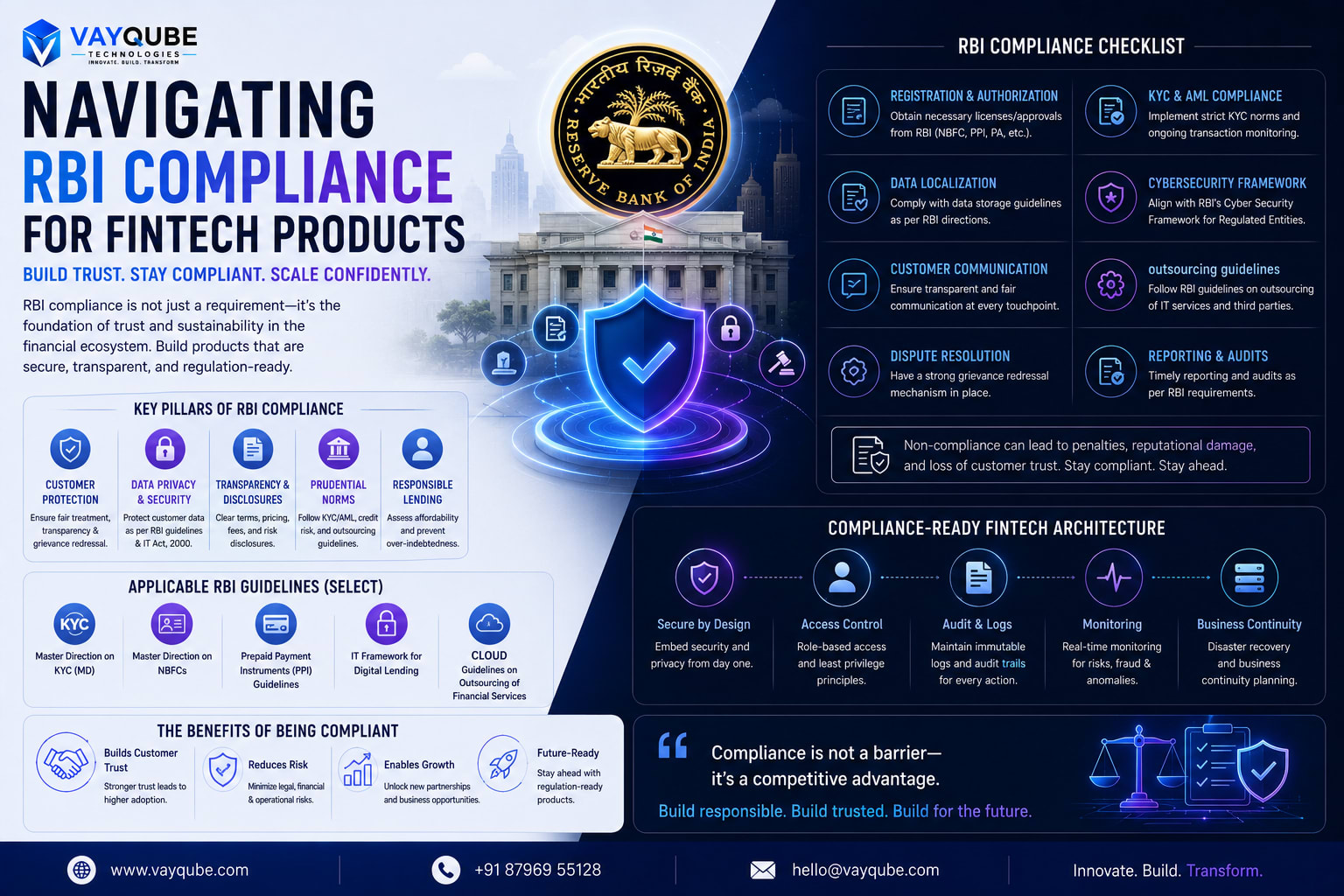
Introduction to RBI Compliance
The Reserve Bank of India (RBI) plays a crucial role in regulating the financial sector in India, and its guidelines have a significant impact on FinTech products. RBI compliance is essential for FinTech companies operating in India, as it ensures the security and integrity of financial transactions.
Overview of RBI Compliance
RBI compliance involves adhering to a set of rules and regulations set by the Reserve Bank of India, which govern various aspects of financial transactions, including payment systems, mobile wallets, and digital banking. These regulations are designed to protect consumers, prevent money laundering, and maintain the stability of the financial system.
Importance of Compliance for FinTech Products
Compliance with RBI guidelines is vital for FinTech products, as it helps to build trust with customers, reduces the risk of financial losses, and prevents reputational damage. Non-compliance can result in severe penalties, fines, and even the cancellation of licenses. Therefore, FinTech companies must prioritize RBI compliance to ensure the long-term success and sustainability of their products.
Introduction to RBI Guidelines
The Reserve Bank of India has issued several guidelines and regulations for FinTech companies, including the Payment and Settlement Systems Act, 2007, and the Master Direction on Digital Payment Security Controls. These guidelines provide a framework for FinTech companies to follow, ensuring that their products and services meet the required standards for security, reliability, and customer protection.
Some key aspects of RBI guidelines include:
- Customer authentication and verification
- Transaction security and encryption
- Data storage and protection
- Compliance with anti-money laundering (AML) and know-your-customer (KYC) regulations
- Regular audits and risk assessments
By understanding and complying with these guidelines, FinTech companies can ensure that their products meet the required standards, reducing the risk of non-compliance and reputational damage. In the next section, we will delve deeper into the key aspects of RBI compliance and their implications for FinTech products.
Why It Matters
Compliance with RBI regulations is crucial for FinTech products operating in India. Non-compliance can have severe consequences, including financial penalties, reputational damage, and even business closure. On the other hand, adhering to RBI regulations can bring numerous benefits, such as increased customer trust, improved operational efficiency, and enhanced business reputation.
Consequences of Non-Compliance
The consequences of non-compliance with RBI regulations can be far-reaching and devastating for FinTech products. Some of the potential consequences include:
- Financial penalties and fines
- Reputational damage and loss of customer trust
- Business closure or suspension of operations
- Legal action and prosecution
- Damage to the company's brand and goodwill
Benefits of Adhering to RBI Regulations
Adhering to RBI regulations can have numerous benefits for FinTech products, including:
- Increased customer trust and confidence
- Improved operational efficiency and reduced risk
- Enhanced business reputation and credibility
- Access to new markets and customers
- Improved relationships with regulators and other stakeholders
Impact on Business Operations and Reputation
Compliance with RBI regulations can have a significant impact on business operations and reputation. For example:
- Compliance can help FinTech products to mitigate risks and prevent financial losses
- Compliance can help to improve operational efficiency and reduce costs
- Compliance can help to enhance business reputation and credibility, leading to increased customer trust and loyalty
- Non-compliance can lead to reputational damage and loss of customer trust, ultimately affecting the bottom line of the business
The importance of RBI compliance cannot be overstated, and FinTech products must prioritize compliance to avoid the consequences of non-compliance and reap the benefits of adhering to RBI regulations. By doing so, FinTech products can ensure the long-term sustainability and success of their business, while also contributing to the stability and integrity of the financial system.
Implementation Considerations
When implementing RBI compliance measures, FinTech products must consider several factors, including:
- The complexity and scope of the regulations
- The resources and expertise required to ensure compliance
- The potential impact on business operations and reputation
- The need for ongoing monitoring and review to ensure continued compliance By carefully considering these factors, FinTech products can develop effective compliance strategies that meet the requirements of RBI regulations and support the long-term success of their business.
Core Architecture
To navigate RBI compliance for FinTech products, it's essential to understand the key components of the core architecture. This includes the technical requirements for FinTech products, data security, and privacy measures.
Technical Requirements
The technical requirements for FinTech products are designed to ensure the security and integrity of financial data. Some of the key technical requirements include:
- Implementing robust encryption methods to protect sensitive data
- Using secure protocols for data transmission and storage
- Conducting regular security audits and penetration testing
- Ensuring compliance with industry standards and regulations, such as PCI-DSS and ISO 27001
Data Security Measures
Data security is a critical aspect of RBI compliance, and FinTech companies must implement robust measures to protect sensitive data. Some of the key data security measures include:
- Implementing access controls and authentication mechanisms to restrict access to authorized personnel
- Using secure data storage solutions, such as encrypted databases and secure file systems
- Conducting regular data backups and disaster recovery planning
- Ensuring that all data is handled and processed in accordance with RBI guidelines and regulations
Privacy Measures
In addition to data security, FinTech companies must also implement robust privacy measures to protect sensitive customer information. Some of the key privacy measures include:
- Implementing transparent data collection and usage policies
- Obtaining explicit customer consent for data collection and usage
- Ensuring that all customer data is handled and processed in accordance with RBI guidelines and regulations
- Providing customers with clear and concise information about their rights and options regarding data collection and usage
The core architecture of RBI compliance for FinTech products is designed to ensure the security, integrity, and privacy of financial data. By implementing robust technical requirements, data security measures, and privacy measures, FinTech companies can ensure compliance with RBI regulations and maintain the trust and confidence of their customers.
Implementation Strategy
Implementing RBI compliance for FinTech products requires a strategic approach that takes into account the unique needs and requirements of the organization. This includes:
- Conducting a thorough risk assessment to identify potential vulnerabilities and weaknesses
- Developing a comprehensive compliance plan that outlines the steps and procedures for achieving and maintaining compliance
- Implementing a robust governance framework that ensures ongoing compliance and monitoring
- Providing training and awareness programs for employees and stakeholders to ensure that they understand the importance of RBI compliance and their role in maintaining it.
Production Readiness
To ensure production readiness, FinTech companies must test and validate their RBI compliance measures in a production-like environment. This includes:
- Conducting thorough testing and validation of all compliance measures
- Ensuring that all systems and processes are fully operational and functional
- Conducting regular security audits and penetration testing to identify and address potential vulnerabilities
- Ensuring that all compliance measures are fully documented and easily accessible to regulatory authorities and auditors.
Business Benefits
Implementing RBI compliance in FinTech products offers numerous benefits that can significantly impact a company's bottom line. By prioritizing compliance, FinTech companies can enhance their credibility and trust among customers, regulators, and investors. This, in turn, leads to increased customer confidence, as users feel more secure when using compliant products.
Enhanced Credibility and Trust
Compliance with RBI regulations demonstrates a commitment to security, stability, and customer protection. This can lead to:
- Improved brand reputation
- Increased customer loyalty
- Better relationships with regulators and investors
- Enhanced credibility in the market
Increased Customer Confidence
When FinTech products adhere to RBI guidelines, customers are more likely to trust the platform, leading to:
- Higher adoption rates
- Increased transaction volumes
- Improved customer retention
- Positive word-of-mouth referrals
Competitive Advantage in the Market
By prioritizing RBI compliance, FinTech companies can differentiate themselves from competitors and establish a competitive advantage. This can be achieved through:
- Demonstrating a commitment to security and customer protection
- Offering compliant products that meet regulatory requirements
- Attracting customers who value security and stability
- Expanding market share through strategic partnerships and collaborations
In the highly competitive FinTech market, RBI compliance is no longer a nice-to-have, but a must-have for companies looking to establish themselves as trusted and reliable players. By prioritizing compliance, FinTech companies can reap the benefits of enhanced credibility, increased customer confidence, and a competitive advantage in the market.
Real-World Applications
In real-world scenarios, RBI compliance can be applied in various ways, such as:
- Implementing robust security measures to protect customer data
- Conducting regular audits to ensure compliance with regulatory requirements
- Developing compliant products that meet specific regulatory guidelines
- Collaborating with regulators and industry experts to stay up-to-date with changing regulations
By focusing on RBI compliance, FinTech companies can ensure they are well-equipped to navigate the complex regulatory landscape and capitalize on emerging opportunities.
Scalability
To ensure RBI compliance for FinTech products, scalability is a critical factor. As the customer base expands, the system must be able to handle increased traffic and data volume without compromising performance or security.
Designing Compliant Systems for Growth
A scalable system is designed to accommodate growth while maintaining compliance with evolving regulations. This involves:
- Implementing flexible architecture that can adapt to changing regulatory requirements
- Ensuring data storage and processing capabilities can handle increased volume
- Developing a robust security framework to protect sensitive customer data
Flexible Architecture for Evolving Regulations
A flexible architecture allows FinTech companies to respond quickly to changes in regulations, reducing the risk of non-compliance. This can be achieved by:
- Using modular design principles to enable easy integration of new components
- Implementing APIs to facilitate seamless communication between systems
- Adopting a microservices architecture to enable scalability and flexibility
Scalable Solutions for Expanding Customer Base
As the customer base grows, FinTech companies must ensure that their systems can handle increased traffic and data volume. Scalable solutions include:
- Cloud-based infrastructure to enable on-demand scaling
- Load balancing and autoscaling to ensure optimal system performance
- Implementing caching mechanisms to reduce latency and improve response times
By prioritizing scalability and flexibility, FinTech companies can ensure that their systems remain compliant with RBI regulations while supporting business growth and expansion. This involves ongoing monitoring and evaluation of the system's performance, as well as regular updates and maintenance to ensure that it remains aligned with evolving regulatory requirements.
Production Considerations
When implementing scalable solutions, FinTech companies must consider production readiness and the potential impact on their customers. This includes:
- Ensuring that the system is thoroughly tested and validated before deployment
- Implementing rollback procedures to minimize downtime in case of issues
- Providing clear communication to customers about system updates and maintenance schedules
By taking a proactive and strategic approach to scalability, FinTech companies can navigate RBI compliance requirements while supporting business growth and delivering high-quality services to their customers.
Implementation Challenges
Achieving RBI compliance for FinTech products can be a complex and daunting task. Several common obstacles can hinder the implementation process, including technical hurdles and potential pitfalls.
Technical Hurdles
Some of the technical challenges that FinTech companies may face when implementing RBI compliance include:
- Integrating with existing systems and infrastructure
- Ensuring data quality and integrity
- Implementing robust security measures to prevent data breaches
- Developing scalable and flexible architectures to accommodate growing user bases
Overcoming Implementation Challenges
To overcome these challenges, FinTech companies can employ several strategies, such as:
- Conducting thorough risk assessments to identify potential vulnerabilities
- Developing comprehensive implementation plans and timelines
- Collaborating with regulatory experts and compliance specialists to ensure adherence to RBI guidelines
- Investing in employee training and education to ensure that all stakeholders understand the importance of compliance
Real-World Examples
For instance, a FinTech company offering digital payment services may need to implement robust security measures to prevent data breaches and ensure the integrity of financial transactions. By investing in advanced encryption technologies and implementing strict access controls, the company can minimize the risk of non-compliance and ensure a seamless user experience.
Production Considerations
When implementing RBI compliance measures, FinTech companies must also consider production readiness and scalability. This includes ensuring that compliance measures are integrated into the development lifecycle, and that all systems and processes are designed to accommodate growing user bases and increasing transaction volumes. By prioritizing production readiness and scalability, FinTech companies can ensure that their compliance measures are effective and sustainable in the long term.
Strategies for Success
To achieve success in implementing RBI compliance, FinTech companies should focus on developing a culture of compliance, where all stakeholders understand the importance of adherence to regulatory guidelines. This can be achieved by:
- Establishing clear compliance policies and procedures
- Providing ongoing training and education to employees
- Encouraging a culture of transparency and accountability
- Continuously monitoring and evaluating compliance measures to ensure their effectiveness.
Use Cases
Real-world examples of RBI compliance in FinTech products are crucial in understanding the practical implications of regulatory requirements. Several FinTech companies have successfully implemented RBI compliance measures, resulting in improved operational efficiency and reduced risk.
Successful Implementation Stories
- Paytm, a leading digital payments company, implemented a robust RBI compliance framework to ensure adherence to regulatory guidelines. This included implementing strict KYC norms, transaction monitoring, and reporting requirements.
- PolicyBazaar, an online insurance marketplace, developed a compliance program that ensured RBI regulations were met, enabling the company to expand its services and customer base.
- PhonePe, a digital payments platform, implemented a compliance framework that ensured RBI guidelines were followed, resulting in increased customer trust and loyalty.
Lessons Learned from Compliance Challenges
Implementing RBI compliance measures can be complex and challenging. FinTech companies have learned valuable lessons from their experiences, including:
- The importance of proactive compliance planning and risk assessment
- The need for ongoing training and awareness programs for employees
- The value of investing in technology and automation to streamline compliance processes
- The benefits of collaborating with regulatory experts and industry peers to stay updated on changing regulations
Real-World Examples
In one instance, a FinTech company faced a compliance challenge when introducing a new payment product. The company had to navigate complex RBI regulations and ensure that the product met all necessary requirements. By working closely with regulatory experts and conducting thorough risk assessments, the company was able to successfully launch the product and achieve RBI compliance.
In another example, a digital lending platform had to implement RBI's guidelines on outsourcing and data localization. The company had to invest in new technology and processes to ensure that customer data was stored and processed in accordance with RBI regulations. The implementation was successful, and the company was able to maintain its operational efficiency while ensuring RBI compliance.
These real-world examples demonstrate the importance of RBI compliance in FinTech products and the need for careful planning, implementation, and ongoing monitoring to ensure regulatory requirements are met. By learning from the experiences of other FinTech companies, businesses can develop effective compliance strategies and navigate the complex regulatory landscape.
Production Considerations
When implementing RBI compliance measures, FinTech companies must consider production readiness and the potential impact on their operations. This includes:
- Ensuring that compliance processes are integrated into existing workflows and systems
- Conducting thorough testing and quality assurance to ensure that compliance measures are effective
- Providing ongoing training and support to employees to ensure that they understand and can implement compliance requirements
- Continuously monitoring and reviewing compliance processes to ensure that they remain effective and up-to-date.
Best Practices
To ensure RBI compliance for FinTech products, it's essential to adopt proven strategies that maintain compliance and facilitate ongoing improvement.
Proven Strategies
Implementing a robust compliance framework is crucial for FinTech companies. This involves:
- Establishing clear policies and procedures for compliance
- Conducting regular training sessions for employees to ensure they understand RBI regulations
- Designating a compliance officer to oversee and implement compliance measures
- Implementing a system for tracking and reporting compliance issues
Ongoing Monitoring and Audit Procedures
Ongoing monitoring and audit procedures are vital for identifying and addressing compliance gaps. This includes:
- Conducting regular internal audits to assess compliance with RBI regulations
- Engaging external auditors to provide an independent assessment of compliance
- Implementing a system for tracking and addressing audit findings and recommendations
Continuous Improvement of Compliance Processes
Continuously improving compliance processes is essential for ensuring that FinTech companies remain compliant with evolving RBI regulations. This involves:
- Regularly reviewing and updating compliance policies and procedures
- Implementing new technologies and tools to enhance compliance monitoring and reporting
- Collaborating with regulatory bodies and industry associations to stay informed about regulatory updates and best practices
By adopting these best practices, FinTech companies can ensure they maintain RBI compliance and minimize the risk of non-compliance. This not only helps to avoid regulatory penalties but also enhances the reputation and trustworthiness of the company.
Implementation Considerations
When implementing these best practices, FinTech companies should consider their specific business needs and regulatory requirements. This includes:
- Assessing the complexity and scope of their compliance requirements
- Evaluating the resources and budget required to implement and maintain compliance measures
- Developing a roadmap for implementing compliance measures and tracking progress
By taking a proactive and structured approach to RBI compliance, FinTech companies can ensure they are well-equipped to navigate the complexities of regulatory compliance and focus on driving business growth and innovation.
Real-World Examples
Real-world examples of FinTech companies that have successfully implemented RBI compliance measures include:
- Implementing automated compliance monitoring systems to track and report compliance issues
- Developing compliance training programs for employees to enhance awareness and understanding of RBI regulations
- Collaborating with regulatory bodies to provide feedback on proposed regulatory updates and ensure compliance with new requirements
These examples demonstrate the importance of adopting a proactive and structured approach to RBI compliance, and highlight the benefits of prioritizing compliance as a key business imperative.
Frequently Asked Questions
To help FinTech companies navigate the complexities of RBI compliance, we've compiled a list of common questions and clarifications on regulatory requirements.
Common Questions
Some of the most frequently asked questions about RBI compliance include:
- What are the key regulatory requirements for FinTech products in India?
- How do I ensure my product is compliant with RBI guidelines?
- What are the consequences of non-compliance with RBI regulations?
- How often do I need to audit and update my compliance measures?
Clarifications on Regulatory Requirements
The RBI has outlined specific guidelines for FinTech companies operating in India, including requirements for:
- Data localization and storage
- Customer due diligence and KYC procedures
- Transaction monitoring and reporting
- Security and risk management protocols It's essential to understand these requirements and ensure your product is designed and implemented with compliance in mind.
Additional Resources
For further information and guidance on RBI compliance, FinTech companies can refer to:
- The RBI's official website and regulatory updates
- Industry associations and forums, such as the FinTech Association of India
- Consultations with legal and regulatory experts specializing in FinTech and RBI compliance
- Relevant publications and research papers on RBI compliance and FinTech regulation
By understanding the common questions and clarifications on regulatory requirements, FinTech companies can better navigate the complexities of RBI compliance and ensure their products are production-ready and compliant with Indian regulations.
Implementation Considerations
When implementing RBI compliance measures, FinTech companies should consider the following:
- Integrating compliance protocols into their product development lifecycle
- Conducting regular audits and risk assessments to ensure ongoing compliance
- Providing training and support for employees on RBI compliance and regulatory requirements
- Continuously monitoring and updating compliance measures to adapt to changing regulatory landscapes
Real-World Examples
Real-world examples of RBI compliance in action include:
- Payment companies implementing robust KYC procedures and transaction monitoring systems
- Lending platforms ensuring compliance with RBI guidelines on credit reporting and data sharing
- Digital wallet providers implementing secure storage and data localization measures to meet RBI requirements
By understanding the importance of RBI compliance and taking a proactive approach to implementation, FinTech companies can minimize risk and ensure the success of their products in the Indian market.
Conclusion
In navigating RBI compliance for FinTech products, several key takeaways emerge as crucial for success. Firstly, understanding the regulatory landscape and the specific requirements that apply to your FinTech product is essential. This involves not just familiarity with the RBI's guidelines but also an ongoing commitment to staying updated with any changes or new directives.
Summary of Key Takeaways
- Compliance as a Foundation: RBI compliance is not just a regulatory necessity but a foundation upon which the trust and reliability of FinTech products are built.
- Scalability and Flexibility: Implementing systems that are scalable and flexible is crucial for adapting to both growing user bases and evolving regulatory requirements.
- Risk Management: Effective risk management strategies are vital for mitigating potential compliance risks and ensuring the continuity of FinTech services.
Importance of Prioritizing RBI Compliance
Prioritizing RBI compliance is not merely about avoiding legal repercussions; it's about building a sustainable and trustworthy FinTech business. Compliance ensures that FinTech products operate within established legal and ethical boundaries, protecting both the business and its customers. By prioritizing compliance, FinTech companies can foster a culture of integrity and transparency, which are essential for long-term success in the highly regulated financial services sector.
Final Thoughts
Navigating RBI compliance for FinTech products requires a multifaceted approach that combines legal expertise, technological innovation, and a deep understanding of the financial sector's regulatory landscape. As the FinTech industry continues to evolve, the importance of compliance will only grow. By focusing on scalability, risk management, and ongoing compliance, FinTech companies can position themselves for success while contributing to the development of a more secure and reliable financial services ecosystem. Ultimately, RBI compliance is not an obstacle to innovation but a necessary framework that guides FinTech products towards sustainable growth and customer trust.
Related Vayqube Resources
- How To Build Fintech Application Payments Security Scaling
- Best Mobile App Development Company In India
- Best Mobile App Development Company In Usa
- Best Mobile App Development Company In New York
- Best Fintech Software Development Company In India
- Mobile App Development Company India
Next Step
If your systems are struggling with scalability, automation, architecture complexity, or operational efficiency, it's time to modernize your infrastructure and workflows.
👉 Talk to a Vayqube solution architect and build systems designed for long-term production growth: