
Accelerating Product Delivery with DevOps
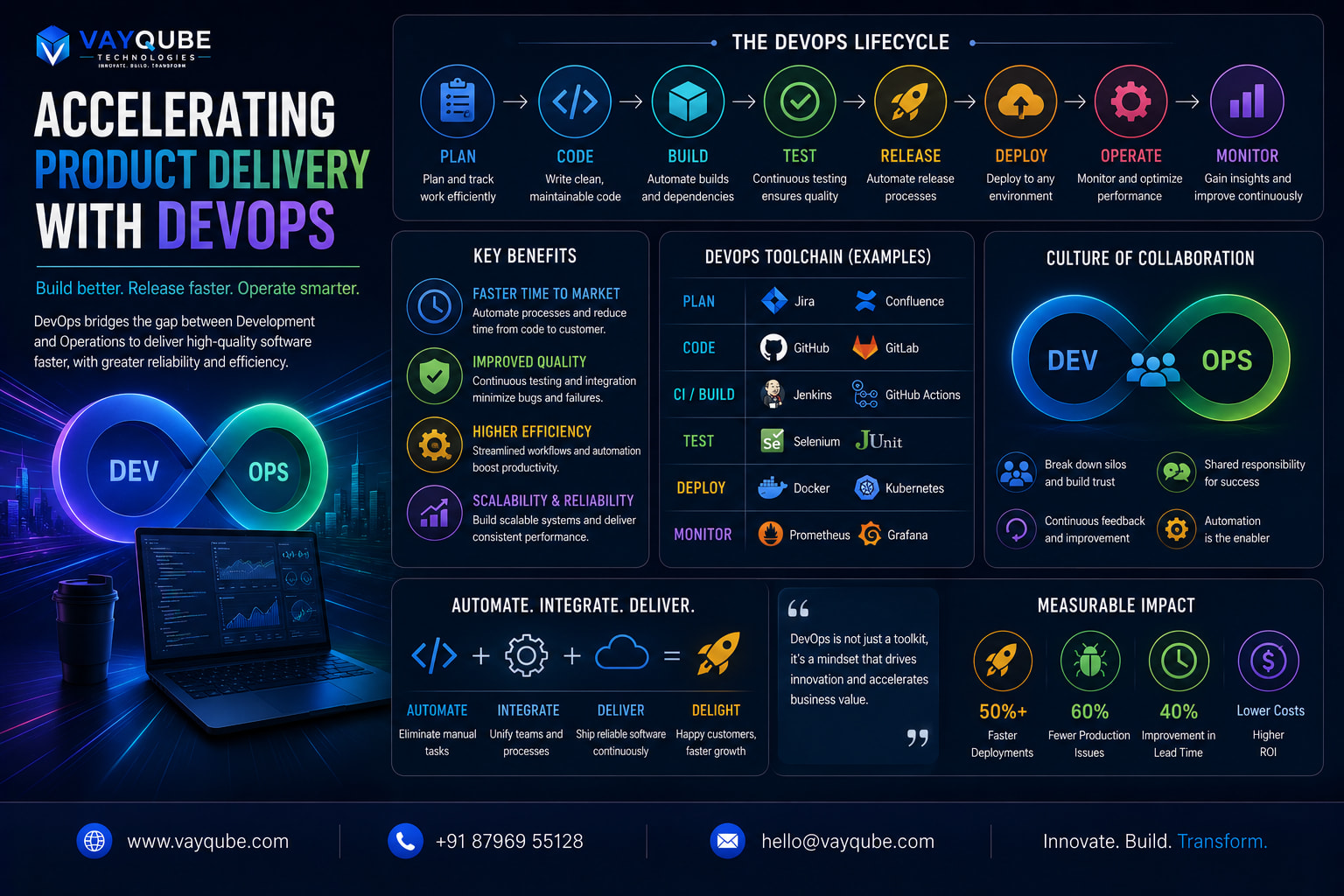
By adopting DevOps, organizations can streamline their development and deployment processes, resulting in accelerated product delivery and increased competitiveness.
Vayqube Team
Software architecture and product engineering
Introduction to Accelerated Product Delivery
In today's fast-paced digital landscape, businesses are under increasing pressure to deliver high-quality products quickly and efficiently. DevOps, a set of practices that combines software development and operations, has emerged as a key strategy for accelerating product delivery. By bridging the gap between development and operations teams, DevOps enables organizations to improve collaboration, increase automation, and reduce time-to-market.
The Importance of Speed
Accelerating product delivery is crucial for businesses to stay competitive. The ability to quickly respond to changing market conditions, customer needs, and emerging trends can make all the difference between success and failure. With DevOps, organizations can achieve faster time-to-market, improved product quality, and increased customer satisfaction. This, in turn, can lead to increased revenue, market share, and brand loyalty.
Overview of the Blog's Content
This blog will delve into the world of DevOps and explore its role in accelerating product delivery. We will discuss the key principles and practices of DevOps, including continuous integration and delivery, automated testing, and infrastructure as code. We will also examine real-world examples of organizations that have successfully implemented DevOps to improve their product delivery capabilities. Additionally, we will provide guidance on how to implement DevOps in your own organization, including strategies for overcoming common challenges and achieving production readiness.
Some of the key topics that will be covered include:
- The benefits and challenges of implementing DevOps
- The role of automation and continuous delivery in accelerating product delivery
- The importance of collaboration and communication between development and operations teams
- Strategies for implementing DevOps in large and small organizations
- Real-world examples of DevOps in action, including case studies and success stories
By the end of this blog, readers will have a deep understanding of the principles and practices of DevOps and how they can be applied to accelerate product delivery in their own organizations. Whether you are a developer, operations professional, or business leader, this blog will provide valuable insights and practical advice on how to improve your product delivery capabilities and achieve success in today's fast-paced digital landscape.
Key Considerations for Implementation
When implementing DevOps, there are several key considerations that organizations must take into account. These include:
- The need for cultural and organizational change
- The importance of automation and tooling
- The role of metrics and monitoring in measuring success
- The need for continuous learning and improvement
- The importance of security and compliance in DevOps practices
By understanding these key considerations, organizations can set themselves up for success and achieve the full benefits of DevOps. In the next section, we will explore the principles and practices of DevOps in more detail, including the role of continuous integration and delivery, automated testing, and infrastructure as code.
Why It Matters
The impact of slow product delivery on business can be significant, leading to lost revenue, decreased customer satisfaction, and a competitive disadvantage. In today's fast-paced digital landscape, businesses that fail to deliver products quickly and efficiently risk being left behind by more agile competitors.
Business Impact
Slow product delivery can have far-reaching consequences, including:
- Delayed time-to-market, resulting in lost revenue and missed opportunities
- Decreased customer satisfaction, leading to negative reviews and a damaged reputation
- Increased costs, as prolonged development cycles and inefficient processes take their toll on resources
- Reduced competitiveness, as businesses that fail to innovate and adapt quickly fall behind industry leaders
Benefits of Rapid Product Delivery
On the other hand, rapid product delivery can have a transformative impact on business, enabling companies to:
- Respond quickly to changing market conditions and customer needs
- Innovate and experiment with new products and services, driving growth and revenue
- Improve customer satisfaction, through faster and more reliable delivery of high-quality products
- Gain a competitive advantage, by leveraging agile development methodologies and DevOps practices to outmaneuver slower-moving rivals
Industry Trends and Benchmarks
Industry trends and benchmarks highlight the importance of rapid product delivery, with:
- 75% of companies reporting that DevOps practices have improved their ability to deliver products faster
- 60% of organizations citing improved customer satisfaction as a key benefit of DevOps adoption
- The top 25% of companies in terms of DevOps maturity achieving 50% higher revenue growth than their less mature peers
- The average company taking 4-6 months to deliver a new feature or product, while top-performing companies can deliver in as little as 1-2 weeks
As businesses strive to stay ahead of the curve, the ability to deliver products quickly and efficiently has become a key differentiator, separating industry leaders from laggards. By embracing DevOps practices and prioritizing rapid product delivery, companies can unlock significant benefits, drive growth and revenue, and stay competitive in an increasingly fast-paced and digital landscape.
Core Architecture
The core architecture of DevOps is built around several key components that work together to accelerate product delivery. At its core, DevOps is about bridging the gap between development and operations teams, enabling them to work together more effectively.
Key Components
The key components of DevOps include:
- Continuous Integration and Continuous Deployment (CI/CD): This involves integrating code changes into a central repository frequently, and then automatically deploying those changes to production. This helps to reduce errors, improve code quality, and speed up the deployment process.
- Automation and Monitoring Tools: Automation tools such as Jenkins, GitLab CI/CD, and CircleCI help to automate the build, test, and deployment process, while monitoring tools such as Prometheus, Grafana, and New Relic help to monitor the performance and health of the application.
CI/CD Pipeline
A CI/CD pipeline is a series of automated processes that take code changes from development to production. This pipeline typically includes:
- Code Commit: Developers commit code changes to a central repository.
- Automated Build: The code is automatically built and compiled.
- Automated Testing: The code is automatically tested for errors and bugs.
- Deployment: The code is automatically deployed to production.
- Monitoring: The application is monitored for performance and health.
Automation and Monitoring
Automation and monitoring tools are critical components of the DevOps core architecture. These tools help to:
- Reduce Manual Errors: Automation tools help to reduce manual errors by automating repetitive tasks.
- Improve Code Quality: Automation tools help to improve code quality by automatically testing and validating code changes.
- Improve Application Performance: Monitoring tools help to improve application performance by identifying bottlenecks and areas for optimization.
Real-World Examples
In real-world scenarios, companies such as Amazon, Netflix, and Google have implemented DevOps practices to accelerate product delivery. For example, Amazon uses a CI/CD pipeline to deploy code changes to production every 11.6 seconds, while Netflix uses automation and monitoring tools to ensure high availability and performance of its streaming service.
Production Considerations
When implementing DevOps practices in production, it's essential to consider:
- Scalability: The ability of the system to scale to meet increasing demand.
- Security: The security of the system and the data it handles.
- Compliance: Compliance with regulatory requirements and industry standards.
- Monitoring and Logging: The ability to monitor and log the system to identify issues and areas for improvement.
Business Benefits
The implementation of DevOps in an organization has numerous benefits that can significantly impact its bottom line. By adopting DevOps practices, businesses can experience improved time-to-market, increased quality and reliability, and enhanced collaboration and productivity.
Faster Time-to-Market
Improved time-to-market is a key benefit of DevOps, enabling organizations to respond quickly to changing market conditions and customer needs. With automated testing, continuous integration, and continuous delivery, DevOps allows businesses to release new features and updates faster, giving them a competitive edge in the market. This is particularly important in today's fast-paced digital landscape, where speed and agility are crucial for staying ahead of the competition.
Increased Quality and Reliability
DevOps also leads to increased quality and reliability of software releases. By integrating testing into the development process and using automated testing tools, businesses can identify and fix defects earlier, reducing the likelihood of errors and downtime. This results in higher-quality software releases, improved customer satisfaction, and reduced maintenance costs.
Enhanced Collaboration and Productivity
Another significant benefit of DevOps is enhanced collaboration and productivity among teams. By breaking down silos and fostering a culture of collaboration, DevOps encourages cross-functional teams to work together, share knowledge, and align their goals. This leads to improved communication, increased productivity, and better outcomes, as teams work together towards a common goal. Some key benefits of this collaboration include:
- Improved communication and feedback loops
- Increased transparency and visibility into the development process
- Better alignment of development and operations teams
- Enhanced knowledge sharing and skill development
By adopting DevOps practices, businesses can experience these benefits and more, leading to improved competitiveness, increased customer satisfaction, and ultimately, revenue growth. As organizations continue to navigate the complexities of digital transformation, DevOps is becoming an essential component of their strategy, enabling them to deliver high-quality software faster and more reliably.
Scalability
To achieve scalability in DevOps, it's essential to design and implement systems that can handle increased traffic and user growth. This involves adopting a flexible and adaptable approach to DevOps, allowing for seamless integration of new tools and technologies as the system evolves.
Scaling DevOps for Large and Complex Systems
Scaling DevOps for large and complex systems requires a deep understanding of the system's architecture and components. This includes:
- Identifying bottlenecks and areas of inefficiency
- Implementing automated testing and deployment processes
- Utilizing containerization and orchestration tools to manage resources and ensure high availability
- Adopting a microservices architecture to enable scalability and flexibility
Handling Increased Traffic and User Growth
As the system grows, it's crucial to handle increased traffic and user growth effectively. This can be achieved by:
- Implementing load balancing and autoscaling to distribute traffic and ensure optimal resource utilization
- Utilizing caching and content delivery networks (CDNs) to reduce latency and improve performance
- Implementing monitoring and logging tools to detect and respond to issues quickly
- Conducting regular performance testing and optimization to ensure the system can handle increased traffic
Best Practices for Scalable DevOps Implementation
To ensure a scalable DevOps implementation, consider the following best practices:
- Adopt a cloud-native approach to leverage scalable infrastructure and services
- Implement continuous integration and continuous delivery (CI/CD) pipelines to automate testing and deployment
- Utilize infrastructure as code (IaC) tools to manage and version infrastructure configurations
- Foster a culture of collaboration and communication between development, operations, and quality assurance teams to ensure seamless coordination and issue resolution
By following these guidelines and adopting a scalable DevOps approach, organizations can ensure their systems are capable of handling increased traffic and user growth, while maintaining high levels of performance, reliability, and security. This enables businesses to focus on delivering value to their customers, rather than being held back by inefficient and inflexible systems.
Implementation Strategy
A well-planned implementation strategy is critical to the success of a scalable DevOps project. This involves:
- Defining clear goals and objectives for the project
- Assessing the current system and identifying areas for improvement
- Developing a roadmap for implementation, including timelines and milestones
- Establishing a cross-functional team to oversee the project and ensure collaboration between stakeholders
By taking a structured and informed approach to DevOps implementation, organizations can minimize risks, ensure smooth execution, and achieve the desired business outcomes.
Implementation Challenges
Implementing DevOps practices can be a complex and challenging process, requiring significant changes to an organization's culture, processes, and technology. Several common obstacles can hinder the adoption of DevOps, including cultural and organizational barriers, as well as technical challenges.
Cultural and Organizational Barriers
Cultural and organizational barriers are often the most significant hurdles to DevOps adoption. These barriers can include:
- Resistance to change from team members who are accustomed to traditional siloed workflows
- Lack of communication and collaboration between development and operations teams
- Insufficient training and education on DevOps practices and tools
- Inadequate leadership support and commitment to DevOps initiatives
- Existing organizational structures and processes that are not conducive to DevOps principles
Technical Challenges and Solutions
Technical challenges can also pose significant obstacles to DevOps adoption. Some common technical challenges include:
- Integrating disparate tools and systems to create a cohesive DevOps pipeline
- Ensuring security and compliance in automated deployment processes
- Managing and monitoring complex distributed systems
- Implementing effective continuous testing and continuous integration practices
- Scaling DevOps practices to meet the needs of large, complex organizations
To overcome these technical challenges, organizations can leverage a range of solutions, including:
- Automation tools such as Jenkins, GitLab CI/CD, and CircleCI
- Containerization platforms like Docker and Kubernetes
- Monitoring and logging tools like Prometheus, Grafana, and ELK Stack
- Security and compliance tools like HashiCorp Vault and AWS IAM
- Cloud-based infrastructure and platform services like AWS, Azure, and Google Cloud
By understanding and addressing these cultural, organizational, and technical challenges, organizations can successfully implement DevOps practices and accelerate their product delivery.
Real-World Examples
Real-world examples of successful DevOps implementations can provide valuable insights and lessons learned. For instance, companies like Amazon, Netflix, and Google have all successfully implemented DevOps practices to accelerate their product delivery and improve their overall efficiency. These companies have demonstrated that with the right culture, processes, and technology, DevOps can be a powerful catalyst for innovation and growth.
Production Considerations
When implementing DevOps practices, it's essential to consider production readiness and the potential impact on existing systems and processes. This includes:
- Ensuring that DevOps practices are aligned with business objectives and outcomes
- Developing a comprehensive testing strategy to ensure quality and reliability
- Implementing effective monitoring and logging to ensure visibility and control
- Developing a plan for scaling DevOps practices to meet growing demand
- Ensuring that DevOps practices are secure, compliant, and auditable.
Use Cases
Successful DevOps implementation can be seen in various industries, with real-world examples showcasing its benefits.
Industry-Specific Examples
Some notable examples include:
- Financial institutions, such as banks, using DevOps to improve the speed and security of their online services
- Healthcare organizations, leveraging DevOps to accelerate the development of medical research and patient care applications
- E-commerce companies, utilizing DevOps to enhance the performance and reliability of their online platforms
Measurable Benefits
The implementation of DevOps has resulted in significant benefits, including:
- Reduced time-to-market for new products and features
- Improved collaboration and communication between development and operations teams
- Enhanced quality and reliability of software releases
- Increased efficiency and reduced costs through automation and process optimization
Real-World Results
Companies such as Amazon, Google, and Microsoft have successfully implemented DevOps, achieving notable results, including:
- Amazon's ability to deploy code changes every 11.6 seconds
- Google's reduction of deployment time from weeks to minutes
- Microsoft's improvement of deployment frequency from monthly to daily
Production Considerations
When implementing DevOps in a production environment, it's essential to consider factors such as:
- Scalability and performance requirements
- Security and compliance regulations
- Monitoring and logging capabilities
- Continuous testing and quality assurance
Implementation Strategy
A well-planned implementation strategy is crucial to the success of DevOps. This includes:
- Defining clear goals and objectives
- Assessing current processes and infrastructure
- Developing a roadmap for implementation
- Providing training and support for teams
- Continuously monitoring and evaluating progress
Industry-Specific Challenges
Different industries face unique challenges when implementing DevOps, such as:
- Financial institutions: ensuring security and compliance with regulations
- Healthcare organizations: protecting sensitive patient data
- E-commerce companies: handling high traffic and scalability requirements
Overcoming Challenges
To overcome these challenges, organizations can:
- Develop a deep understanding of their industry's specific requirements
- Collaborate with experts and thought leaders
- Invest in ongoing training and education
- Foster a culture of continuous improvement and innovation
Best Practices
To accelerate product delivery with DevOps, it's essential to focus on several key best practices that foster a culture of collaboration, automation, and continuous improvement.
Establishing a DevOps Culture
Establishing a DevOps culture is foundational. This involves breaking down silos between development and operations teams, promoting open communication, and encouraging collaboration. A DevOps culture emphasizes shared responsibility for the entire service lifecycle, from design through to deployment and maintenance. This cultural shift is critical for aligning teams around common goals and objectives, ensuring that everyone is working towards delivering high-quality products quickly and reliably.
Implementing Automation and Monitoring
Implementing automation and monitoring is another crucial aspect. Automation helps reduce manual errors and speeds up processes, such as testing, building, and deployment. Continuous Integration/Continuous Deployment (CI/CD) pipelines are a cornerstone of this approach, enabling rapid and reliable delivery of software changes. Monitoring and logging are equally important, providing real-time insights into system performance and health, which can help identify and resolve issues before they impact users.
Continuously Measuring and Improving
Continuously measuring and improving is vital for the success of DevOps initiatives. This involves setting clear metrics and Key Performance Indicators (KPIs) that reflect the goals of the organization, such as deployment frequency, lead time, mean time to recovery (MTTR), and change failure rate. Regular feedback loops, both from automated systems and human stakeholders, are essential for identifying areas for improvement and implementing changes that enhance the overall efficiency and effectiveness of the DevOps practice.
By focusing on these best practices, organizations can create a robust DevOps framework that supports accelerated product delivery, enhances quality, and improves customer satisfaction. The implementation of these practices requires careful planning, execution, and ongoing evaluation to ensure they align with the organization's strategic objectives and contribute to its long-term success.
Key considerations for successful DevOps implementation include:
- Aligning DevOps practices with business objectives
- Ensuring cross-functional collaboration and training
- Leveraging technology to automate and streamline processes
- Embracing a culture of continuous learning and improvement
- Fostering open communication and feedback across teams
These considerations highlight the complexity and multifaceted nature of DevOps, which extends beyond mere technical implementation to encompass cultural, procedural, and strategic dimensions.
FAQ
Frequently asked questions about DevOps can help clarify the benefits and challenges of implementing this approach. Some common questions include:
- What is the primary goal of DevOps, and how does it impact product delivery?
- How does DevOps differ from traditional software development methodologies?
- What are the key challenges in implementing DevOps, and how can they be addressed?
Addressing Common Concerns
Addressing common concerns and misconceptions about DevOps is crucial for a successful implementation. Some of the concerns include:
- The perceived loss of control and visibility in a DevOps environment
- The potential for decreased quality and increased risk
- The difficulty in measuring the effectiveness of DevOps
Additional Resources
For further learning and to address specific concerns, there are several additional resources available, including:
- Industry reports and research studies on the benefits and challenges of DevOps
- Case studies and success stories from organizations that have implemented DevOps
- Online courses and training programs for DevOps practitioners and leaders
Real-World Examples
Real-world examples of DevOps in action can help illustrate the benefits and challenges of this approach. For instance:
- A company that has successfully implemented DevOps may see a significant reduction in time-to-market and an increase in product quality
- A DevOps team that has implemented continuous integration and continuous deployment (CI/CD) may see a significant reduction in deployment errors and downtime
- A organization that has adopted a DevOps culture may see an increase in collaboration and communication between development and operations teams
Production Considerations
When implementing DevOps in a production environment, there are several key considerations to keep in mind, including:
- Ensuring the security and compliance of the DevOps pipeline
- Implementing monitoring and logging to ensure visibility and control
- Developing a rollback strategy in case of deployment errors or issues
Implementation Strategy
A well-planned implementation strategy is critical to the success of DevOps. This includes:
- Defining clear goals and objectives for the DevOps implementation
- Assessing the current state of the organization and identifying areas for improvement
- Developing a roadmap for implementation and ensuring that all stakeholders are aligned and informed
Scalability and Business Impact
The scalability and business impact of DevOps should also be considered. For example:
- How will DevOps impact the organization's ability to scale and grow?
- What are the potential cost savings and revenue increases associated with DevOps?
- How will DevOps impact the organization's competitiveness and market position?
Conclusion
In summary, accelerating product delivery with DevOps is crucial for businesses to stay competitive in today's fast-paced market. The key takeaways from this discussion include the importance of a well-designed core architecture, the numerous business benefits of DevOps, and the need to address scalability and implementation challenges.
Key Takeaways
- DevOps enables organizations to deliver products faster and with higher quality
- A well-designed core architecture is essential for successful DevOps implementation
- Business benefits of DevOps include improved collaboration, increased efficiency, and enhanced customer experience
- Scalability and implementation challenges must be addressed to ensure successful DevOps adoption
Final Thoughts
As we have seen, DevOps is not just a set of tools or practices, but a cultural shift that requires organizations to rethink their approach to product delivery. By embracing DevOps, businesses can accelerate time-to-market, improve product quality, and increase customer satisfaction.
Call to Action
To accelerate product delivery with DevOps in your organization, start by assessing your current architecture and identifying areas for improvement. Develop a clear implementation strategy, and invest in the necessary tools and training to support your teams. With the right approach and mindset, you can unlock the full potential of DevOps and stay ahead of the competition.
Real-World Implementation
Consider the example of a leading e-commerce company that implemented DevOps to reduce deployment time from weeks to minutes. By automating testing and deployment, and improving collaboration between development and operations teams, the company was able to increase productivity, reduce errors, and improve customer satisfaction.
Next Steps
To get started with DevOps, focus on building a strong foundation, including a well-designed core architecture, automated testing and deployment, and continuous monitoring and feedback. With the right foundation in place, you can begin to realize the benefits of DevOps and accelerate product delivery in your organization.
Related Vayqube Resources
- Best Software Development Company In New York
- Best Fintech Software Development Company In New York
- Healthcare Software Development Company New York
- The Real Cost Of Building Ai Products
- Why Most Ai Projects Fail Before Production
- How To Build Fintech Application Payments Security Scaling
Next Step
If your systems are struggling with scalability, automation, architecture complexity, or operational efficiency, it's time to modernize your infrastructure and workflows.
👉 Talk to a Vayqube solution architect and build systems designed for long-term production growth: