
Revolutionizing Enterprise Software: The Future of AI Automation
As AI technology advances, enterprise software is poised for a significant transformation. Learn how AI automation can boost efficiency, reduce costs, and drive business growth.
Vayqube Team
Author
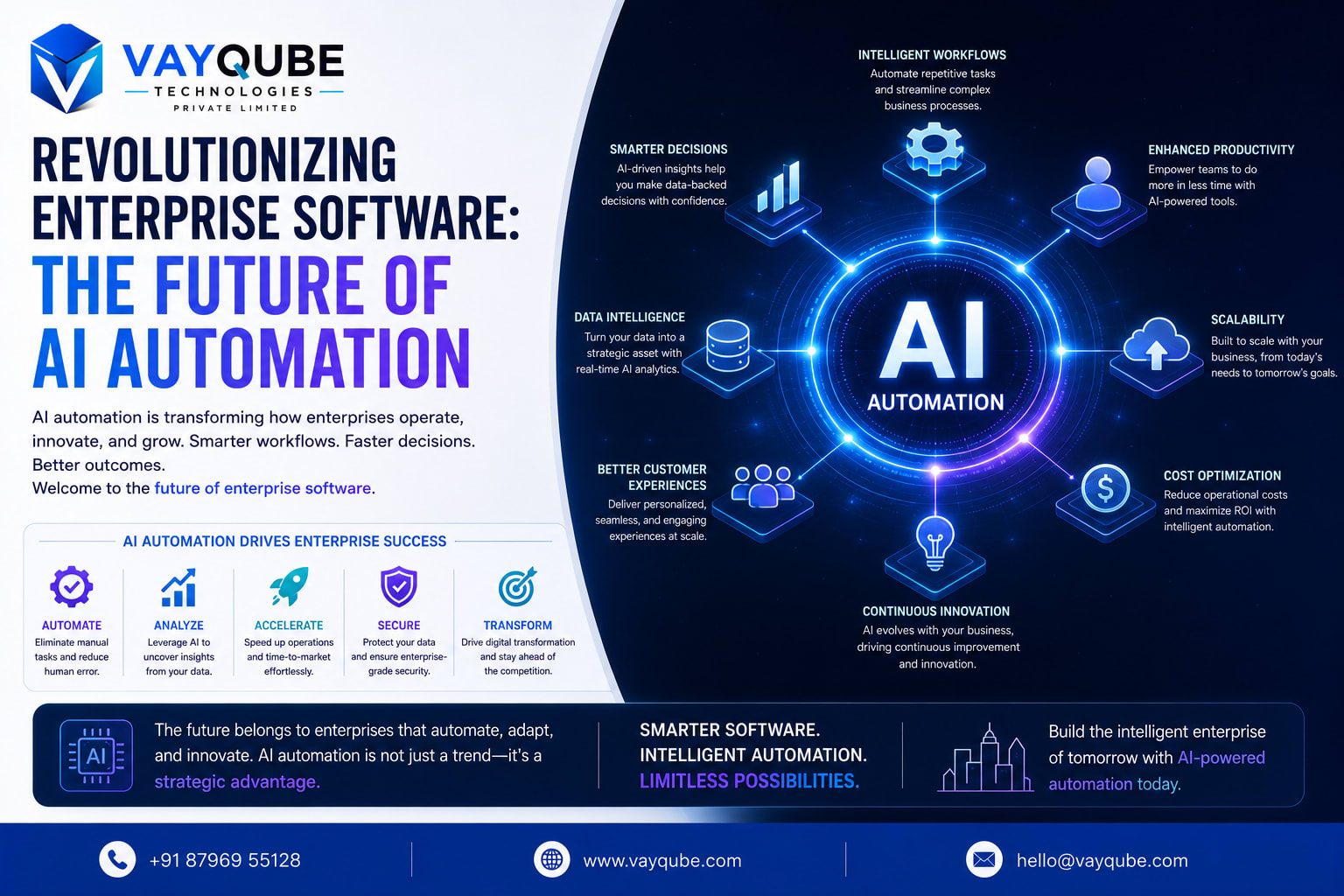
The Rise of AI Automation
AI automation has been transforming the enterprise software landscape, bringing about unprecedented levels of efficiency and productivity. In recent years, we have witnessed a significant shift in the way businesses operate, with AI-powered automation playing a central role in this transformation.
A Brief History of AI Adoption
The concept of AI automation is not new, but its adoption in enterprise software has gained momentum only in the last decade. Initially, AI was used in niche areas such as customer service and data analysis. However, with advancements in machine learning and natural language processing, AI automation has become more pervasive, finding applications in various aspects of enterprise software.
Current State of AI Adoption
Today, AI automation is being used in a wide range of enterprise software applications, from workflow automation and predictive maintenance to chatbots and virtual assistants. The current state of AI adoption is characterized by a growing demand for AI-powered solutions, driven by the need for increased efficiency, reduced costs, and enhanced customer experience.
Revolutionizing Enterprise Software
The impact of AI automation on enterprise software is profound, enabling businesses to automate repetitive tasks, make data-driven decisions, and improve overall productivity. With AI automation, enterprises can process vast amounts of data, identify patterns, and make predictions, leading to better decision-making and improved outcomes. As AI automation continues to evolve, we can expect to see even more innovative applications of this technology in enterprise software.
Key Drivers of AI Automation
The adoption of AI automation in enterprise software is driven by several key factors, including:
- Increasing demand for digital transformation
- Need for improved efficiency and productivity
- Growing availability of AI-powered tools and platforms
- Expanding volumes of data and the need for data-driven decision-making
- Rising expectations for enhanced customer experience
Implementation and Production Considerations
As enterprises embark on their AI automation journey, they must consider several key factors, including the development of a clear implementation strategy, the selection of suitable AI-powered tools and platforms, and the need for ongoing maintenance and support. Additionally, enterprises must ensure that their AI automation solutions are production-ready, scalable, and secure, with adequate provisions for data governance and compliance.
Why It Matters
The impact of AI automation on enterprise software is multifaceted, leading to significant improvements in various aspects of business operations.
Efficiency and Productivity
Increasing efficiency and productivity is a key benefit of AI automation. By automating repetitive and mundane tasks, businesses can free up resources and focus on higher-value activities. This leads to improved productivity, reduced costs, and enhanced overall performance. For instance, AI-powered tools can automate data entry, document processing, and other administrative tasks, allowing employees to concentrate on strategic initiatives.
Customer Experience
Enhancing customer experience is another crucial aspect of AI automation. AI-driven chatbots and virtual assistants can provide 24/7 customer support, helping to resolve queries and issues promptly. Additionally, AI-powered analytics can help businesses gain a deeper understanding of customer behavior and preferences, enabling them to tailor their services and products to meet specific needs.
Business Innovation and Competitiveness
Driving business innovation and competitiveness is a critical outcome of AI automation. By leveraging AI and machine learning, businesses can develop new products and services, improve existing ones, and stay ahead of the competition. For example, AI-powered predictive maintenance can help companies reduce downtime and improve overall equipment effectiveness, leading to increased competitiveness and revenue growth.
Some of the key advantages of AI automation include:
- Improved accuracy and reduced errors
- Enhanced scalability and flexibility
- Faster decision-making and response times
- Better customer insights and personalization
- Increased innovation and competitiveness
As businesses continue to adopt AI automation, they can expect to see significant improvements in efficiency, customer experience, and innovation. By harnessing the power of AI, companies can stay ahead of the curve and achieve long-term success in an increasingly competitive market.
Real-World Applications
In real-world scenarios, AI automation is being used to transform various industries, from healthcare and finance to manufacturing and logistics. For instance, AI-powered robots are being used in warehouses to automate inventory management and shipping, while AI-driven algorithms are being used in healthcare to analyze medical images and diagnose diseases. These applications demonstrate the vast potential of AI automation to drive business innovation and competitiveness.
The future of enterprise software is closely tied to the development and adoption of AI automation. As AI technology continues to evolve, businesses can expect to see new and innovative applications of AI automation, leading to improved efficiency, customer experience, and competitiveness.
Core Architecture
The core architecture of AI automation in enterprise software is built on several key components.
Machine Learning and Deep Learning Fundamentals
Machine learning and deep learning are the backbone of AI automation, enabling systems to learn from data and make predictions or decisions. These fundamentals are crucial in developing intelligent systems that can automate complex tasks, such as data analysis, predictive maintenance, and process optimization. By leveraging machine learning algorithms, enterprises can uncover hidden patterns in their data, leading to improved decision-making and increased efficiency.
Natural Language Processing and Computer Vision
Natural language processing (NLP) and computer vision are two critical aspects of AI automation. NLP enables systems to understand and generate human-like language, facilitating tasks such as chatbots, sentiment analysis, and text classification. Computer vision, on the other hand, allows systems to interpret and understand visual data from images and videos, enabling applications such as object detection, facial recognition, and image classification. These technologies have numerous applications in enterprise software, including customer service, marketing, and quality control.
Integration with Existing Enterprise Systems
To maximize the benefits of AI automation, it is essential to integrate these technologies with existing enterprise systems. This includes integrating with legacy systems, such as ERP, CRM, and SCM, as well as modern systems, such as cloud-based applications and IoT devices. By integrating AI automation with these systems, enterprises can unlock new insights, automate manual processes, and improve overall efficiency. Some key considerations for integration include:
- Data compatibility and standardization
- API-based integration for seamless communication
- Scalability and flexibility to accommodate growing demands
- Security and governance to ensure data integrity and compliance
By focusing on these core architecture components, enterprises can build a robust foundation for AI automation, driving innovation, and improving their bottom line. Key benefits of a well-designed core architecture include:
- Improved efficiency and productivity
- Enhanced decision-making capabilities
- Increased customer satisfaction and engagement
- Better competitiveness in the market
- Reduced costs and improved resource allocation
As enterprises continue to adopt AI automation, it is crucial to consider the implementation strategy and production readiness of these technologies. This includes developing a clear roadmap, identifying key use cases, and ensuring that the necessary infrastructure and resources are in place to support large-scale deployment. By taking a strategic and thoughtful approach to AI automation, enterprises can unlock the full potential of these technologies and drive meaningful business impact.
Business Benefits
The integration of AI automation in enterprise software has numerous benefits, including cost savings and revenue growth. By automating repetitive and mundane tasks, businesses can reduce labor costs and allocate resources more efficiently. Additionally, AI-driven insights can help identify new revenue streams and opportunities, leading to increased growth and competitiveness.
Cost Savings and Revenue Growth
Some of the key ways AI automation can drive cost savings and revenue growth include:
- Automating data entry and processing tasks, reducing manual errors and increasing productivity
- Providing predictive analytics and insights to inform business decisions and identify new opportunities
- Enhancing customer service and support through AI-powered chatbots and virtual assistants
- Optimizing supply chain and logistics operations to reduce costs and improve efficiency
Improved Decision-Making and Risk Management
AI automation can also improve decision-making and risk management by providing businesses with real-time data and insights. This can help identify potential risks and opportunities, enabling businesses to make more informed decisions and mitigate potential threats. Some of the key ways AI automation can improve decision-making and risk management include:
- Providing real-time data and analytics to inform business decisions
- Identifying potential risks and opportunities through predictive modeling and machine learning
- Enhancing compliance and regulatory management through AI-powered monitoring and reporting
Enhanced Collaboration and Workflow Automation
AI automation can also enhance collaboration and workflow automation by streamlining processes and improving communication. This can help reduce errors and improve productivity, enabling businesses to work more efficiently and effectively. Some of the key ways AI automation can enhance collaboration and workflow automation include:
- Automating routine tasks and workflows to reduce manual errors and increase productivity
- Enhancing communication and collaboration through AI-powered tools and platforms
- Providing real-time visibility and tracking to improve workflow management and optimization
Scalability
To achieve seamless AI automation, scalability is a critical factor. Enterprise software must be able to handle increased traffic and large datasets without compromising performance.
Cloud-Based Infrastructure
A cloud-based infrastructure is essential for scalability, as it allows for on-demand resource allocation and automatic scaling. This ensures that the system can handle sudden spikes in traffic or data processing requirements. By leveraging cloud-based services, enterprises can reduce the risk of downtime and ensure high availability.
Handling Large Datasets
Handling large datasets requires a robust and efficient data processing system. This can be achieved through distributed computing, where data is processed in parallel across multiple nodes. Additionally, leveraging big data technologies such as Hadoop and Spark can help process large datasets quickly and efficiently.
Ensuring Reliability and Uptime
Ensuring reliability and uptime is crucial for enterprise software. This can be achieved through implementing redundancy, failover mechanisms, and load balancing. By ensuring that the system is always available, enterprises can minimize downtime and ensure business continuity. Key considerations for ensuring reliability and uptime include:
- Implementing monitoring and logging mechanisms to detect potential issues
- Conducting regular maintenance and updates to prevent technical debt
- Leveraging automation tools to streamline deployment and scaling processes
- Ensuring disaster recovery and business continuity plans are in place
By prioritizing scalability, enterprises can ensure that their AI automation systems are able to handle increased traffic and large datasets, while maintaining reliability and uptime. This is critical for achieving production readiness and ensuring the long-term success of AI automation initiatives.
Production Readiness
To ensure production readiness, enterprises must consider several factors, including:
- Data quality and integrity
- System security and compliance
- User adoption and training
- Ongoing maintenance and support By carefully evaluating these factors, enterprises can ensure that their AI automation systems are fully prepared for production deployment, and can achieve the desired business impact.
Implementation Challenges
To successfully integrate AI automation into enterprise software, several challenges must be addressed. These challenges can be significant, and overcoming them is crucial for a smooth implementation.
Data Quality and Preparation
Data quality and preparation are critical components of AI automation. Poor data quality can lead to biased models, inaccurate predictions, and ineffective automation. Ensuring that data is accurate, complete, and consistent is essential. This can be achieved by:
- Implementing data validation and cleansing processes
- Establishing data governance policies
- Providing training and support for data management best practices
Change Management and Training
Change management and training are also essential for successful implementation. AI automation can significantly alter business processes, and employees must be prepared to adapt. This can be achieved by:
- Developing a comprehensive change management plan
- Providing training and support for employees
- Encouraging a culture of innovation and experimentation
Addressing Security and Compliance Concerns
Security and compliance concerns must also be addressed. AI automation can introduce new security risks, and ensuring that data is protected is critical. This can be achieved by:
- Implementing robust security measures, such as encryption and access controls
- Conducting regular security audits and risk assessments
- Ensuring compliance with relevant regulations and standards
Effective implementation of AI automation requires careful consideration of these challenges. By addressing data quality and preparation, change management and training, and security and compliance concerns, enterprises can ensure a successful implementation and realize the full benefits of AI automation.
In real-world scenarios, enterprises have successfully addressed these challenges by:
- Establishing cross-functional teams to oversee implementation
- Developing comprehensive implementation plans
- Providing ongoing training and support for employees
- Continuously monitoring and evaluating the effectiveness of AI automation.
By taking a proactive and structured approach to implementation, enterprises can overcome the challenges associated with AI automation and achieve significant business benefits.
Use Cases
The potential applications of AI automation in enterprise software are vast and varied. In this section, we will explore some of the most significant use cases, including customer service and support automation, predictive maintenance and quality control, and intelligent document processing and management.
Customer Service and Support Automation
AI-powered chatbots and virtual assistants are revolutionizing the way companies interact with their customers. By automating routine inquiries and support requests, businesses can free up human customer support agents to focus on more complex and high-value tasks. For example, a company like IBM can use AI-powered chatbots to handle initial customer inquiries, routing more complex issues to human support agents.
- Automated ticketing systems can help prioritize and route support requests
- AI-powered chatbots can provide 24/7 support and help customers with routine inquiries
- Sentiment analysis can help companies identify areas for improvement and optimize their customer support strategies
Predictive Maintenance and Quality Control
AI automation can also be used to predict and prevent equipment failures, reducing downtime and improving overall quality control. By analyzing sensor data and other inputs, AI algorithms can identify potential issues before they occur, allowing companies to take proactive maintenance steps. For instance, a manufacturing company like Siemens can use AI-powered predictive maintenance to identify potential equipment failures and schedule maintenance accordingly.
- Predictive analytics can help companies identify potential equipment failures and schedule maintenance
- AI-powered quality control systems can detect defects and anomalies in real-time
- Automated reporting and analytics can help companies optimize their maintenance and quality control strategies
Intelligent Document Processing and Management
AI automation can also be used to streamline document processing and management, reducing manual errors and improving overall efficiency. By using AI-powered optical character recognition (OCR) and natural language processing (NLP), companies can automate tasks such as data extraction, document classification, and compliance checking. For example, a financial services company like JPMorgan Chase can use AI-powered document processing to automate the extraction of data from financial documents.
- AI-powered OCR and NLP can automate data extraction and document classification
- Automated compliance checking can help companies identify and mitigate potential risks
- Intelligent document management systems can help companies optimize their document workflows and improve overall efficiency
By exploring these use cases, businesses can gain a deeper understanding of the potential benefits and applications of AI automation in enterprise software. Whether it's improving customer service, predicting equipment failures, or streamlining document processing, AI automation has the potential to revolutionize the way companies operate and compete in the market.
Best Practices
To ensure successful AI automation implementation, it's crucial to follow best practices that prioritize scalability, business outcomes, and continuous evaluation.
Starting Small and Scaling Up
Starting with a small, manageable project allows enterprises to test AI automation capabilities, identify potential roadblocks, and develop strategies for overcoming them. This approach enables organizations to scale up their AI automation efforts gradually, minimizing disruptions to existing operations and maximizing the potential for long-term success. Key considerations include:
- Identifying high-impact, low-complexity areas for initial implementation
- Developing a phased rollout plan to ensure seamless integration with existing systems
- Establishing clear metrics for measuring progress and determining when to scale up
Focusing on Business Outcomes and ROI
AI automation initiatives should be designed with specific business outcomes in mind, such as increased efficiency, improved customer satisfaction, or enhanced competitiveness. By focusing on tangible, measurable objectives, enterprises can ensure that their AI automation efforts are aligned with overall business strategy and generate a positive return on investment (ROI). Important factors to consider include:
- Defining clear, quantifiable goals for AI automation initiatives
- Establishing a robust framework for measuring and tracking ROI
- Continuously monitoring and adjusting AI automation strategies to optimize business outcomes
Continuously Monitoring and Evaluating AI Performance
To ensure that AI automation systems continue to deliver optimal results, enterprises must implement ongoing monitoring and evaluation processes. This includes:
- Regularly assessing AI system performance against established metrics and benchmarks
- Identifying and addressing potential issues or biases in AI decision-making
- Continuously updating and refining AI models to incorporate new data, adapt to changing business conditions, and improve overall performance.
Frequently Asked Questions
The implementation of AI automation in enterprise software raises several important questions. Here, we address some of the most common inquiries to provide clarity and guidance for businesses looking to leverage AI automation.
Common AI Automation Applications
The most common AI automation applications include:
- Automated data processing and analysis
- Chatbots and virtual assistants for customer service
- Predictive maintenance and quality control in manufacturing
- Personalized marketing and sales strategies
- Automated bookkeeping and accounting processes
These applications have the potential to significantly enhance operational efficiency, reduce costs, and improve customer experiences.
Getting Started with AI Automation
To get started with AI automation, businesses should:
- Identify areas where automation can add the most value
- Assess the current technology infrastructure and identify potential integration points
- Develop a clear implementation strategy and roadmap
- Invest in employee training and development to ensure a smooth transition
- Monitor and evaluate the performance of AI automation systems to ensure they are meeting business objectives
By taking a structured approach to AI automation, businesses can minimize disruption and maximize the benefits of this technology.
Potential Risks and Limitations
While AI automation offers numerous benefits, there are also potential risks and limitations to consider, including:
- Job displacement and the need for workforce retraining
- Dependence on high-quality data to ensure accurate decision-making
- Cybersecurity risks associated with increased reliance on technology
- Potential biases in AI algorithms and decision-making processes
- Need for ongoing maintenance and updates to ensure AI systems remain effective and efficient
By understanding these risks and limitations, businesses can take steps to mitigate them and ensure that AI automation is implemented in a responsible and sustainable manner.
Real-World Implementation Considerations
In real-world scenarios, AI automation implementation requires careful consideration of production readiness, scalability, and business impact. This includes:
- Ensuring that AI systems can handle large volumes of data and traffic
- Implementing robust testing and validation processes to ensure AI systems are functioning as intended
- Developing strategies for addressing potential errors or biases in AI decision-making
- Continuously monitoring and evaluating the performance of AI automation systems to identify areas for improvement
By prioritizing these considerations, businesses can ensure that AI automation is successfully integrated into their operations and delivers the expected benefits.
Recap and Future Outlook
The integration of AI automation in enterprise software has the potential to revolutionize the way businesses operate, making them more efficient, agile, and competitive. Key benefits include enhanced productivity, improved accuracy, and reduced operational costs. However, challenges such as data quality issues, integration complexities, and the need for continuous monitoring and maintenance must be addressed.
Embracing the Future
As AI technology continues to evolve, we can expect to see more sophisticated automation capabilities, including advanced machine learning algorithms and natural language processing. These developments will enable enterprises to automate more complex tasks, make better-informed decisions, and drive innovation. Potential future developments include:
- Increased use of autonomous systems
- Greater emphasis on explainable AI
- More seamless human-AI collaboration
Call to Action
To stay ahead of the curve, enterprises must be proactive in embracing AI automation. This involves:
- Assessing current processes and identifying areas ripe for automation
- Investing in AI talent and technology
- Developing a strategic roadmap for AI adoption
- Fostering a culture of innovation and continuous learning
Production Readiness
As enterprises embark on their AI automation journey, it's crucial to consider production readiness. This includes:
- Ensuring scalability and reliability
- Implementing robust security measures
- Developing comprehensive monitoring and maintenance strategies
- Establishing clear governance and compliance frameworks
Real-World Applications
The applications of AI automation in enterprise software are vast and varied. From automating customer service interactions to streamlining supply chain operations, the potential for transformation is significant. By leveraging AI automation, businesses can unlock new levels of efficiency, drive growth, and stay competitive in an increasingly complex and dynamic market.
Next Steps
For enterprises looking to harness the power of AI automation, the next steps are clear:
- Conduct a thorough assessment of current processes and systems
- Develop a tailored AI strategy aligned with business objectives
- Invest in the necessary talent, technology, and infrastructure
- Foster a culture of innovation and continuous improvement
By taking these steps, enterprises can position themselves for success in an AI-driven future, driving growth, innovation, and competitiveness through the strategic adoption of AI automation.
Related Vayqube Resources
- Ai Agents Changing Customer Support Operations 2026
- Businesses Replacing Manual Workflows With Ai Agents 2026
- Best Software Development Company In New York
- Best Fintech Software Development Company In New York
- Healthcare Software Development Company New York
- Logistics Software Development Company New York
Next Step
If your systems are struggling with scalability, automation, architecture complexity, or operational efficiency, it's time to modernize your infrastructure and workflows.
👉 Talk to a Vayqube solution architect and build systems designed for long-term production growth: