
Unlocking Payment Gateways: A Deep Dive into Internal Mechanics
Payment gateways are the backbone of e-commerce, enabling businesses to accept payments online. But have you ever wondered how they work internally? From tokenization to settlement, we explore the key components and processes that make payment gateways tick.
Vayqube Team
Author
Introduction to Payment Gateways
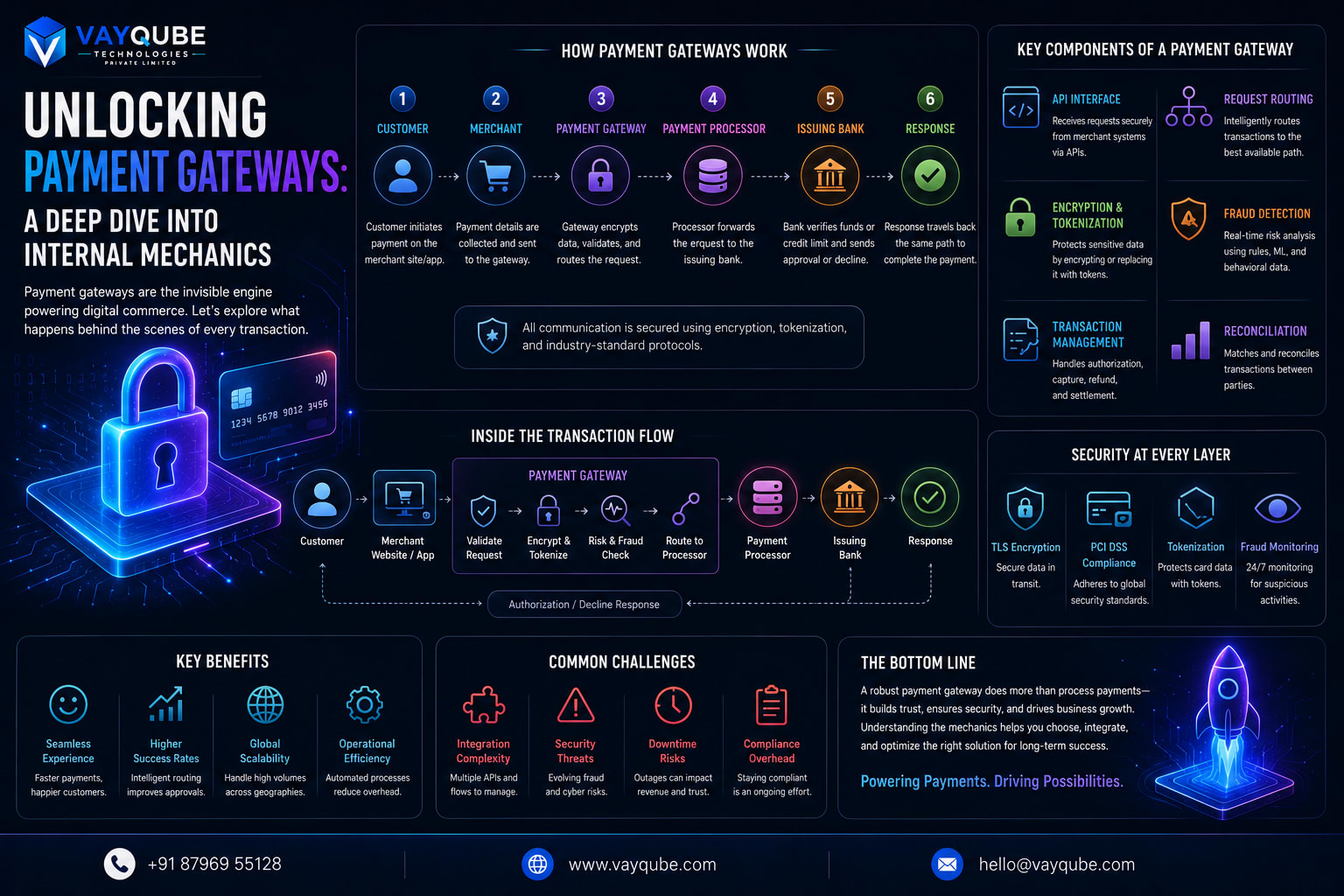
Payment gateways are a crucial component of online transactions, enabling businesses to accept payments from customers through various channels. At their core, payment gateways facilitate the secure transfer of funds between a customer's payment method and a merchant's bank account. Understanding the internal mechanics of payment gateways is essential for businesses to optimize their payment processing, reduce costs, and improve customer satisfaction.
The Importance of Internal Mechanics
The internal mechanics of payment gateways involve a complex series of processes, including payment method tokenization, encryption, and authentication. By grasping these internal mechanics, businesses can better navigate the payment ecosystem, identify potential bottlenecks, and implement strategies to mitigate risks and optimize payment flows. This knowledge is particularly critical for businesses operating in highly competitive markets, where a seamless payment experience can be a key differentiator.
Key aspects of payment gateways that businesses should understand include:
- Payment method support, such as credit cards, online banking, and digital wallets
- Transaction processing, including authorization, capture, and settlement
- Security measures, such as encryption, tokenization, and compliance with industry standards like PCI-DSS
- Integration options, including APIs, SDKs, and plugins for popular e-commerce platforms
By delving into the internal mechanics of payment gateways, businesses can unlock new opportunities for growth, improve their bottom line, and enhance the overall customer experience. In the following sections, we will explore the intricacies of payment gateways, discussing real-world examples, implementation strategies, and production considerations that businesses should be aware of when integrating payment gateways into their operations.
Real-World Implications
In real-world scenarios, understanding the internal mechanics of payment gateways can have a significant impact on a business's ability to scale and adapt to changing market conditions. For instance, a business that understands the payment gateway's transaction processing capabilities can optimize its payment flows to reduce latency and improve conversion rates. Similarly, a business that is aware of the security measures implemented by the payment gateway can better protect its customers' sensitive information and reduce the risk of fraud.
By examining the internal mechanics of payment gateways, businesses can develop a more nuanced understanding of the payment ecosystem and make informed decisions about their payment processing strategies. This knowledge can also help businesses to identify potential pain points and areas for improvement, allowing them to refine their payment experiences and stay ahead of the competition.
Implementation Strategies
When implementing payment gateways, businesses should consider a range of factors, including the payment gateway's compatibility with their existing infrastructure, the level of support provided by the payment gateway, and the payment gateway's compliance with industry standards. By carefully evaluating these factors, businesses can ensure a seamless integration of the payment gateway into their operations and minimize the risk of technical issues or security breaches.
In addition, businesses should also consider the payment gateway's scalability and flexibility, as well as its ability to support multiple payment methods and currencies. By selecting a payment gateway that can adapt to their evolving needs, businesses can future-proof their payment processing and stay competitive in an increasingly global marketplace.
Production Considerations
In production environments, payment gateways must be able to handle high volumes of transactions while maintaining optimal performance and security. To ensure this, businesses should carefully monitor their payment gateway's performance, identifying potential bottlenecks and areas for optimization. This may involve implementing load balancing, caching, or other techniques to improve the payment gateway's scalability and reliability.
By prioritizing production considerations, businesses can ensure that their payment gateways are always available and performing optimally, even during peak periods or unexpected spikes in traffic. This is critical for maintaining customer trust and loyalty, as well as minimizing the risk of lost sales or revenue due to payment processing issues.
Next Steps
In the next section, we will delve deeper into the technical aspects of payment gateways, exploring the various components and processes that underpin these complex systems. We will also examine real-world examples of payment gateways in action, highlighting the benefits and challenges of implementing these systems in different business contexts.
By exploring the technical and practical aspects of payment gateways, businesses can gain a more comprehensive understanding of the payment ecosystem and develop effective strategies for optimizing their payment processing and improving customer satisfaction. Whether you are a seasoned payment professional or just starting to explore the world of payment gateways, this guide will provide you with the insights and expertise you need to succeed in an increasingly competitive and rapidly evolving market.
Why It Matters
Unlocking the internal mechanics of payment gateways is crucial for businesses to understand the intricacies of online transactions. This knowledge has a significant impact on several key areas, including security and compliance, transaction efficiency, and business revenue.
Security and Compliance
Security and compliance are paramount when it comes to payment gateways. A deep understanding of the internal mechanics enables businesses to implement robust security measures, reducing the risk of data breaches and fraudulent transactions. This, in turn, helps to maintain customer trust and avoid costly non-compliance fines. Key considerations include:
- Data encryption and tokenization
- Secure socket layer (SSL) certificates
- Compliance with industry standards, such as PCI-DSS
Transaction Efficiency
Transaction efficiency is another critical aspect of payment gateways. By understanding how payment gateways process transactions, businesses can optimize their checkout processes, reducing cart abandonment rates and improving customer satisfaction. This includes:
- Streamlining payment processing workflows
- Implementing real-time payment processing
- Minimizing transaction failures and declines
Business Revenue Impact
The internal mechanics of payment gateways also have a direct impact on business revenue. By optimizing payment processing, businesses can increase conversion rates, reduce transaction costs, and improve cash flow. This can be achieved by:
- Analyzing transaction data to identify trends and areas for improvement
- Implementing dynamic pricing and discounting strategies
- Offering a range of payment options to cater to different customer preferences
Understanding the internal mechanics of payment gateways is essential for businesses to stay competitive in today's fast-paced digital landscape. By prioritizing security and compliance, transaction efficiency, and business revenue impact, companies can unlock the full potential of their payment gateways and drive long-term growth and success.
Real-World Applications
In real-world scenarios, businesses that have successfully unlocked the internal mechanics of payment gateways have seen significant improvements in their online transactions. For instance, companies that have implemented robust security measures have reported a reduction in fraudulent transactions, while those that have optimized their checkout processes have seen an increase in conversion rates. By applying this knowledge, businesses can create a seamless and secure payment experience for their customers, ultimately driving revenue growth and competitiveness.
Implementation Strategy
To unlock the internal mechanics of payment gateways, businesses should develop a comprehensive implementation strategy that addresses security and compliance, transaction efficiency, and business revenue impact. This strategy should include:
- Conducting thorough risk assessments and security audits
- Implementing payment processing workflows that prioritize efficiency and accuracy
- Analyzing transaction data to identify areas for improvement and optimize revenue streams.
Core Architecture
The core architecture of a payment gateway is a complex system that enables secure and efficient transactions between merchants, customers, and financial institutions.
Payment Processing Flow
The payment processing flow is a critical component of the core architecture, involving a series of steps that facilitate the transfer of funds from the customer to the merchant. This flow typically includes:
- Authorization: verifying the customer's account information and available funds
- Capture: transferring the authorized funds to the merchant's account
- Settlement: finalizing the transaction and updating the customer's and merchant's accounts
- Reconciliation: verifying the transaction details and ensuring accuracy
Key Components and Stakeholders
The core architecture of a payment gateway involves several key components and stakeholders, including:
- Payment processors: handling the transaction flow and interacting with financial institutions
- Acquiring banks: managing the merchant's account and facilitating fund transfers
- Issuing banks: managing the customer's account and verifying account information
- Card networks: enabling communication between financial institutions and facilitating transactions
- Merchants: initiating transactions and receiving payments
- Customers: providing payment information and authorizing transactions
Data Exchange and Protocols
Data exchange and protocols play a crucial role in the core architecture of a payment gateway, ensuring secure and reliable communication between stakeholders. This includes:
- APIs: enabling integration with merchants and financial institutions
- Messaging protocols: facilitating communication between stakeholders, such as ISO 8583
- Data encryption: protecting sensitive payment information, such as TLS and SSL
- Tokenization: replacing sensitive payment information with unique tokens, enhancing security and reducing risk
The core architecture of a payment gateway must be designed to accommodate various payment methods, including credit cards, debit cards, and alternative payment methods, while ensuring scalability, reliability, and security. By understanding the payment processing flow, key components and stakeholders, and data exchange and protocols, businesses can better navigate the complexities of payment gateways and optimize their implementation strategy.
Business Benefits
Unlocking payment gateways can have a significant impact on a business's bottom line. By understanding the internal mechanics of payment gateways, companies can optimize their payment processes to improve conversion rates, enhance customer experience, and gain a competitive advantage.
Increased Conversion Rates
A well-implemented payment gateway can streamline the checkout process, reducing friction and increasing the likelihood of a successful transaction. This can be achieved through features such as:
- Tokenization, which securely stores customer payment information for future transactions
- One-click payments, which eliminate the need for customers to re-enter payment details
- Support for multiple payment methods, which caters to different customer preferences
Enhanced Customer Experience
A payment gateway that is intuitive, secure, and reliable can significantly enhance the overall customer experience. This can be achieved through:
- Clear and concise payment instructions
- Real-time payment status updates
- Support for multiple languages and currencies
Competitive Advantage
In today's competitive market, a payment gateway that is optimized for performance, security, and user experience can be a key differentiator. By investing in a robust payment gateway, businesses can:
- Improve their brand reputation and trust
- Increase customer loyalty and retention
- Stay ahead of competitors who may be using outdated or inefficient payment systems
By focusing on these business benefits, companies can unlock the full potential of their payment gateways and drive growth, revenue, and customer satisfaction. The next step is to explore the implementation strategies and production considerations that can help businesses achieve these benefits.
Scalability
To ensure seamless payment processing, scalability is a critical aspect of payment gateways. Handling high transaction volumes is a key challenge that payment gateways must overcome.
Handling High Transaction Volumes
Payment gateways must be designed to handle sudden spikes in transaction volumes without compromising performance. This can be achieved through load balancing, distributed architecture, and autoscaling. By distributing the workload across multiple servers, payment gateways can ensure that transactions are processed efficiently, even during peak periods.
Some key considerations for handling high transaction volumes include:
- Implementing a messaging queue to manage incoming transactions
- Using a distributed database to store transaction data
- Leveraging cloud-based infrastructure to scale up or down as needed
Flexibility and Adaptability
Payment gateways must also be flexible and adaptable to accommodate changing business needs. This includes supporting multiple payment methods, currencies, and payment instruments. By providing a flexible payment infrastructure, businesses can quickly respond to changing market conditions and customer preferences.
Key factors to consider when evaluating flexibility and adaptability include:
- Support for multiple payment protocols and standards
- Ability to integrate with existing systems and infrastructure
- Capacity to accommodate new payment methods and instruments
Future-Proofing Payment Infrastructure
To future-proof payment infrastructure, businesses must consider emerging trends and technologies, such as blockchain, artificial intelligence, and the Internet of Things (IoT). By investing in a scalable and adaptable payment infrastructure, businesses can stay ahead of the curve and capitalize on new opportunities.
Some strategies for future-proofing payment infrastructure include:
- Investing in research and development to stay ahead of emerging trends
- Collaborating with fintech companies and startups to leverage innovative technologies
- Developing a roadmap for adopting new payment technologies and standards
Implementation Challenges
Implementing a payment gateway can be a complex process, fraught with technical, regulatory, and quality assurance challenges. As businesses strive to provide seamless payment experiences for their customers, they must navigate these obstacles to ensure a smooth and secure transaction process.
Technical Integration Complexities
Technical integration is a critical aspect of payment gateway implementation. It requires careful consideration of various factors, including:
- API compatibility and connectivity
- Data encryption and security protocols
- Payment processing workflows and transaction routing
- Integration with existing systems, such as e-commerce platforms and accounting software These technical complexities can be daunting, especially for businesses with limited IT resources or expertise.
Regulatory Compliance Hurdles
Payment gateways must comply with a myriad of regulations, including:
- Payment Card Industry Data Security Standard (PCI-DSS)
- General Data Protection Regulation (GDPR)
- Anti-Money Laundering (AML) and Know Your Customer (KYC) regulations
- Local and national laws governing payment processing and financial transactions Ensuring regulatory compliance can be a significant challenge, requiring significant investments of time, money, and resources.
Testing and Quality Assurance
Thorough testing and quality assurance are essential to ensure that payment gateways function correctly and securely. This includes:
- Conducting comprehensive testing of payment processing workflows and transaction scenarios
- Performing security audits and vulnerability assessments
- Implementing robust error handling and exception management mechanisms
- Conducting regular maintenance and updates to ensure ongoing security and compliance By prioritizing testing and quality assurance, businesses can minimize the risk of errors, security breaches, and reputational damage.
As payment gateways continue to evolve and play a critical role in e-commerce and financial transactions, it is essential to address these implementation challenges head-on. By understanding the technical, regulatory, and quality assurance complexities involved, businesses can develop effective strategies for overcoming these hurdles and delivering seamless, secure payment experiences for their customers.
In real-world scenarios, businesses have successfully addressed these implementation challenges by partnering with experienced payment gateway providers, investing in robust testing and quality assurance processes, and prioritizing ongoing maintenance and updates. By taking a proactive and strategic approach to payment gateway implementation, businesses can unlock the full potential of these critical systems and drive long-term growth and success.
Use Cases
The payment gateway is a critical component of various industries, enabling businesses to accept payments from customers worldwide. In this section, we will explore the different use cases where payment gateways play a vital role.
E-commerce and Retail
E-commerce and retail businesses rely heavily on payment gateways to process transactions. With the rise of online shopping, payment gateways have become an essential tool for these industries. Some of the key features that payment gateways offer to e-commerce and retail businesses include:
- Support for multiple payment methods, such as credit cards, debit cards, and digital wallets
- Tokenization and encryption for secure transactions
- Recurring payment options for subscription-based services
- Real-time transaction tracking and reporting
Digital Services and Subscriptions
Digital services, such as streaming platforms, software as a service (SaaS), and online courses, also utilize payment gateways to manage subscription-based payments. Payment gateways provide these businesses with features like:
- Automated recurring payments
- Prorated billing for mid-cycle plan changes
- Support for multiple currencies and payment methods
- Integration with popular subscription management platforms
Cross-Border Transactions
Cross-border transactions are becoming increasingly common, and payment gateways play a crucial role in facilitating these transactions. Payment gateways offer features such as:
- Support for multiple currencies and exchange rates
- Compliance with international payment regulations, such as GDPR and PCI-DSS
- Real-time currency conversion and exchange rate updates
- Partnerships with local banks and payment processors to reduce transaction fees
By understanding the different use cases for payment gateways, businesses can better appreciate the importance of implementing a reliable and secure payment processing system. In the next section, we will delve into the implementation strategy for payment gateways, exploring the key considerations and best practices for integrating payment gateways into existing infrastructure.
Best Practices
To ensure seamless and secure payment processing, it's essential to follow best practices that prioritize security, user experience, and performance monitoring.
Security and Risk Management
Implementing robust security measures is crucial to prevent fraud and protect sensitive customer information. This includes:
- Using secure protocols such as HTTPS and TLS to encrypt data
- Implementing tokenization to replace sensitive data with unique tokens
- Conducting regular security audits and penetration testing to identify vulnerabilities
- Maintaining compliance with industry standards such as PCI-DSS and GDPR
User Experience Optimization
A well-designed payment gateway can significantly improve the user experience, leading to increased conversion rates and customer satisfaction. Key considerations include:
- Streamlining the payment process to reduce friction and abandonment
- Providing clear and concise payment instructions and feedback
- Offering multiple payment options to cater to different customer preferences
- Ensuring mobile optimization to accommodate the growing number of mobile users
Monitoring and Analytics
Real-time monitoring and analytics are vital to identify performance issues, detect potential security threats, and optimize the payment gateway for better results. This includes:
- Tracking key performance indicators such as transaction success rates and processing times
- Analyzing customer behavior and payment trends to inform optimization strategies
- Setting up alerts and notifications to promptly address issues and minimize downtime
- Using data analytics to identify areas for improvement and measure the effectiveness of optimization efforts
By prioritizing these best practices, businesses can ensure a secure, user-friendly, and high-performance payment gateway that drives revenue growth and customer satisfaction.
Frequently Asked Questions
To further clarify the intricacies of payment gateways, let's address some common misconceptions and provide actionable advice for troubleshooting and future-proofing your payment infrastructure.
Common Misconceptions
There are several misconceptions surrounding payment gateways that can lead to misunderstandings about their functionality and capabilities. Some of these include:
- Believing that all payment gateways are created equal, when in fact, each has its own strengths, weaknesses, and specializations.
- Assuming that payment gateways only facilitate transactions, when they often provide additional services such as fraud detection, recurring billing, and analytics.
- Thinking that integrating a payment gateway is a one-time task, when in reality, it requires ongoing maintenance and updates to ensure security and compliance.
Troubleshooting Tips
When issues arise with your payment gateway, it's essential to have a systematic approach to troubleshooting. Here are some tips:
- Verify that your payment gateway is properly configured and that all necessary settings are correctly implemented.
- Check for any updates or patches that may be required to ensure compatibility and security.
- Monitor your transaction logs to identify any patterns or trends that may indicate the source of the issue.
- Reach out to your payment gateway's support team for assistance, as they often have extensive knowledge and resources to help resolve problems.
The Future of Payment Gateways
As the payments landscape continues to evolve, payment gateways must adapt to meet the changing needs of businesses and consumers. Some trends that will shape the future of payment gateways include:
- Increased focus on security and compliance, driven by the need to protect sensitive customer data and prevent fraud.
- Growing demand for omnichannel payment experiences, which will require payment gateways to support a wide range of devices and platforms.
- Rising importance of emerging technologies such as blockchain, artificial intelligence, and the Internet of Things (IoT), which will enable new payment methods and use cases.
- Greater emphasis on customer experience and user interface, as businesses seek to create seamless and intuitive payment processes that drive conversions and loyalty.
Conclusion
In the realm of digital transactions, understanding the internal mechanics of payment gateways is crucial for businesses aiming to expand their customer base and increase revenue. The key to unlocking the full potential of payment gateways lies in grasping their core architecture, scalability, and implementation challenges.
Key Takeaways
- Payment gateways act as bridges between merchants and financial institutions, facilitating secure and efficient transactions.
- The core architecture of payment gateways involves a complex interplay of payment processors, gateways, and banks.
- Scalability and reliability are critical factors in choosing a payment gateway, as they directly impact the user experience and conversion rates.
- Implementing a payment gateway requires careful consideration of security, compliance, and user interface.
Actionable Next Steps
To leverage payment gateways effectively, businesses should:
- Conduct thorough research on different payment gateways to find the best fit for their specific needs.
- Develop a comprehensive implementation strategy that addresses security, scalability, and user experience.
- Continuously monitor and optimize their payment gateway to ensure high transaction success rates and minimal downtime.
- Stay up-to-date with the latest trends and regulatory requirements in the payment industry.
Final Thoughts on Payment Gateways
As the digital payment landscape continues to evolve, payment gateways will play an increasingly vital role in facilitating transactions and driving business growth. By understanding the internal mechanics of payment gateways and implementing them effectively, businesses can unlock new revenue streams, enhance customer satisfaction, and stay ahead of the competition. The future of payment gateways holds much promise, with emerging technologies like blockchain and artificial intelligence poised to further transform the payment industry.
Related Vayqube Resources
- How To Build Fintech Application Payments Security Scaling
- Best Fintech Software Development Company In Singapore City
- Best Mobile App Development Company In Singapore City
- Best Fintech Software Development Company In New York
- Best Mobile App Development Company In New York
- Digital Banking Software Development
Next Step
If your systems are struggling with scalability, automation, architecture complexity, or operational efficiency, it's time to modernize your infrastructure and workflows.
👉 Talk to a Vayqube solution architect and build systems designed for long-term production growth: