
Staff Augmentation Explained
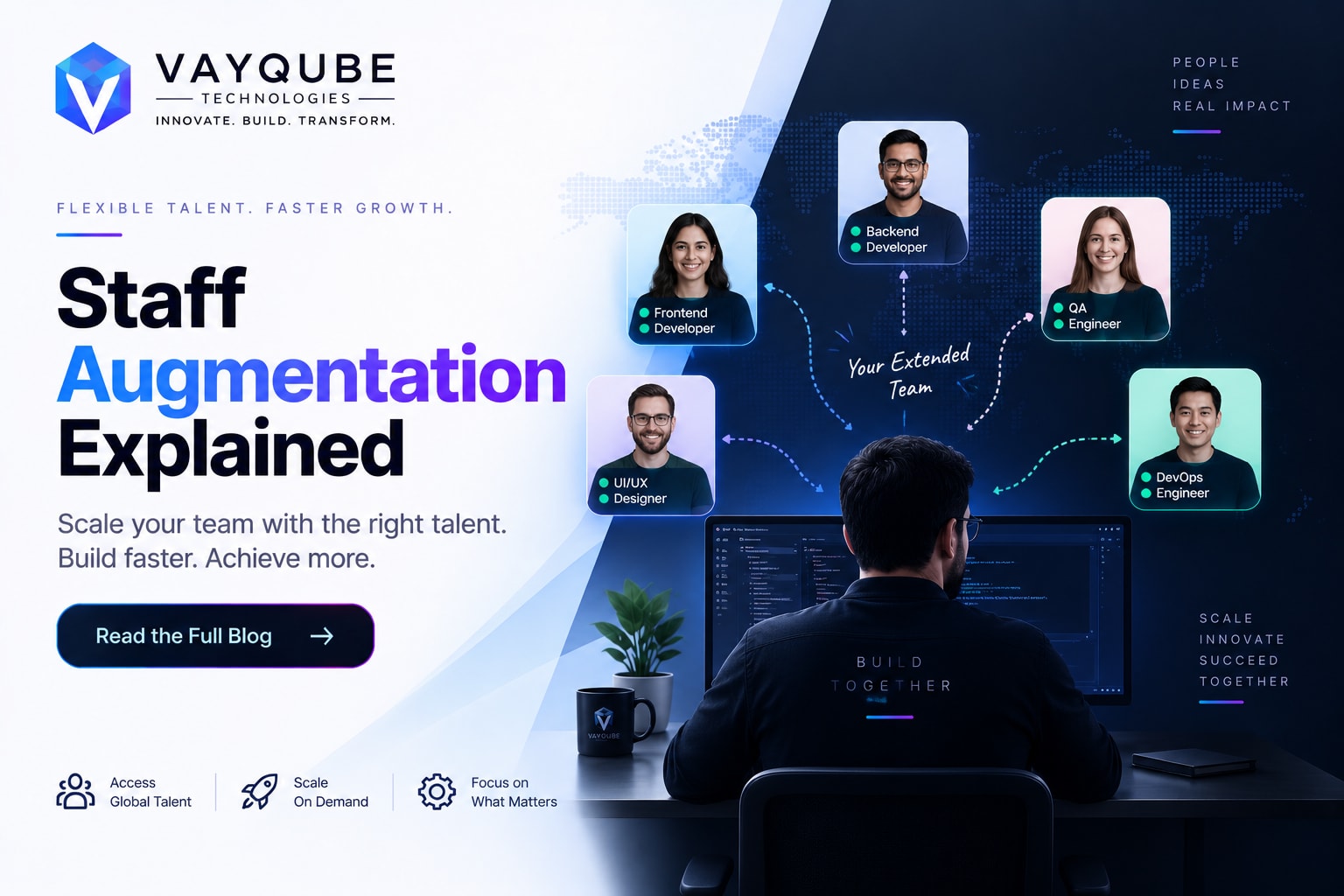
Staff augmentation is a strategic approach to filling skill gaps and enhancing team capabilities. By leveraging external talent, businesses can quickly adapt to changing market conditions and drive growth
Vayqube Team
Software architecture and product engineering
Introduction
Staff augmentation is a strategic approach to filling skill gaps and enhancing team capabilities. It involves hiring external professionals to work alongside internal teams, bringing specialized expertise and fresh perspectives to drive business growth.
At its core, staff augmentation is about definition and purpose. It is defined as the process of supplementing an organization's existing staff with external talent, typically on a project-by-project basis. This approach allows companies to access specialized skills, increase productivity, and improve overall performance without the long-term commitment of hiring full-time employees.
Key Aspects of Staff Augmentation
Some key aspects of staff augmentation include:
- Flexibility: Allows companies to quickly scale up or down to meet changing project requirements
- Cost-effectiveness: Reduces the costs associated with recruiting, training, and retaining full-time employees
- Access to specialized skills: Enables companies to tap into a global talent pool and acquire the expertise needed to drive innovation and competitiveness
A brief overview of staff augmentation reveals its potential to transform the way companies approach talent acquisition and management. By leveraging external talent, businesses can accelerate project delivery, enhance product quality, and gain a competitive edge in the market.
Real-World Applications
In real-world scenarios, staff augmentation is used by companies to address a range of challenges, from filling immediate skill gaps to driving long-term growth and innovation. For instance, a software development company might use staff augmentation to bring in expert developers with specialized skills in emerging technologies like AI or blockchain.
This approach enables the company to quickly develop and deploy cutting-edge products, enhancing its market position and competitiveness. Similarly, a marketing firm might use staff augmentation to access freelance writers, designers, or social media specialists, allowing it to deliver high-quality campaigns and content to its clients without the overhead of maintaining a large in-house team.
By understanding the definition, purpose, and applications of staff augmentation, businesses can make informed decisions about how to leverage this strategy to achieve their goals and drive success in an increasingly competitive and rapidly changing market landscape.
Implementation Considerations
When implementing a staff augmentation strategy, companies should consider several key factors, including:
- Clearly defining project requirements and objectives
- Identifying the right talent and skills to meet those needs
- Establishing effective communication and collaboration channels between internal teams and external talent
- Developing a comprehensive onboarding process to ensure seamless integration of external professionals into the company's culture and workflows
By carefully considering these factors and adopting a strategic approach to staff augmentation, businesses can unlock the full potential of this talent acquisition strategy and achieve significant benefits in terms of productivity, innovation, and competitiveness.
Why It Matters
Staff augmentation is a strategic approach to staffing that allows businesses to adapt to changing needs and circumstances. By understanding the benefits of flexible staffing and addressing skill gaps, organizations can better position themselves for success.
Benefits of Flexible Staffing
Flexible staffing models provide several benefits, including:
- Increased agility: allowing businesses to quickly respond to changes in the market or industry
- Improved cost management: enabling companies to scale their workforce up or down as needed, reducing unnecessary overhead costs
- Enhanced innovation: bringing in fresh perspectives and expertise to drive innovation and growth
Addressing Skill Gaps
Staff augmentation also helps address skill gaps within an organization. By bringing in external experts or contractors, businesses can:
- Fill immediate needs: quickly acquiring the necessary skills to complete a project or meet a deadline
- Develop internal capabilities: providing training and upskilling opportunities for existing employees to develop new skills
- Drive digital transformation: leveraging external expertise to implement new technologies and drive business innovation
Effective staff augmentation requires a deep understanding of the organization's needs and goals. By taking a strategic approach to staffing, businesses can create a more agile, adaptable, and innovative workforce. This, in turn, can drive business growth, improve competitiveness, and enhance overall performance.
Key considerations for implementing staff augmentation include identifying the right talent, managing cultural fit, and ensuring seamless integration with existing teams. By prioritizing these factors, organizations can unlock the full potential of staff augmentation and achieve their business objectives.
In real-world scenarios, staff augmentation has been used to drive success in various industries, from technology and finance to healthcare and manufacturing. For example, a company may use staff augmentation to bring in expert data scientists to develop and implement AI-powered solutions, or to augment their marketing team with freelance writers and designers to launch a new product campaign.
By embracing flexible staffing models and addressing skill gaps, businesses can stay ahead of the curve and achieve their goals in an increasingly competitive landscape.
Core Architecture
The core architecture of staff augmentation is built around flexibility and scalability. To achieve this, organizations can adopt various models of staff augmentation, each with its own set of advantages and considerations.
Models of Staff Augmentation
There are several models of staff augmentation that organizations can choose from, depending on their specific needs and goals. Some of the most common models include:
- Project-based augmentation: This model involves bringing in external staff to work on specific projects, allowing organizations to scale up or down as needed.
- Staff augmentation as a service: This model involves partnering with a third-party provider to augment an organization's staff on an ongoing basis, often with a focus on specific skills or expertise.
- Hybrid models: Some organizations may choose to combine elements of different models to create a hybrid approach that meets their unique needs.
Key Components
Regardless of the model chosen, there are several key components that are essential to the success of staff augmentation. These include:
- Clear communication: Effective communication is critical to ensuring that augmented staff are properly integrated into the organization and that their work is aligned with overall goals and objectives.
- Well-defined roles and responsibilities: Clearly defining the roles and responsibilities of augmented staff helps to avoid confusion and ensures that everyone is working towards the same objectives.
- Strong project management: Good project management is essential to ensuring that augmented staff are properly utilized and that projects are delivered on time and to the required standard.
- Cultural alignment: Ensuring that augmented staff are culturally aligned with the organization is critical to ensuring a smooth and successful integration.
Business Benefits
Staff augmentation offers numerous benefits to businesses, making it an attractive solution for companies looking to enhance their capabilities.
Cost Savings
One of the primary advantages of staff augmentation is the potential for significant cost savings. By hiring external experts on a project basis, companies can avoid the costs associated with recruiting, training, and retaining full-time employees. This approach also eliminates the need for benefits, payroll taxes, and other expenses related to permanent staff. Additionally, staff augmentation allows businesses to scale up or down quickly, reducing the financial risks associated with hiring and firing employees.
Increased Efficiency
Staff augmentation can also lead to increased efficiency within an organization. External experts bring specialized skills and knowledge, enabling them to complete tasks more quickly and effectively than internal staff. This, in turn, can lead to faster project turnaround times, improved quality, and enhanced customer satisfaction. Furthermore, augmented staff can help alleviate workload pressures on existing employees, reducing the risk of burnout and improving overall job satisfaction.
Improved Productivity
The introduction of external experts through staff augmentation can have a profound impact on productivity. By leveraging the skills and expertise of augmented staff, businesses can tackle complex projects and tasks that may have been beyond the capabilities of their internal teams. This can lead to innovative solutions, improved processes, and enhanced competitiveness. Moreover, the fresh perspectives and ideas brought by external experts can help stimulate innovation and growth within the organization, driving long-term success and profitability.
Key benefits of staff augmentation include:
- Access to specialized skills and expertise
- Enhanced scalability and flexibility
- Reduced recruitment and training costs
- Improved project turnaround times and quality
- Increased innovation and competitiveness
By understanding the business benefits of staff augmentation, companies can make informed decisions about how to leverage this strategy to drive growth, improve efficiency, and enhance their overall competitiveness.
Scalability
To achieve true scalability, staff augmentation must be able to adapt to business growth. This means being able to quickly ramp up or down to meet changing demands.
Adapting to Business Growth
As companies expand, their staffing needs often change. Staff augmentation allows businesses to bring in specialized talent to support growth initiatives, without the long-term commitment of hiring full-time employees. This flexibility is crucial for companies looking to enter new markets, launch new products, or respond to changes in their industry.
Key benefits of adapting to business growth through staff augmentation include:
- Rapid access to specialized skills and expertise
- Ability to quickly scale up or down to meet changing demands
- Reduced recruitment and training costs associated with hiring full-time employees
Flexibility in Staffing
Staff augmentation provides businesses with the flexibility to staff projects and initiatives in a way that makes sense for their specific needs. This can include bringing in temporary support for a specific project, or hiring permanent employees to fill a skills gap. By having access to a flexible staffing model, businesses can respond more quickly to changes in their market, and stay ahead of the competition.
Some examples of flexible staffing models include:
- Project-based staffing: bringing in temporary staff to support a specific project or initiative
- Skills-based staffing: hiring staff with specific skills or expertise to fill a skills gap
- Outcome-based staffing: staffing based on specific business outcomes or objectives
Implementation Challenges
Implementing staff augmentation can be complex, and several challenges may arise. Two key areas of concern are integration with existing teams and managing augmented staff.
Integration with Existing Teams
When integrating augmented staff with existing teams, several factors come into play. These include:
- Communication barriers: Ensuring that all team members, including augmented staff, are on the same page and working towards the same goals.
- Cultural differences: Integrating staff from different cultural backgrounds and ensuring that they mesh with the existing team culture.
- Skillset differences: Managing the varying skill levels and expertise of augmented staff and ensuring they complement the existing team.
To overcome these challenges, it's essential to establish clear communication channels, define project goals and objectives, and provide training and support to ensure a smooth integration.
Managing Augmented Staff
Managing augmented staff requires a strategic approach to ensure that they are effectively utilized and integrated into the existing team. This includes:
- Defining roles and responsibilities: Clearly outlining the tasks and expectations for augmented staff to ensure they understand their responsibilities.
- Performance monitoring: Regularly monitoring the performance of augmented staff to ensure they meet project requirements and are working effectively with the existing team.
- Feedback mechanisms: Establishing feedback mechanisms to ensure that augmented staff receive constructive feedback and are able to adjust their work accordingly.
By addressing these challenges and implementing effective management strategies, organizations can ensure a successful staff augmentation implementation that drives business growth and improves project outcomes.
Key considerations for managing augmented staff include:
- Ensuring that augmented staff have the necessary tools and resources to perform their tasks effectively.
- Providing opportunities for professional development and growth to ensure that augmented staff remain engaged and motivated.
- Establishing a clear understanding of the project timeline, milestones, and deliverables to ensure that augmented staff are working towards the same goals as the existing team.
By taking a proactive approach to managing augmented staff, organizations can minimize the risks associated with staff augmentation and maximize the benefits, including improved project outcomes, increased efficiency, and enhanced scalability.
Use Cases
Staff augmentation is a versatile strategy that can be applied to various scenarios, offering flexibility and customization to meet specific business needs.
Project-Based Augmentation
This approach involves bringing in external experts to work on specific projects with defined timelines and objectives. The benefits include:
- Access to specialized skills that may not be available in-house
- Enhanced project delivery capabilities without long-term staffing commitments
- Ability to scale up or down as project requirements change
- Fresh perspectives and innovative approaches from external professionals
For instance, a company launching a new product might augment its staff with experienced marketing professionals to handle the campaign, or a tech firm might bring in freelance developers to accelerate the development of a new feature.
Long-Term Staff Enhancement
In contrast, long-term staff enhancement focuses on integrating external talent into the existing team structure for an extended period. This can be particularly useful for:
- Filling persistent skill gaps in the organization
- Supporting continuous business growth and expansion
- Enhancing the overall capabilities and competitiveness of the in-house team
- Developing a more diverse and dynamic work environment
Examples include augmenting a company's IT department with external experts to support a long-term digital transformation initiative or enhancing the sales team with seasoned professionals to drive consistent revenue growth.
Both project-based augmentation and long-term staff enhancement offer unique advantages, and the choice between them depends on the organization's specific goals, challenges, and strategic priorities. By understanding these use cases, businesses can better leverage staff augmentation to achieve their objectives and stay competitive in a rapidly changing market.
Best Practices
To ensure the success of staff augmentation, it's essential to follow best practices that promote effective collaboration and goal achievement.
Clear Communication
Clear communication is the foundation of a successful staff augmentation strategy. This involves establishing open and transparent channels of communication between the augmented staff and the existing team. Regular updates, progress reports, and feedback sessions can help prevent misunderstandings and ensure that everyone is aligned with the project's objectives.
Some key aspects of clear communication include:
- Defining roles and responsibilities to avoid confusion
- Establishing a common language and terminology
- Encouraging active listening and feedback
- Using collaboration tools to facilitate communication and information sharing
Defined Goals and Objectives
Having defined goals and objectives is crucial to the success of staff augmentation. This involves setting clear, measurable, and achievable targets that align with the organization's overall strategy. Defined goals and objectives help to:
- Focus efforts on high-priority tasks
- Allocate resources effectively
- Measure progress and adjust strategies as needed
- Ensure that the augmented staff is working towards the same objectives as the existing team
By following these best practices, organizations can maximize the benefits of staff augmentation and achieve their desired outcomes. Effective communication and defined goals and objectives are essential to building a strong foundation for success.
Some additional considerations for defined goals and objectives include:
- Breaking down large objectives into smaller, manageable tasks
- Establishing key performance indicators (KPIs) to measure progress
- Regularly reviewing and updating goals and objectives to ensure they remain relevant and achievable
- Ensuring that the augmented staff has the necessary skills and resources to achieve the defined goals and objectives.
FAQ
Staff augmentation is a popular strategy for businesses looking to fill skill gaps and enhance their teams. However, it also raises several questions. Here are some common concerns and questions about staff augmentation:
Common Questions About Staff Augmentation
Some of the most frequently asked questions about staff augmentation include:
- What is the difference between staff augmentation and outsourcing?
- How do I ensure the augmented staff is aligned with my company culture?
- What are the benefits of staff augmentation compared to hiring full-time employees?
- How do I manage and integrate augmented staff with my existing team?
- What are the common risks associated with staff augmentation, and how can I mitigate them?
Addressing Concerns
Businesses often have concerns about staff augmentation, such as:
- Loss of control over the augmented staff
- Difficulty in integrating augmented staff with existing teams
- Potential risks to company data and intellectual property
- Challenges in managing and measuring the performance of augmented staff
- Uncertainty about the long-term costs and benefits of staff augmentation
To address these concerns, it's essential to:
- Clearly define the roles and responsibilities of the augmented staff
- Establish strong communication channels and project management processes
- Implement robust security measures to protect company data and intellectual property
- Develop a comprehensive onboarding process to ensure smooth integration with existing teams
- Establish key performance indicators (KPIs) to measure the success of staff augmentation initiatives
By understanding the common questions and concerns associated with staff augmentation, businesses can make informed decisions and develop effective strategies for implementing this approach. This, in turn, can help them achieve their goals, drive growth, and stay competitive in today's fast-paced business landscape.
Some real-world examples of successful staff augmentation include:
- A fintech company that augmented its development team to accelerate the launch of a new product
- A healthcare organization that augmented its data analytics team to improve patient outcomes
- A retail company that augmented its marketing team to enhance its e-commerce capabilities
In each of these cases, staff augmentation enabled the businesses to quickly access the skills and expertise they needed to drive innovation, improve efficiency, and achieve their objectives.
When implementing staff augmentation, it's crucial to consider production readiness and ensure that the augmented staff can seamlessly integrate with existing systems, processes, and teams. This includes:
- Developing a comprehensive training program to ensure the augmented staff has the necessary skills and knowledge
- Establishing clear communication channels and collaboration tools to facilitate teamwork and knowledge sharing
- Implementing robust testing and quality assurance processes to ensure the augmented staff meets the required standards
- Continuously monitoring and evaluating the performance of the augmented staff to identify areas for improvement and optimize the staff augmentation strategy.
Summary of Staff Augmentation
Staff augmentation is a strategic approach to staffing that enables businesses to quickly adapt to changing needs and requirements. By leveraging external talent and expertise, organizations can fill skill gaps, enhance their capabilities, and drive innovation. This approach has become increasingly popular in recent years, as companies seek to remain agile and competitive in a rapidly evolving market.
Key Takeaways
- Staff augmentation allows businesses to access specialized skills and expertise on a flexible, as-needed basis
- This approach can help organizations reduce costs, improve efficiency, and enhance their overall competitiveness
- Staff augmentation can be used to support a wide range of business functions, from software development and IT to marketing and sales
Future of Flexible Staffing
As the business landscape continues to evolve, the demand for flexible staffing solutions is likely to grow. Staff augmentation is well-positioned to play a key role in this trend, as companies seek to balance their need for specialized skills and expertise with the need for greater agility and adaptability. Some potential future developments in staff augmentation include:
- Increased use of artificial intelligence and machine learning to match talent with business needs
- Greater emphasis on upskilling and reskilling existing employees to enhance their versatility and value
- More widespread adoption of flexible, remote work arrangements to attract and retain top talent
- Growing recognition of the importance of culture and values in determining the success of staff augmentation initiatives
Real-World Applications
Staff augmentation is already being used in a variety of real-world contexts, from tech startups to large enterprises. For example, a company might use staff augmentation to:
- Supplement its in-house development team with specialized expertise in areas like cloud computing or cybersecurity
- Enhance its marketing capabilities with external talent and expertise in areas like social media or content creation
- Support its sales team with external resources and expertise in areas like lead generation or account management
By providing businesses with access to specialized skills and expertise on a flexible, as-needed basis, staff augmentation can help drive growth, innovation, and competitiveness in a rapidly evolving market.
Related Vayqube Resources
- Startups Building Ai Products Without Large Teams
- Best Fintech Software Development Company In New York
- Top Fintech Software Development Company In New York
- Best Fintech Software Development Company In India
- Best Fintech Software Development Company In Usa
- Best Fintech Software Development Company In Uk
Next Step
If your systems are struggling with scalability, automation, architecture complexity, or operational efficiency, it's time to modernize your infrastructure and workflows.
👉 Talk to a Vayqube solution architect and build systems designed for long-term production growth: