
India vs USA: A Comparative Analysis of Software Development Costs
When it comes to software development, cost is a crucial factor. India and the USA are two popular destinations, but which one offers the best value? Explore the differences in software development costs between these two countries.
Vayqube Team
Author
Understanding Cost Differences
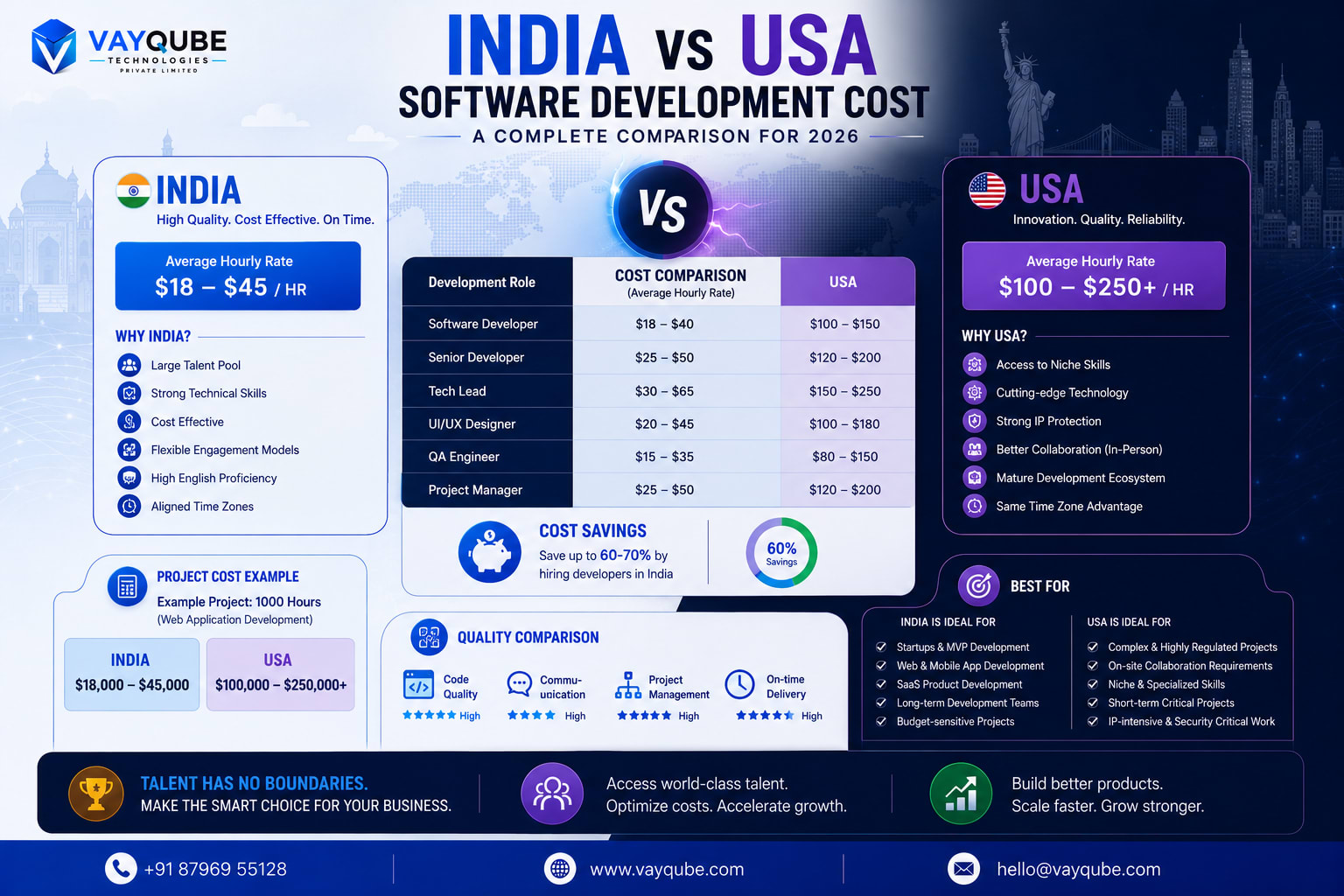
The decision to outsource software development to India or the USA can have significant implications for businesses, particularly when it comes to costs. Understanding the cost differences between these two countries is crucial for companies looking to optimize their software development budgets.
In India, software development costs are generally lower due to the country's large pool of skilled developers and competitive pricing. This has made India a popular destination for companies looking to outsource their software development needs. On the other hand, the USA offers high-quality software development services, but at a higher cost.
Key Cost Considerations
When evaluating software development costs in India and the USA, businesses should consider the following factors:
- Labor costs: The cost of hiring skilled developers in India is significantly lower compared to the USA.
- Infrastructure costs: The cost of setting up and maintaining infrastructure, such as offices and equipment, can vary significantly between the two countries.
- Technology costs: The cost of using specific technologies or tools can also differ between India and the USA.
Business Implications
The cost differences between India and the USA can have significant implications for businesses. For example, companies that outsource their software development to India can benefit from cost savings, which can be reinvested in other areas of the business. On the other hand, companies that choose to develop software in the USA may benefit from faster time-to-market and higher quality products, but at a higher cost.
Real-World Examples
Many companies have successfully outsourced their software development to India, resulting in significant cost savings. For instance, a US-based startup may outsource its mobile app development to an Indian company, saving up to 50% on development costs. In contrast, a company that requires high-quality, custom software development may choose to develop in the USA, despite the higher costs, to ensure faster time-to-market and higher quality products.
Implementation Strategy
When deciding between India and the USA for software development, businesses should consider their specific needs and priorities. This includes evaluating factors such as development time, quality requirements, and budget constraints. By understanding the cost differences and implications of outsourcing to India or developing in the USA, businesses can make informed decisions that align with their overall strategy and goals.
Why It Matters
The cost of software development can have a significant impact on a company's bottom line, making it a crucial consideration for businesses looking to invest in custom software solutions.
Financial Implications
The financial implications of software development costs can be substantial, affecting not only the initial investment but also the long-term maintenance and update costs. Companies need to carefully evaluate the cost-benefit analysis of outsourcing software development to countries like India versus keeping it in-house in the USA.
Factors Influencing Cost Variations
Several factors contribute to the cost variations between India and the USA, including:
- Labor costs: The cost of hiring skilled developers and engineers varies significantly between the two countries.
- Infrastructure costs: The cost of setting up and maintaining development infrastructure, including hardware, software, and office space, differs between India and the USA.
- Cultural and language differences: Communication barriers and cultural differences can impact the efficiency and effectiveness of software development projects.
- Government policies and regulations: Tax incentives, intellectual property laws, and data protection regulations can influence the cost of software development in each country.
Real-World Examples
Companies like Microsoft and Google have outsourced software development to India, taking advantage of the country's skilled workforce and lower labor costs. On the other hand, companies like Apple and Amazon have chosen to keep their software development in-house in the USA, prioritizing control, security, and innovation.
Production Considerations
When evaluating the cost of software development, companies must consider production readiness, scalability, and implementation strategy. The ability to quickly deploy and scale software solutions can be a significant competitive advantage, and companies must weigh the trade-offs between cost, quality, and time-to-market.
Business Impact
The decision to outsource software development to India or keep it in-house in the USA can have far-reaching implications for a company's business strategy and competitiveness. By carefully evaluating the factors influencing cost variations and considering real-world examples, companies can make informed decisions that balance cost, quality, and innovation.
Core Architecture
The core architecture of software development plays a crucial role in determining the overall cost of a project. In India and the USA, different software development methodologies are employed, which significantly impact the cost.
Methodology Comparison
In India, agile methodologies such as Scrum and Kanban are widely adopted, allowing for flexibility and rapid iteration. In contrast, the USA tends to favor a mix of agile and traditional waterfall approaches, depending on the project's complexity and requirements. Key differences in methodology include:
- Project planning and management
- Team structure and communication
- Risk management and mitigation
Technology Stacks and Infrastructure
The choice of technology stack and infrastructure also varies between India and the USA. Indian developers often prefer open-source technologies such as Linux, MySQL, and PHP, which are cost-effective and widely supported. In the USA, a broader range of technologies is used, including proprietary software like Microsoft Azure and Oracle. Infrastructure costs, including server maintenance and cloud services, are generally higher in the USA due to the cost of living and labor expenses.
Cost Analysis
When comparing the costs of software development in India and the USA, several factors come into play. These include:
- Labor costs: Indian developers tend to be more affordable, with average salaries ranging from $10,000 to $20,000 per year, compared to $50,000 to $100,000 per year in the USA.
- Infrastructure costs: The USA has higher infrastructure costs due to the cost of living and labor expenses.
- Technology costs: The choice of technology stack and infrastructure can significantly impact the overall cost of a project, with open-source technologies often being more cost-effective.
Implementation Strategy
To minimize costs and maximize efficiency, companies should consider the following implementation strategies:
- Outsourcing: Outsourcing certain aspects of software development to countries like India can help reduce labor costs.
- Cloud services: Utilizing cloud services can help reduce infrastructure costs and improve scalability.
- Technology selection: Carefully selecting the technology stack and infrastructure can help minimize costs and improve efficiency.
Business Benefits
The decision to outsource software development to India or opt for a USA-based development team has significant implications for businesses.
Cost Savings Opportunities
Outsourcing to India presents a compelling value proposition, with cost savings being a primary driver. The country's large pool of skilled developers, combined with lower labor costs, can result in substantial savings for businesses. Key benefits include:
- Reduced personnel expenses, as Indian developers' salaries are generally lower than those in the USA
- Access to a vast talent pool, enabling businesses to find the right expertise for their projects
- Increased flexibility in scaling development teams up or down, depending on project requirements
Leveraging USA-Based Development Teams
While outsourcing to India offers cost advantages, there are scenarios where leveraging a USA-based development team is more beneficial. These include:
- Projects requiring close collaboration and direct communication with the development team, where proximity and similar time zones are essential
- Initiatives that involve sensitive or high-security data, where businesses may prefer to keep development in-house or work with a local team to maintain control and ensure compliance
- Situations where the development team needs to be deeply integrated with the business, such as in agile development methodologies that require frequent face-to-face interactions and rapid feedback loops
Strategic Decision-Making
Businesses must weigh these factors carefully, considering the specific needs of each project. By doing so, they can make informed decisions about whether to outsource to India or work with a USA-based development team, ultimately optimizing their software development costs and outcomes.
Production Readiness and Scalability
When deciding between these options, it's also crucial to consider production readiness and scalability. This includes evaluating the development team's ability to:
- Deliver high-quality software that meets the business's requirements and is ready for production
- Scale quickly to meet changing project demands, whether that involves ramping up or down
- Ensure seamless integration with existing systems and infrastructure, minimizing disruptions and ensuring continuity
Real-World Applications
In real-world scenarios, businesses often opt for a hybrid approach, where certain projects are outsourced to India for cost savings, while others are kept local to ensure close collaboration and control. This balanced strategy allows companies to leverage the benefits of both options, depending on the project's specific requirements and goals.
Implementation Strategy
To successfully implement such a strategy, businesses should:
- Clearly define project requirements and objectives
- Assess the development team's expertise and capabilities, whether in India or the USA
- Establish effective communication channels and project management processes to ensure smooth collaboration and timely issue resolution
- Continuously monitor project progress and adjust the strategy as needed to ensure optimal outcomes and business impact.
Scalability
Scaling software development teams is a critical aspect of any organization's growth strategy. When comparing India and the USA, several factors come into play that can impact the scalability of development teams.
Scaling Challenges
Growing development capacity in both India and the USA presents unique challenges. In India, finding skilled talent in niche areas can be difficult, while in the USA, the high cost of hiring and retaining top talent can be a significant barrier. Additionally, cultural and language differences can affect team dynamics and communication.
- High demand for skilled developers in India leads to increased competition for top talent
- Limited availability of experts in emerging technologies in the USA
- Integrating new team members into existing development processes can be time-consuming and costly
Opportunities for Growth
Despite these challenges, both India and the USA offer opportunities for scaling software development teams. India's large pool of skilled engineers and relatively low labor costs make it an attractive destination for companies looking to expand their development capacity. In the USA, the presence of top-tier universities and research institutions provides access to cutting-edge technology and innovative talent.
- India's IT industry has a strong track record of delivering high-quality software development services
- The USA's vibrant startup ecosystem and entrepreneurial culture foster innovation and experimentation
- Strategic partnerships and collaborations can help bridge the gap between development teams in India and the USA
Implementation Strategies
To successfully scale software development teams in India and the USA, companies should focus on implementing flexible and adaptable processes. This includes adopting agile methodologies, leveraging cloud-based collaboration tools, and prioritizing continuous learning and professional development.
- Establish clear communication channels and project management protocols
- Foster a culture of innovation and experimentation within the development team
- Develop strategic partnerships with local universities, research institutions, and industry organizations to stay up-to-date with the latest technologies and trends
Real-World Examples
Several companies have successfully scaled their software development teams in both India and the USA. For example, a leading fintech company expanded its development capacity in India by partnering with local IT services providers, while a US-based healthcare startup established a development center in India to leverage the country's expertise in medical technology.
- A US-based e-commerce company scaled its development team in India by adopting a hybrid agile methodology
- An Indian IT services company established a development center in the USA to serve local clients and tap into the country's innovative ecosystem
Production Considerations
When scaling software development teams in India and the USA, companies must also consider production-related factors such as infrastructure, security, and compliance. This includes ensuring that development teams have access to the necessary tools and resources, as well as implementing robust testing and quality assurance processes.
- Ensure that development teams have access to scalable and secure infrastructure
- Implement robust testing and quality assurance processes to ensure high-quality software delivery
- Prioritize compliance with local regulations and industry standards, such as GDPR and HIPAA.
Implementation Challenges
When collaborating on software development projects between India and the USA, several challenges arise that can impact the success of the project.
Cultural and Communication Barriers
Cultural and communication barriers are significant hurdles in India-USA collaborations. Differences in work culture, language, and time zones can lead to misunderstandings and delays. For instance, the USA and India have different holidays, working hours, and communication styles, which can cause confusion and miscommunication. To overcome these barriers, it's essential to establish clear communication channels, define project timelines, and set expectations from the outset.
Some strategies to address cultural and communication barriers include:
- Regular virtual meetings to ensure everyone is on the same page
- Using collaboration tools to facilitate communication and project management
- Establishing a clear escalation process for issues and concerns
- Providing cultural sensitivity training to team members
Intellectual Property and Data Security Concerns
Addressing intellectual property and data security concerns is crucial in India-USA collaborations. Companies must ensure that their intellectual property is protected and that sensitive data is secure. This can be achieved by:
- Signing non-disclosure agreements (NDAs) and intellectual property agreements
- Implementing robust data security measures, such as encryption and access controls
- Conducting regular security audits and risk assessments
- Establishing incident response plans in case of security breaches
By addressing these implementation challenges, companies can ensure successful collaborations and mitigate potential risks. It's essential to be proactive and take a structured approach to overcome cultural and communication barriers, as well as intellectual property and data security concerns.
Production Readiness
To ensure production readiness, companies must consider several factors, including:
- Testing and quality assurance
- Deployment and release management
- Monitoring and maintenance
- Scalability and performance
By focusing on these areas, companies can ensure that their software development projects are delivered on time, within budget, and meet the required quality standards. This, in turn, can help to build trust and credibility with clients and stakeholders, ultimately driving business success.
Real-World Examples
Several companies have successfully navigated the challenges of India-USA collaborations. For example, a US-based company partnered with an Indian software development firm to develop a cloud-based application. By establishing clear communication channels, defining project timelines, and addressing intellectual property and data security concerns, the companies were able to deliver the project on time and within budget. The application was successfully deployed, and the company achieved significant cost savings and improved scalability.
Implementation Strategy
To implement a successful India-USA collaboration, companies should:
- Develop a clear project plan and timeline
- Establish open and transparent communication channels
- Address intellectual property and data security concerns
- Focus on production readiness and testing
- Continuously monitor and evaluate the collaboration to identify areas for improvement
By following this implementation strategy, companies can overcome the challenges of India-USA collaborations and achieve successful outcomes.
Use Cases
Successful collaborations between Indian and US-based software development teams have yielded impressive results across various industries.
Real-World Examples
Some notable examples include:
- A US-based fintech company partnering with an Indian development team to build a mobile payment platform, resulting in a 30% reduction in development costs and a 25% increase in customer engagement.
- A healthcare organization in the US collaborating with an Indian software development company to develop a telemedicine platform, which led to a 40% reduction in patient wait times and a 20% increase in patient satisfaction.
Industry-Specific Case Studies
Industry-specific case studies provide valuable insights into the benefits of India-USA software development collaborations. For instance, in the fintech sector, a US-based company partnered with an Indian team to develop a blockchain-based payment system, resulting in a 50% reduction in transaction costs and a 30% increase in transaction speed. In the healthcare sector, a US-based hospital partnered with an Indian software development company to develop an AI-powered patient diagnosis system, which led to a 25% reduction in diagnosis errors and a 15% reduction in patient treatment costs.
Key Takeaways
These real-world examples and case studies demonstrate the potential benefits of India-USA software development collaborations, including:
- Reduced development costs
- Improved product quality
- Increased customer engagement
- Enhanced scalability and reliability
- Faster time-to-market
Production Considerations
When implementing such collaborations, it's essential to consider production readiness, including:
- Ensuring compliance with regulatory requirements
- Implementing robust security measures
- Conducting thorough testing and quality assurance
- Establishing clear communication channels and project management protocols
- Defining key performance indicators (KPIs) to measure success and identify areas for improvement.
Implementation Strategy
A well-planned implementation strategy is crucial to the success of India-USA software development collaborations. This includes:
- Defining project scope and objectives
- Establishing a clear understanding of roles and responsibilities
- Developing a comprehensive project plan and timeline
- Identifying and mitigating potential risks and challenges
- Fostering a culture of collaboration and open communication.
Best Practices
To ensure successful software development projects between India and the USA, it's essential to adopt effective strategies for communication, project management, and cultural understanding.
Communication and Project Management
Effective communication is critical to the success of any software development project. This can be achieved by:
- Establishing clear project goals and expectations
- Setting up regular virtual meetings to discuss progress and address concerns
- Using collaboration tools, such as Slack or Trello, to facilitate communication and task management
- Defining a clear escalation process for issues that require immediate attention
Navigating Cultural and Time Zone Differences
Cultural and time zone differences can pose significant challenges to software development projects. To navigate these differences:
- Develop a deep understanding of the cultural nuances and business practices in both India and the USA
- Establish a shared understanding of project timelines, deadlines, and milestones
- Use time zone differences to your advantage by leveraging the follow-the-sun model, where work is passed on to team members in different time zones to ensure continuous progress
- Celebrate and respect cultural differences, using them as an opportunity to learn and grow
Implementation Strategies
To implement these best practices, consider the following strategies:
- Develop a comprehensive project plan that outlines clear goals, objectives, and timelines
- Establish a strong project management team that can facilitate communication and coordination between team members
- Provide cultural sensitivity training to team members to ensure they understand and respect cultural differences
- Continuously monitor and evaluate project progress, making adjustments as needed to ensure successful project delivery
Real-World Examples
Many companies have successfully navigated the challenges of software development between India and the USA by adopting these best practices. For example:
- A US-based company partnered with an Indian software development firm to develop a cloud-based application, using regular virtual meetings and collaboration tools to facilitate communication and project management
- An Indian company established a US-based subsidiary to better serve its American clients, providing cultural sensitivity training to its team members to ensure they understood and respected cultural differences
Production Considerations
When implementing software development projects between India and the USA, it's essential to consider production readiness and scalability. This can be achieved by:
- Developing a comprehensive testing and quality assurance plan to ensure the application meets the required standards
- Establishing a robust infrastructure to support the application, including servers, databases, and networking components
- Continuously monitoring and evaluating application performance, making adjustments as needed to ensure scalability and reliability.
Frequently Asked Questions
To help businesses make informed decisions about software development costs in India and the USA, we've compiled a list of common questions and answers.
Outsourcing and Scalability
Some of the most frequently asked questions about software development costs in India and the USA revolve around outsourcing and scalability. These include:
- What are the benefits of outsourcing software development to India or the USA?
- How do I ensure scalability when outsourcing software development?
- What are the key factors to consider when choosing between India and the USA for software development?
Implementation and Costs
Other common questions focus on implementation and costs, such as:
- What are the average costs of software development in India and the USA?
- How do I estimate the total cost of ownership for software development in each country?
- What are the key cost drivers in software development, and how can they be managed?
Real-World Examples
To illustrate the differences in software development costs between India and the USA, consider the following real-world examples:
- A startup in the USA may pay upwards of $100,000 to develop a mobile app, while a similar app developed in India may cost between $20,000 to $50,000.
- A large enterprise in India may spend millions of dollars on software development, while a similar company in the USA may spend tens of millions of dollars.
Production Considerations
When evaluating software development costs in India and the USA, it's essential to consider production readiness and the ability to deploy software quickly and efficiently. This includes:
- What are the key factors to consider when evaluating the production readiness of a software development team?
- How can I ensure that my software development team is able to deploy software quickly and efficiently?
- What are the benefits of using agile methodologies in software development, and how can they be implemented in India and the USA?
Additional Considerations
Additional considerations when evaluating software development costs in India and the USA include:
- What are the cultural and language differences between India and the USA, and how may they impact software development?
- How can I ensure that my software development team is able to communicate effectively and work collaboratively?
- What are the key factors to consider when evaluating the security and intellectual property protection of software development in India and the USA?
Key Takeaways and Recommendations
The comparative analysis of software development costs between India and the USA has highlighted significant differences in pricing, talent availability, and cultural considerations.
Actionable Insights for Businesses
To make informed decisions, businesses should consider the following key takeaways:
- India offers cost-effective solutions with a large pool of skilled developers, making it ideal for startups and small to medium-sized enterprises.
- The USA provides high-quality solutions with a strong emphasis on innovation, security, and intellectual property protection, suiting large enterprises and projects requiring complex architectures.
- Cultural and language barriers can impact project success in India, while the USA offers a more familiar business environment for Western companies.
Strategic Recommendations
For businesses considering India or the USA for software development, the following recommendations are crucial:
- Assess project requirements and budget to determine the most suitable location.
- Evaluate the trade-offs between cost, quality, and time-to-market when making a decision.
- Develop a comprehensive outsourcing strategy, including vendor selection, communication plans, and risk management.
- Consider nearshoring or hybrid models that combine the benefits of both India and the USA.
Implementation and Production Readiness
To ensure successful implementation and production readiness, businesses should:
- Establish clear communication channels and project management protocols.
- Define quality assurance and testing processes to ensure high standards.
- Develop a robust security framework to protect intellectual property and sensitive data.
- Plan for scalability and flexibility to accommodate changing project requirements.
Real-World Applications and Production Considerations
In real-world scenarios, businesses have successfully leveraged both India and the USA for software development, achieving significant cost savings and improved time-to-market.
- A US-based fintech company outsourced development to India, reducing costs by 30% and accelerating project delivery by 25%.
- A European enterprise opted for a hybrid model, combining US-based innovation with Indian development, resulting in a 40% reduction in overall project costs.
Final Considerations
Ultimately, the choice between India and the USA for software development depends on a business's specific needs, priorities, and goals. By carefully evaluating these factors and considering the recommendations outlined above, companies can make informed decisions and achieve successful outcomes in their software development projects.
Related Vayqube Resources
- Best Fintech Software Development Company In India
- Best Fintech Software Development Company In Singapore City
- Best Mobile App Development Company In India
- Best Mobile App Development Company In Singapore City
- Top Fintech Software Development Company In India
- Best Fintech Software Development Company In Usa
Next Step
If your systems are struggling with scalability, automation, architecture complexity, or operational efficiency, it's time to modernize your infrastructure and workflows.
👉 Talk to a Vayqube solution architect and build systems designed for long-term production growth: