
AI Model Showdown: OpenAI vs Claude vs Gemini for Business
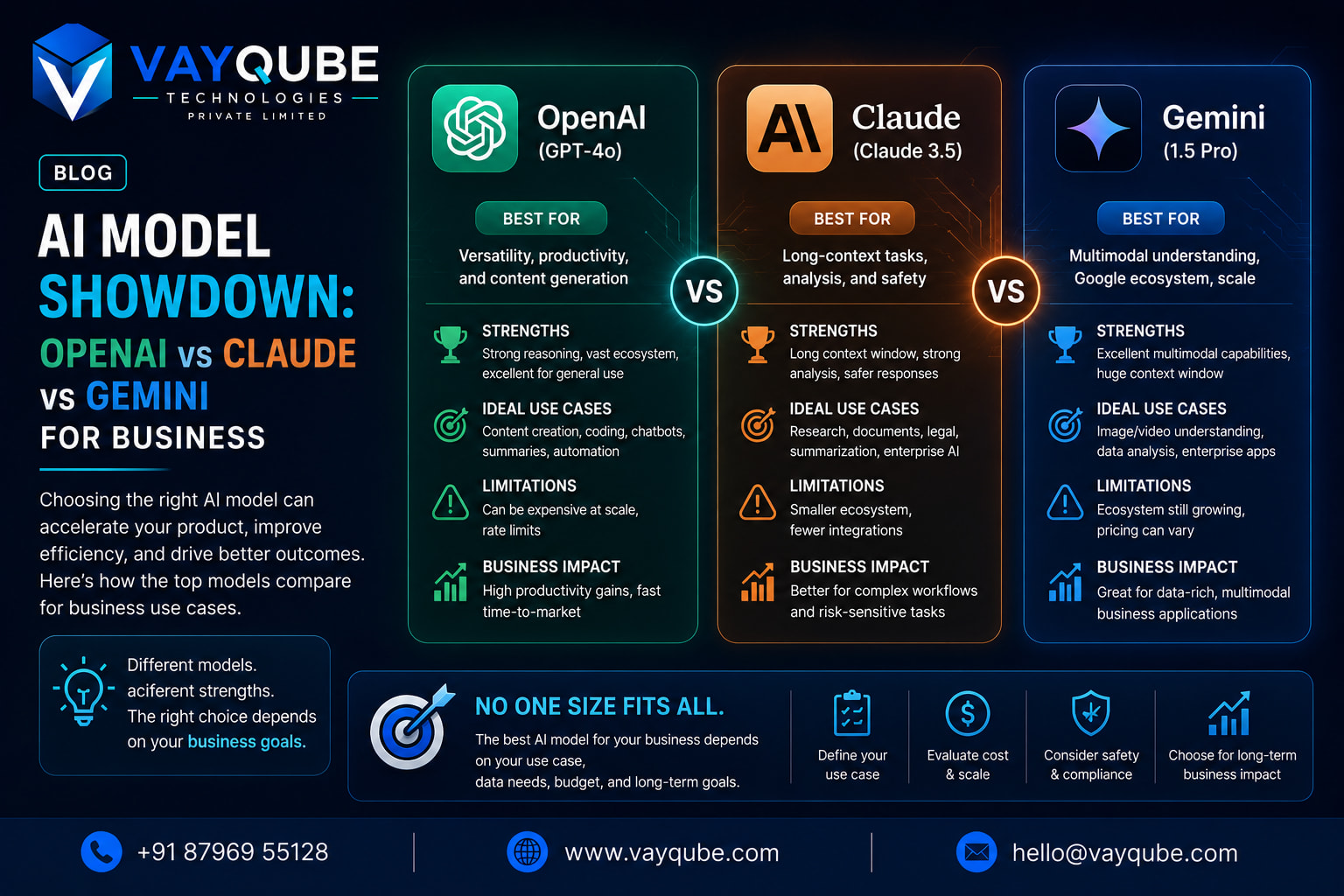
In the rapidly evolving AI landscape, businesses must choose the right model to drive innovation and growth. This comparison of OpenAI, Claude, and Gemini helps you make an informed decision.
Vayqube Team
Software architecture and product engineering
Introduction to AI Models for Business
The AI landscape is rapidly evolving, with various models emerging to cater to diverse business needs. OpenAI, Claude, and Gemini are three prominent AI models that have gained significant attention in recent times. Each of these models boasts unique features, capabilities, and applications, making the choice of the right model crucial for businesses seeking to leverage AI for growth and innovation.
Overview of AI Models
OpenAI, Claude, and Gemini are designed to perform various tasks, such as natural language processing, text generation, and conversational dialogue. These models have been trained on vast amounts of data, enabling them to learn patterns, relationships, and context. The primary difference between these models lies in their architecture, training data, and intended use cases. Understanding these differences is essential for businesses to select the most suitable model for their specific needs.
Importance of Choosing the Right AI Model
Selecting the right AI model can have a significant impact on business outcomes. The wrong choice can lead to suboptimal performance, inefficiencies, and wasted resources. On the other hand, the right model can drive innovation, improve customer engagement, and enhance operational efficiency. Businesses must consider factors such as scalability, integration, and customization when evaluating AI models. Additionally, they must assess the model's ability to handle complex tasks, adapt to changing requirements, and provide actionable insights.
Key considerations for businesses include:
- Model accuracy and reliability
- Data requirements and integration
- Customization and flexibility
- Scalability and performance
- Cost and return on investment
By carefully evaluating these factors and considering the unique strengths and weaknesses of each AI model, businesses can make informed decisions and unlock the full potential of AI for their organization. The next section will delve into the specifics of each model, exploring their features, applications, and use cases in real-world business scenarios.
Why It Matters
The integration of AI models into business operations has become a crucial aspect of staying competitive in today's fast-paced market. Companies that leverage AI effectively can experience significant improvements in efficiency, productivity, and decision-making.
Impact on Business Operations
AI models like OpenAI, Claude, and Gemini have the potential to revolutionize various aspects of business operations, including customer service, data analysis, and content creation. By automating routine tasks and providing valuable insights, these models can help businesses streamline their processes and make more informed decisions.
Some key benefits of AI integration include:
- Enhanced customer experience through personalized support and services
- Improved data analysis and interpretation, leading to better business decisions
- Increased efficiency and productivity, resulting in cost savings and revenue growth
- Ability to process and analyze large amounts of data, uncovering new business opportunities
Competitive Advantage
Leveraging AI models can provide businesses with a significant competitive advantage. Companies that adopt AI early on can gain a first-mover advantage, setting them apart from their competitors and establishing themselves as industry leaders.
To maximize the benefits of AI, businesses should focus on:
- Developing a clear AI strategy that aligns with their overall business goals
- Investing in the right AI model and infrastructure to support their operations
- Providing ongoing training and support to ensure successful AI implementation
- Continuously monitoring and evaluating the effectiveness of their AI solutions to identify areas for improvement
By understanding the impact of AI on business operations and leveraging its potential, companies can position themselves for success in an increasingly competitive market. The choice of AI model, whether OpenAI, Claude, or Gemini, will depend on the specific needs and goals of the business, as well as its ability to integrate with existing systems and infrastructure.
Real-World Applications
In real-world scenarios, AI models are being used to drive business growth and improvement. For example, companies are using AI-powered chatbots to provide 24/7 customer support, while others are leveraging AI-driven analytics to gain valuable insights into customer behavior and preferences.
As AI technology continues to evolve, we can expect to see even more innovative applications of AI in business, from automated content creation to predictive maintenance and beyond. The key to success will be in selecting the right AI model and implementing it in a way that supports the company's overall business strategy.
By doing so, businesses can unlock the full potential of AI and stay ahead of the competition in an increasingly complex and rapidly changing market. The ability to adapt and evolve will be crucial, as companies that fail to leverage AI effectively risk being left behind.
Implementation Strategy
To ensure successful AI implementation, businesses should develop a clear strategy that takes into account their specific needs and goals. This includes:
- Assessing the current state of their operations and identifying areas where AI can have the greatest impact
- Evaluating different AI models and selecting the one that best aligns with their business objectives
- Developing a plan for integrating AI into their existing systems and infrastructure
- Providing ongoing training and support to ensure that employees are equipped to work effectively with AI technology
By following this approach, companies can maximize the benefits of AI and position themselves for long-term success. The choice of AI model will depend on a variety of factors, including the company's industry, size, and specific needs.
In the next section, we will delve deeper into the specifics of each AI model, exploring their unique features and capabilities, as well as their potential applications in real-world business scenarios.
Core Architecture
The core architecture of AI models is a critical factor in determining their suitability for business applications. In this section, we will delve into the architectural details of OpenAI, Claude, and Gemini, highlighting their strengths and weaknesses.
OpenAI Architecture
OpenAI's architecture is built around a massive transformer model, which enables it to process and generate human-like language. The model is trained on a vast dataset of text from the internet, books, and other sources, allowing it to learn patterns and relationships in language. Key features of OpenAI's architecture include:
- A large-scale transformer model with billions of parameters
- A multi-layer neural network that enables deep learning and complex pattern recognition
- A robust training dataset that includes a wide range of texts and styles
Claude Architecture
Claude's architecture, on the other hand, is designed to be more modular and flexible. It uses a combination of natural language processing (NLP) and machine learning algorithms to generate human-like text. Claude's architecture is notable for its:
- Modular design, which allows for easier integration with other systems and applications
- Use of transfer learning, which enables the model to adapt to new tasks and domains with minimal retraining
- Focus on conversational AI, which makes it well-suited for chatbots and other interactive applications
Gemini Architecture
Gemini's architecture is built around a unique blend of machine learning and knowledge graph-based approaches. The model uses a large knowledge graph to store and retrieve information, which enables it to generate more accurate and informative text. Key features of Gemini's architecture include:
- A large-scale knowledge graph that stores millions of entities and relationships
- A machine learning-based approach that enables the model to learn and adapt to new data and tasks
- A focus on knowledge-intensive applications, such as question answering and text summarization
In terms of scalability and production readiness, all three models have their strengths and weaknesses. OpenAI's massive transformer model requires significant computational resources, but can handle large volumes of text and generate high-quality results. Claude's modular design makes it easier to deploy and integrate, but may require more fine-tuning and customization. Gemini's knowledge graph-based approach enables it to generate more accurate and informative text, but may require more data preparation and curation.
When evaluating these models for business applications, it's essential to consider factors such as scalability, customization, and integration with existing systems. By understanding the core architecture of each model, businesses can make more informed decisions about which one to use and how to deploy it effectively.
Business Benefits
The integration of AI models like OpenAI, Claude, and Gemini into business operations can have a significant impact on overall performance and customer satisfaction. By leveraging these advanced technologies, companies can experience numerous benefits that drive growth and competitiveness.
Increased Efficiency
One of the primary advantages of using AI models is the ability to automate repetitive and time-consuming tasks, freeing up resources for more strategic and creative endeavors. This can lead to:
- Streamlined workflows
- Reduced manual errors
- Enhanced productivity
- Faster turnaround times
As a result, businesses can allocate more time and resources to high-value activities, such as innovation, customer engagement, and strategic planning.
Enhanced Customer Experience
AI-powered models can also play a crucial role in delivering personalized and responsive customer experiences. By analyzing customer data and behavior, businesses can:
- Offer tailored recommendations and solutions
- Provide 24/7 support and assistance
- Anticipate and address customer needs proactively
- Foster loyalty and retention through meaningful interactions
This can lead to increased customer satisfaction, improved brand reputation, and ultimately, revenue growth.
Improved Decision-Making
The insights and analytics provided by AI models can help businesses make informed, data-driven decisions. By analyzing complex data sets and identifying patterns, companies can:
- Gain a deeper understanding of market trends and customer behavior
- Identify opportunities for growth and optimization
- Develop targeted strategies and initiatives
- Measure and evaluate the effectiveness of their efforts
This can lead to more effective decision-making, reduced risk, and improved overall performance.
Scalability
To ensure seamless integration and optimal performance, businesses require AI models that can handle large volumes of data and support high-traffic applications. In this section, we'll delve into the scalability aspects of OpenAI, Claude, and Gemini, exploring their capabilities in handling massive data sets and high-traffic demands.
Handling Large Volumes of Data
When it comes to processing vast amounts of data, the AI models' architecture and infrastructure play a crucial role.
- OpenAI's models are designed to handle large datasets, leveraging distributed computing and parallel processing to ensure efficient data processing.
- Claude's architecture is built around a modular design, allowing for easy scalability and adaptability to handle increasing data volumes.
- Gemini's approach focuses on optimizing data processing workflows, enabling the model to handle large datasets while minimizing computational resources.
Support for High-Traffic Applications
High-traffic applications require AI models that can maintain performance and responsiveness even under intense loads.
- OpenAI's infrastructure is designed to support high-traffic applications, with automatic scaling and load balancing ensuring optimal performance.
- Claude's flexible deployment options enable businesses to choose the best approach for their specific use case, whether it's on-premises, cloud-based, or a hybrid model.
- Gemini's cloud-native design allows for seamless integration with high-traffic applications, providing a scalable and reliable solution for businesses.
Flexibility in Deployment Options
The ability to deploy AI models in various environments is essential for businesses with diverse infrastructure requirements.
- OpenAI offers a range of deployment options, including cloud-based, on-premises, and hybrid models, providing businesses with flexibility and control.
- Claude's modular design enables easy deployment in various environments, including cloud, on-premises, and edge computing.
- Gemini's cloud-native approach provides a scalable and secure solution for businesses, with support for major cloud providers and on-premises deployments.
By evaluating the scalability of these AI models, businesses can make informed decisions about which solution best fits their specific needs and use cases, ensuring a successful implementation that drives real-world results.
Implementation Challenges
Implementing AI models like OpenAI, Claude, and Gemini into business operations can be complex and requires careful consideration of several factors.
Integration with Existing Systems
One of the primary challenges is integrating these models with existing systems and infrastructure. This includes ensuring compatibility with current software, hardware, and data storage solutions. Businesses must assess their technological landscape and determine the best approach for seamless integration, whether through APIs, custom development, or third-party services.
Data Quality and Preparation
Data quality and preparation are crucial for the effective training and operation of AI models. Businesses must ensure that their data is accurate, complete, and relevant to the tasks they want the models to perform. This involves data cleansing, normalization, and potentially anonymization to comply with privacy regulations. The quality of the data directly impacts the model's performance and reliability.
Model Training and Fine-Tuning
Model training and fine-tuning are ongoing processes that require significant resources and expertise. Businesses need to invest in personnel who can manage, update, and refine the models over time to maintain their effectiveness and adapt to changing business needs. This includes monitoring performance metrics, addressing bias, and incorporating new data to keep the models current and relevant.
To overcome these challenges, businesses should:
- Develop a comprehensive integration strategy
- Implement robust data management practices
- Invest in ongoing model maintenance and improvement
- Foster a culture of innovation and continuous learning
By addressing these implementation challenges, businesses can unlock the full potential of AI models like OpenAI, Claude, and Gemini, driving innovation, efficiency, and growth in their operations.
Real-World Considerations
In real-world scenarios, the success of AI model implementation depends on a deep understanding of the business's specific needs and challenges. This involves not just the technical aspects of integration and model training but also change management, employee training, and ensuring that the solutions align with the company's strategic objectives.
Production Readiness
Ensuring production readiness is critical before deploying AI models in live business environments. This includes thorough testing, quality assurance, and validation to guarantee that the models perform as expected under various conditions. Production readiness also involves planning for scalability, reliability, and security to mitigate risks and ensure continuous operation.
Use Cases
The AI models from OpenAI, Claude, and Gemini offer a range of applications for businesses, from enhancing customer experience to streamlining content creation.
Customer Service Chatbots
Implementing AI-powered chatbots can significantly improve customer service efficiency. These chatbots can handle a high volume of inquiries simultaneously, providing instant responses to common questions and routing complex issues to human representatives. For instance, a company like IKEA could use these chatbots to help customers with furniture assembly instructions or product availability, freeing up human customer support agents to focus on more complex issues.
Content Generation and Summarization
AI models can generate high-quality content, such as blog posts, social media updates, and product descriptions, saving businesses time and resources. Additionally, these models can summarize long documents, extracting key points and insights, which can be invaluable for market research, competitor analysis, and internal reporting. A marketing agency, for example, could leverage AI-generated content to produce engaging social media posts for its clients, ensuring consistency and reducing the workload on human content creators.
Sentiment Analysis and Feedback
Sentiment analysis, powered by AI, allows businesses to gauge customer sentiment from feedback, reviews, and social media posts. This capability helps companies understand their strengths and weaknesses, make data-driven decisions, and improve their products and services. For example, a restaurant chain could use sentiment analysis to identify common complaints about its menu items or service quality, enabling it to make targeted improvements to enhance customer satisfaction and loyalty.
By integrating these use cases into their operations, businesses can enhance their customer service, improve their content creation capabilities, and make more informed decisions based on customer feedback. This not only leads to better customer experiences but also contributes to the scalability and competitiveness of the business in its market.
The choice between OpenAI, Claude, and Gemini for these use cases depends on the specific needs and goals of the business. Each model has its strengths and weaknesses, and understanding these is crucial for effective implementation. For customer service chatbots, the ability to understand natural language and respond appropriately is key. For content generation and summarization, the model's ability to produce coherent, engaging content is paramount. And for sentiment analysis, the accuracy of the model in interpreting customer sentiment is critical.
In real-world scenarios, businesses often combine these use cases to achieve a holistic approach to customer interaction and service improvement. For instance, using AI-generated content to inform and engage customers, while also employing sentiment analysis to understand the impact of this content and make necessary adjustments. This integrated approach can lead to more personalized and effective customer service, ultimately driving business success.
The implementation of these AI models requires careful consideration of production readiness, including factors such as data privacy, model training, and integration with existing systems. Ensuring that these aspects are well-planned and executed is vital for the successful deployment of AI solutions in business environments.
Ultimately, the effective use of AI models like those from OpenAI, Claude, and Gemini can transform how businesses interact with their customers, create content, and analyze feedback. By leveraging these technologies, companies can achieve significant improvements in efficiency, customer satisfaction, and competitiveness, setting them up for long-term success in their respective markets.
Best Practices
To get the most out of AI models like OpenAI, Claude, and Gemini in a business setting, it's crucial to follow a set of best practices that ensure effective implementation and continuous improvement.
Starting with a Clear Use Case
Begin by defining a clear use case for the AI model. This involves identifying specific business problems or opportunities where the model can add significant value. For instance, if the goal is to enhance customer service, the use case might involve using the AI model to generate human-like responses to frequent customer inquiries. A well-defined use case helps in setting the right objectives and metrics for success.
Monitoring and Evaluating Model Performance
Once the AI model is deployed, it's essential to monitor its performance continuously. This involves tracking key metrics such as accuracy, response time, and user satisfaction. For OpenAI, Claude, and Gemini, this could mean regularly assessing the relevance and quality of the responses generated by the models. By doing so, businesses can identify areas where the model might need adjustment or improvement.
Continuous Update and Refinement
AI models are not set-and-forget solutions. They require continuous updates and refinements to maintain their performance and adapt to changing business needs. This could involve retraining the model with new data, updating the model's architecture, or fine-tuning its parameters. For example, as new products or services are introduced, the AI model should be updated to reflect this, ensuring that it can provide accurate and helpful information to customers.
Some key considerations for continuous refinement include:
- Regularly reviewing user feedback to identify areas for improvement
- Incorporating new data sources to enhance the model's knowledge base
- Staying updated with the latest advancements in AI technology to leverage potential improvements
- Conducting A/B testing to compare the performance of different model versions or configurations
By following these best practices, businesses can maximize the benefits of AI models like OpenAI, Claude, and Gemini, ensuring that they contribute positively to the bottom line while enhancing customer experience and operational efficiency.
Implementation Strategy
A well-planned implementation strategy is vital for the successful integration of AI models into business operations. This involves not only the technical aspects of deployment but also change management, training for staff, and communication with stakeholders. For instance, businesses might need to develop new workflows that incorporate the AI model's capabilities, ensuring a seamless user experience.
Real-World Applications
In real-world scenarios, these best practices play out in various ways. For example, a company using OpenAI for content generation might start by defining a clear use case, such as producing high-quality blog posts. They would then monitor the model's performance, ensuring that the generated content meets the company's standards for quality and relevance. Continuous refinement might involve updating the model with new industry trends or retraining it to better capture the company's tone and style.
By focusing on these aspects, businesses can harness the full potential of AI models, driving innovation, efficiency, and growth in their operations.
Frequently Asked Questions
As businesses consider implementing AI models, several questions arise. This section aims to address some of the most common queries related to OpenAI, Claude, and Gemini.
Understanding the Differences
What is the difference between OpenAI, Claude, and Gemini? The primary distinction lies in their core architecture, training data, and intended use cases. OpenAI is known for its general-purpose AI capabilities, while Claude focuses on more specialized, industry-specific applications. Gemini, on the other hand, offers a unique blend of AI and machine learning tailored for enterprise solutions. Understanding these differences is crucial for selecting the right AI model for your business needs.
Choosing the Right AI Model
How do I choose the right AI model for my business? The selection process involves evaluating your business goals, the type of tasks you want to automate, and the level of customization required. Consider the following factors:
- Specific industry needs
- Desired level of automation
- Integration requirements with existing systems
- Scalability and performance expectations
- Budget constraints
Cost Considerations
What are the costs associated with implementing AI models? The costs can vary significantly depending on the AI model, implementation complexity, and the scale of deployment. Key cost factors include:
- Licensing fees for the AI model
- Infrastructure costs for hosting and running the model
- Development and integration expenses
- Ongoing maintenance and update costs
- Potential costs for training and fine-tuning the model for specific business needs
Implementation Strategy
When implementing an AI model, it's essential to have a clear strategy in place. This includes defining project scope, timelines, and resource allocation. Consider the following steps:
- Conduct a thorough needs assessment
- Evaluate potential AI models based on business requirements
- Develop a detailed implementation plan
- Allocate necessary resources and budget
- Establish metrics for measuring success and ROI
Real-World Applications
Real-world examples of AI model implementation can provide valuable insights. For instance, a company might use OpenAI for general customer service chatbots, while Claude could be utilized for more specialized legal or medical document analysis. Gemini, with its enterprise focus, might be chosen for large-scale data analysis and predictive modeling tasks. Understanding these use cases can help inform the decision-making process.
Production Readiness
Ensuring production readiness is critical before deploying an AI model. This involves thorough testing, validation, and ensuring that the model can scale with business growth. Consider factors such as:
- Model performance under various loads
- Integration with existing production systems
- Monitoring and maintenance strategies
- Plans for updating and refining the model over time
By carefully considering these factors and questions, businesses can make informed decisions about which AI model to implement and how to ensure a successful integration that meets their specific needs and goals.
Conclusion
In the AI model showdown between OpenAI, Claude, and Gemini, each platform has demonstrated its unique strengths and weaknesses. To recap, our analysis has highlighted the key differences in core architecture, business benefits, scalability, and implementation challenges.
Summary of Key Findings
The main takeaways from our comparison are:
- OpenAI excels in natural language processing and generation, making it a top choice for content creation and customer service applications.
- Claude's focus on conversational AI and its ability to integrate with various platforms make it an attractive option for businesses seeking to enhance customer engagement.
- Gemini's emphasis on enterprise-grade security and compliance features positions it as a leader in the realm of sensitive and regulated industries.
Recommendations for Businesses
When considering AI models for business applications, we recommend the following:
- Assess your specific use cases and prioritize the features that align with your goals.
- Evaluate the scalability and implementation requirements of each platform to ensure a seamless integration with your existing infrastructure.
- Consider the total cost of ownership, including any additional fees for support, maintenance, and customization.
Future Outlook for AI in Business
As AI technology continues to evolve, we can expect to see even more sophisticated models emerge, offering enhanced capabilities and improved performance. Businesses that invest in AI today will be well-positioned to capitalize on these advancements and stay ahead of the competition. The future of AI in business holds tremendous promise, with potential applications in areas such as:
- Predictive analytics and decision-making
- Automated process optimization
- Personalized customer experiences
- Intelligent workflow management
By understanding the strengths and limitations of each AI model and adopting a strategic approach to implementation, businesses can unlock the full potential of AI and drive meaningful growth and innovation.
Related Vayqube Resources
- Ai Agents Changing Customer Support Operations 2026
- Businesses Replacing Manual Workflows With Ai Agents 2026
- Best Software Development Company In New York
- Best Fintech Software Development Company In New York
- Why Most Ai Projects Fail Before Production
- Top Software Development Company In New York
Next Step
If your systems are struggling with scalability, automation, architecture complexity, or operational efficiency, it's time to modernize your infrastructure and workflows.
👉 Talk to a Vayqube solution architect and build systems designed for long-term production growth: