
Best Prompt Engineering Practices
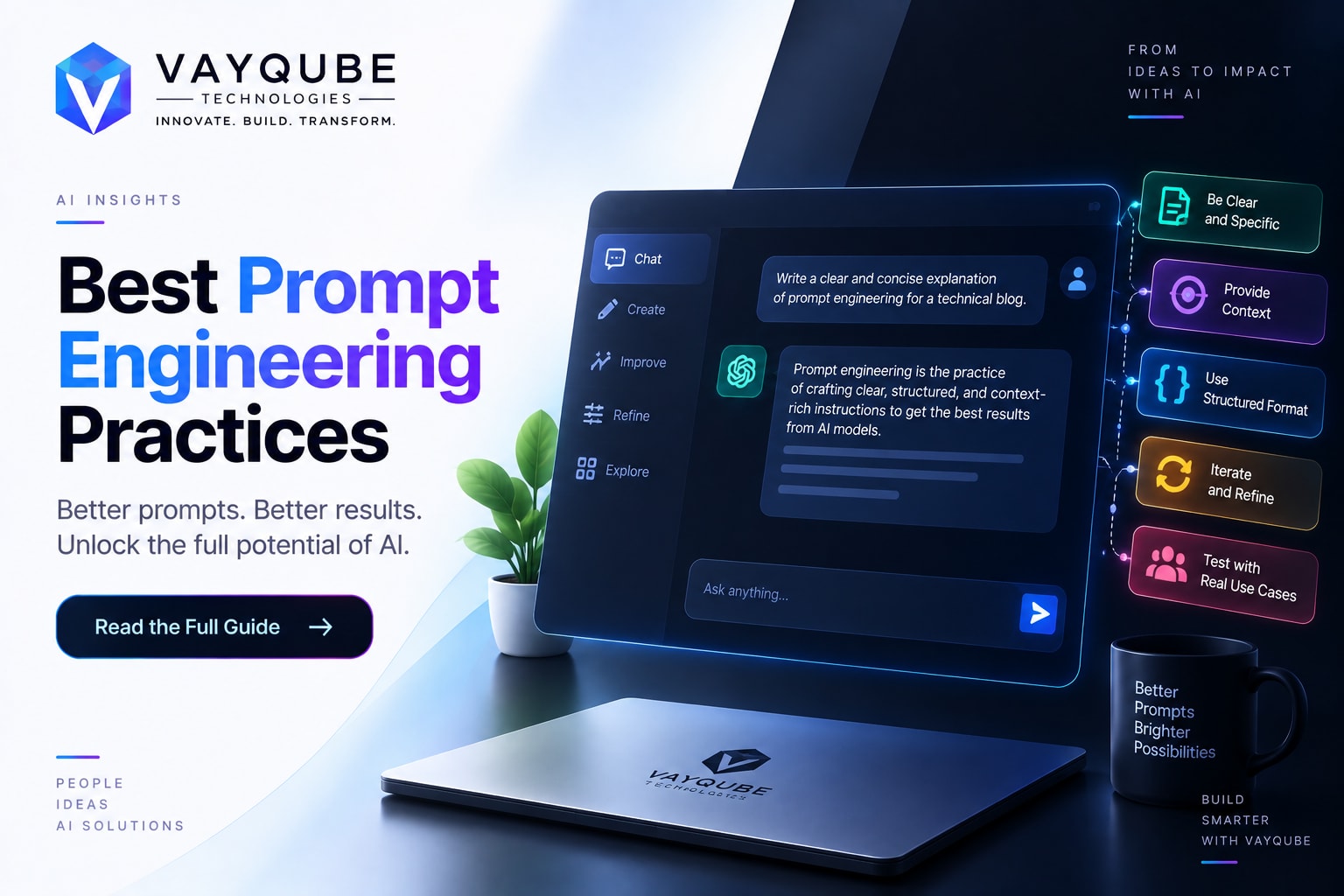
Discover the best practices for prompt engineering to unlock the full potential of your language models. Learn how to craft effective prompts that drive accurate and informative responses.
Vayqube Team
Software architecture and product engineering
Introduction
Prompt engineering is a crucial aspect of modern SaaS applications, playing a significant role in determining the overall user experience and effectiveness of these systems. At its core, prompt engineering involves the design and optimization of text prompts that interact with users, guiding them to provide the necessary input for the application to function as intended.
Overview of Prompt Engineering
Prompt engineering encompasses a range of activities, from crafting clear and concise prompts to testing and refining them based on user feedback and behavior. The goal is to create prompts that are intuitive, easy to understand, and minimize user frustration. Effective prompt engineering can significantly improve user engagement, reduce errors, and enhance the overall usability of SaaS applications.
Importance in Modern SaaS Applications
In modern SaaS applications, prompt engineering is vital for several reasons. Firstly, it directly impacts user adoption and retention. Well-designed prompts can make an application more accessible and user-friendly, encouraging users to explore its full potential. Secondly, prompt engineering influences data quality. By guiding users to input accurate and relevant data, prompts can help maintain the integrity of the application's database, which is essential for analytics, reporting, and decision-making purposes.
The importance of prompt engineering also extends to security and compliance. Poorly designed prompts can inadvertently lead to security vulnerabilities or non-compliance with regulatory requirements, especially in applications that handle sensitive user data. Furthermore, in applications that utilize AI and machine learning, prompts are often the primary interface through which users interact with these technologies. Therefore, the quality of prompts can significantly affect the perceived intelligence and usefulness of the application.
To implement effective prompt engineering, developers and designers must consider a range of factors, including the application's target audience, the specific tasks users need to perform, and the overall user experience goals. This involves a deep understanding of human-computer interaction principles, user behavior, and the application's technical capabilities. By prioritizing prompt engineering, SaaS developers can create more intuitive, efficient, and enjoyable applications that meet the evolving needs of their users.
Key Considerations
When approaching prompt engineering, several key considerations come into play:
- Clarity and Conciseness: Prompts should be easy to understand, avoiding ambiguity and ensuring that users know exactly what information is being requested.
- Relevance: Prompts must be relevant to the task at hand, providing context and minimizing unnecessary user input.
- Feedback: Implementing feedback mechanisms is crucial, allowing users to understand the outcome of their interactions and make necessary adjustments.
- Accessibility: Prompts should be designed with accessibility in mind, ensuring that all users, including those with disabilities, can interact with the application effectively.
By focusing on these aspects and integrating prompt engineering as a core part of the development process, SaaS applications can achieve a higher level of usability, user satisfaction, and ultimately, business success.
Why It Matters
Prompt engineering plays a crucial role in the development and deployment of AI models, particularly in applications where user interaction is key. By focusing on best practices in this area, organizations can reap several benefits that impact both the technical and business aspects of their operations.
Key Benefits
The importance of prompt engineering can be seen in three primary areas:
- Improved model performance: Well-crafted prompts can significantly enhance the accuracy and relevance of model responses, leading to better overall system performance.
- Enhanced user experience: When prompts are carefully designed, they can guide users to interact with the system in a more intuitive and effective way, improving satisfaction and engagement.
- Increased efficiency: By optimizing prompts, organizations can reduce the time and resources needed to achieve their goals, whether it's through automated processing, user support, or content generation.
Real-World Impact
In real-world applications, the impact of prompt engineering can be substantial. For instance, in customer service chatbots, a well-designed prompt can help resolve issues more quickly and accurately, leading to higher customer satisfaction rates. Similarly, in content generation tools, optimized prompts can result in more relevant and coherent output, saving time and effort in post-processing and editing.
Implementation Considerations
To leverage these benefits, organizations should consider integrating prompt engineering into their development workflows. This involves not only designing effective prompts but also continuously testing and refining them based on user feedback and system performance metrics. By doing so, companies can ensure that their AI-powered systems meet the evolving needs of their users and stakeholders, ultimately driving business success.
Production Readiness
Ensuring production readiness of prompt-engineered systems requires careful consideration of scalability, reliability, and maintainability. This includes developing prompts that can adapt to various user scenarios, integrating with existing infrastructure, and monitoring performance in real-world conditions. By prioritizing these aspects, organizations can confidently deploy their AI solutions, knowing they will perform optimally under diverse and changing conditions.
Core Architecture
The core architecture of a prompt engineering system is crucial for its effectiveness and scalability. A well-designed architecture enables the system to handle complex prompts, integrate with various data sources, and provide accurate responses.
Design Principles
When designing the core architecture, several principles should be considered:
- Modularity: Break down the system into smaller, independent components to facilitate maintenance, updates, and scalability.
- Flexibility: Allow for easy integration with different data sources, models, and algorithms to accommodate various use cases and applications.
- Scalability: Ensure the system can handle increasing volumes of prompts and data without compromising performance.
- Reliability: Implement robust error handling and redundancy mechanisms to minimize downtime and ensure consistent responses.
Key Components
The core architecture typically consists of the following key components:
- Prompt Analysis: Responsible for parsing, tokenizing, and analyzing the input prompt to extract relevant information and context.
- Knowledge Retrieval: Retrieves relevant data and information from various sources, such as databases, knowledge graphs, or external APIs.
- Model Orchestrator: Manages the interaction between different models, algorithms, and data sources to generate accurate and informative responses.
- Response Generation: Generates human-like responses based on the output from the model orchestrator and prompt analysis components.
System Integration
To ensure seamless interaction between components and external systems, consider the following integration strategies:
- API-based Integration: Use standardized APIs to connect components and external systems, enabling easy data exchange and minimizing integration overhead.
- Message Queueing: Implement message queueing systems to handle asynchronous communication between components, ensuring reliable and efficient data processing.
- Data Warehousing: Utilize data warehousing solutions to store and manage large volumes of data, providing a single source of truth for the system and facilitating data analytics and reporting.
Business Benefits
Implementing best prompt engineering practices can have a significant impact on a business's bottom line. By optimizing prompts, companies can reduce costs, increase revenue, and gain a competitive edge in the market.
Cost Savings
One of the primary benefits of prompt engineering is cost savings. By designing efficient and effective prompts, businesses can reduce the amount of time and resources spent on data labeling, model training, and testing. This can lead to significant cost savings, as companies can:
- Minimize the need for large datasets
- Reduce the number of model iterations required
- Decrease the computational resources needed for training and testing
Revenue Growth
Best prompt engineering practices can also drive revenue growth by improving the accuracy and reliability of AI models. By crafting high-quality prompts, businesses can:
- Improve model performance and accuracy
- Increase user engagement and adoption
- Enhance customer experience and satisfaction This can lead to increased revenue through:
- Improved sales and conversion rates
- Enhanced customer loyalty and retention
- Increased average order value and customer lifetime value
Competitive Advantage
Companies that adopt best prompt engineering practices can gain a competitive advantage in the market. By leveraging optimized prompts, businesses can:
- Develop more accurate and reliable AI models
- Improve time-to-market for new products and features
- Enhance their brand reputation and credibility This can lead to a competitive edge, as companies can:
- Differentiate themselves from competitors
- Attract and retain top talent in the industry
- Establish themselves as leaders in AI innovation and adoption
Scalability
To ensure the scalability of prompt engineering, it's crucial to consider the potential volume of data and traffic that the system will handle. This involves designing the architecture to support large volumes of data and high-traffic applications, while also ensuring reliability.
Handling Large Volumes of Data
When dealing with large volumes of data, the system should be able to process and analyze the data efficiently. This can be achieved by:
- Implementing data partitioning and parallel processing to speed up data analysis
- Using distributed computing frameworks to handle large-scale data processing
- Leveraging cloud-based infrastructure to scale up or down as needed
Supporting High-Traffic Applications
High-traffic applications require a system that can handle a large number of concurrent requests. To support this, consider:
- Implementing load balancing and autoscaling to distribute traffic across multiple instances
- Using caching mechanisms to reduce the load on the system and improve response times
- Optimizing database queries and indexing to improve data retrieval efficiency
Ensuring Reliability
Reliability is critical in a scalable system, as downtime or errors can have significant consequences. To ensure reliability:
- Implement robust error handling and logging mechanisms to quickly identify and resolve issues
- Use redundancy and failover mechanisms to minimize the impact of component failures
- Conduct regular testing and monitoring to identify potential bottlenecks and areas for improvement
By considering these factors and implementing scalable design principles, prompt engineering systems can efficiently handle large volumes of data and support high-traffic applications, while ensuring reliability and minimizing downtime. This enables businesses to confidently deploy and grow their applications, knowing that the underlying system can scale to meet their needs.
Implementation Challenges
When implementing prompt engineering practices, several challenges can arise. Data quality issues are a significant concern, as the accuracy and relevance of the training data directly impact the model's performance. If the data is noisy, incomplete, or biased, the model may not generalize well to new, unseen prompts, leading to suboptimal results.
Data Quality Issues
Some common data quality issues include:
- Inconsistent formatting and naming conventions
- Missing or duplicate data points
- Outdated or irrelevant information
- Biased or imbalanced data distributions To mitigate these issues, it's essential to implement robust data validation, cleaning, and preprocessing pipelines. This may involve data normalization, feature scaling, and handling missing values.
Model Complexity
Model complexity is another challenge, as overly complex models can be difficult to interpret, train, and deploy. This can lead to increased computational requirements, longer training times, and higher risks of overfitting. To address this, it's crucial to select models that balance complexity and performance, using techniques such as regularization, early stopping, and model pruning.
Integration with Existing Systems
Integration with existing systems is also a significant challenge, as prompt engineering models may need to interact with various applications, services, and infrastructure components. This can involve developing custom APIs, data connectors, or adapters to facilitate seamless communication between systems. Additionally, ensuring compatibility with different software versions, frameworks, and libraries is vital to prevent integration issues and ensure smooth deployment.
Use Cases
Prompt engineering has numerous applications in various industries, and its use cases continue to expand as the technology advances.
Virtual Assistants
Virtual assistants, such as Siri, Alexa, and Google Assistant, rely heavily on prompt engineering to understand and respond to user queries. By crafting well-designed prompts, developers can improve the accuracy and helpfulness of these assistants, enabling them to better serve their users. For instance, a virtual assistant can be trained to recognize and respond to follow-up questions, providing a more seamless and natural interaction experience.
Chatbots
Chatbots are another significant application of prompt engineering, particularly in customer service and support. By engineering effective prompts, chatbots can gather relevant information from users, route them to the correct support channels, and even provide personalized solutions to their queries. This not only enhances user experience but also reduces the workload on human support agents, allowing them to focus on more complex issues.
Content Generation
Content generation is a rapidly growing use case for prompt engineering, with applications in writing, design, and even music composition. By providing well-crafted prompts, AI models can generate high-quality, engaging content that resonates with target audiences. This can be particularly useful for businesses looking to scale their content creation without sacrificing quality or authenticity. For example, a company can use prompt engineering to generate product descriptions, social media posts, or even entire blog articles, freeing up their content teams to focus on strategic and creative work.
Some key considerations when implementing prompt engineering for content generation include:
- Ensuring the prompts are specific, clear, and well-defined to avoid ambiguity and misinterpretation
- Providing sufficient context and background information to enable the AI model to generate relevant and accurate content
- Establishing a robust feedback loop to refine and improve the prompts over time, based on user engagement and other key performance indicators
- Balancing the level of automation with human oversight and review to guarantee the generated content meets the required standards and brand voice.
Best Practices
To ensure the effectiveness and reliability of prompt engineering, it's crucial to adopt a set of best practices that cover various aspects of the process.
Testing and Validation
Testing and validation are critical components of prompt engineering. This involves evaluating the performance of prompts in real-world scenarios to identify areas for improvement. Key considerations include:
- Developing a comprehensive testing framework that assesses prompt accuracy, relevance, and consistency
- Utilizing diverse datasets to validate prompt performance across different contexts and use cases
- Implementing iterative testing cycles to refine and optimize prompts based on feedback and results
Continuous Monitoring
Continuous monitoring is essential for maintaining the quality and effectiveness of prompts over time. This includes:
- Regularly reviewing prompt performance metrics to detect potential issues or declines in quality
- Analyzing user feedback and behavioral data to identify trends and areas for improvement
- Updating and refining prompts as needed to ensure they remain relevant and effective
Collaboration Between Teams
Collaboration between teams is vital for successful prompt engineering. This involves:
- Cross-functional teams working together to design, develop, and deploy prompts
- Establishing clear communication channels and feedback loops to ensure prompt requirements are met
- Fostering a culture of continuous learning and improvement, where teams share knowledge and best practices to optimize prompt engineering outcomes
By adopting these best practices, organizations can ensure their prompt engineering efforts are well-structured, effective, and aligned with business objectives. This, in turn, can lead to improved user experiences, increased efficiency, and enhanced overall performance.
In real-world scenarios, the implementation of these best practices can vary depending on the specific use case and requirements. For instance, a company developing a chatbot for customer support may prioritize testing and validation to ensure prompts are accurate and relevant to user queries. In contrast, a company using prompts for content generation may focus more on continuous monitoring to detect potential biases or inaccuracies in the generated content.
Ultimately, the key to successful prompt engineering is to strike a balance between these best practices and continually adapt to changing requirements and user needs.
FAQ
Understanding Prompt Engineering
Prompt engineering is the process of designing and optimizing text prompts to effectively interact with language models, ensuring they produce accurate and relevant responses. This involves carefully crafting the input text to elicit specific, desired outputs from the model.
Improving Model Performance
By refining the prompts used to query language models, businesses can significantly improve model performance. Well-designed prompts help models understand the context and intent behind the query, leading to more accurate and informative responses. This, in turn, enhances the overall quality of the outputs, making them more reliable and useful for various applications.
Common Challenges
Some common challenges associated with prompt engineering include:
- Ambiguity: Crafting prompts that are too vague or open-ended can lead to inconsistent or irrelevant responses.
- Lack of context: Failing to provide sufficient background information or context can result in models misinterpreting the prompt.
- Overfitting: Using prompts that are too specific or tailored to a particular model can lead to poor performance when the model is faced with new, unseen data.
- Evaluation metrics: Developing effective metrics to evaluate the performance of prompt-engineered models can be difficult, making it hard to measure the success of prompt engineering efforts.
Conclusion
The field of prompt engineering has experienced significant growth, and its importance will only continue to increase as AI technology advances. To recap, the key takeaways from this discussion include:
- Understanding the core architecture of prompt engineering and its components
- Recognizing the business benefits, such as improved efficiency and decision-making
- Addressing scalability and implementation challenges
- Exploring various use cases and best practices for effective prompt engineering
Future of Prompt Engineering
As AI continues to evolve, prompt engineering will play a crucial role in shaping the future of human-AI interaction. We can expect to see advancements in areas like:
- Multimodal interaction, enabling more natural and intuitive communication with AI systems
- Edge cases and adversarial testing, ensuring prompt engineering is robust and reliable
- Specialized prompt engineering for specific industries, such as healthcare or finance
Final Thoughts
In the real world, prompt engineering is not just a theoretical concept, but a practical tool for businesses and organizations to improve their operations and decision-making. By adopting best practices and staying up-to-date with the latest developments, companies can unlock the full potential of prompt engineering and stay ahead of the curve. Some notable examples of successful prompt engineering implementations include:
- Virtual customer service agents that use prompt engineering to provide personalized support
- AI-powered content generation tools that rely on prompt engineering to produce high-quality content
- Chatbots that utilize prompt engineering to improve user engagement and experience
These examples demonstrate the versatility and effectiveness of prompt engineering in various applications. As the field continues to evolve, it is essential to prioritize ongoing research, development, and education to ensure that prompt engineering is used responsibly and to its full potential.
Related Vayqube Resources
- Cloud Cost Optimization Strategies For Saas Startups
- Best Software Development Company In Singapore City
- Best Saas Development Company In Singapore City
- Best Fintech Software Development Company In Singapore City
- Healthcare Software Development Company Singapore City
- Modern Cloud Security Best Practices
Next Step
If your systems are struggling with scalability, automation, architecture complexity, or operational efficiency, it's time to modernize your infrastructure and workflows.
👉 Talk to a Vayqube solution architect and build systems designed for long-term production growth: