
AI for Customer Support: Boosting Business
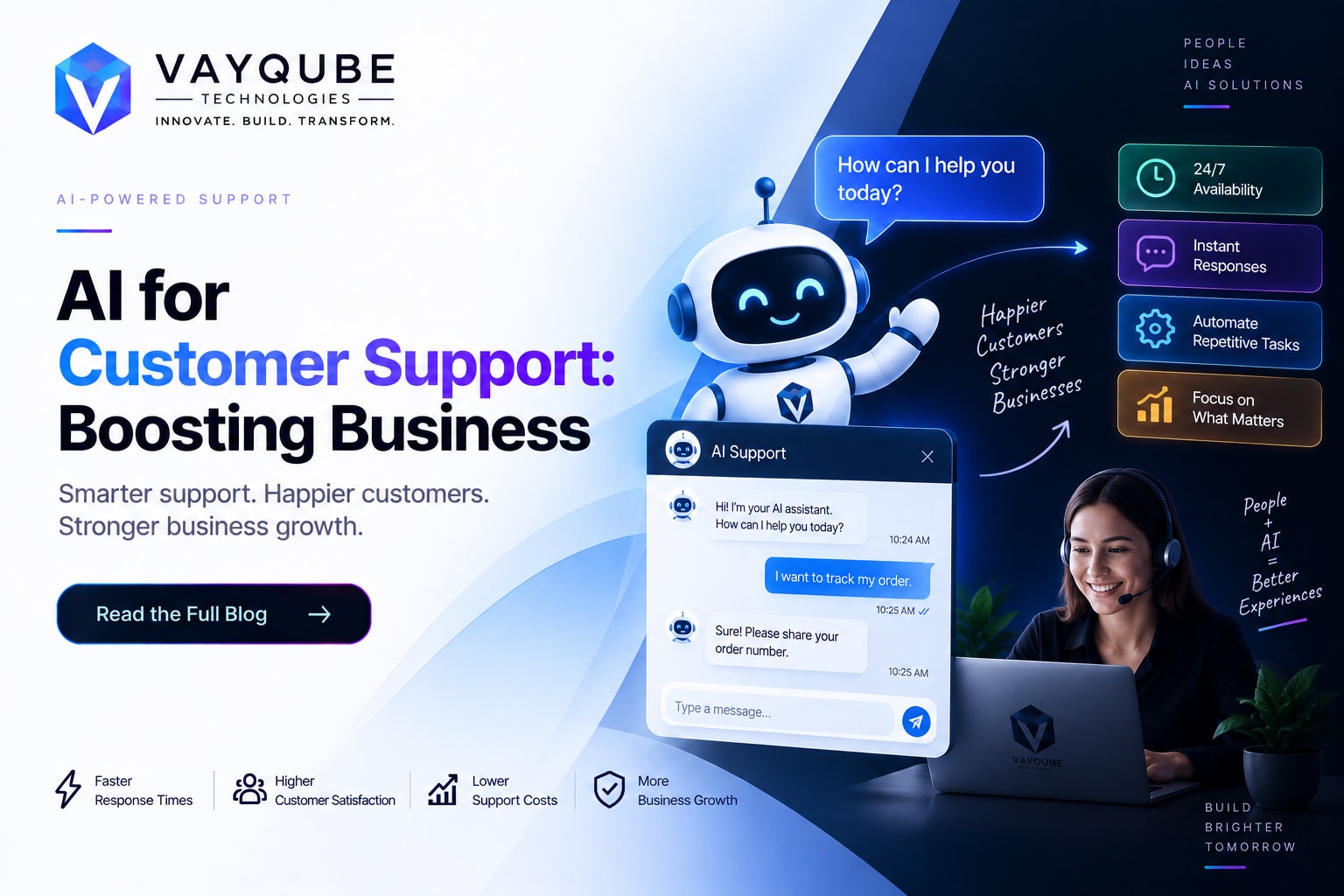
Businesses are leveraging AI to revolutionize customer support, providing 24/7 assistance and personalizing the customer experience. By implementing AI-powered support tools, companies can significantly improve response times and customer satisfaction
Vayqube Team
Software architecture and product engineering
Introduction to AI-Powered Customer Support
The integration of Artificial Intelligence (AI) in customer support has revolutionized the way businesses interact with their customers. AI-powered customer support systems are designed to provide quick, accurate, and personalized responses to customer inquiries, enhancing the overall customer experience.
Overview of AI in Customer Support
AI technologies such as chatbots, virtual assistants, and machine learning algorithms are being used to automate customer support processes. These technologies enable businesses to provide 24/7 support, reduce response times, and increase resolution rates. Additionally, AI-powered systems can analyze customer data and behavior, providing valuable insights that can be used to improve support strategies and enhance customer satisfaction.
Importance of Effective Customer Support
Effective customer support is crucial for businesses as it directly impacts customer loyalty, retention, and ultimately, revenue. Customers expect prompt, reliable, and personalized support, and businesses that fail to deliver on these expectations risk losing customers to competitors. Moreover, positive customer support experiences can lead to increased customer loyalty, positive word-of-mouth, and online reviews, which can drive business growth and expansion.
Key aspects of effective customer support include:
- Quick response times
- Personalized support experiences
- Empathetic and knowledgeable support agents
- Omnichannel support options
- Continuous improvement and feedback mechanisms
By leveraging AI technologies, businesses can enhance these aspects of customer support, leading to improved customer satisfaction, loyalty, and retention. The strategic implementation of AI in customer support can also help businesses to stay competitive, improve operational efficiency, and drive business growth.
Real-World Applications of AI in Customer Support
AI-powered customer support systems are being used in various industries, including e-commerce, healthcare, and finance. For example, chatbots are being used to provide basic support and route complex issues to human support agents. Virtual assistants are being used to provide personalized support and recommendations to customers. Machine learning algorithms are being used to analyze customer data and predict support requirements, enabling proactive support strategies.
The implementation of AI in customer support requires careful consideration of several factors, including data quality, system integration, and agent training. Businesses must also ensure that AI-powered systems are transparent, explainable, and aligned with customer support strategies and goals. By doing so, businesses can unlock the full potential of AI in customer support and drive significant improvements in customer satisfaction, loyalty, and retention.
Why It Matters
The implementation of AI in customer support has a significant impact on customer satisfaction. By providing 24/7 support, AI-powered chatbots can help resolve customer queries quickly and efficiently, leading to increased customer satisfaction rates. Additionally, AI can help analyze customer feedback and sentiment, enabling businesses to identify areas for improvement and make data-driven decisions.
Impact on Customer Satisfaction
Some key benefits of AI-powered customer support include:
- Faster response times, with many queries being resolved in under a minute
- Personalized support experiences, tailored to individual customer needs
- Improved first contact resolution rates, reducing the need for follow-up interactions
- Enhanced customer self-service capabilities, allowing customers to find answers to common questions quickly and easily
The role of AI in driving business growth cannot be overstated. By automating routine support tasks, businesses can free up human resources to focus on more complex and high-value tasks, such as resolving complex customer issues and developing strategic support initiatives. This can lead to significant cost savings and improved support efficiency.
Role in Driving Business Growth
AI can also help businesses to identify new opportunities for growth, by analyzing customer data and behavior. For example:
- AI can help identify upsell and cross-sell opportunities, by analyzing customer purchase history and behavior
- AI can help businesses to develop targeted marketing campaigns, by analyzing customer demographics and preferences
- AI can help businesses to optimize their support channels, by analyzing customer interaction data and identifying areas for improvement
By leveraging AI in customer support, businesses can gain a competitive edge in the market, improve customer satisfaction and loyalty, and drive long-term growth and success. The key to success lies in implementing AI in a way that complements and enhances human support capabilities, rather than replacing them.
Core Architecture
The core architecture of AI for customer support is built around two primary components: Natural Language Processing (NLP) and Machine Learning (ML) algorithms.
NLP Capabilities
NLP is a crucial aspect of AI-powered customer support, enabling the system to understand and interpret human language. This includes:
- Tokenization: breaking down text into individual words or tokens
- Sentiment analysis: determining the emotional tone behind customer messages
- Entity recognition: identifying specific entities such as names, locations, and products
ML Algorithms
ML algorithms play a vital role in analyzing customer interactions and providing personalized support. These algorithms can be categorized into two main types:
- Supervised learning: using labeled datasets to train the model and make predictions
- Unsupervised learning: identifying patterns and relationships in unlabeled data
Effective implementation of NLP and ML algorithms is critical to the success of AI-powered customer support. By leveraging these technologies, businesses can automate routine support tasks, provide 24/7 support, and improve customer satisfaction.
Implementation Considerations
When implementing AI for customer support, businesses should consider the following factors:
- Data quality: ensuring that the training data is accurate, complete, and relevant
- Model complexity: selecting the right balance between model complexity and interpretability
- Integration: seamlessly integrating the AI system with existing support infrastructure
By carefully evaluating these factors and implementing a well-designed core architecture, businesses can unlock the full potential of AI for customer support and drive significant improvements in efficiency, productivity, and customer satisfaction.
Real-World Applications
Real-world applications of AI for customer support include:
- Chatbots: using NLP and ML to provide automated support and route complex issues to human agents
- Virtual assistants: leveraging AI to provide personalized support and recommendations
- Sentiment analysis: using ML to analyze customer feedback and identify areas for improvement
These applications demonstrate the potential of AI to transform the customer support landscape and provide businesses with a competitive edge in the market.
Business Benefits
The integration of AI in customer support has numerous benefits for businesses. Two of the most significant advantages are enhanced customer experience and increased efficiency and reduced costs.
Enhanced Customer Experience
AI-powered customer support systems can provide personalized and timely responses to customer inquiries, leading to increased customer satisfaction. Some key aspects of enhanced customer experience include:
- Faster response times, with AI systems able to respond to customer inquiries in real-time
- More accurate and relevant responses, as AI systems can analyze customer data and provide tailored solutions
- Improved issue resolution rates, as AI systems can quickly identify and resolve common issues
Increased Efficiency and Reduced Costs
AI-powered customer support systems can also help businesses increase efficiency and reduce costs. Some key aspects of increased efficiency and reduced costs include:
- Automated response systems, which can handle a high volume of customer inquiries without the need for human intervention
- Reduced support ticket volume, as AI systems can provide customers with quick and easy access to information and solutions
- Lower operational costs, as businesses can reduce the number of human support agents needed to handle customer inquiries
By leveraging AI in customer support, businesses can create a more efficient and effective support system, leading to increased customer satisfaction and loyalty. Additionally, the cost savings achieved through the use of AI can be significant, allowing businesses to allocate resources more effectively and improve their bottom line.
The use of AI in customer support also enables businesses to gain valuable insights into customer behavior and preferences, which can be used to inform product development and marketing strategies. Furthermore, AI-powered customer support systems can help businesses to identify and address potential issues before they become major problems, reducing the risk of reputational damage and financial loss.
Overall, the benefits of AI in customer support are clear, and businesses that fail to leverage this technology risk being left behind by their more forward-thinking competitors. As the use of AI in customer support continues to evolve, it is likely that we will see even more innovative applications of this technology in the future.
In terms of implementation, businesses should consider a phased approach, starting with the automation of simple support tasks and gradually moving on to more complex issues. This will allow businesses to test and refine their AI-powered customer support systems, ensuring that they are effective and efficient.
It is also important for businesses to consider the potential risks and challenges associated with the use of AI in customer support, such as the need for high-quality training data and the potential for bias in AI decision-making. By carefully evaluating these risks and challenges, businesses can ensure that their AI-powered customer support systems are both effective and responsible.
Ultimately, the key to success in the use of AI in customer support is to strike a balance between technology and human touch. While AI can provide many benefits in terms of efficiency and accuracy, it is still important for businesses to maintain a human element in their support interactions, in order to build trust and loyalty with their customers.
Scalability
To ensure seamless customer support, it's crucial to handle high volumes of customer inquiries efficiently. AI-powered customer support systems can process multiple inquiries simultaneously, reducing response times and increasing customer satisfaction. This is particularly important for businesses with large customer bases or those experiencing rapid growth.
Handling High Volumes
Key considerations for handling high volumes of customer inquiries include:
- Implementing load balancing to distribute incoming inquiries across multiple AI instances
- Utilizing cloud-based infrastructure to scale up or down as needed
- Ensuring the AI system can integrate with existing support systems, such as ticketing systems or CRM platforms
Integration with Existing Systems
Integrating AI-powered customer support with existing support systems is vital for a cohesive customer experience. This integration enables businesses to:
- Leverage existing customer data to provide personalized support
- Automate ticket routing and escalation processes
- Provide a unified view of customer interactions across multiple support channels
Effective integration requires careful planning and execution, including:
- Defining clear APIs and data exchange protocols
- Ensuring data consistency and integrity across systems
- Implementing robust testing and validation procedures to guarantee seamless integration
By addressing these scalability considerations, businesses can ensure their AI-powered customer support systems provide exceptional customer experiences, even at high volumes. This, in turn, can lead to increased customer loyalty, improved brand reputation, and ultimately, revenue growth.
Implementation Challenges
Implementing AI for customer support can be complex, and several challenges must be addressed to ensure successful integration. Two key areas of focus are data quality and integration, as well as ensuring the accuracy and reliability of the AI system.
Data Quality and Integration
Data quality is crucial for training AI models, as poor quality data can lead to biased or inaccurate results. Customer support data often comes from various sources, such as ticketing systems, chat logs, and customer feedback forms. Integrating this data into a single, unified platform can be difficult, especially when dealing with disparate data formats and structures. To overcome this challenge, businesses must invest in data cleansing, normalization, and integration tools to ensure that their AI models are trained on high-quality, relevant data.
Some common data quality issues that businesses may encounter include:
- Inconsistent data formatting
- Missing or duplicate data
- Outdated or irrelevant data
- Data silos and lack of integration
Ensuring AI System Accuracy and Reliability
Ensuring the accuracy and reliability of AI systems is critical for customer support, as incorrect or inconsistent responses can lead to frustrated customers and damaged brand reputation. To achieve high accuracy and reliability, businesses must:
- Train AI models on large, diverse datasets
- Continuously monitor and evaluate AI system performance
- Implement robust testing and validation procedures
- Ensure that AI systems are transparent and explainable, with clear audit trails and decision-making processes
By addressing these implementation challenges, businesses can unlock the full potential of AI for customer support, providing faster, more accurate, and more personalized support to their customers. This, in turn, can lead to increased customer satisfaction, loyalty, and retention, ultimately driving business growth and revenue.
Use Cases
AI can be applied to various aspects of customer support, enhancing the overall experience and efficiency. Two notable use cases are chatbots for initial customer interactions and AI-powered ticketing systems for issue resolution.
Chatbots for Initial Interactions
Chatbots can be employed to handle initial customer inquiries, providing immediate responses to common questions and freeing human support agents to focus on more complex issues. This approach has several benefits, including:
- Reduced wait times for customers
- Increased availability of support agents for critical issues
- Personalized support experiences through AI-driven chatbot interactions
AI-Powered Ticketing Systems
AI-powered ticketing systems can automatically categorize, prioritize, and assign tickets to support agents, streamlining the issue resolution process. These systems can also analyze customer feedback and sentiment, enabling support teams to identify areas for improvement and optimize their strategies. Key advantages of AI-powered ticketing systems include:
- Faster issue resolution times
- Improved ticket assignment and routing
- Enhanced customer satisfaction through data-driven support decisions
Effective implementation of these use cases requires careful consideration of factors such as customer expectations, support agent workflows, and technology integration. By leveraging AI in customer support, businesses can create more efficient, personalized, and scalable support experiences that drive long-term growth and loyalty.
To maximize the potential of AI in customer support, it's essential to focus on production readiness, ensuring that AI-powered solutions are thoroughly tested, validated, and refined before deployment. This involves collaborating with cross-functional teams, including support agents, product managers, and engineers, to guarantee a seamless and effective integration of AI capabilities into existing support infrastructure.
Real-world examples of successful AI-powered customer support implementations can be seen in companies that have integrated chatbots and AI-driven ticketing systems into their support workflows, resulting in significant reductions in support costs, improved customer satisfaction, and enhanced brand reputation.
Best Practices
To ensure the effective integration of AI in customer support, it's crucial to follow best practices that promote efficiency, accuracy, and continuous improvement.
Performance Monitoring
Monitoring and evaluating AI system performance is essential to identify areas of improvement and optimize the system for better results. This involves tracking key performance indicators (KPIs) such as:
- First Contact Resolution (FCR) rate
- Average Handling Time (AHT)
- Customer Satisfaction (CSAT) score
- Net Promoter Score (NPS)
Model Training and Updates
Continuously training and updating AI models is vital to adapt to changing customer behaviors, preferences, and emerging trends. This can be achieved by:
- Regularly reviewing and updating the knowledge base
- Incorporating customer feedback and ratings
- Leveraging machine learning algorithms to identify patterns and anomalies
- Using active learning techniques to select the most informative samples for human annotation
Effective implementation of these best practices enables businesses to maximize the potential of AI in customer support, leading to enhanced customer experiences, improved efficiency, and increased loyalty.
Real-World Applications
In real-world scenarios, companies like Amazon and Microsoft have successfully implemented AI-powered customer support systems, resulting in significant improvements in response times, resolution rates, and customer satisfaction. For instance, Amazon's virtual assistant can resolve up to 70% of customer inquiries without human intervention, freeing up support agents to focus on more complex issues.
Production Considerations
When deploying AI-powered customer support systems in production environments, it's essential to consider factors such as:
- Data quality and availability
- Model interpretability and explainability
- Integration with existing support infrastructure
- Scalability and reliability
- Security and compliance with regulatory requirements
By carefully evaluating these factors and following best practices, businesses can ensure seamless integration of AI in customer support, driving business growth and success.
FAQ
The integration of AI in customer support is a rapidly evolving field, with new developments and advancements emerging regularly. As businesses continue to adopt and implement AI-powered support systems, several key questions arise.
Future of AI in Customer Support
The future of AI in customer support is promising, with potential applications including:
- Enhanced chatbot capabilities, enabling more nuanced and personalized customer interactions
- Advanced sentiment analysis, allowing for more accurate and empathetic responses to customer inquiries
- Integration with other business systems, such as CRM and ERP, to provide a more comprehensive and unified customer experience
As AI technology continues to advance, we can expect to see even more sophisticated and effective AI-powered support systems.
Measuring Success of AI-Powered Support Systems
To measure the success of AI-powered support systems, businesses should consider the following key performance indicators (KPIs):
- First contact resolution (FCR) rate, which measures the percentage of customer inquiries resolved on the first interaction
- Customer satisfaction (CSAT) score, which measures the overall satisfaction of customers with the support experience
- Net promoter score (NPS), which measures the likelihood of customers to recommend the business to others
- Deflection rate, which measures the percentage of customer inquiries handled by the AI system without human intervention
By tracking these KPIs, businesses can gain valuable insights into the effectiveness of their AI-powered support systems and make data-driven decisions to optimize and improve their customer support operations.
In addition to these metrics, businesses should also consider the return on investment (ROI) of their AI-powered support systems, including the cost savings and revenue growth generated by the implementation of these systems.
Real-world examples of successful AI-powered support systems can be seen in companies such as Amazon, which uses AI-powered chatbots to provide 24/7 customer support, and Domino's Pizza, which uses AI-powered virtual assistants to handle customer orders and inquiries.
These examples demonstrate the potential of AI-powered support systems to transform the customer experience and drive business success.
To ensure the successful implementation of AI-powered support systems, businesses should consider the following best practices:
- Start small, with a pilot program or proof of concept, to test and refine the AI system before full-scale deployment
- Provide ongoing training and support for human customer support agents, to ensure they are equipped to work effectively with the AI system
- Continuously monitor and evaluate the performance of the AI system, to identify areas for improvement and optimize its effectiveness.
By following these best practices and carefully considering the key factors involved, businesses can unlock the full potential of AI-powered support systems and achieve significant benefits in terms of customer satisfaction, operational efficiency, and revenue growth.
Conclusion
In summary, AI for customer support has the potential to revolutionize the way businesses interact with their customers. The key points to consider when implementing AI for customer support include:
- Understanding the core architecture of AI-powered customer support systems
- Recognizing the business benefits, such as increased efficiency and improved customer satisfaction
- Addressing scalability and implementation challenges
- Identifying real-world use cases and best practices
- Overcoming common challenges and FAQs
Implementing AI for customer support requires careful consideration of several factors, including the type of AI technology to use, the level of automation desired, and the potential impact on customer experience. By weighing these factors and developing a strategic implementation plan, businesses can unlock the full potential of AI for customer support and achieve significant benefits.
Some final thoughts on implementing AI for customer support include:
- Starting small and scaling up gradually to ensure a smooth transition
- Continuously monitoring and evaluating the performance of AI-powered customer support systems
- Providing ongoing training and support for customer support agents to ensure they can effectively work with AI systems
- Fostering a culture of innovation and experimentation to stay ahead of the curve in AI adoption
By following these guidelines and considering the unique needs and goals of their business, companies can successfully implement AI for customer support and achieve improved customer satisfaction, increased efficiency, and enhanced competitiveness in the market.
Key Takeaways
The main considerations for businesses looking to implement AI for customer support include:
- Developing a deep understanding of the technology and its potential applications
- Carefully evaluating the potential benefits and challenges of AI adoption
- Creating a strategic implementation plan that addresses scalability, integration, and customer experience
- Fostering a culture of innovation and continuous improvement to stay ahead of the curve in AI adoption
Future Outlook
As AI technology continues to evolve and improve, we can expect to see even more innovative applications of AI for customer support in the future. Some potential developments on the horizon include:
- Increased use of machine learning and natural language processing to improve the accuracy and effectiveness of AI-powered customer support systems
- Greater integration of AI with other technologies, such as chatbots and virtual assistants, to create seamless and intuitive customer experiences
- Expanded use of AI for customer support in new and emerging markets, such as healthcare and financial services.
Related Vayqube Resources
- Ai Agents Changing Customer Support Operations 2026
- Businesses Replacing Manual Workflows With Ai Agents 2026
- Mastering Rbi Compliance For Fintech Products Strategic Guide
- Ai Powered Crm Systems Future Of Customer Management
- Why Most Ai Projects Fail Before Production
- How To Build Fintech Application Payments Security Scaling
Next Step
If your systems are struggling with scalability, automation, architecture complexity, or operational efficiency, it's time to modernize your infrastructure and workflows.
👉 Talk to a Vayqube solution architect and build systems designed for long-term production growth: