
Mastering RBI Compliance for FinTech Products: A Strategic Guide
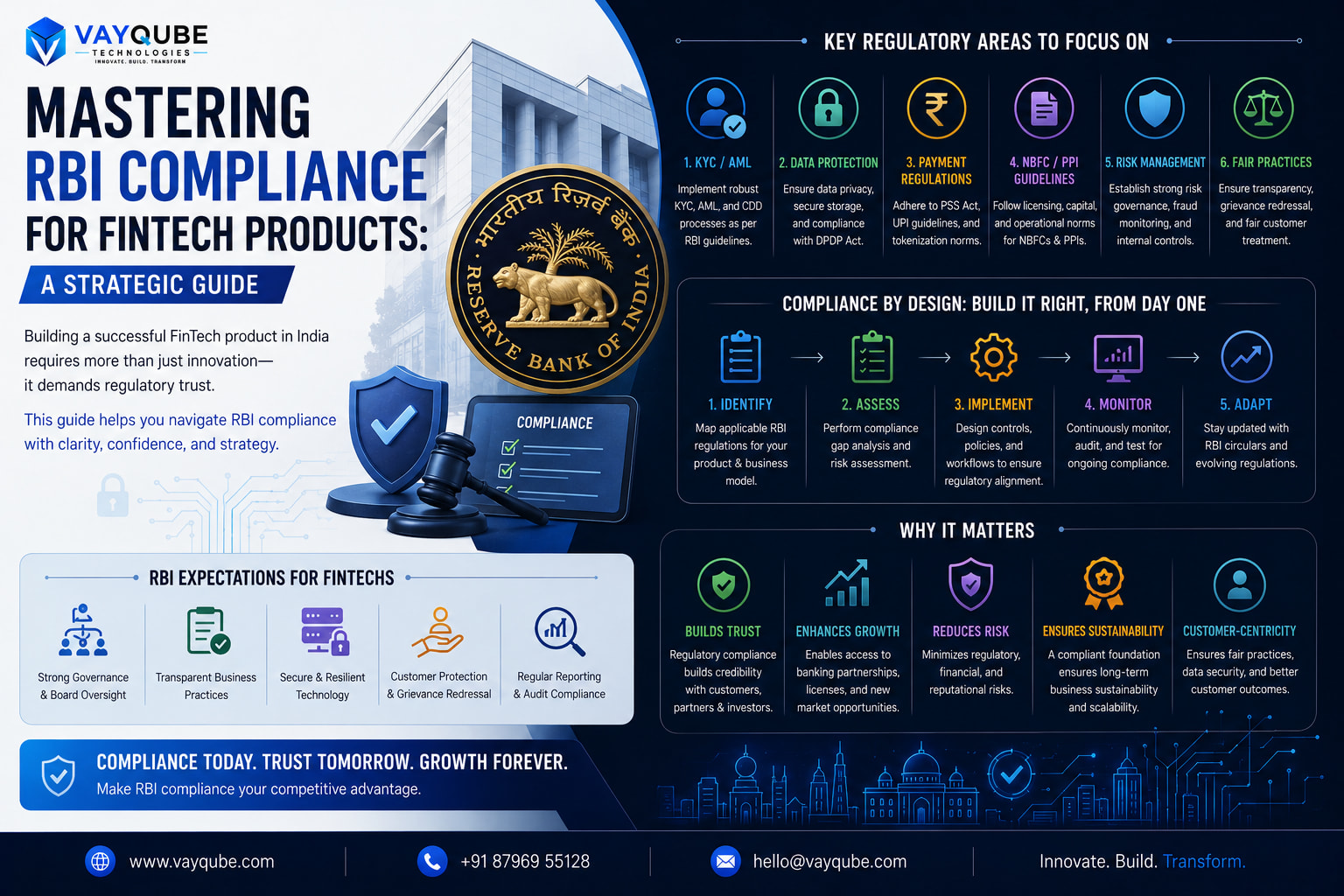
Navigating RBI compliance for FinTech products requires a blend of regulatory expertise and scalable technology. This guide explores practical strategies, implementation frameworks, and real-world examples to help FinTechs achieve compliance while maintaining agility and innovation.
Vayqube Team
FinTech compliance and secure systems engineering
Introduction
Overview of RBI Compliance in the FinTech Landscape
The Reserve Bank of India (RBI) plays a pivotal role in shaping the regulatory framework for FinTech innovation. As digital financial services proliferate, compliance with RBI guidelines has become a cornerstone for FinTech startups and scale-ups operating in India. The RBI’s regulatory focus spans data security, anti-money laundering (AML), consumer protection, and operational resilience, ensuring that technological advancements align with systemic stability and user trust. For FinTech companies, navigating this landscape demands a strategic approach that balances agility with adherence to evolving norms.
Key Regulatory Expectations for FinTech Products
RBI mandates a robust compliance architecture tailored to the unique risks posed by digital financial products. Core expectations include:
- Data Localization and Privacy: Adherence to data storage and processing norms under the Digital Financial Services framework.
- KYC and AML Protocols: Implementation of risk-based customer due diligence and transaction monitoring systems.
- Consumer Rights Protection: Transparent communication, grievance redressal mechanisms, and fair pricing practices.
- Licensing and Operational Standards: Compliance with licensing requirements for payment systems, lending platforms, and other regulated services.
Non-compliance risks hefty penalties, reputational damage, and operational disruptions, making proactive alignment with RBI directives critical for sustainable growth.
Purpose of This Strategic Guide
This guide is designed to equip FinTech leaders with actionable insights to embed RBI compliance into their product development and operational strategies. It explores:
- Scalable Compliance Frameworks: Building systems that adapt to regulatory changes without stifling innovation.
- Risk Mitigation Strategies: Leveraging technology for real-time monitoring and audit readiness.
- Implementation Roadmaps: Practical steps for startups and enterprises to achieve compliance while maintaining agility.
By addressing both theoretical and operational aspects, this resource aims to empower organizations to turn compliance into a competitive advantage in India’s dynamic FinTech ecosystem.
Why RBI Compliance Matters
Consequences of Non-Compliance
Non-compliance with RBI regulations exposes FinTech businesses to severe financial, operational, and reputational risks. Penalties can include substantial fines, license revocations, or restrictions on product offerings. For instance, failure to adhere to data localization mandates under the RBI’s Digital Lending Guidelines may result in immediate shutdowns of non-compliant services. Beyond monetary losses, reputational damage can erode customer trust and investor confidence. A single compliance lapse—such as a data breach due to inadequate security protocols—can lead to negative media coverage, loss of key partnerships, and long-term brand erosion.
Building Trust with Regulators and Customers
RBI compliance serves as a foundational element for trust-building in the financial ecosystem. Regulators prioritize entities that demonstrate proactive adherence to guidelines, which streamlines approvals for product launches, partnerships, or market expansions. For customers, compliance signals reliability and ethical operations. For example, adherence to KYC (Know Your Customer) norms and anti-money laundering (AML) protocols reassures users that their financial data is secure and transactions are conducted transparently. This trust is critical in competitive markets where customers increasingly favor platforms that align with regulatory best practices.
Enabling Market Expansion Through Regulatory Alignment
Compliance with RBI standards acts as a catalyst for scaling operations across India and beyond. Many global markets recognize RBI certifications as a benchmark for financial integrity, easing entry into jurisdictions with similar regulatory frameworks. For instance, a FinTech platform compliant with RBI’s UPI (Unified Payments Interface) guidelines can more easily integrate with international payment networks. Additionally, compliance reduces the complexity of due diligence during mergers, acquisitions, or fundraising rounds, as investors prioritize businesses with robust governance structures. By aligning with RBI requirements, FinTechs position themselves to capitalize on emerging opportunities while mitigating risks associated with fragmented regulatory landscapes.
Core Compliance Architecture
Foundational Components
A robust compliance architecture for RBI adherence centers on three pillars: Know Your Customer (KYC), Anti-Money Laundering (AML), and data localization.
- KYC: Beyond basic identity verification, RBI mandates continuous customer risk assessment. Implement multi-tiered verification (document checks, biometric validation, and risk scoring) to align with evolving regulatory expectations. For instance, digital wallets must integrate real-time document validation tools to ensure compliance during user onboarding.
- AML: Transaction monitoring systems (TMS) are critical for detecting suspicious patterns. Use machine learning models to flag high-risk transactions, such as frequent small deposits or cross-border transfers. A payment gateway serving global merchants might deploy a hybrid approach—rule-based alerts for low-risk scenarios and AI-driven analysis for complex cases.
- Data Localization: RBI requires financial data to reside within India. This demands infrastructure investments, such as region-specific cloud instances or partnerships with local data centers. A SaaS-based lending platform could leverage AWS Mumbai regions or collaborate with Indian CSPs to meet storage mandates without latency trade-offs.
Integration with Existing FinTech Infrastructure
Seamless integration minimizes operational disruption while ensuring compliance. Key considerations include:
- API-First Design: Embed compliance checks into existing workflows via APIs. For example, a neobank’s core banking system can call a centralized KYC service during account opening, reducing manual interventions.
- Real-Time Data Pipelines: AML systems require access to live transaction data. Use Kafka or similar tools to stream data from payment gateways to compliance engines, enabling instant risk scoring.
- Legacy System Modernization: Older platforms may lack native compliance capabilities. Wrap legacy code with microservices to expose compliance functionalities without full-scale overhauls. A traditional bank digitizing its services might deploy a middleware layer to connect mainframe databases with modern AML tools.
Role of Automation in Compliance Workflows
Automation reduces human error and accelerates compliance processes:
- Document Processing: AI-powered OCR tools extract and validate KYC documents (e.g., Aadhaar, PAN) in seconds, cutting down manual review time by up to 70%.
- Regulatory Reporting: Automated systems generate RBI-mandated reports (e.g., Suspicious Activity Reports) with minimal manual input, ensuring timeliness and accuracy.
- Risk Assessment: Deploy ML models to dynamically update customer risk profiles based on transaction behavior, reducing reliance on periodic manual reviews.
For production readiness, ensure automation tools are auditable and explainable. A digital insurance platform might use automated decision logs to demonstrate compliance during RBI audits, while maintaining fallback manual processes for edge cases.
Implementation Strategy
Prioritize scalability and flexibility:
- Use modular architectures to adapt to regulatory changes (e.g., updating AML rules without overhauling entire systems).
- Partner with compliance-as-a-service providers for rapid deployment of KYC/AML modules.
- Conduct regular stress tests to validate system performance under peak loads and evolving threat landscapes.
By aligning foundational components, integration strategies, and automation, FinTechs can build compliance frameworks that are both RBI-compliant and operationally efficient.
Business Benefits of Proactive Compliance
Reduced Operational Risks and Cost Savings
Proactive RBI compliance minimizes exposure to regulatory penalties, legal disputes, and reputational damage. By embedding compliance into product design and operations, FinTechs avoid costly retroactive fixes, such as system overhauls or manual audits. Automated compliance workflows reduce human error and streamline reporting, cutting operational overhead. For instance, real-time transaction monitoring tools aligned with RBI guidelines can flag anomalies instantly, preventing fraud and reducing investigation costs.
Enhanced Customer Acquisition and Retention
Trust is the cornerstone of financial services. Proactive compliance signals reliability to customers, especially in markets like India where RBI regulations govern critical areas like data localization and payment gateways. FinTechs that demonstrate adherence to standards like KYC (Know Your Customer) and AML (Anti-Money Laundering) attract risk-averse clients, including enterprises and government-backed institutions. Retention improves when customers feel their data and funds are secure, reducing churn in competitive sectors like digital lending or neo-banking.
Competitive Differentiation in Regulated Markets
In crowded FinTech ecosystems, compliance becomes a strategic differentiator. Startups and scale-ups that achieve RBI certification faster than competitors gain market access advantages. For example, a payment gateway compliant with UPI (Unified Payments Interface) guidelines can partner with banks more easily, accelerating time-to-market. Proactive compliance also positions companies for cross-border expansion, as adherence to Indian regulations often aligns with global standards like GDPR or FATF recommendations, easing entry into new geographies.
By treating compliance as a growth lever rather than a constraint, FinTechs unlock operational efficiency, customer trust, and market agility—key drivers of long-term success in regulated environments.
Scalability Considerations
Designing Compliance Frameworks for Growth
Scalable RBI compliance starts with a modular architecture that accommodates expanding product lines and geographic reach. A rigid, monolithic system risks bottlenecks as transaction volumes grow or new regulations emerge. Instead, adopt a layered approach where compliance checks are decoupled from core business logic. For example, use microservices to isolate KYC verification, transaction monitoring, or reporting modules, enabling independent scaling.
Key strategies include:
- Tiered compliance workflows: Prioritize high-risk transactions for real-time scrutiny while applying lighter checks to low-risk activities.
- Automated policy engines: Deploy rule-based systems that adapt to changing thresholds (e.g., transaction limits, fraud patterns).
- Real-time data pipelines: Ensure compliance tools can ingest and analyze data at scale, leveraging distributed databases or stream processing frameworks.
A digital bank expanding into new markets, for instance, can pre-configure region-specific RBI requirements into its compliance layer without overhauling the entire platform.
Adapting to Evolving Regulatory Requirements
Regulatory landscapes, especially in FinTech, are dynamic. RBI guidelines may tighten around digital payments, data localization, or cybersecurity as the industry matures. Scalable compliance demands proactive monitoring and agile adjustment mechanisms.
Implement:
- Continuous regulatory monitoring: Integrate feeds from official RBI channels, industry forums, and legal tech platforms to flag upcoming changes.
- Version-controlled policy repositories: Maintain a centralized, auditable database of compliance rules that can be updated without disrupting operations.
- Scenario testing environments: Simulate regulatory shifts (e.g., new reporting mandates) in staging to assess impact before deployment.
For example, a neobank facing updated data privacy norms could rapidly reconfigure its data storage and access controls by leveraging a pre-tested compliance playbook. Collaboration with legal and compliance teams ensures changes align with both technical and regulatory realities.
Leveraging Cloud-Native Solutions for Flexibility
Cloud infrastructure is foundational to scalable RBI compliance. It offers elasticity to handle peak loads, geographic redundancy for data sovereignty, and built-in tools for audit trails and encryption.
Best practices include:
- Multi-region deployments: Distribute workloads across cloud regions to meet data residency requirements while maintaining performance.
- Containerized compliance microservices: Use Kubernetes or similar orchestration tools to scale compliance components dynamically.
- Serverless architecture for event-driven tasks: Automate periodic reporting or batch processing using serverless functions to reduce overhead.
A payment gateway processing millions of daily transactions, for instance, can use cloud-native analytics to detect anomalies at scale while encrypting sensitive data in transit and at rest. Additionally, cloud providers often offer pre-certified compliance templates (e.g., ISO 27001, SOC 2), accelerating RBI alignment.
By embedding scalability into the compliance design, FinTechs ensure regulatory adherence evolves alongside business growth, avoiding costly retrofits or operational disruptions.
Implementation Challenges
Balancing Innovation with Regulatory Constraints
FinTech companies thrive on agility and disruption, yet RBI compliance demands rigorous adherence to established frameworks. This tension creates a critical challenge: how to innovate rapidly without compromising regulatory obligations. For instance, real-time payment systems or AI-driven credit scoring models must align with RBI’s data privacy and security mandates.
Strategies to address this include embedding compliance officers within product teams and adopting modular architectures that isolate regulated components. Proactive engagement with regulators during pilot phases can also mitigate risks while maintaining innovation velocity.
Managing Cross-Functional Team Dependencies
RBI compliance requires alignment across legal, product, engineering, and operations teams—each with distinct priorities. Delays in resolving compliance ambiguities can stall product launches, while misaligned assumptions between teams may lead to costly rework.
A structured approach involves:
- Centralized compliance ownership: Assign a dedicated team to oversee cross-functional coordination.
- Automated compliance workflows: Use tools to streamline approvals and documentation.
- Shared KPIs: Align metrics like compliance readiness timelines across departments.
For example, a digital wallet platform launching in India must synchronize KYC processes across UX design, backend APIs, and legal teams to meet RBI’s customer verification norms.
Navigating Ambiguous or Changing Regulations
RBI guidelines often evolve in response to emerging risks, leaving FinTechs to interpret vague or transitional requirements. For instance, recent changes in data localization policies or digital lending norms required companies to rapidly adapt systems without clear precedents.
Best practices include:
- Continuous regulatory monitoring: Leverage AI-driven tools to track updates and assess impact.
- Scenario-based testing: Simulate compliance under varying regulatory conditions during development.
- Regulator collaboration: Participate in industry forums to influence and anticipate policy shifts.
A payments platform navigating shifting UPI guidelines, for example, might maintain parallel system architectures to accommodate potential regulatory pivots while ensuring business continuity.
Real-World Use Cases
Digital Payments Platforms: Transaction Monitoring at Scale
Digital payments platforms handling high-volume transactions must implement real-time monitoring systems to detect suspicious activities aligned with RBI norms. For instance, platforms enabling UPI (Unified Payments Interface) transactions in India use AI-driven anomaly detection to flag unusual patterns—such as multiple high-value transfers from a single account within minutes. These systems automatically generate Suspicious Activity Reports (SARs) and escalate them to compliance teams.
Key implementation considerations include:
- Real-time data processing: Leveraging distributed systems like Apache Kafka for instant transaction analysis.
- Geofencing: Restricting transactions from high-risk regions to mitigate fraud.
- Audit trails: Maintaining immutable logs for regulatory reviews.
Challenges include balancing performance with compliance overhead, especially during peak transaction volumes.
Lending Startups: Credit Information Bureau (CIB) Integration
Lending platforms must adhere to RBI’s Credit Information System (Regulation and Use) Directions, which mandate sharing borrower data with CIBs like CIBIL or Experian. Startups often integrate APIs with these bureaus to:
- Verify creditworthiness: Pull real-time credit scores during loan applications.
- Report repayment behavior: Automatically update borrower data post-disbursement.
For example, a peer-to-peer lending platform might use a microservices architecture to decouple credit checks from core lending workflows, ensuring compliance without disrupting user experience. Challenges include managing data accuracy and obtaining explicit borrower consent for information sharing.
Neobanks: Data Governance and Security
Neobanks, which operate entirely or partially in the digital realm, must enforce robust data governance frameworks to meet RBI’s data localization and security requirements. This includes:
- Data localization: Storing Indian customer data within geo-fenced infrastructure.
- Encryption: Applying AES-256 encryption for data at rest and in transit.
- Access controls: Implementing role-based access (RBAC) to restrict sensitive data exposure.
A case in point is a digital bank offering instant account openings. To comply with Know Your Customer (KYC) norms, it uses OCR and facial recognition to verify documents, while ensuring all customer data is stored in India. Regular third-party audits and penetration testing are conducted to validate compliance.
Production Readiness in Compliance Workflows
Across these use cases, production readiness hinges on:
- Automated reporting: Tools like Elasticsearch for generating compliance dashboards.
- Disaster recovery: Ensuring backup systems maintain audit trails during outages.
- Regulatory updates: Building flexible architectures to adapt to evolving RBI guidelines.
By embedding compliance into product design—rather than treating it as an afterthought—FinTechs can reduce operational risks while scaling securely.
Best Practices for RBI Compliance
Conducting Regular Compliance Audits
Proactive compliance audits are the cornerstone of maintaining RBI adherence. These audits should be scheduled quarterly, with ad-hoc reviews triggered by regulatory updates or product changes. Leverage automated tools to monitor transactional data, user access logs, and reporting workflows in real time. Prioritize audits on high-risk areas such as anti-money laundering (AML) protocols, data privacy controls, and financial reporting accuracy. Document findings with actionable remediation plans and assign ownership to specific teams to ensure accountability.
Investing in Employee Training and Awareness
Human error remains a leading cause of compliance gaps. Implement a structured training program that aligns with RBI guidelines and evolves with regulatory changes. Use scenario-based learning modules to simulate real-world compliance challenges, such as handling suspicious transactions or responding to regulatory inquiries. Conduct bi-annual refresher courses and measure effectiveness through quizzes and mock audits. Foster a culture of compliance by recognizing employees who proactively identify risks.
Collaborating with Legal and Regulatory Experts
RBI requirements are dynamic and often nuanced. Partner with legal counsel specializing in Indian financial regulations and engage directly with RBI advisory bodies. Establish a cross-functional compliance committee that includes external experts to review product roadmaps, policy updates, and incident response plans. This collaboration ensures alignment with the latest interpretations of RBI norms, such as those related to digital lending or data localization. Co-develop a compliance playbook that bridges technical implementation and regulatory expectations.
Building Scalable Compliance Workflows
Design compliance processes that scale with business growth. Automate repetitive tasks like KYC verification, transaction monitoring, and report generation using AI-driven tools. Integrate compliance checks into DevOps pipelines to catch issues early in the development cycle. Use cloud-native infrastructure to ensure data residency and encryption standards meet RBI mandates. Regularly stress-test systems to handle peak loads without compromising compliance SLAs.
Leveraging Real-Time Reporting Mechanisms
RBI mandates strict reporting timelines for financial transactions and operational incidents. Deploy real-time dashboards that provide visibility into compliance metrics, such as pending customer verifications or overdue audits. Use machine learning to predict and flag anomalies before they escalate. Ensure all reporting tools are auditable and generate tamper-proof records. For cross-border transactions, implement multi-jurisdictional reporting frameworks to avoid conflicts with local and international regulations.
Preparing for Regulatory Scrutiny
Maintain a comprehensive audit trail of all compliance activities, including decision logs, policy updates, and communication with regulators. Conduct mock inspections to identify gaps in documentation or procedural adherence. Develop a rapid response protocol for RBI inquiries, including escalation paths and predefined templates for submitting documentation. Regularly update senior leadership on compliance posture through concise, data-driven reports that highlight risks and mitigation strategies.
Frequently Asked Questions
What are the key RBI guidelines for FinTech startups?
The Reserve Bank of India (RBI) mandates FinTech companies to adhere to guidelines spanning anti-money laundering (AML) protocols, customer due diligence (CDD), data localization, and cybersecurity frameworks. Key requirements include:
- KYC Compliance: Mandatory verification of user identities through government-issued documents or Aadhaar-based e-KYC.
- Data Storage: Sensitive financial data must be stored on servers located within India.
- Transaction Monitoring: Real-time monitoring systems to detect suspicious activities.
- Reporting Obligations: Submission of periodic reports (e.g., STRs, CTRs) to the Financial Intelligence Unit of India (FIU-INDIA).
Failure to align with these guidelines can delay licensing approvals or trigger penalties.
How to handle data privacy requirements under RBI?
RBI’s data privacy expectations are rooted in the IT Act, 2000 and DPDP Act, 2023. To comply:
- Encrypt Sensitive Data: Use AES-256 or equivalent encryption for data at rest and in transit.
- Access Controls: Implement role-based access and multi-factor authentication (MFA) for databases.
- Third-Party Vetting: Ensure vendors and partners adhere to RBI’s data localization and security norms.
- Audit Trails: Maintain logs of data access and modifications for at least 5 years.
Proactive measures like privacy impact assessments (PIAs) and data minimization policies further mitigate risks.
What are the penalties for non-compliance?
RBI imposes monetary penalties, licensing restrictions, or operational shutdowns for non-compliance. Penalties can range from ₹1 lakh to ₹10 lakh per violation under Section 47A of the Banking Regulation Act. Repeat offenders may face:
- Revocation of payment gateway or NBFC licenses.
- Public notices damaging brand reputation.
- Criminal proceedings for willful misconduct.
Regulatory actions are typically preceded by show-cause notices, giving companies a window to rectify issues.
How to stay updated on regulatory changes?
RBI frequently updates its policies via circulars, master directions, and press releases. To stay ahead:
- Monitor RBI’s Official Channels: Subscribe to alerts on the RBI website and follow their social media.
- Engage Legal Advisors: Partner with compliance experts familiar with Indian financial regulations.
- Leverage RegTech Tools: Use AI-driven platforms like ComplyAdvantage or Onfido for real-time compliance updates.
- Attend Industry Forums: Participate in events hosted by the Indian FinTech Association or NASSCOM for insights into emerging trends.
Proactive tracking ensures timely adaptation to regulatory shifts, minimizing operational disruptions.
Conclusion
Strategic Importance of Embedding Compliance Early
Building RBI compliance into the foundational architecture of FinTech products is not a checkbox exercise—it’s a strategic differentiator. Early integration reduces the risk of costly retrofits, operational disruptions, and reputational damage. For instance, a digital lending platform that embeds KYC/AML checks at the design phase avoids the complexity and expense of retrofitting compliance into a live system. This proactive approach ensures seamless scalability, as regulatory requirements evolve alongside business growth.
Future-Proofing FinTech Products for Regulatory Shifts
Regulatory landscapes are dynamic, especially in India’s rapidly evolving FinTech ecosystem. Future-proofing requires a combination of agile compliance frameworks and continuous monitoring. Consider leveraging AI-driven tools for real-time transaction monitoring or modular system designs that allow quick adaptation to new RBI guidelines. For example, a neobank using cloud-native infrastructure can deploy compliance updates across regions without service interruptions, ensuring resilience against regulatory changes.
Final Recommendations for Building Compliant, Scalable Solutions
- Collaborate Cross-Functionally: Foster alignment between legal, compliance, and engineering teams to embed regulations into product roadmaps.
- Invest in Automation: Deploy tools for automated reporting, audit trails, and risk assessments to reduce manual overhead.
- Prioritize Data Governance: Ensure data localization, encryption, and access controls meet RBI standards for sensitive financial information.
- Leverage Third-Party Expertise: Partner with compliance consultants or use regulated third-party services (e.g., payment gateways) to offload specialized requirements.
- Adopt Continuous Compliance Practices: Implement regular audits, penetration testing, and employee training to maintain adherence as products scale.
By treating RBI compliance as a core business enabler—not a constraint—FinTech companies can build trust, mitigate risks, and accelerate growth in India’s competitive market. The key lies in balancing innovation with rigor, ensuring solutions are both cutting-edge and production-ready.
Related Vayqube Resources
- How To Build Fintech Application Payments Security Scaling
- How To Build Scalable Nodejs Backend Production Guide
- Startups Building Ai Products Without Large Teams
- The Real Cost Of Building Ai Products
- Real Time Application Development
- Event Driven Architecture Development
Next Step
If your systems are struggling with scalability, automation, architecture complexity, or operational efficiency, it's time to modernize your infrastructure and workflows.
👉 Talk to a Vayqube solution architect and build systems designed for long-term production growth:
Additional implementation notes
<!-- merged-from:rbi-compliance-challenges-for-fintech-products -->Privacy Measures
In addition to data security, FinTech companies must also implement robust privacy measures to protect sensitive customer information. Some of the key privacy measures include:
- Implementing transparent data collection and usage policies
- Obtaining explicit customer consent for data collection and usage
- Ensuring that all customer data is handled and processed in accordance with RBI guidelines and regulations
- Providing customers with clear and concise information about their rights and options regarding data collection and usage
The core architecture of RBI compliance for FinTech products is designed to ensure the security, integrity, and privacy of financial data. By implementing robust technical requirements, data security measures, and privacy measures, FinTech companies can ensure compliance with RBI regulations and maintain the trust and confidence of their customers.
Continuous Improvement of Compliance Processes
Continuously improving compliance processes is essential for ensuring that FinTech companies remain compliant with evolving RBI regulations. This involves:
- Regularly reviewing and updating compliance policies and procedures
- Implementing new technologies and tools to enhance compliance monitoring and reporting
- Collaborating with regulatory bodies and industry associations to stay informed about regulatory updates and best practices
By adopting these best practices, FinTech companies can ensure they maintain RBI compliance and minimize the risk of non-compliance. This not only helps to avoid regulatory penalties but also enhances the reputation and trustworthiness of the company.