
The Foundation of AI Success: Why Infrastructure Matters
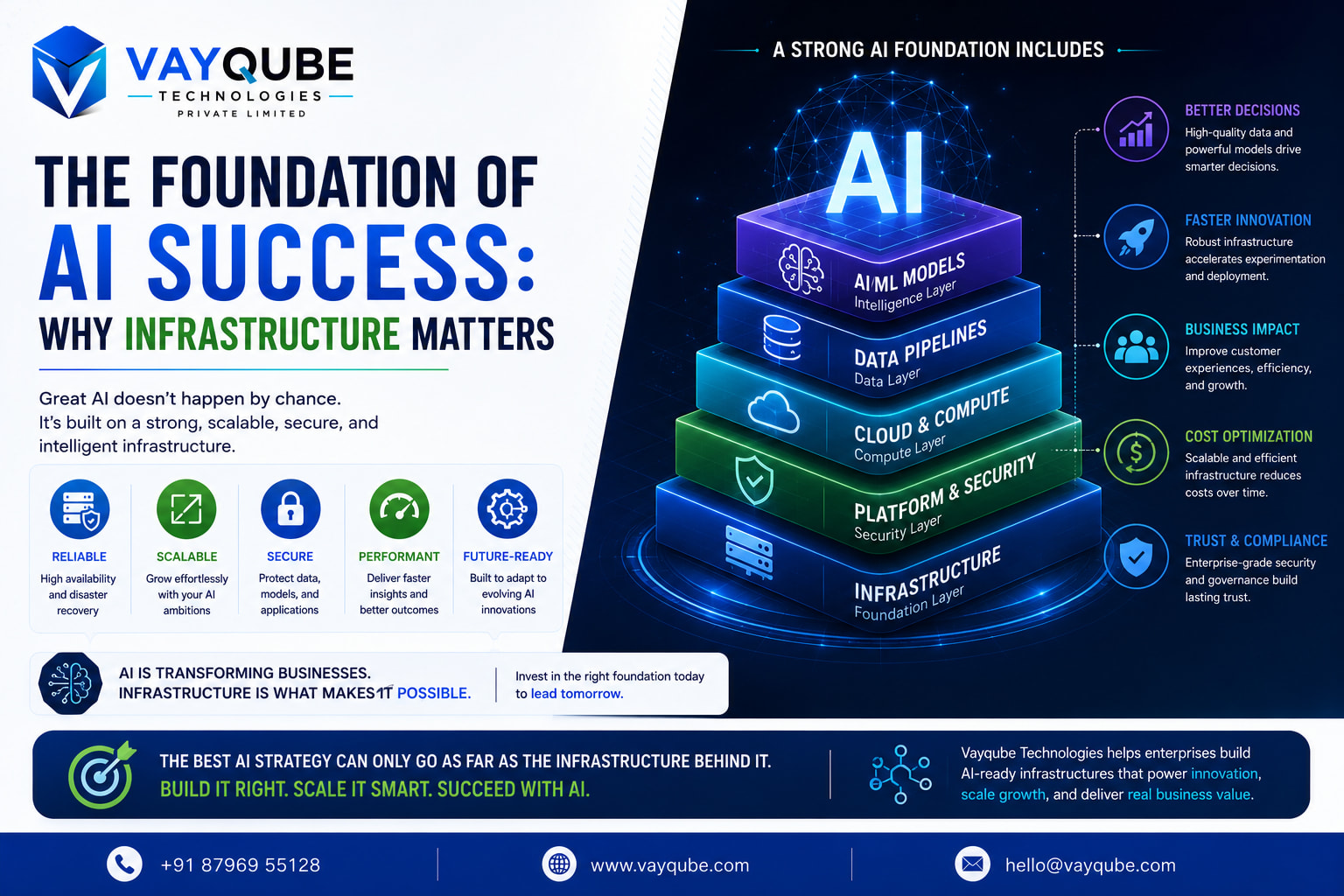
As organizations invest in AI, it's easy to get caught up in the excitement of new features and capabilities. However, the true key to unlocking AI's potential lies in its infrastructure. A well-designed AI infrastructure is the foundation upon which successful AI initiatives are built, enabling scalability, reliability, and efficiency.
Vayqube Team
Author
Introduction to AI Infrastructure
A well-designed infrastructure is the backbone of any successful AI implementation. It provides the foundation for scalability, reliability, and performance, enabling businesses to unlock the full potential of their AI investments. In today's fast-paced digital landscape, a solid AI infrastructure is no longer a luxury, but a necessity for organizations seeking to drive innovation and stay ahead of the competition.
The Importance of a Solid Foundation
A robust AI infrastructure is essential for supporting the complex and computationally intensive workloads associated with AI and machine learning. It enables businesses to process vast amounts of data, deploy models quickly, and ensure seamless integration with existing systems. Without a solid foundation, AI initiatives can quickly become mired in technical debt, leading to delays, inefficiencies, and ultimately, a failure to deliver on expected outcomes.
Key considerations for building a solid AI infrastructure include:
- Scalability: the ability to handle increasing volumes of data and traffic
- Performance: the ability to process complex workloads quickly and efficiently
- Reliability: the ability to ensure high uptime and minimize downtime
- Security: the ability to protect sensitive data and prevent unauthorized access
Real-World Implications
In real-world scenarios, a well-designed AI infrastructure can be the difference between success and failure. For instance, a company like Netflix relies heavily on AI to personalize user experiences and recommend content. A robust infrastructure enables Netflix to process vast amounts of user data, deploy new models quickly, and ensure seamless integration with existing systems. This, in turn, drives user engagement, retention, and ultimately, revenue growth.
In contrast, a poorly designed infrastructure can lead to significant challenges, including delayed deployment, increased costs, and decreased performance. By prioritizing infrastructure from the outset, businesses can avoid these pitfalls and set themselves up for long-term success in the AI landscape.
Building a Strong Foundation
To build a strong foundation for AI success, businesses must prioritize infrastructure from the outset. This involves careful planning, strategic investment, and a deep understanding of the technical and operational requirements of AI workloads. By getting the infrastructure right, businesses can create a solid foundation for AI innovation, drive growth, and stay ahead of the competition in an increasingly digital landscape.
Why It Matters
The infrastructure underlying AI systems plays a crucial role in determining the performance and reliability of AI models. Inadequate infrastructure can have far-reaching consequences, impacting not only the accuracy and efficiency of AI models but also the overall business outcomes.
Impact on AI Model Performance
The performance of AI models is heavily dependent on the quality of the infrastructure. Key factors such as computing power, storage, and networking capabilities can significantly influence the training time, accuracy, and scalability of AI models. For instance, a robust infrastructure can enable faster training of AI models, allowing businesses to quickly deploy and update their models, thereby staying competitive in the market.
Consequences of Inadequate Infrastructure
Inadequate infrastructure can lead to a range of negative consequences, including:
- Prolonged training times, resulting in delayed deployment of AI models
- Reduced accuracy and reliability of AI models, leading to poor decision-making
- Increased risk of model drift and data leakage, compromising data security and integrity
- Inability to scale AI models to meet growing demand, resulting in missed business opportunities
- Higher operational costs due to inefficient use of resources, impacting profitability
Real-World Implications
In real-world scenarios, the consequences of inadequate infrastructure can be severe. For example, a company that fails to invest in a robust infrastructure may struggle to deploy AI models that can handle large volumes of data, leading to missed opportunities and competitive disadvantage. On the other hand, a company that prioritizes infrastructure investment can reap significant benefits, including improved AI model performance, increased efficiency, and enhanced business outcomes.
Production Considerations
When deploying AI models in production environments, it is essential to consider the infrastructure requirements carefully. This includes ensuring that the infrastructure can handle the expected volume of data, provide sufficient computing power, and guarantee high availability and reliability. By doing so, businesses can minimize the risk of infrastructure-related issues and ensure that their AI models perform optimally, driving business success.
Implementation Strategy
To ensure the success of AI initiatives, businesses should adopt a strategic approach to infrastructure planning. This involves:
- Assessing current infrastructure capabilities and identifying gaps
- Developing a roadmap for infrastructure upgrades and investments
- Implementing scalable and flexible infrastructure solutions
- Monitoring and optimizing infrastructure performance continuously
- Ensuring alignment between infrastructure and AI model requirements
By prioritizing infrastructure investment and adopting a strategic approach to infrastructure planning, businesses can unlock the full potential of AI and drive meaningful business outcomes.
Core Architecture
The core architecture of AI infrastructure is comprised of several key components that work together to enable efficient and scalable AI model development and deployment.
Key Components
The primary components of AI infrastructure include:
- Data storage solutions, such as data lakes and warehouses, that provide a centralized repository for AI model training data
- High-performance computing resources, including GPUs and TPUs, that accelerate AI model training and inference
- Networking infrastructure, such as high-speed interconnects and low-latency networks, that facilitate communication between AI systems and data sources
Role of Data Storage
Data storage plays a critical role in AI infrastructure, as it provides a foundation for AI model training and deployment. A well-designed data storage solution must be able to handle large volumes of data, provide low-latency access to data, and ensure data integrity and security.
Role of Computing Power
Computing power is another essential component of AI infrastructure, as it enables the rapid training and deployment of AI models. High-performance computing resources, such as GPUs and TPUs, are designed to accelerate AI workloads, reducing training times and improving model accuracy.
Role of Networking
Networking infrastructure is also critical to AI infrastructure, as it enables communication between AI systems and data sources. A well-designed networking infrastructure must be able to handle high volumes of data, provide low-latency communication, and ensure network security and reliability.
Implementation Considerations
When implementing AI infrastructure, several factors must be considered, including scalability, performance, and security. A scalable AI infrastructure must be able to handle increasing volumes of data and AI workloads, while maintaining performance and security.
Real-World Examples
Real-world examples of AI infrastructure implementation include:
- Cloud-based AI platforms, such as Google Cloud AI Platform and Amazon SageMaker, that provide pre-built AI infrastructure and tools
- On-premises AI infrastructure, such as NVIDIA DGX systems, that provide high-performance computing resources for AI model training and deployment
- Hybrid AI infrastructure, such as Azure Stack, that combines on-premises and cloud-based AI infrastructure to provide a flexible and scalable AI platform.
Production Readiness
To ensure production readiness, AI infrastructure must be designed and implemented with several factors in mind, including:
- High availability and reliability
- Low latency and high throughput
- Scalability and flexibility
- Security and compliance
- Monitoring and maintenance.
Best Practices
Best practices for AI infrastructure implementation include:
- Designing for scalability and flexibility
- Implementing robust security and compliance measures
- Monitoring and maintaining AI infrastructure regularly
- Continuously evaluating and improving AI infrastructure performance.
Business Benefits
The right infrastructure is crucial for unlocking the full potential of AI initiatives. By investing in a robust and scalable foundation, organizations can reap significant benefits that drive business success.
Improved Model Accuracy and Reliability
A well-designed infrastructure enables the development of more accurate and reliable AI models. This is achieved through the ability to process large volumes of high-quality data, which is essential for training and testing AI algorithms. With improved model accuracy, organizations can make more informed decisions, reduce errors, and increase confidence in their AI-driven insights.
Enhanced Scalability and Flexibility
A scalable infrastructure allows organizations to quickly adapt to changing business needs and increasing data volumes. This flexibility is critical for supporting the rapid evolution of AI technologies and ensuring that AI initiatives remain aligned with business objectives. By leveraging cloud-based infrastructure, organizations can easily scale up or down to meet demand, reducing the risk of resource bottlenecks and ensuring seamless deployment of AI models.
Increased Efficiency and Reduced Costs
An optimized infrastructure can significantly reduce the costs associated with AI development and deployment. By automating routine tasks, minimizing data duplication, and leveraging open-source tools, organizations can streamline their AI workflows and improve productivity. Additionally, a well-designed infrastructure can reduce energy consumption, lower maintenance costs, and extend the lifespan of AI systems, resulting in significant cost savings over time.
Key benefits of a well-designed AI infrastructure include:
- Faster deployment of AI models
- Improved collaboration among data scientists and engineers
- Enhanced security and governance of AI systems
- Better integration with existing business applications and systems
- Increased transparency and explainability of AI decision-making processes
By prioritizing infrastructure development, organizations can create a solid foundation for their AI initiatives, driving business success and unlocking the full potential of AI technologies.
Scalability
Scalability is a critical component of AI infrastructure, as it enables organizations to handle increasing amounts of data and traffic without compromising performance. In the context of AI, scalability refers to the ability of a system to handle growing workloads, adapt to changing requirements, and maintain optimal performance.
Importance of Scalability
The importance of scalability in AI infrastructure cannot be overstated. As AI models become more complex and data-intensive, they require more computational resources to operate effectively. Without a scalable infrastructure, organizations may struggle to deploy and maintain AI models, leading to decreased performance, increased latency, and reduced accuracy. Some key reasons why scalability matters in AI infrastructure include:
- Handling large datasets and high-volume data streams
- Supporting multiple AI models and applications
- Ensuring high-performance computing and fast processing times
- Adapting to changing requirements and evolving business needs
Strategies for Scaling AI Infrastructure
To achieve scalability in AI infrastructure, organizations can employ several strategies, including:
- Distributed computing and parallel processing
- Cloud-based infrastructure and services
- Containerization and orchestration using tools like Kubernetes
- Auto-scaling and load balancing to ensure optimal resource utilization
- Data partitioning and caching to reduce latency and improve performance By implementing these strategies, organizations can create a scalable AI infrastructure that supports the deployment and maintenance of complex AI models, while also ensuring high-performance, reliability, and adaptability.
Real-World Examples
Real-world examples of scalable AI infrastructure include:
- Cloud-based AI platforms like Google Cloud AI Platform and Amazon SageMaker
- Distributed computing frameworks like Apache Spark and Hadoop
- Containerized AI applications using Docker and Kubernetes
- Auto-scaling AI services like AWS SageMaker AutoPilot and Google Cloud AI Platform AutoML These examples demonstrate how organizations can leverage scalable infrastructure to support AI development, deployment, and maintenance, while also ensuring high-performance, reliability, and adaptability.
Implementation Considerations
When implementing scalable AI infrastructure, organizations should consider several key factors, including:
- Data storage and management
- Compute resources and processing power
- Networking and communication
- Security and access control
- Monitoring and maintenance By carefully evaluating these factors and implementing a scalable AI infrastructure, organizations can ensure the successful deployment and maintenance of complex AI models, while also driving business innovation and growth.
Implementation Challenges
Implementing AI infrastructure can be a complex and daunting task, with several common obstacles that can hinder success. These challenges can be broadly categorized into technical, operational, and strategic issues.
Technical Hurdles
Some of the most significant technical challenges include:
- Data quality and availability: AI algorithms require large amounts of high-quality data to function effectively.
- Integration with existing systems: AI infrastructure often needs to be integrated with existing systems, which can be time-consuming and costly.
- Scalability and performance: AI workloads can be computationally intensive, requiring significant resources to ensure optimal performance.
Operational Obstacles
Operational challenges can also pose significant hurdles, including:
- Lack of skilled personnel: Implementing and maintaining AI infrastructure requires specialized skills, which can be difficult to find and retain.
- Insufficient budget: AI infrastructure can be costly to implement and maintain, requiring significant investment.
- Inadequate governance: AI infrastructure requires careful governance to ensure that it is aligned with business objectives and compliant with regulatory requirements.
Best Practices for Overcoming Challenges
To overcome these challenges, organizations can follow several best practices, including:
- Developing a clear AI strategy that aligns with business objectives
- Investing in employee training and development to build the necessary skills
- Implementing a phased approach to AI infrastructure deployment, starting with small pilot projects and gradually scaling up
- Establishing a robust governance framework to ensure compliance and alignment with business objectives
- Fostering a culture of innovation and experimentation, encouraging employees to explore new AI applications and use cases.
Real-World Examples
Several organizations have successfully overcome these challenges and achieved significant benefits from their AI infrastructure investments. For example, a leading retail company implemented an AI-powered recommendation engine, which resulted in a significant increase in sales and customer engagement. A major healthcare provider used AI to analyze medical images, improving diagnosis accuracy and reducing costs. These examples demonstrate the potential of AI infrastructure to drive business success, but also highlight the importance of careful planning, execution, and governance.
Use Cases
Successful AI infrastructure implementation can be seen in various industries, each with its unique applications and benefits.
Real-World Examples
Real-world examples of AI infrastructure implementation include:
- Healthcare: AI-powered diagnosis and treatment recommendations, patient data analysis, and personalized medicine.
- Finance: AI-driven risk management, portfolio optimization, and fraud detection.
- Retail: AI-based customer service chatbots, personalized product recommendations, and supply chain optimization.
Industry-Specific Applications
Industry-specific applications of AI infrastructure include:
- Manufacturing: Predictive maintenance, quality control, and supply chain management.
- Transportation: Autonomous vehicles, route optimization, and traffic management.
- Education: AI-powered adaptive learning, student assessment, and personalized education plans.
Benefits and Outcomes
The benefits of AI infrastructure implementation can be significant, including:
- Improved efficiency and productivity
- Enhanced customer experience
- Increased revenue and competitiveness
- Better decision-making and risk management
- Improved data analysis and insights
Production Considerations
When implementing AI infrastructure in production, considerations include:
- Scalability: Ensuring the infrastructure can handle large volumes of data and traffic.
- Security: Protecting sensitive data and ensuring the integrity of AI models.
- Monitoring and Maintenance: Continuously monitoring and maintaining the infrastructure to ensure optimal performance.
- Collaboration: Ensuring effective collaboration between data scientists, engineers, and business stakeholders.
Implementation Strategy
A well-planned implementation strategy is crucial for successful AI infrastructure deployment, including:
- Assessing Business Needs: Identifying business goals and requirements.
- Selecting AI Technologies: Choosing the right AI technologies and tools.
- Designing Infrastructure: Designing and building a scalable and secure infrastructure.
- Deploying and Monitoring: Deploying and continuously monitoring the infrastructure.
Best Practices
To ensure the successful deployment of AI solutions, it's crucial to follow best practices for designing and implementing effective AI infrastructure. This involves careful planning, execution, and ongoing optimization to maximize performance while minimizing costs.
Designing Effective Infrastructure
When designing AI infrastructure, consider the following guidelines:
- Align infrastructure with business objectives to ensure that AI solutions support key goals and outcomes
- Select scalable and flexible infrastructure components to accommodate growing demands and evolving requirements
- Implement robust security measures to protect sensitive data and prevent unauthorized access
- Foster collaboration between IT, data science, and business teams to ensure seamless integration and effective communication
Optimizing Performance and Costs
To optimize AI infrastructure performance and minimize costs, consider the following tips:
- Monitor and analyze usage patterns to identify areas for optimization and potential cost savings
- Implement efficient data storage and management practices to reduce data redundancy and improve access times
- Leverage cloud-based services and automation tools to streamline deployment, scaling, and maintenance processes
- Develop a comprehensive cost management strategy to track expenses, allocate resources, and predict future costs
Real-World Implementation
In real-world scenarios, effective AI infrastructure design and implementation can significantly impact business outcomes. For example, a company deploying AI-powered customer service chatbots may require infrastructure that can handle sudden spikes in traffic and provide seamless integration with existing CRM systems. By following best practices and optimizing infrastructure performance, businesses can ensure that their AI solutions deliver maximum value and support long-term growth and success.
Production Readiness
To ensure production readiness, AI infrastructure must be thoroughly tested, validated, and optimized for performance, security, and scalability. This involves:
- Conducting thorough stress testing and performance benchmarking to identify potential bottlenecks and areas for improvement
- Implementing robust monitoring and logging mechanisms to detect and respond to issues in real-time
- Developing comprehensive backup and disaster recovery strategies to minimize downtime and ensure business continuity
- Establishing clear governance and compliance policies to ensure regulatory adherence and data protection.
Frequently Asked Questions
The following are some of the most common questions organizations have when it comes to AI infrastructure, along with detailed explanations to help address these concerns.
What is the Role of Cloud Computing in AI Infrastructure?
Cloud computing plays a critical role in AI infrastructure, offering scalability, flexibility, and cost-effectiveness. It enables organizations to quickly deploy and manage AI models without the need for expensive hardware investments. Key benefits include:
- On-demand access to computing resources
- Reduced capital expenditures
- Enhanced collaboration and data sharing
How Do I Ensure Data Quality and Integrity for AI Models?
Ensuring data quality and integrity is crucial for the success of AI models. This involves:
- Implementing robust data validation and cleansing processes
- Establishing data governance policies
- Conducting regular data audits to identify and address potential issues
What Are the Key Considerations for Implementing AI Infrastructure?
When implementing AI infrastructure, key considerations include:
- Scalability and flexibility to accommodate growing demands
- Security and compliance to protect sensitive data
- Integration with existing systems and tools
- Ongoing maintenance and support to ensure optimal performance
How Can I Measure the Success of My AI Infrastructure?
Measuring the success of AI infrastructure involves tracking key performance indicators (KPIs) such as:
- Model accuracy and performance
- Data processing and analysis speed
- Cost savings and return on investment (ROI)
- User adoption and satisfaction
What Are the Most Common Challenges in AI Infrastructure Implementation?
Common challenges in AI infrastructure implementation include:
- Data quality and availability issues
- Insufficient computing resources and scalability
- Lack of skilled personnel and expertise
- Integrating AI with existing systems and tools
How Can I Address the Skills Gap in AI Infrastructure?
Addressing the skills gap in AI infrastructure involves:
- Providing training and development opportunities for existing staff
- Hiring skilled professionals with expertise in AI and data science
- Partnering with external vendors and consultants to fill gaps
- Encouraging a culture of innovation and continuous learning
What Is the Future of AI Infrastructure, and How Can I Prepare?
The future of AI infrastructure is expected to involve increased use of cloud computing, edge computing, and hybrid approaches. To prepare, organizations should:
- Stay up-to-date with the latest trends and technologies
- Develop a flexible and scalable infrastructure
- Focus on building a skilled and agile workforce
- Prioritize ongoing innovation and experimentation
Conclusion
The foundation of AI success is built on a robust infrastructure that supports the unique demands of artificial intelligence and machine learning workloads. As we've explored throughout this article, a well-designed infrastructure is crucial for businesses to unlock the full potential of AI and drive meaningful success.
Key Takeaways
The key points to remember are:
- A robust infrastructure is essential for supporting AI and ML workloads
- A well-designed core architecture is critical for scalability and performance
- Businesses can reap significant benefits from AI, including improved efficiency and decision-making
- Implementation challenges can be overcome with careful planning and best practices
- Real-world use cases demonstrate the potential of AI to drive business success
In summary, the importance of AI infrastructure cannot be overstated. By prioritizing infrastructure design and implementation, businesses can set themselves up for success and unlock the full potential of AI to drive innovation and growth.
Final Thoughts
As businesses continue to adopt and integrate AI into their operations, the importance of infrastructure will only continue to grow. By recognizing the critical role that infrastructure plays in AI success, businesses can make informed decisions about how to design and implement their AI infrastructure, and set themselves up for long-term success. The future of AI is exciting and full of potential, and with the right infrastructure in place, businesses can unlock new opportunities and drive meaningful growth and innovation.
By focusing on the development of a robust AI infrastructure, businesses can ensure that they are well-positioned to take advantage of the latest advancements in AI and ML, and stay ahead of the competition in an increasingly complex and rapidly evolving landscape. Ultimately, the success of AI depends on the foundation of infrastructure that supports it, and businesses that prioritize infrastructure design and implementation will be best positioned to drive real-world success and achieve their goals.
Related Vayqube Resources
- Why Most Ai Projects Fail Before Production
- How To Build Fintech Application Payments Security Scaling
- How To Build Scalable Nodejs Backend Production Guide
- Best Mobile App Development Company In Usa
- Best Mobile App Development Company In New York
- Real Time Application Development
Next Step
If your systems are struggling with scalability, automation, architecture complexity, or operational efficiency, it's time to modernize your infrastructure and workflows.
👉 Talk to a Vayqube solution architect and build systems designed for long-term production growth: