
Cloud Wars: AWS vs Azure vs GCP for Modern SaaS
Discover the strengths and weaknesses of AWS, Azure, and GCP to determine the best cloud platform for your modern SaaS application.
Vayqube Team
Software architecture and product engineering
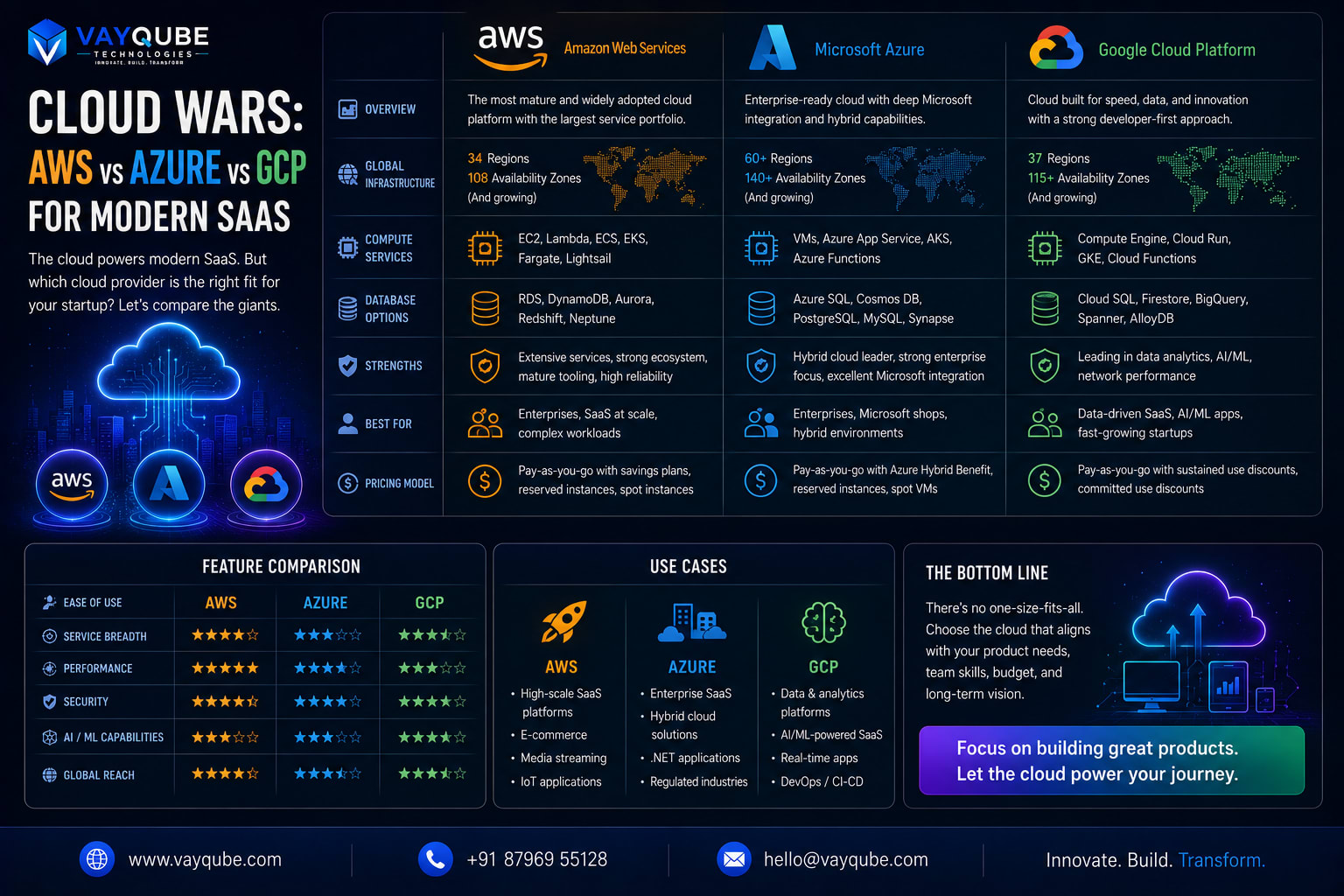
Introduction to Cloud Wars
The cloud computing landscape has become a battleground for Amazon Web Services (AWS), Microsoft Azure, and Google Cloud Platform (GCP) as they vie for dominance in the market. Each of these cloud providers offers a unique set of services and features that cater to different needs and use cases. For modern SaaS (Software as a Service) companies, choosing the right cloud infrastructure is crucial for scalability, reliability, and cost-effectiveness.
Overview of Cloud Providers
AWS, Azure, and GCP are the three leading cloud providers that offer a wide range of services, including computing, storage, networking, and machine learning. Each provider has its strengths and weaknesses, and the choice of which one to use depends on the specific needs of the SaaS company. For example, AWS is known for its maturity and wide range of services, while Azure is strong in the enterprise market and has a large customer base. GCP, on the other hand, is known for its innovative approach to cloud computing and its strengths in machine learning and data analytics.
Importance of Cloud Infrastructure for SaaS
Cloud infrastructure is critical for SaaS companies as it provides the foundation for building, deploying, and scaling applications. A good cloud infrastructure can help SaaS companies to reduce costs, improve performance, and increase reliability. It also provides the necessary security, compliance, and governance features to ensure that applications are secure and meet regulatory requirements. With the right cloud infrastructure, SaaS companies can focus on developing and delivering their applications, rather than worrying about the underlying infrastructure.
Brief Comparison of AWS, Azure, and GCP
A brief comparison of the three cloud providers reveals some key differences:
- Compute Services: AWS offers a wide range of compute services, including EC2, Lambda, and Elastic Container Service. Azure offers Virtual Machines, Functions, and Container Instances, while GCP offers Compute Engine, Cloud Functions, and Kubernetes Engine.
- Storage Services: AWS offers S3, EBS, and Elastic File System, while Azure offers Blob Storage, File Storage, and Disk Storage. GCP offers Cloud Storage, Persistent Disk, and Cloud Datastore.
- Pricing: AWS and Azure offer similar pricing models, with discounts for committed usage and reserved instances. GCP offers a unique pricing model that is based on the actual usage, rather than the provisioned resources.
In the next section, we will delve deeper into the features and services offered by each cloud provider, and explore how they can be used to build and deploy modern SaaS applications.
Why It Matters
The choice of cloud infrastructure has a profound impact on the scalability and success of modern SaaS applications. As companies undergo digital transformation, the role of the cloud extends beyond mere infrastructure to a strategic foundation for innovation and growth.
Scalability and Growth
The cloud choice directly affects a SaaS company's ability to scale efficiently. With the right cloud provider, businesses can quickly adapt to changing market conditions, handle sudden spikes in demand, and expand into new markets. For instance, a SaaS company experiencing rapid growth may need to quickly deploy new instances, scale up resources, or integrate new services. The flexibility and scalability of the cloud infrastructure can make or break the company's ability to capitalize on new opportunities.
Security and Compliance
Security and compliance are critical considerations for SaaS companies, and the cloud plays a vital role in addressing these concerns. Cloud providers like AWS, Azure, and GCP offer a range of security features and compliance frameworks that can help SaaS companies meet stringent regulatory requirements. However, the complexity of cloud security and compliance can be overwhelming, and companies must carefully evaluate the security posture of each cloud provider to ensure it aligns with their risk tolerance and compliance needs.
Digital Transformation
The cloud is a key enabler of digital transformation, allowing SaaS companies to innovate, experiment, and disrupt traditional business models. By leveraging cloud-native services, companies can build modern, cloud-based applications that are more agile, responsive, and customer-centric. The cloud also provides a platform for integrating emerging technologies like AI, machine learning, and IoT, which can help SaaS companies differentiate themselves and create new revenue streams.
Some key factors to consider when evaluating cloud providers for digital transformation include:
- Support for cloud-native architectures and microservices
- Availability of advanced data analytics and machine learning services
- Integration with emerging technologies like serverless computing and edge computing
- Ability to support hybrid and multi-cloud environments
By carefully evaluating these factors and considering the unique needs of their business, SaaS companies can choose a cloud provider that supports their growth, innovation, and digital transformation goals.
Core Architecture
The core architecture of a cloud platform is crucial for modern SaaS applications, as it directly impacts scalability, performance, and reliability. In this section, we'll delve into the architectural fundamentals of AWS, Azure, and GCP.
AWS Architecture Overview
AWS architecture is built around a highly available and scalable framework, with a focus on microservices and containerization. Key components include:
- Virtual Private Cloud (VPC) for network isolation and security
- Elastic Compute Cloud (EC2) for compute resources
- Simple Storage Service (S3) for object storage
- Relational Database Service (RDS) for managed databases
AWS's architecture is designed to support a wide range of workloads, from web and mobile applications to big data and analytics.
Azure Architecture Fundamentals
Azure's architecture is centered around a modular, services-based approach, with a strong emphasis on hybrid cloud and edge computing. Core components include:
- Virtual Networks (VNets) for network management
- Azure Kubernetes Service (AKS) for container orchestration
- Blob Storage for unstructured data
- Azure SQL Database for managed relational databases
Azure's architecture is designed to support a broad range of use cases, from enterprise applications to IoT and AI workloads.
GCP Architecture and Key Components
GCP's architecture is built around a highly scalable and secure framework, with a focus on machine learning and data analytics. Key components include:
- Virtual Private Cloud (VPC) for network management
- Compute Engine for compute resources
- Cloud Storage for object and file storage
- Cloud SQL for managed relational databases
GCP's architecture is designed to support a wide range of workloads, from web and mobile applications to big data and machine learning.
When evaluating these architectures, it's essential to consider factors such as scalability, security, and manageability, as well as the specific needs of your SaaS application. By understanding the core architecture of each platform, you can make informed decisions about which cloud provider best aligns with your business goals and technical requirements.
In the context of modern SaaS applications, the ability to scale and adapt quickly is critical. AWS, Azure, and GCP all offer a range of tools and services to support scalability, but the specific architecture and design of your application will play a significant role in determining its overall performance and reliability.
Ultimately, the choice of cloud provider will depend on a variety of factors, including the specific needs of your application, the expertise of your team, and the overall business goals of your organization. By carefully evaluating the core architecture of each platform, you can make a more informed decision and ensure the long-term success of your SaaS application.
Business Benefits
The cloud wars between AWS, Azure, and GCP have led to a highly competitive market, resulting in numerous benefits for modern SaaS businesses.
Cost Savings and ROI
One of the primary advantages of adopting a cloud-based infrastructure is the potential for significant cost savings. By leveraging the scalability and on-demand resources of cloud providers, SaaS companies can reduce their capital expenditures and operational costs. This, in turn, can lead to a substantial increase in return on investment (ROI). For instance, a SaaS company can quickly scale up or down to match changing demand, avoiding the need for expensive hardware upgrades or new equipment purchases.
Increased Agility and Innovation
The cloud enables SaaS businesses to be more agile and innovative, allowing them to quickly respond to changing market conditions and customer needs. With the cloud, companies can rapidly deploy new applications, services, and features, reducing the time and effort required to bring new products to market. This increased agility also enables SaaS companies to experiment with new technologies and innovations, such as artificial intelligence, machine learning, and the Internet of Things (IoT), without being hindered by legacy infrastructure.
Enhanced Customer Experience
A cloud-based infrastructure can also significantly enhance the customer experience for SaaS users. By providing scalable, on-demand access to applications and services, SaaS companies can ensure high levels of performance, reliability, and uptime. This, in turn, can lead to increased customer satisfaction, loyalty, and retention. Additionally, the cloud enables SaaS companies to provide personalized and data-driven experiences, using analytics and machine learning to better understand customer behavior and preferences. Some key benefits of enhanced customer experience include:
- Improved application performance and responsiveness
- Increased uptime and reliability
- Personalized and data-driven experiences
- Enhanced security and compliance features
- Faster access to new features and services
The ability to provide a high-quality customer experience is critical for modern SaaS businesses, as it can be a key differentiator in a competitive market. By leveraging the cloud to enhance the customer experience, SaaS companies can build trust, loyalty, and advocacy among their users, driving long-term growth and success.
Scalability
To ensure seamless growth and optimal resource utilization, modern SaaS applications require a scalable infrastructure. The three cloud giants, AWS, Azure, and GCP, offer distinct scaling approaches to cater to diverse business needs.
Horizontal vs Vertical Scaling
Horizontal scaling involves adding more instances or resources to handle increased workload, while vertical scaling focuses on upgrading existing resources for better performance. AWS, Azure, and GCP support both scaling methods, but the implementation varies:
- AWS: Provides Auto Scaling for horizontal scaling and instance type upgrades for vertical scaling
- Azure: Offers Autoscale for horizontal scaling and virtual machine scale sets for vertical scaling
- GCP: Supports horizontal scaling through Autoscaling and vertical scaling via instance type upgrades
Auto-Scaling Capabilities
Each provider has its own auto-scaling features:
- AWS Auto Scaling: Dynamically adjusts resource capacity based on demand, using metrics like CPU utilization and request latency
- Azure Autoscale: Scales resources based on schedule, metrics, or a combination of both
- GCP Autoscaling: Automatically adds or removes instances based on CPU utilization, request latency, and other custom metrics
Performance Optimization Strategies
To maximize scalability and performance, consider the following strategies:
- Right-sizing resources: Ensure instances are properly sized for workload demands
- Caching and content delivery: Implement caching mechanisms and content delivery networks (CDNs) to reduce latency and improve responsiveness
- Load balancing: Distribute traffic efficiently across instances to prevent bottlenecks
- Monitoring and analytics: Leverage built-in monitoring tools and analytics services to identify performance bottlenecks and optimize resource allocation
When evaluating the scalability of AWS, Azure, and GCP, consider the trade-offs between horizontal and vertical scaling, as well as the auto-scaling capabilities of each provider. By understanding these factors and implementing performance optimization strategies, modern SaaS applications can achieve seamless scalability and ensure a superior user experience.
Production Considerations
In a production environment, it's essential to consider the following factors to ensure scalability:
- Instance type and size: Choose the right instance type and size to handle expected workloads
- Region and availability zone: Select regions and availability zones that provide the best latency and redundancy for your application
- Network configuration: Optimize network settings, such as security groups and subnetting, to ensure efficient communication between instances
- Cost optimization: Regularly monitor and optimize resource utilization to minimize costs and maximize ROI.
Implementation Challenges
When it comes to implementing a cloud strategy for modern SaaS, several challenges arise. These challenges can make or break the success of a SaaS company, and it's essential to address them head-on.
Migration Complexities
Migrating to a new cloud platform can be a daunting task, especially for companies with existing infrastructure and applications. The process involves assessing the current environment, identifying dependencies, and developing a migration plan. This can be time-consuming and requires significant resources. Some key considerations include:
- Data migration: transferring large amounts of data to the new platform
- Application refactoring: modifying applications to take advantage of cloud-native services
- Security and compliance: ensuring the new environment meets security and compliance requirements
Integration with Existing Infrastructure
Integrating cloud services with existing infrastructure is another significant challenge. Companies often have a mix of on-premises and cloud-based systems, and integrating these environments can be complex. Key considerations include:
- Network connectivity: establishing secure and reliable connections between on-premises and cloud environments
- Identity and access management: managing user identities and access across multiple environments
- Data consistency: ensuring data consistency and integrity across different systems and environments
Managing Multi-Cloud Environments
As companies adopt a multi-cloud strategy, managing these environments becomes increasingly complex. This requires a deep understanding of each cloud platform, as well as the ability to manage and optimize resources across multiple environments. Some key considerations include:
- Cloud governance: establishing policies and procedures for cloud usage and management
- Cost optimization: optimizing costs across multiple cloud platforms
- Security and compliance: ensuring security and compliance across multiple environments
To overcome these challenges, companies must develop a comprehensive cloud strategy that takes into account their specific needs and requirements. This includes assessing their current environment, identifying potential roadblocks, and developing a plan to address these challenges. By doing so, companies can ensure a successful cloud implementation and reap the benefits of modern SaaS.
Real-World Examples
Companies like Netflix and Airbnb have successfully navigated these challenges and implemented cloud strategies that drive their business forward. For example, Netflix uses a multi-cloud approach to ensure high availability and scalability, while Airbnb has developed a cloud-based platform that enables it to quickly deploy new features and services. These examples demonstrate the importance of careful planning and execution in overcoming implementation challenges.
Production Considerations
When implementing a cloud strategy, it's essential to consider production readiness. This includes ensuring that the cloud environment is scalable, secure, and compliant with regulatory requirements. Companies must also develop a plan for monitoring and managing the cloud environment, as well as for addressing any issues that may arise. By taking a proactive approach to production readiness, companies can ensure a smooth transition to the cloud and minimize downtime.
Use Cases
The choice of cloud provider has a significant impact on the success of modern SaaS applications. Each provider has its strengths and weaknesses, and understanding the use cases for each is crucial for making an informed decision.
Real-World Examples of SaaS on AWS
AWS is a popular choice for SaaS applications due to its mature ecosystem and wide range of services. For example, companies like Netflix and Airbnb have built their applications on AWS, leveraging its scalability and reliability to support their global user bases. Key benefits of using AWS for SaaS include:
- High availability and redundancy
- Scalability to support large user bases
- Wide range of services, including machine learning and analytics
Azure Use Cases for Enterprise SaaS
Azure is a strong contender for enterprise SaaS applications, particularly those that require integration with Microsoft products. Companies like Microsoft Dynamics and SAP have built their SaaS applications on Azure, taking advantage of its tight integration with Microsoft tools and services. Azure's strengths for SaaS include:
- Tight integration with Microsoft products
- Advanced security and compliance features
- Strong support for hybrid cloud environments
GCP Implementations for Scalable SaaS
GCP is a popular choice for SaaS applications that require high scalability and performance. Companies like Snapchat and Spotify have built their applications on GCP, leveraging its high-performance computing capabilities and advanced data analytics services. Key benefits of using GCP for SaaS include:
- High-performance computing capabilities
- Advanced data analytics and machine learning services
- Strong support for containerized applications and microservices architecture
In each of these cases, the choice of cloud provider depends on the specific needs and requirements of the SaaS application. By understanding the strengths and weaknesses of each provider, developers can make informed decisions about which platform to use for their application.
Production Considerations
When deploying SaaS applications to production, it's essential to consider factors like scalability, security, and reliability. This includes:
- Designing for high availability and redundancy
- Implementing robust security and compliance measures
- Monitoring and optimizing application performance
By taking a thoughtful and intentional approach to cloud provider selection and production deployment, SaaS developers can build highly scalable and reliable applications that meet the needs of their users.
Implementation Strategy
A well-planned implementation strategy is critical to the success of SaaS applications on any cloud provider. This includes:
- Carefully evaluating the trade-offs between different cloud providers
- Designing a scalable and reliable architecture
- Implementing robust security and compliance measures
- Continuously monitoring and optimizing application performance
By following these best practices, SaaS developers can build highly successful applications that meet the needs of their users and drive business growth.
Best Practices
To ensure a successful deployment of modern SaaS applications on cloud platforms like AWS, Azure, or GCP, it's crucial to follow best practices that cater to scalability, security, and cost optimization.
Designing for Scalability and Security
Designing a SaaS application with scalability and security in mind is paramount. This involves:
- Implementing microservices architecture to enable seamless scaling of individual components
- Utilizing containerization (e.g., Docker) and orchestration tools (e.g., Kubernetes) for efficient resource management and deployment
- Incorporating robust security measures, such as encryption, access controls, and regular security audits, to protect sensitive data
Monitoring and Logging Strategies
Effective monitoring and logging are critical for identifying performance bottlenecks, security threats, and areas of improvement. Key strategies include:
- Implementing comprehensive monitoring tools (e.g., Prometheus, Grafana) to track performance metrics and detect anomalies
- Utilizing logging solutions (e.g., ELK Stack) to collect, process, and analyze log data for insights into application behavior
- Setting up alerting systems to notify teams of potential issues, ensuring prompt action and minimizing downtime
Optimizing Costs and Resource Utilization
Optimizing costs and resource utilization is essential for maintaining a competitive edge and ensuring the long-term viability of SaaS applications. This can be achieved by:
- Right-sizing resources (e.g., instances, storage) to match actual workload demands, avoiding overprovisioning and waste
- Leveraging cost-effective services and pricing models (e.g., spot instances, reserved instances) offered by cloud providers
- Implementing automation scripts to manage resource scaling, ensuring that resources are allocated efficiently and in real-time, based on changing application needs
By adopting these best practices, SaaS businesses can ensure their applications are scalable, secure, and cost-effective, ultimately driving business growth and competitiveness in the market.
Real-World Considerations
In real-world scenarios, the choice between AWS, Azure, and GCP often depends on specific business needs, existing infrastructure, and the expertise of the development team. For instance, a business already invested in the Microsoft ecosystem might find Azure the most appealing due to its native integration with Microsoft products. Conversely, a business looking for a high degree of customization and control over its infrastructure might prefer AWS or GCP, depending on their specific requirements and the expertise of their team.
Ultimately, the key to success in the cloud wars is not just about choosing the right platform, but also about implementing best practices that ensure scalability, security, and cost optimization, thereby laying a solid foundation for business growth and innovation.
Frequently Asked Questions
When it comes to cloud migration, several questions arise about the suitability of AWS, Azure, and GCP for modern SaaS applications. Here are some common concerns and their resolutions:
Common Questions About Cloud Migration
- What are the key considerations for migrating a SaaS application to the cloud?
- How do I choose the right cloud provider for my business needs?
- What are the potential risks and challenges associated with cloud migration?
Comparison of Pricing Models
The pricing models of AWS, Azure, and GCP differ significantly, and understanding these differences is crucial for making an informed decision.
- AWS offers a pay-as-you-go model, with costs based on resource usage.
- Azure provides a similar pay-as-you-go model, with additional discounts for committed usage.
- GCP offers a custom pricing model, with discounts for large-scale deployments.
Support and Documentation Resources
Each cloud provider offers a range of support and documentation resources to help businesses navigate the migration process.
- AWS provides extensive documentation, tutorials, and support forums.
- Azure offers a comprehensive documentation set, as well as 24/7 support and a community forum.
- GCP provides detailed documentation, tutorials, and a community forum, with additional support options for enterprise customers.
Additional Considerations
When evaluating cloud providers, it's essential to consider factors beyond pricing and support, such as security, compliance, and scalability.
- How do the cloud providers ensure the security and integrity of sensitive data?
- What compliance certifications and standards do the cloud providers adhere to?
- How do the cloud providers support scalability and high availability for SaaS applications?
Real-World Examples
Several businesses have successfully migrated their SaaS applications to the cloud, achieving significant benefits in terms of scalability, cost savings, and improved performance.
- A leading e-commerce platform migrated to AWS, achieving a 30% reduction in infrastructure costs.
- A software development company moved to Azure, realizing a 25% increase in application performance.
- A financial services firm deployed on GCP, achieving a 40% reduction in latency and improved security.
Production Considerations
When migrating a SaaS application to the cloud, it's crucial to consider production readiness and the potential impact on business operations.
- How will the cloud migration affect application performance and user experience?
- What are the potential risks and mitigation strategies for downtime and data loss?
- How will the cloud provider support business continuity and disaster recovery?
Conclusion
In the cloud wars between AWS, Azure, and GCP, each provider has its strengths and weaknesses. The choice of cloud infrastructure for modern SaaS applications depends on several factors, including scalability, security, and cost.
Summary of Key Findings
The key findings from our analysis can be summarized as follows:
- AWS offers a wide range of services and a large community of developers, making it a popular choice for SaaS applications.
- Azure provides strong integration with Microsoft products and a growing set of AI and machine learning services.
- GCP offers a robust set of data analytics and machine learning services, making it a popular choice for data-intensive applications.
Recommendations for SaaS Providers
Based on our analysis, we recommend the following for SaaS providers:
- Evaluate your application's specific needs and choose a cloud provider that aligns with those needs.
- Consider a multi-cloud strategy to avoid vendor lock-in and take advantage of the strengths of each provider.
- Develop a cloud-agnostic architecture to ensure flexibility and scalability.
Future Outlook for Cloud Infrastructure
The future of cloud infrastructure looks promising, with increasing adoption of cloud-native technologies and a growing demand for scalable and secure cloud services. As the cloud wars continue, we can expect to see:
- Increased innovation and competition between cloud providers, driving down costs and improving services.
- Growing demand for cloud-agnostic and multi-cloud strategies, as SaaS providers seek to avoid vendor lock-in and take advantage of the strengths of each provider.
- Greater emphasis on security, compliance, and data governance, as SaaS providers seek to protect their applications and data in the cloud.
Some of the key trends that will shape the future of cloud infrastructure include:
- Serverless computing and containerization
- Artificial intelligence and machine learning
- Edge computing and IoT
- Cloud security and compliance
By understanding these trends and choosing the right cloud provider for their needs, SaaS providers can build scalable, secure, and efficient applications that meet the demands of their users.
Implementation Roadmap
To implement a successful cloud strategy, SaaS providers should follow a structured approach, including:
- Assessing their application's specific needs and choosing a cloud provider that aligns with those needs.
- Developing a cloud-agnostic architecture to ensure flexibility and scalability.
- Implementing a multi-cloud strategy to avoid vendor lock-in and take advantage of the strengths of each provider.
- Continuously monitoring and evaluating their cloud strategy to ensure it remains aligned with their business goals.
By following this roadmap, SaaS providers can ensure a successful transition to the cloud and take advantage of the many benefits that cloud infrastructure has to offer.
Related Vayqube Resources
- Best Mobile App Development Company In Singapore City
- Best Mobile App Development Company In Usa
- Best Mobile App Development Company In New York
- Best Software Development Company In Singapore City
- Best Saas Development Company In Singapore City
- Best Fintech Software Development Company In Singapore City
Next Step
If your systems are struggling with scalability, automation, architecture complexity, or operational efficiency, it's time to modernize your infrastructure and workflows.
👉 Talk to a Vayqube solution architect and build systems designed for long-term production growth: