
How Startups Budget MVP Development: Expert Strategies & Tips
Startups must strategically budget for MVP development to ensure product viability and scalability. Discover actionable steps to optimize costs and prioritize features effectively.
Vayqube Team
Software architecture and product engineering
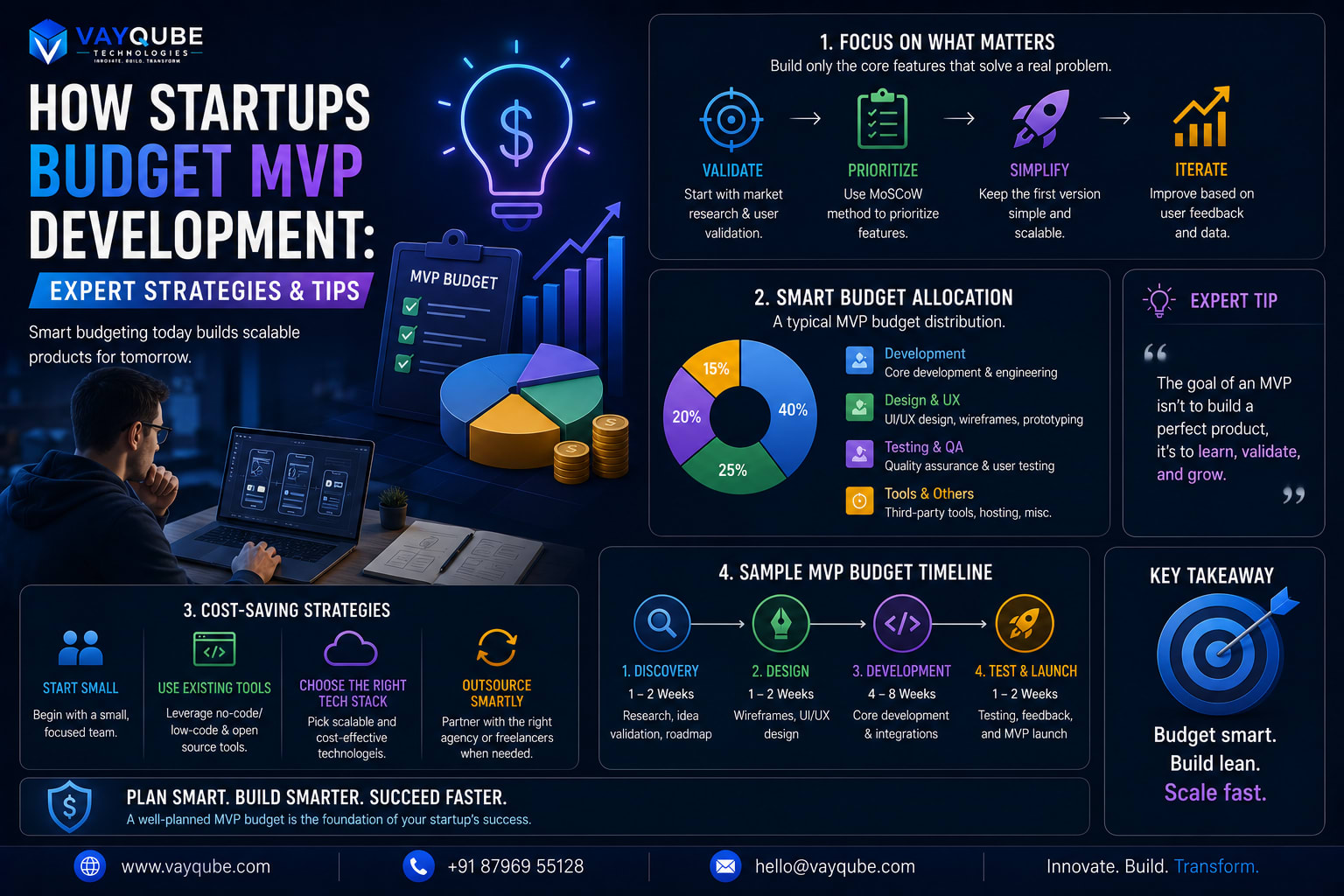
Introduction
The Minimum Viable Product (MVP) is more than a development milestone—it’s a strategic lever for startups to validate ideas, accelerate learning, and secure a competitive edge. In today’s fast-paced SaaS landscape, an MVP isn’t just about launching quickly; it’s about allocating resources to test hypotheses, gather user feedback, and iterate with precision. Startups that treat MVP budgeting as a tactical exercise often overlook its broader implications: it’s a decision that shapes product-market fit, investor confidence, and long-term scalability.
Budgeting for MVP development demands a balance between frugality and foresight. While cutting costs is tempting, underinvesting in critical features or overcommitting to unnecessary complexity can derail even the most promising ventures. This guide equips startups with actionable strategies to:
- Prioritize features that deliver maximum value with minimal overhead
- Align development timelines with funding cycles and growth objectives
- Leverage external expertise without compromising ownership
- Plan for post-launch scalability and maintenance
By focusing on these objectives, startups can transform MVP budgeting from a financial constraint into a growth engine. The following sections dive into battle-tested frameworks for achieving this balance, tailored to real-world scenarios and production-ready execution.
Why It Matters
Common Pitfalls of Under/Over-Budgeting MVP Development
Under-budgeting often forces startups to compromise on critical aspects like security, scalability, or user experience, leading to a fragile product that fails to attract early adopters. For example, a fintech startup might skimp on compliance-related features, resulting in regulatory roadblocks post-launch. Conversely, over-budgeting can drain resources before achieving product-market fit. A healthtech company might overspend on a polished UI/UX for a niche feature that users never requested, delaying time-to-market and burning cash.
Balanced budgeting ensures the MVP delivers core value without unnecessary complexity. It avoids the trap of building a "minimum" product that’s either too minimal to matter or too bloated to iterate quickly.
Aligning MVP Budgets with Business Objectives
Proper budgeting bridges the gap between product development and strategic goals. A well-structured MVP budget forces startups to prioritize features that directly contribute to key metrics—whether that’s user acquisition, revenue generation, or data collection. For instance, an e-commerce startup might allocate 60% of its MVP budget to payment gateway integration and inventory management (core drivers of revenue) and 40% to UI/UX and analytics.
This alignment ensures every dollar spent ties back to business outcomes. It also creates accountability, as teams can measure progress against predefined milestones rather than chasing endless feature creep.
The Budget-Fundraising Readiness Link
Investors scrutinize how startups manage resources. A realistic, data-driven MVP budget signals financial discipline and market understanding. For example, a SaaS startup that allocates 30% of its budget to customer onboarding tools demonstrates awareness of churn risks—a key concern for investors.
Conversely, vague or inflated budgets raise red flags. A startup asking for $500k without a clear breakdown of engineering, marketing, and operational costs may appear unprepared for scaling. A well-structured budget, paired with usage projections and risk mitigation plans, positions the startup as a low-risk, high-potential investment.
By tying budgeting to fundraising, startups create a narrative that resonates with VCs: Here’s how we’ll use capital to achieve milestones that de-risk the business. This approach turns the MVP budget into a strategic tool, not just a financial exercise.
Core Architecture of MVP Budgeting
Breaking Down Costs: Development, Design, Testing, and Maintenance
MVP budgeting requires a granular understanding of cost drivers across four core pillars:
- Development: Labor (in-house or outsourced), tools/licenses (e.g., IDEs, APIs), and third-party services (e.g., payment gateways). Prioritize core functionality to avoid over-engineering.
- Design: UX/UI prototyping (Figma, Sketch), user research, and iteration costs. Allocate 10–20% of the total budget here to ensure usability without scope creep.
- Testing: QA automation tools (e.g., Selenium), manual testing, and bug-fixing reserves. Budget 15–25% for testing to mitigate post-launch risks.
- Maintenance: Post-launch updates, server costs (cloud infrastructure), and customer support. Reserve 20–30% of the initial budget for the first 6 months.
Fixed vs. Variable Cost Allocation
Startups must balance fixed and variable costs to maintain flexibility:
- Fixed Costs: Salaries, subscription licenses (e.g., AWS, Adobe), and infrastructure. These provide stability but require careful forecasting.
- Variable Costs: Cloud usage (pay-as-you-go), freelance contractors, and marketing spend. These scale with usage but introduce uncertainty.
Strategy: Allocate 60–70% to fixed costs for core team and tools, leaving 30–40% for variable expenses. Use buffer funds (5–10% of total) to absorb unexpected variable costs.
Prioritizing Features Based on Business Impact
Feature prioritization ensures the MVP delivers maximum value with minimal resources:
- Framework: Use the MoSCoW Method (Must-have, Should-have, Could-have, Won’t-have) or ROI Scoring to rank features by revenue potential, user impact, and technical feasibility.
- Real-World Example: A fintech startup might prioritize secure authentication (must-have) over a polished onboarding flow (should-have) to meet compliance and build trust.
- Validation: Align feature lists with KPIs (e.g., user retention, conversion rates) and validate with early adopters via surveys or beta testing.
By anchoring budget decisions to business outcomes, startups reduce waste and accelerate time-to-market while maintaining scalability.
Business Benefits of Strategic Budgeting
Accelerating Time-to-Market While Minimizing Risk
Strategic budgeting ensures startups allocate resources to high-impact features first, avoiding scope creep and unnecessary complexity. By prioritizing core functionalities that deliver immediate value, teams can launch faster while maintaining a lean footprint. This approach reduces technical debt and mitigates risks associated with over-engineering.
For example, a fintech startup might focus its MVP budget on secure transaction processing and basic user authentication, deferring advanced analytics until post-launch. This targeted spending accelerates deployment while ensuring foundational stability.
Key strategies include:
- Using lean methodologies to validate assumptions early
- Allocating contingency funds for critical unknowns
- Aligning budget phases with milestone-driven development
Building Investor Confidence Through Financial Clarity
A well-structured budget demonstrates foresight and discipline, which are critical for attracting investment. Investors seek teams that understand cost control, resource optimization, and scalable growth pathways. Transparent financial planning—包括 runway projections, burn rate analysis, and ROI timelines—signals professionalism and reduces perceived risk.
Startups that tie budget allocations to measurable outcomes (e.g., "X% of funds will drive user acquisition to achieve Y% activation rate") position themselves as data-driven and mission-focused. This clarity fosters trust, especially during pitch meetings or funding negotiations.
Real-world impact:
A healthtech company secured Series A funding by showcasing a budget that mapped directly to clinical trial milestones, proving both feasibility and scalability to investors.
Enabling Data-Driven Iteration Post-Launch
Strategic budgeting reserves resources for post-launch activities, ensuring teams can act on user feedback and performance metrics. This includes allocating funds for:
- Analytics tools to track KPIs
- Iterative feature enhancements
- A/B testing and UX optimization
By planning for these phases upfront, startups avoid reactive spending and maintain agility. For instance, an e-commerce MVP might budget for post-launch customer surveys and dynamic pricing experiments, using real-world data to refine its value proposition.
This approach transforms the budget from a static document into a living roadmap, aligning financial resources with continuous improvement cycles.
Scalability Considerations
Designing Budgets That Support Future Growth
Startups must allocate resources with an eye toward expansion, even when building an MVP. This means prioritizing modular architecture that allows for incremental upgrades rather than complete overhauls. For example, selecting cloud services with pay-as-you-go pricing (e.g., AWS Lambda, Firebase) ensures infrastructure costs align with user growth. Budgets should also reserve contingency funds (10–15% of total) for scaling-related surprises, such as unexpected traffic spikes or performance bottlenecks.
Key strategies include:
- Phased funding allocation: Tie budget releases to milestones like user acquisition thresholds or feature adoption rates.
- Vendor lock-in avoidance: Choose tools with open APIs or multi-cloud compatibility to retain flexibility.
- Team scalability: Budget for hiring or upskilling engineers as the product evolves, rather than relying on outsourced labor long-term.
Balancing Short-Term Constraints With Long-Term Vision
While MVP budgets often focus on immediate deliverables, startups must avoid solutions that create technical debt. For instance, a cost-effective but rigid database might save money upfront but require costly migration later. Instead, balance trade-offs by:
- Prioritizing foundational elements: Invest in scalable authentication systems, monitoring tools, and CI/CD pipelines early.
- Leveraging open-source alternatives: Use PostgreSQL over proprietary databases or Kubernetes for container orchestration to reduce long-term licensing fees.
- Adopting iterative budgeting: Reassess financial plans quarterly to reallocate resources based on user feedback and growth metrics.
This approach ensures the MVP lays the groundwork for enterprise-grade scalability without overextending initial budgets.
Infrastructure Costs That Scale With User Adoption
Cloud infrastructure is the backbone of scalable SaaS startups, but unchecked spending can derail budgets. To align costs with adoption:
- Use auto-scaling features: Configure services like AWS Auto Scaling or Google Cloud Autoscaler to dynamically adjust resources based on demand.
- Optimize reserved instances: Commit to discounted cloud capacity for predictable workloads while using spot instances for variable demand.
- Monitor and adjust: Implement tools like Datadog or Prometheus to track resource usage and eliminate inefficiencies (e.g., idle servers, unoptimized queries).
For databases, consider managed services (e.g., Amazon Aurora, PlanetScale) that handle scaling automatically. Similarly, serverless architectures reduce overhead by charging only for usage, ideal for variable traffic patterns.
By embedding scalability into budgeting decisions, startups ensure their MVP evolves seamlessly from proof-of-concept to production-grade platforms.
Implementation Challenges
Managing Scope Creep Without Overspending
Scope creep is a silent budget killer for startups. To combat this:
- Adopt prioritization frameworks like MoSCoW (Must-have, Should-have, Could-have, Won’t-have) or RICE (Reach, Impact, Confidence, Effort) to ruthlessly filter features.
- Iterate with agile sprints—break the MVP into phases, delivering core value first and deferring non-essential elements.
- Set clear boundaries with stakeholders using a shared product roadmap and regular check-ins to align expectations.
- Leverage tools like Jira or Trello to track scope changes and their cost implications in real time.
Navigating Team Size and Skillset Requirements
Balancing team composition with budget constraints is critical:
- Assess existing skills—identify gaps early (e.g., frontend, backend, DevOps) and prioritize hiring or upskilling.
- Opt for hybrid models: Combine in-house talent with freelancers or remote teams for specialized skills (e.g., AI/ML integration).
- Invest in cross-training to create versatile team members who can handle multiple responsibilities.
- Explore no-code/low-code platforms for non-core features to reduce dependency on niche expertise.
Vendor Selection and Contract Negotiation Pitfalls
Choosing the wrong partner or signing a flawed contract can derail budgets:
- Conduct thorough due diligence: Vet vendors for domain expertise, client references, and financial stability.
- Avoid ambiguous contracts: Define deliverables, timelines, and payment milestones clearly. Include penalties for delays.
- Negotiate flexible terms: Opt for usage-based pricing models or phased payments tied to milestones.
- Plan for exit clauses: Ensure contracts allow for easy transition if the vendor underperforms or the startup pivots.
Each challenge demands proactive planning, clear communication, and a focus on value-driven decisions to keep MVP development on track and within budget.
SaaS Startup: Balancing Cloud Costs and Feature Development
For a SaaS startup, MVP budgeting often revolves around optimizing cloud infrastructure costs while delivering core features. A common challenge is avoiding over-provisioning resources early while ensuring scalability.
Strategy:
- Cloud Cost Optimization: Use tools like AWS Cost Explorer or Google Cloud Billing to monitor spend and identify inefficiencies.
- Phased Feature Rollouts: Prioritize features with the highest customer impact first, delaying non-critical additions until post-launch.
- Reserved Instances: Commit to discounted cloud capacity for predictable workloads to reduce long-term costs.
Real-World Example:
A fintech startup focused on budgeting tools allocated 60% of its MVP budget to cloud infrastructure and security, ensuring compliance (e.g., GDPR) while keeping feature development lean. By using serverless architectures for non-core functionalities, they reduced initial cloud costs by 40%.
Hardware Startup: Prototyping Budgets with Manufacturing Constraints
Hardware startups face unique MVP budgeting challenges due to physical prototyping and manufacturing costs. Balancing R&D with production readiness is critical.
Strategy:
- Iterative Prototyping: Use 3D printing or low-cost PCB prototypes to validate designs before mass production.
- Supplier Negotiations: Lock in bulk pricing early with manufacturers to reduce per-unit costs.
- Simulation Tools: Leverage CAD and simulation software to minimize physical prototyping cycles.
Real-World Example:
A wearable tech startup allocated 30% of its MVP budget to prototyping, using 3D-printed casings to test ergonomics. By partnering with a contract manufacturer early, they secured favorable terms for initial production runs, avoiding costly redesigns later.
Marketplace Platform: Budgeting for Dual-Sided User Acquisition
Marketplace MVPs require budgeting for both supply and demand sides, creating a chicken-and-egg problem.
Strategy:
- Tiered Incentives: Offer discounts or bonuses to early adopters on one side (e.g., sellers) to attract the other (e.g., buyers).
- Data-Driven Marketing: Allocate budget to channels with the highest ROI for each user segment.
- Network Effects Focus: Prioritize features that enhance platform stickiness, like reviews or messaging.
Real-World Example:
A B2B marketplace for freelance developers spent 50% of its MVP budget on acquisition, targeting companies first with free trial listings. Simultaneously, they used referral bonuses to attract developers, creating a balanced ecosystem within six months.
Each use case highlights the importance of aligning MVP budgeting with strategic constraints—whether cloud economics, manufacturing logistics, or network effects. By focusing on high-impact, low-risk investments, startups can validate their product while preserving capital for scaling.
Best Practices
Agile Budgeting Frameworks for Adaptive Planning
Startups thrive on flexibility, and agile budgeting frameworks enable dynamic resource allocation aligned with iterative development cycles. Unlike traditional fixed budgets, agile approaches allow teams to adjust spending based on real-time feedback, sprint outcomes, and changing market demands. For example, a startup using Scrum might allocate 20% of its budget per sprint to prototyping, 50% to core development, and 30% to testing and iteration. This ensures capital is directed toward high-impact activities while maintaining room for pivots.
Key benefits include:
- Reduced risk of overspending on unproven features
- Faster reallocation of funds to high-priority tasks
- Improved alignment between budget and product roadmap
Leveraging Open-Source Tools to Reduce Costs
Open-source technologies offer startups a cost-effective way to build MVPs without licensing fees. Tools like React (UI), PostgreSQL (database), and Docker (containerization) provide enterprise-grade capabilities at minimal cost. For instance, a fintech startup might use Stripe’s open-source SDKs for payment integration instead of building custom solutions, saving thousands in development hours.
Prioritize tools that:
- Integrate seamlessly with existing tech stacks
- Have active community support for troubleshooting
- Scale cost-effectively as the product grows
Building Contingency Reserves (10–15% of Total Budget)
Unforeseen challenges—such as API integration delays, security vulnerabilities, or third-party service outages—are inevitable in MVP development. Allocating 10–15% of the total budget as a contingency reserve ensures startups can address these issues without derailing the project.
A SaaS startup, for example, might set aside $15,000 from a $100,000 budget to cover unexpected cloud infrastructure costs during user onboarding spikes. This buffer prevents budget overruns and maintains team morale by avoiding last-minute resource constraints.
Continuous Cost Monitoring and Reallocation
Proactive financial management requires tracking expenses against deliverables and reallocating resources as needed. Tools like AWS Cost Explorer or Google Cloud Billing can provide granular insights into cloud spending, while project management platforms like Jira or Asana help align task progress with budget burn rates.
Best practices include:
- Weekly budget reviews to identify under/over-spent areas
- Quarterly reallocation of funds based on user feedback and KPIs
- Sunsetting low-ROI features to free up resources for high-impact work
For example, a healthtech startup might reallocate 20% of its QA budget to customer acquisition after discovering that user onboarding friction was a bigger barrier to growth than perceived technical risks.
By embedding these practices into their workflow, startups can maintain financial discipline while retaining the agility needed to iterate and scale effectively.
What's the average budget range for a startup MVP?
The average budget for a startup MVP varies widely based on industry, complexity, and geography. For basic web or mobile apps, budgets typically range from $50,000 to $150,000, while more complex solutions (e.g., AI-driven platforms or IoT integrations) can exceed $300,000. Key cost drivers include:
- Technology stack (custom vs. off-the-shelf solutions)
- Team structure (in-house vs. outsourced development)
- Geographic labor costs (e.g., Silicon Valley vs. Eastern Europe)
- Regulatory requirements (e.g., healthcare or fintech compliance)
Startups should prioritize lean development and validate assumptions early to avoid overspending.
How to handle unexpected costs during development?
Unexpected costs are inevitable in MVP development. Mitigate risks with:
- Contingency planning: Allocate 15–20% of the total budget for unforeseen expenses.
- Agile budgeting: Break the project into phases and adjust allocations based on progress.
- Regular reviews: Conduct weekly or biweekly budget check-ins with stakeholders.
- Feature prioritization: Use frameworks like MoSCoW (Must-have, Should-have, Could-have, Won’t-have) to reallocate resources dynamically.
For example, a startup building a logistics platform might encounter higher-than-expected API integration costs. By maintaining a contingency fund and reprioritizing non-critical features, they can absorb the shock without derailing the project.
When should startups consider external funding for MVP?
Seek external funding when:
- Validation is complete: You have proof of concept (e.g., user feedback, beta testing results).
- Scalability is proven: The MVP demonstrates a clear path to growth or revenue.
- Resource gaps exist: Internal funds are insufficient to meet development timelines.
Common funding avenues include:
- Seed funding: For early-stage validation (e.g., friends, family, or angel investors).
- Venture capital: For scaling post-MVP (requires robust metrics and traction).
- Grants or accelerators: Non-dilutive options for specific industries (e.g., tech, social impact).
Avoid over-reliance on external capital until the MVP has measurable traction to maximize equity retention.
How to balance quality vs. cost in MVP development?
The MVP should deliver just enough quality to validate the product without over-engineering. Strategies include:
- Focus on core value propositions: Build only the features that solve the primary user problem.
- Use scalable but cost-effective tools: Leverage cloud services (e.g., AWS, Firebase) for infrastructure.
- Test early and often: Validate assumptions with real users to avoid costly pivots later.
- Outsource non-core tasks: Partner with freelancers or agencies for design or QA to reduce overhead.
For instance, a fintech startup might prioritize secure authentication and transaction workflows over a polished UI in the MVP phase, then refine aesthetics post-launch.
Key Takeaways
- MVP budgets are highly contextual but should align with lean principles.
- Plan for uncertainty with contingency funds and agile processes.
- Seek external funding only after validating core assumptions.
- Balance quality by focusing on user-centric features and iterative testing.
Conclusion
Budgeting as a Strategic Lever for MVP Success
A well-structured MVP budget is not merely a financial exercise—it’s a strategic tool to align resources with business objectives, mitigate risks, and accelerate time-to-market. By prioritizing core functionalities, validating assumptions early, and maintaining flexibility, startups can turn budget constraints into innovation drivers. The key lies in balancing short-term execution with long-term scalability, ensuring every dollar spent contributes to measurable progress.
Final Advice: Start Small, Think Big, Budget Wisely
- Start small: Focus on solving a single problem exceptionally well. Avoid over-engineering; validate demand before scaling features.
- Think big: Design architectures and workflows that accommodate future growth, even if initial implementation is minimal.
- Budget wisely: Allocate resources dynamically. Regularly reassess priorities, and maintain a contingency fund (10–15% of the total budget) for unforeseen challenges.
Next Steps: Creating a Tailored MVP Budget Framework
- Define success metrics: Align budget milestones with KPIs like user acquisition costs, retention rates, or feature adoption.
- Prioritize features rigorously: Use frameworks like MoSCoW (Must-have, Should-have, Could-have, Won’t-have) to categorize requirements.
- Estimate costs holistically: Include development, testing, deployment, and post-launch support. Leverage cloud cost calculators for infrastructure planning.
- Build feedback loops: Integrate user testing and analytics early to validate budget allocations and pivot quickly if needed.
By treating budgeting as a living process—not a one-time task—startups can optimize their MVP journey, reduce waste, and position themselves for sustainable growth.
Related Vayqube Resources
- Best Fintech Software Development Company In Singapore City
- Best Mobile App Development Company In Singapore City
- Best Fintech Software Development Company In Usa
- How To Build Fintech Application Payments Security Scaling
- How To Build Scalable Nodejs Backend Production Guide
- Best Mobile App Development Company In Usa
Next Step
If your systems are struggling with scalability, automation, architecture complexity, or operational efficiency, it's time to modernize your infrastructure and workflows.
👉 Talk to a Vayqube solution architect and build systems designed for long-term production growth: