
SaaS Companies Scale to Millions
SaaS companies can scale to millions of users with the right strategy. By implementing scalable infrastructure and processes, companies can drive growth and success.
Vayqube Team
Author
Introduction
SaaS companies have revolutionized the way businesses operate, offering innovative solutions to everyday problems. These companies have experienced tremendous growth, with many scaling to millions of dollars in revenue. But what sets these successful SaaS companies apart from others, and how do they achieve such rapid growth?
The importance of scaling cannot be overstated. As a SaaS company grows, its infrastructure, processes, and team must also scale to meet increasing demand. This requires careful planning, strategic decision-making, and a deep understanding of the company's strengths, weaknesses, and target market.
In this blog post, we will explore the key factors that contribute to a SaaS company's ability to scale to millions. We will examine the strategies and tactics employed by successful SaaS companies, including their approaches to product development, marketing, sales, and customer success. Through real-world examples and production considerations, we will provide actionable insights and guidance for SaaS companies looking to achieve rapid growth and success.
Key Characteristics of Scalable SaaS Companies
Some common characteristics of scalable SaaS companies include:
- A strong, unique value proposition that resonates with their target market
- A robust, scalable infrastructure that can handle increasing traffic and demand
- A data-driven approach to decision-making, with a focus on key metrics and KPIs
- A culture of innovation and continuous improvement, with a emphasis on experimentation and learning
- A customer-centric approach, with a focus on delivering exceptional customer experiences and building strong relationships
By understanding these characteristics and how they contribute to a SaaS company's ability to scale, businesses can better position themselves for success and achieve rapid growth in a competitive market.
Overview of the Blog Post
The remainder of this blog post will delve into the specifics of how SaaS companies can scale to millions, including:
- Strategies for developing a scalable product and infrastructure
- Tactics for driving growth through marketing and sales
- Approaches to delivering exceptional customer experiences and building strong relationships
- Considerations for maintaining a culture of innovation and continuous improvement, even as the company grows and evolves.
Why It Matters
Scaling to millions in revenue is a milestone for SaaS companies, and it's crucial to understand the significance of achieving this goal.
Revenue Growth
Revenue growth is a key indicator of a SaaS company's success. As companies scale, they can invest in research and development, sales and marketing, and customer support, which in turn drives further growth. A steady increase in revenue also attracts investors, providing access to more capital to fuel expansion.
Competitive Advantage
Scaling to millions provides a competitive advantage in the market. Larger SaaS companies can negotiate better deals with suppliers, attract top talent, and invest in innovative technologies, making it harder for smaller competitors to keep up. This advantage can lead to increased market share and a stronger position in the industry.
Customer Acquisition and Retention
As SaaS companies grow, they can afford to invest more in customer acquisition and retention strategies. This includes developing more sophisticated marketing campaigns, offering premium customer support, and expanding their product offerings to meet evolving customer needs. By doing so, companies can increase customer loyalty, reduce churn rates, and attract new customers through word-of-mouth referrals.
Some key benefits of scaling to millions include:
- Increased resources to invest in product development and innovation
- Improved operational efficiency and scalability
- Enhanced credibility and reputation in the market
- Greater flexibility to respond to changes in the market and economy
- Increased ability to attract and retain top talent in the industry
By understanding the importance of scaling to millions, SaaS companies can focus on developing strategies that drive growth, improve competitiveness, and increase customer satisfaction. This, in turn, can lead to long-term success and a strong position in the market.
The ability to scale efficiently is critical, and companies must be prepared to adapt their operations, processes, and systems to support rapid growth. This includes investing in scalable infrastructure, developing efficient sales and marketing processes, and implementing robust customer support systems.
In the next section, we will explore the key factors that contribute to a SaaS company's ability to scale to millions, including the importance of having a solid business model, a strong management team, and a scalable technology infrastructure.
Core Architecture
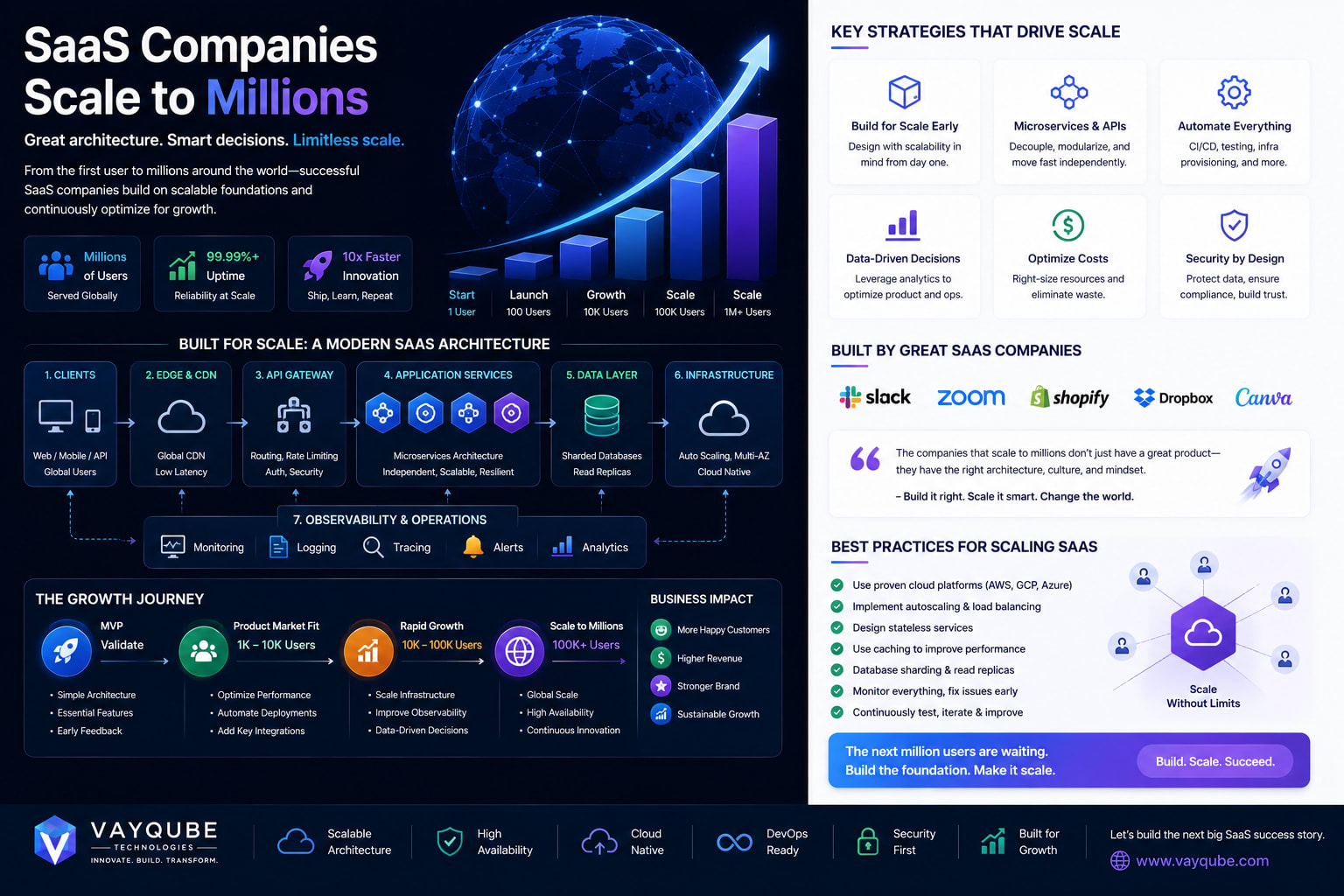
To scale to millions, SaaS companies must design a core architecture that supports growth, reliability, and maintainability. This involves adopting a modular approach, leveraging cloud infrastructure, and implementing DevOps practices.
Microservices
A microservices architecture allows SaaS companies to break down their application into smaller, independent services. This approach enables teams to work on individual components without affecting the entire system. Key benefits of microservices include:
- Improved scalability: each service can be scaled independently
- Enhanced reliability: if one service experiences issues, others remain unaffected
- Faster development: teams can work on separate services simultaneously
Cloud Infrastructure
Cloud infrastructure provides SaaS companies with the flexibility and scalability needed to support rapid growth. By leveraging cloud providers like AWS, Azure, or Google Cloud, companies can:
- Quickly provision and de-provision resources as needed
- Take advantage of built-in scalability and reliability features
- Reduce capital expenditures and operational overhead
DevOps Practices
DevOps practices bridge the gap between development and operations teams, enabling SaaS companies to release software faster and more reliably. Key DevOps practices include:
- Continuous Integration and Continuous Deployment (CI/CD)
- Automated testing and monitoring
- Collaboration and communication between development and operations teams
By implementing microservices, cloud infrastructure, and DevOps practices, SaaS companies can build a core architecture that supports scalability, reliability, and maintainability. This foundation is critical for achieving millions in revenue and ensuring long-term success.
In practice, companies like Netflix and Airbnb have successfully implemented these strategies to achieve massive scale. For example, Netflix's microservices architecture allows them to handle millions of users and provide a seamless viewing experience. Similarly, Airbnb's use of cloud infrastructure and DevOps practices enables them to quickly respond to changing market conditions and user needs.
As SaaS companies grow, their core architecture must evolve to support increasing demands. By prioritizing scalability, reliability, and maintainability, companies can build a strong foundation for long-term success.
Business Benefits
The ability to scale to millions is a key advantage for SaaS companies, offering numerous business benefits.
Increased Efficiency
Scaling efficiently allows SaaS companies to streamline their operations, reducing waste and minimizing the resources required to support growth. This, in turn, enables them to allocate more resources to strategic initiatives, such as product development and customer acquisition. Some key areas where efficiency is improved include:
- Automated workflows and processes
- Optimized resource utilization
- Enhanced productivity
Improved Customer Experience
As SaaS companies scale, they must prioritize the customer experience to maintain high levels of satisfaction and loyalty. This can be achieved by:
- Implementing scalable support systems
- Enhancing product features and functionality
- Providing personalized experiences through data-driven insights
Data-Driven Decision Making
Access to large amounts of data is a natural byproduct of scaling to millions. SaaS companies can leverage this data to inform strategic decisions, optimize operations, and identify new opportunities for growth. Key considerations include:
- Implementing robust data analytics platforms
- Developing a data-driven culture
- Using insights to drive product development and customer engagement strategies
By focusing on these areas, SaaS companies can unlock the full potential of scaling to millions, driving long-term success and sustainability.
Scalability
To achieve scalability, SaaS companies employ several strategies. Horizontal scaling is a key approach, where additional resources are added to handle increased demand. This can be done by adding more servers or instances to the existing infrastructure, allowing the system to distribute the workload and maintain performance.
Horizontal Scaling
Horizontal scaling offers several benefits, including:
- Increased capacity to handle growing user bases
- Improved responsiveness and reduced latency
- Enhanced reliability and fault tolerance
- Simplified maintenance and updates, as new instances can be added or removed as needed
Load Balancing
Load balancing is another crucial aspect of scalability, as it ensures that no single server or instance becomes overwhelmed with requests. By distributing incoming traffic across multiple servers, load balancing helps to:
- Prevent bottlenecks and single points of failure
- Improve responsiveness and reduce wait times
- Increase overall system reliability and uptime
Autoscaling
Autoscaling takes horizontal scaling to the next level by automatically adding or removing resources in response to changing demand. This approach offers several advantages, including:
- Reduced administrative overhead, as the system self-regulates
- Improved cost efficiency, as resources are only added when needed
- Enhanced responsiveness, as the system can quickly adapt to changing conditions
- Increased agility, as new features and services can be deployed more quickly and easily
By implementing these scalability strategies, SaaS companies can ensure that their systems remain responsive, reliable, and performant, even as they grow to millions of users. This, in turn, helps to build trust and loyalty with customers, driving long-term success and revenue growth.
Key considerations for implementing these strategies include:
- Careful monitoring and analysis of system performance and usage patterns
- Development of automated scripts and tools to simplify scaling and management
- Ongoing evaluation and refinement of the overall architecture and infrastructure
- Collaboration between development, operations, and other teams to ensure a unified approach to scalability and performance.
Implementation Challenges
As SaaS companies scale to millions, they face numerous implementation challenges that can hinder their growth. One of the primary concerns is technical debt, which refers to the costs associated with implementing quick fixes or workarounds that need to be revisited later. This can lead to a significant accumulation of debt, making it challenging to maintain and update the system.
Technical Debt
Technical debt can arise from various sources, including:
- Insufficient testing and validation
- Inadequate documentation
- Poor coding practices
- Inconsistent architecture
- Lack of automation
If left unaddressed, technical debt can lead to increased maintenance costs, longer development cycles, and a higher risk of errors and downtime.
Change Management
Another significant challenge is change management. As SaaS companies grow, their systems and processes must adapt to changing requirements and user needs. Effective change management involves:
- Communicating changes to stakeholders
- Assessing the impact of changes on the system
- Implementing changes with minimal disruption
- Monitoring and evaluating the effectiveness of changes
Poor change management can result in system instability, user dissatisfaction, and reputational damage.
Talent Acquisition and Retention
Talent acquisition and retention are also critical implementation challenges. As SaaS companies scale, they require skilled professionals to design, develop, and maintain their systems. However, attracting and retaining top talent can be difficult, especially in a competitive job market. Companies must:
- Offer competitive salaries and benefits
- Provide opportunities for growth and development
- Foster a positive and inclusive company culture
- Encourage innovation and experimentation
By addressing these implementation challenges, SaaS companies can ensure a smoother scaling process and achieve long-term success.
Use Cases
Successful SaaS companies have implemented scalable solutions to reach millions of users. Industry-specific examples include:
- Customer relationship management (CRM) tools for sales teams
- Project management software for marketing agencies
- E-learning platforms for educational institutions
These companies have achieved significant growth by identifying real-world applications for their products. For instance, a CRM tool can be used to manage customer interactions, track sales performance, and analyze market trends.
Industry-Specific Examples
In the healthcare industry, SaaS companies have developed platforms for:
- Electronic health record (EHR) management
- Medical billing and insurance claims
- Telemedicine and remote patient monitoring
These platforms have improved patient care, reduced administrative burdens, and increased revenue for healthcare providers.
Real-World Applications
Real-world applications of SaaS solutions can be seen in various industries, including:
- Financial services: online payment processing, accounting, and investment management
- Retail: e-commerce platforms, inventory management, and supply chain optimization
- Manufacturing: enterprise resource planning (ERP), quality control, and logistics management
These applications have enabled businesses to streamline operations, reduce costs, and improve customer satisfaction. By understanding the specific needs of their target market, SaaS companies can develop tailored solutions that drive growth and revenue.
Production Considerations
When developing SaaS solutions, companies must consider production readiness, including:
- Scalability and performance
- Security and compliance
- Integration with existing systems
- User experience and support
By prioritizing these factors, SaaS companies can ensure that their solutions meet the needs of their users and drive long-term growth and success.
Best Practices
To achieve scalability and reach millions of users, SaaS companies must adopt specific best practices. These practices enable businesses to respond to growth, identify areas for improvement, and make data-driven decisions.
Monitoring and Analytics
Effective monitoring and analytics are crucial for SaaS companies. By tracking key performance indicators (KPIs), such as user engagement, retention rates, and revenue growth, businesses can identify trends and areas for improvement. This data informs product development, marketing strategies, and customer support initiatives. Some key metrics to monitor include:
- User acquisition costs
- Customer lifetime value
- Net promoter score
- Application performance and uptime
Continuous Testing and Feedback
Continuous testing and feedback are essential for ensuring the quality and relevance of a SaaS product. This involves:
- Conducting regular user testing and surveys to gather feedback
- Implementing A/B testing to optimize product features and user interfaces
- Using data analytics to identify areas for improvement
- Fostering a culture of continuous learning and improvement within the organization
Collaboration and Communication
Collaboration and communication are critical for SaaS companies, particularly as they scale. This includes:
- Establishing clear channels of communication among teams and stakeholders
- Implementing collaboration tools to facilitate teamwork and knowledge sharing
- Fostering a culture of transparency and open communication
- Encouraging feedback and recognizing employee contributions to the company's growth and success
By adopting these best practices, SaaS companies can position themselves for success, drive growth, and ultimately scale to millions of users.
FAQ
To address common questions and concerns about SaaS scaling, we've compiled a list of frequently asked questions.
Common Misconceptions
Some common misconceptions about SaaS scaling include:
- The idea that scaling is only necessary for large enterprises
- The assumption that scaling will automatically lead to increased costs
- The belief that scaling is a one-time process
In reality, SaaS companies of all sizes need to consider scaling to meet growing demand and stay competitive.
Addressing Concerns
Addressing concerns and misconceptions about SaaS scaling is crucial for successful implementation. Some key considerations include:
- Understanding the differences between horizontal and vertical scaling
- Recognizing the importance of automation and orchestration
- Developing a comprehensive strategy for monitoring and analytics
Additional Resources
For SaaS companies looking to scale to millions, additional resources are available to support the journey. Some recommended resources include:
- Industry reports and research studies on SaaS scaling
- Case studies and success stories from similar companies
- Online communities and forums for SaaS professionals
By leveraging these resources and addressing common questions and concerns, SaaS companies can better navigate the challenges of scaling and achieve long-term success.
Real-World Examples
Real-world examples of successful SaaS scaling can provide valuable insights and lessons learned. For instance, companies like Salesforce and Zendesk have achieved massive scale through strategic planning and execution. Their experiences demonstrate the importance of:
- Building a strong foundation for growth
- Investing in scalable infrastructure and technology
- Fostering a culture of innovation and continuous improvement
By studying these examples and applying the lessons learned, SaaS companies can develop effective strategies for scaling to millions.
Next Steps
To get started with SaaS scaling, companies should:
- Conduct a thorough assessment of their current infrastructure and technology
- Develop a comprehensive strategy for scaling
- Establish key performance indicators (KPIs) for measuring progress and success
By taking these steps, SaaS companies can set themselves up for success and achieve their goals of scaling to millions.
Conclusion
In summary, SaaS companies can scale to millions by focusing on core architecture, business benefits, scalability, and implementation strategies. Key takeaways include:
- Designing a scalable architecture from the outset
- Leveraging business benefits such as reduced costs and increased agility
- Implementing strategies to handle increased traffic and demand
- Continuously monitoring and optimizing performance
Final Thoughts
Scaling a SaaS company to millions requires careful planning, execution, and ongoing optimization. It's essential to prioritize scalability, reliability, and performance to ensure a seamless user experience. By following best practices and learning from real-world use cases, SaaS companies can overcome implementation challenges and achieve success.
Call to Action
To scale your SaaS company to millions, start by assessing your current architecture and identifying areas for improvement. Develop a comprehensive implementation strategy that addresses scalability, reliability, and performance. Stay up-to-date with the latest industry trends and best practices, and continuously monitor and optimize your performance to ensure long-term success. By taking these steps, you can set your SaaS company on the path to achieving millions in revenue and establishing a strong presence in the market.
Some key considerations for SaaS companies looking to scale include:
- Building a strong team with expertise in scalability and performance
- Investing in automation and monitoring tools to optimize performance
- Fostering a culture of continuous learning and improvement
- Staying focused on customer needs and delivering exceptional user experiences
By prioritizing these factors and staying committed to scalability and performance, SaaS companies can achieve remarkable growth and success.
Related Vayqube Resources
- Cloud Cost Optimization Strategies For Saas Startups
- Best Software Development Company In Singapore City
- Best Saas Development Company In Singapore City
- Best Fintech Software Development Company In Singapore City
- Healthcare Software Development Company Singapore City
- Logistics Software Development Company Singapore City
Next Step
If your systems are struggling with scalability, automation, architecture complexity, or operational efficiency, it's time to modernize your infrastructure and workflows.
👉 Talk to a Vayqube solution architect and build systems designed for long-term production growth: