
SaaS Architecture Mistakes to Avoid
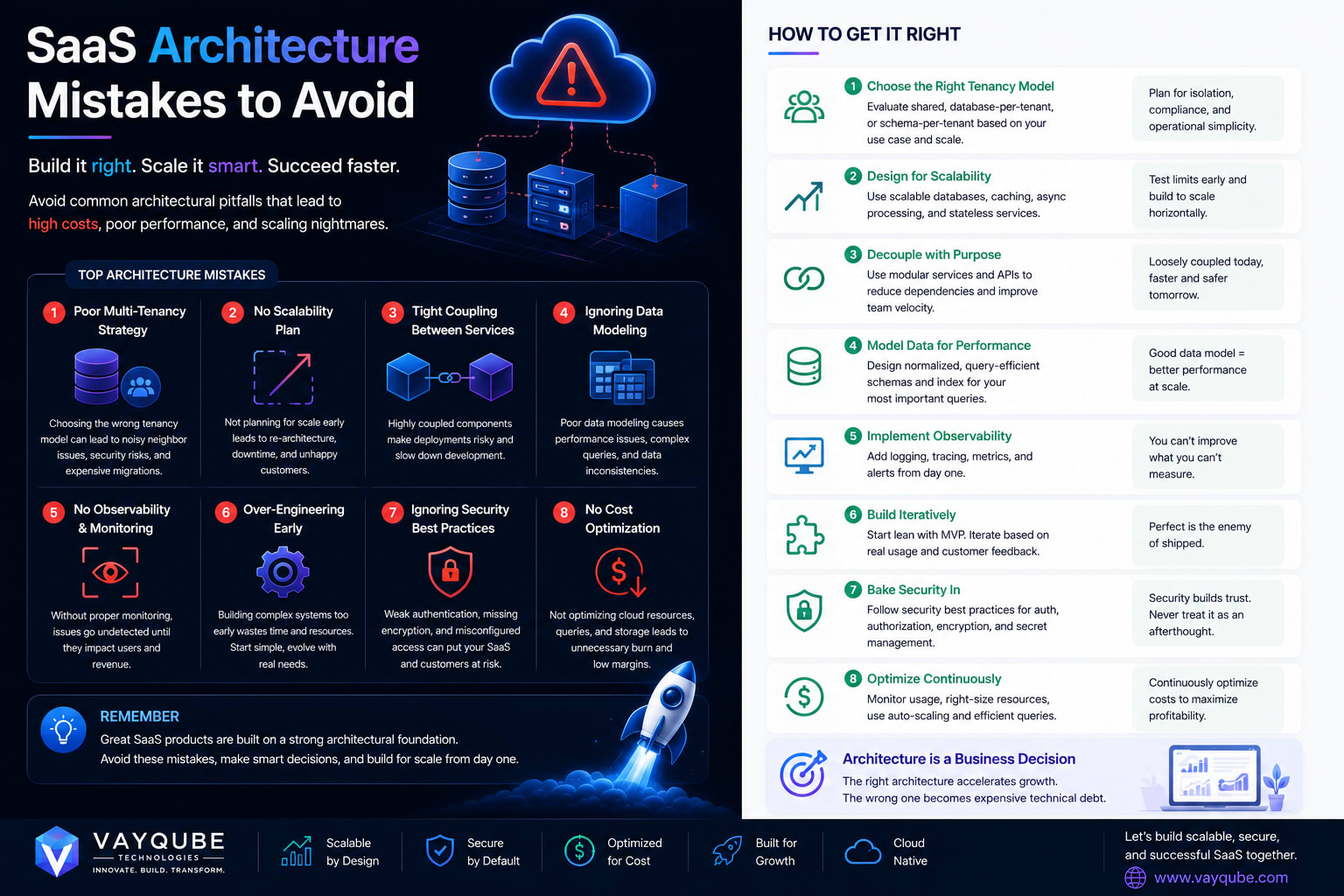
Discover the most common SaaS architecture mistakes that can hinder your platform's growth and learn how to avoid them. By optimizing your architecture, you can improve scalability, performance, and user experience.
Vayqube Team
Author
Introduction
SaaS architecture is the backbone of any successful software-as-a-service application. A well-designed architecture can make all the difference in the scalability, reliability, and performance of a SaaS product. However, mistakes in the architecture can lead to significant consequences, including increased costs, decreased customer satisfaction, and even business failure.
A good SaaS architecture should be able to handle large volumes of traffic, process complex transactions, and provide a seamless user experience. It should also be able to adapt to changing business requirements and scale horizontally to accommodate growing demand. To achieve this, it's essential to avoid common mistakes that can compromise the integrity and effectiveness of the architecture.
Overview of SaaS Architecture
A SaaS architecture typically consists of multiple layers, including the presentation layer, application layer, data layer, and infrastructure layer. Each layer has its own set of responsibilities and must be designed to work seamlessly with the others. The presentation layer handles user interactions, the application layer processes business logic, the data layer manages data storage and retrieval, and the infrastructure layer provides the underlying platform for the application.
Importance of Avoiding Mistakes
Avoiding mistakes in SaaS architecture is crucial because it can have a significant impact on the business. A poorly designed architecture can lead to:
- Increased latency and downtime
- Higher operational costs
- Decreased customer satisfaction
- Reduced scalability and flexibility
- Increased security risks
By understanding the common mistakes to avoid, SaaS companies can design a robust and scalable architecture that meets the needs of their customers and supports their business goals. In the following sections, we will explore the most common SaaS architecture mistakes to avoid and provide guidance on how to design a successful SaaS architecture.
Why It Matters
Poor SaaS architecture can have far-reaching consequences that affect not only the technical aspects of the application but also the overall business. The impact of a poorly designed architecture can be felt across the organization, from development and operations teams to sales and marketing.
Consequences of Poor Architecture
Some of the key consequences of poor SaaS architecture include:
- Increased technical debt, leading to higher maintenance costs and longer development cycles
- Reduced scalability, resulting in poor performance and frustrated users
- Increased risk of security breaches and data losses
- Difficulty in integrating with other systems and services
- Higher operational costs due to inefficient use of resources
A well-designed SaaS architecture, on the other hand, can help mitigate these risks and provide a solid foundation for business growth and scalability. By avoiding common architecture mistakes, SaaS companies can ensure that their applications are able to handle increasing traffic and user demand, while also providing a high level of performance, security, and reliability.
Impact on Business Growth and Scalability
The impact of poor SaaS architecture on business growth and scalability cannot be overstated. A poorly designed architecture can limit the ability of the business to expand its customer base, enter new markets, and develop new features and services. This can result in:
- Missed revenue opportunities due to inability to handle increased traffic and user demand
- Reduced customer satisfaction and retention due to poor performance and reliability
- Increased competition from more agile and scalable competitors
- Difficulty in attracting and retaining top talent due to outdated and inflexible technology stack
By prioritizing a well-designed SaaS architecture, businesses can avoid these pitfalls and create a solid foundation for growth and scalability. This includes considering factors such as cloud infrastructure, microservices, and DevOps practices to ensure that the application is able to handle increasing demand and provide a high level of performance and reliability.
Core Architecture
The core architecture of a SaaS application is comprised of several key components, including the presentation layer, application layer, data layer, and infrastructure layer. Each of these components plays a critical role in ensuring the scalability, reliability, and performance of the application.
Key Components
The key components of SaaS architecture include:
- Presentation Layer: responsible for handling user interactions and presenting data to the user
- Application Layer: handles business logic, workflows, and integrations with other systems
- Data Layer: manages data storage, retrieval, and manipulation
- Infrastructure Layer: provides the underlying infrastructure, including servers, networks, and databases
Design Principles
To ensure scalability and reliability, SaaS architectures should be designed with the following principles in mind:
- Loose Coupling: components should be designed to be independent and modular, allowing for easier maintenance and updates
- Autoscaling: the ability to automatically scale up or down in response to changes in demand
- Load Balancing: distributing workload across multiple servers to ensure optimal performance and minimize downtime
- Redundancy: duplicating critical components to ensure high availability and minimize the risk of single points of failure
Effective design of these components and adherence to these principles can help prevent common SaaS architecture mistakes, such as single points of failure, inadequate scalability, and poor performance. By prioritizing scalability, reliability, and performance, SaaS providers can ensure a high-quality user experience and maintain a competitive edge in the market.
Implementation Considerations
When implementing a SaaS architecture, it's essential to consider the trade-offs between different design approaches. For example, a microservices-based architecture can provide greater flexibility and scalability, but may also introduce additional complexity and overhead. Similarly, a monolithic architecture can be simpler to implement and maintain, but may be less scalable and more prone to single points of failure. By carefully evaluating these trade-offs and prioritizing the needs of the business, SaaS providers can create a robust and scalable architecture that supports their growth and success.
Real-World Examples
Real-world examples of successful SaaS architectures can be seen in companies like Salesforce, Netflix, and Amazon Web Services. These companies have designed their architectures to be highly scalable, reliable, and performant, allowing them to support massive user bases and handle large volumes of data. By studying these examples and applying the design principles and implementation considerations outlined above, SaaS providers can create their own successful architectures and achieve similar levels of success.
Business Benefits
A well-designed SaaS architecture is crucial for driving business success. By avoiding common mistakes, organizations can unlock significant benefits that impact their bottom line. Two key advantages of a robust SaaS architecture are improved customer experience and increased revenue and competitiveness.
Enhanced Customer Experience
A SaaS platform with a solid architecture provides a seamless and intuitive user experience, leading to higher customer satisfaction rates. This, in turn, fosters loyalty and encourages positive word-of-mouth, reducing churn and attracting new customers. Some key aspects of a customer-centric SaaS architecture include:
- Scalable and performant infrastructure to handle increased traffic and usage
- Intuitive and responsive user interfaces that adapt to different devices and screen sizes
- Robust security measures to protect sensitive customer data and prevent downtime
Revenue Growth and Competitiveness
A well-architected SaaS platform can also drive revenue growth and competitiveness by enabling organizations to:
- Quickly respond to changing market conditions and customer needs
- Develop and deploy new features and services faster and more efficiently
- Expand into new markets and geographies with minimal additional investment Some real-world examples of SaaS companies that have achieved significant revenue growth and competitiveness through robust architecture include:
- Salesforce, which has consistently expanded its platform to meet evolving customer needs
- Zoom, which has scaled its infrastructure to support rapid growth and increasing demand for its services
- Dropbox, which has developed a highly scalable and secure architecture to support its growing user base and expanding feature set
By prioritizing a robust and scalable SaaS architecture, organizations can set themselves up for long-term success and avoid the pitfalls of a poorly designed platform. This, in turn, can lead to significant business benefits, including improved customer experience, increased revenue, and enhanced competitiveness.
Scalability
To achieve scalability in SaaS architecture, it's essential to understand the differences between horizontal and vertical scaling. Horizontal scaling involves adding more servers or instances to distribute the workload, while vertical scaling focuses on increasing the power of existing servers.
Horizontal vs Vertical Scaling
Horizontal scaling is generally more effective for SaaS applications, as it allows for easier addition of new resources and better handling of sudden spikes in traffic. Vertical scaling, on the other hand, can become costly and may not be as efficient in handling large volumes of traffic. Some key considerations for horizontal scaling include:
- Adding new servers or instances without disrupting existing services
- Ensuring consistency across all instances
- Implementing effective load balancing strategies
Load Balancing and Autoscaling Strategies
Load balancing is critical in distributing traffic across multiple servers, ensuring no single server is overwhelmed and becomes a bottleneck. Autoscaling strategies take this a step further by automatically adding or removing resources based on demand. Effective load balancing and autoscaling require:
- Monitoring traffic and system performance in real-time
- Setting clear thresholds for scaling up or down
- Implementing automation tools to streamline the scaling process
- Regularly reviewing and adjusting strategies to ensure optimal performance and cost efficiency
When implementing load balancing and autoscaling, consider the trade-offs between cost, performance, and complexity. For example, while autoscaling can provide significant benefits in terms of responsiveness and efficiency, it can also introduce additional complexity and costs. By carefully evaluating these factors and selecting the right strategies for your SaaS application, you can achieve scalable and reliable performance that meets the needs of your users.
Some real-world examples of successful scalability implementations include using cloud providers like AWS or Azure, which offer built-in load balancing and autoscaling capabilities, or leveraging containerization technologies like Kubernetes to manage and orchestrate distributed applications. By understanding the principles of horizontal and vertical scaling, and effectively implementing load balancing and autoscaling strategies, you can build a SaaS architecture that is well-equipped to handle growth and changing demands.
Implementation Challenges
When implementing a SaaS architecture, several challenges can arise, hindering the success of the project. Two key areas to focus on are technical debt and refactoring, as well as change management and stakeholder buy-in.
Technical Debt and Refactoring
Technical debt refers to the costs associated with implementing quick fixes or workarounds that need to be revisited later. In SaaS architecture, technical debt can accumulate rapidly, leading to a complex and difficult-to-maintain system. To avoid this, it's essential to prioritize refactoring, which involves restructuring existing code to make it more maintainable, efficient, and scalable. Some strategies for managing technical debt include:
- Implementing a continuous integration and continuous deployment (CI/CD) pipeline
- Conducting regular code reviews and pair programming sessions
- Allocating dedicated time for refactoring and technical debt repayment
Change Management and Stakeholder Buy-in
Change management is critical when implementing a new SaaS architecture, as it involves coordinating and communicating changes to various stakeholders. This includes not only the development team but also other departments, such as sales, marketing, and customer support. To ensure a smooth transition, it's crucial to obtain stakeholder buy-in by:
- Clearly communicating the benefits and value proposition of the new architecture
- Providing training and support to affected teams
- Establishing a feedback mechanism to address concerns and suggestions
- Developing a comprehensive change management plan that outlines timelines, milestones, and responsibilities
Effective change management and stakeholder buy-in can significantly reduce the risk of implementation challenges and ensure a successful rollout of the new SaaS architecture. By prioritizing these areas, organizations can minimize technical debt, improve scalability, and ultimately drive business growth.
Some common pitfalls to avoid in change management include:
- Insufficient communication and transparency
- Lack of clear goals and objectives
- Inadequate training and support
- Failure to address concerns and feedback from stakeholders
By being aware of these potential pitfalls and taking a proactive approach to change management and technical debt, organizations can set themselves up for success and ensure a smooth implementation of their SaaS architecture.
Use Cases
Successful SaaS architecture implementations can be seen in various industries, from e-commerce to healthcare. For instance, a cloud-based e-commerce platform can handle a large volume of transactions during peak shopping seasons, while a healthcare SaaS application can securely manage patient data and medical records.
Real-World Examples
Some notable examples of successful SaaS architecture include:
- Dropbox, which uses a microservices-based architecture to handle massive amounts of user data and provide seamless file-sharing experiences
- Salesforce, which employs a multi-tenant architecture to support thousands of customers and provide real-time analytics and insights
- Zoom, which utilizes a cloud-based architecture to enable high-quality video conferencing and screen sharing for millions of users worldwide
Lessons Learned
On the other hand, there are also lessons to be learned from failed SaaS architecture implementations. For example, a startup might attempt to build a SaaS application without proper scalability considerations, leading to crashes and downtime during periods of high traffic. Alternatively, a company might neglect to implement adequate security measures, resulting in data breaches and compromised user trust.
Some common pitfalls to avoid include:
- Insufficient load testing and performance optimization
- Inadequate security and compliance measures
- Poorly designed user interfaces and experiences
- Ineffective monitoring and logging mechanisms
- Lack of automation and continuous integration/continuous deployment (CI/CD) pipelines
Production Considerations
When designing and implementing a SaaS architecture, it's essential to consider production readiness and the potential consequences of mistakes. This includes:
- Ensuring high availability and uptime
- Implementing robust security and compliance measures
- Conducting thorough load testing and performance optimization
- Designing intuitive and user-friendly interfaces
- Establishing effective monitoring and logging mechanisms
- Automating deployment and scaling processes using CI/CD pipelines
By studying real-world examples and learning from the mistakes of others, organizations can create a robust and scalable SaaS architecture that meets the needs of their users and drives business success.
Best Practices
To ensure a robust and efficient SaaS architecture, it's crucial to follow best practices that prioritize scalability, reliability, and performance.
Designing for Scalability and Reliability
Designing a SaaS architecture that scales with your business and ensures high reliability is vital. This involves:
- Building a modular architecture that allows for easy addition or removal of components
- Implementing load balancing and auto-scaling to handle increased traffic
- Using cloud services that provide built-in scalability and reliability features
- Implementing redundancy and failover mechanisms to minimize downtime
A well-designed architecture should be able to handle increased traffic and usage without significant performance degradation. This can be achieved by using scalable databases, caching mechanisms, and content delivery networks (CDNs).
Monitoring and Optimizing Performance
Monitoring and optimizing performance is critical to ensure your SaaS application meets the required standards. This includes:
- Implementing monitoring tools to track performance metrics such as latency, throughput, and error rates
- Using analytics to identify bottlenecks and areas for improvement
- Optimizing database queries and schema for better performance
- Implementing caching and caching invalidation strategies to reduce latency
Regular performance monitoring and optimization help identify issues before they become critical, ensuring a seamless user experience and maintaining customer satisfaction.
By following these best practices, businesses can ensure their SaaS architecture is well-equipped to handle growth, provide high reliability, and deliver exceptional performance. This, in turn, leads to increased customer satisfaction, reduced churn rates, and improved revenue growth.
In real-world scenarios, companies like Netflix and Amazon have successfully implemented scalable and reliable SaaS architectures, allowing them to handle massive traffic and provide high-quality services to their customers.
Key considerations for production environments include:
- Ensuring all components are properly tested and validated
- Implementing continuous integration and continuous deployment (CI/CD) pipelines
- Using infrastructure as code (IaC) tools to manage and version infrastructure configurations
- Implementing robust security measures to protect customer data and prevent unauthorized access.
FAQ
When designing a SaaS architecture, several questions and misconceptions often arise. Here are some common ones:
- What is the ideal team structure for implementing a SaaS architecture?
- How do I ensure scalability and performance in my SaaS application?
- What are the key differences between monolithic and microservices-based architectures?
Common Misconceptions
Some common misconceptions about SaaS architecture include:
- Assuming that a monolithic architecture is always less scalable than a microservices-based one
- Believing that implementing a SaaS architecture is a one-time task, rather than an ongoing process
- Overlooking the importance of monitoring and analytics in a SaaS application
Expert Advice
To avoid common mistakes, follow these expert recommendations:
- Start by defining clear business goals and requirements for your SaaS application
- Adopt a modular, service-based architecture that allows for flexibility and scalability
- Implement robust monitoring and analytics to ensure optimal performance and user experience
- Continuously test and refine your architecture to ensure it meets evolving business needs
Real-World Examples
Real-world examples of successful SaaS architectures can be seen in companies like:
- Salesforce, which uses a multi-tenant architecture to support thousands of customers
- Netflix, which employs a microservices-based architecture to ensure scalability and reliability
- Dropbox, which uses a distributed architecture to provide seamless file synchronization across devices
Production Considerations
When implementing a SaaS architecture in production, consider the following:
- Ensure that your architecture is designed for high availability and disaster recovery
- Implement robust security measures to protect user data and prevent unauthorized access
- Use automation and continuous integration to streamline deployment and reduce downtime
- Monitor and analyze user feedback and behavior to inform future architecture improvements
Conclusion
In summary, designing a SaaS architecture requires careful consideration of several key factors to avoid common mistakes. The main takeaways from this discussion include:
- Understanding the importance of a well-structured architecture in achieving business goals
- Recognizing the need for scalability, reliability, and security in SaaS applications
- Implementing best practices such as microservices, cloud-native design, and continuous integration and delivery
- Addressing potential challenges and pitfalls, including technical debt, vendor lock-in, and data management
Final Thoughts
As SaaS companies continue to grow and evolve, their architecture must also adapt to changing requirements and technologies. By avoiding common mistakes and following best practices, businesses can ensure their SaaS applications are scalable, reliable, and meet the needs of their customers.
Next Steps
To apply these principles in practice, consider the following steps:
- Conduct a thorough review of your current architecture to identify areas for improvement
- Develop a roadmap for implementing changes and upgrades, prioritizing key features and functionalities
- Establish a culture of continuous learning and improvement, staying up-to-date with the latest technologies and trends in SaaS architecture
- Engage with experts and peers to share knowledge and experiences, and to learn from others in the industry
- Monitor and analyze performance metrics to inform future design and implementation decisions, ensuring the SaaS application remains aligned with business objectives.
By taking these steps, businesses can create a robust and effective SaaS architecture that supports their growth and success, while avoiding common mistakes and pitfalls.
Related Vayqube Resources
- Multi Tenant Saas Vs Single Tenant Architecture
- Cloud Cost Optimization Strategies For Saas Startups
- Case Study Saas Platform Scaling
- Best Software Development Company In Usa
- Best Software Development Company In New York
- Best Saas Development Company In Usa
Next Step
If your systems are struggling with scalability, automation, architecture complexity, or operational efficiency, it's time to modernize your infrastructure and workflows.
👉 Talk to a Vayqube solution architect and build systems designed for long-term production growth: