
Scaling Enterprise AI Systems for Business Success
Discover the key elements of building enterprise AI systems that scale, from data management to implementation strategies, and unlock the full potential of AI for your business.
Vayqube Team
Software architecture and product engineering
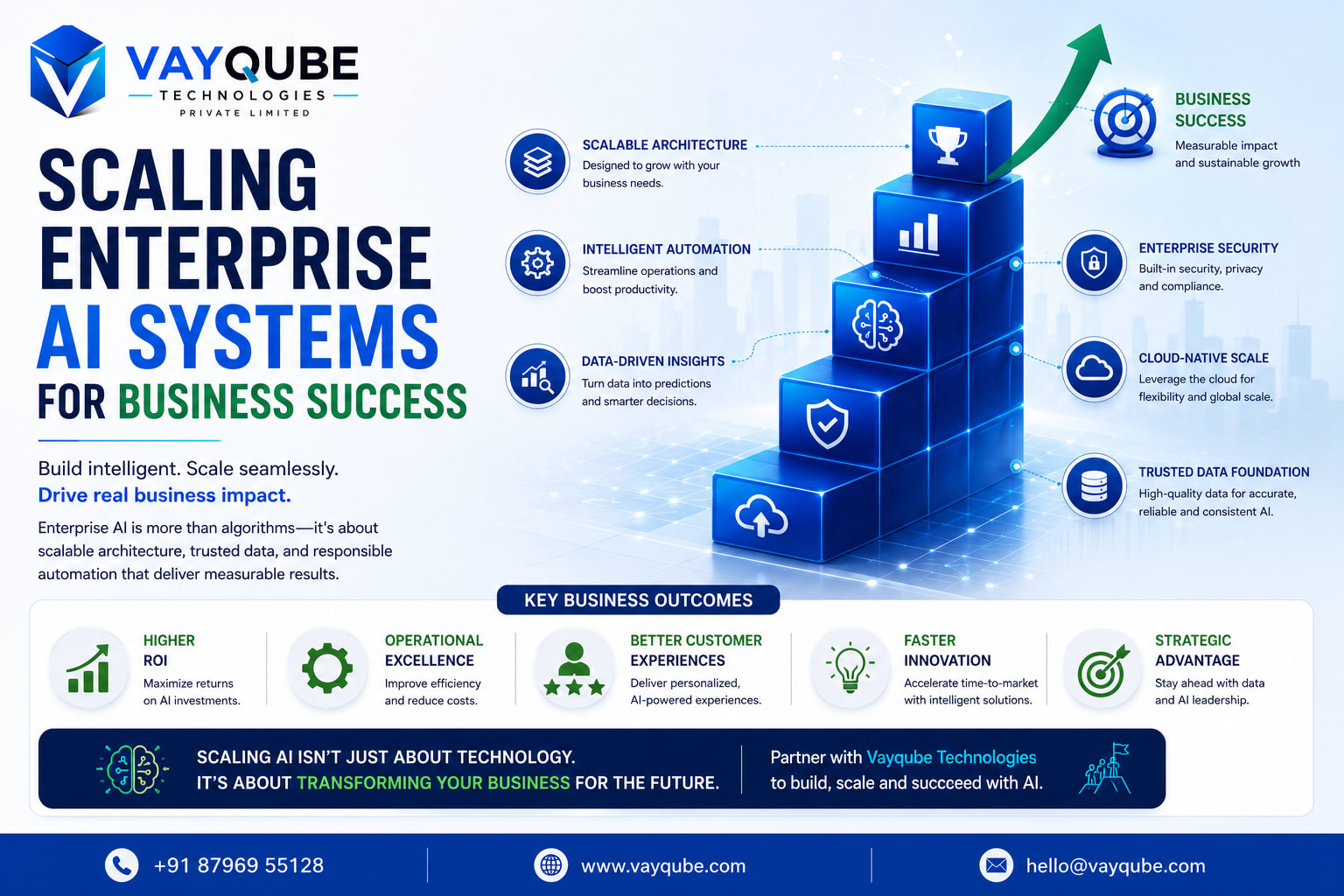
Introduction to Scaling Enterprise AI Systems
Enterprise AI systems have become a crucial component of modern businesses, enabling them to make data-driven decisions, automate processes, and gain a competitive edge. These systems rely on complex algorithms and machine learning models to analyze vast amounts of data, identify patterns, and provide actionable insights.
The importance of scaling AI for business success cannot be overstated. As businesses grow and expand, their AI systems must be able to handle increasing amounts of data, user traffic, and computational demands. Failure to scale AI systems can result in decreased performance, increased latency, and reduced accuracy, ultimately leading to missed opportunities and lost revenue.
Key Considerations for Scaling Enterprise AI
When it comes to scaling enterprise AI systems, there are several key considerations that businesses must take into account. These include:
- Data management and storage: As the volume of data increases, businesses must ensure that their AI systems can handle the influx of information and provide timely insights.
- Computational resources: Scaling AI systems requires significant computational resources, including powerful processors, ample memory, and high-speed storage.
- Model training and deployment: As AI models become more complex, businesses must ensure that they can be trained and deployed efficiently, without compromising performance or accuracy.
Effective scaling of enterprise AI systems requires a deep understanding of the underlying technology, as well as the business requirements and goals. By prioritizing scalability, flexibility, and performance, businesses can unlock the full potential of their AI systems and drive long-term success.
Real-World Examples of Scalable AI Systems
Many businesses have successfully scaled their AI systems to achieve significant benefits. For example, companies like Netflix and Amazon have developed highly scalable AI-powered recommendation engines that can handle millions of users and provide personalized recommendations in real-time. Similarly, businesses like Uber and Lyft have developed AI-powered dispatch systems that can handle large volumes of requests and optimize routes in real-time.
By studying these examples and understanding the key considerations for scaling enterprise AI systems, businesses can develop effective strategies for implementing and scaling their own AI systems. This can help them to stay ahead of the competition, drive innovation, and achieve long-term success.
Implementation Strategy for Scalable AI Systems
To implement scalable AI systems, businesses should focus on developing a robust architecture that can handle increasing amounts of data and user traffic. This can involve using cloud-based infrastructure, distributed computing, and containerization to ensure flexibility and scalability. Additionally, businesses should prioritize model training and deployment, using techniques like transfer learning and automated hyperparameter tuning to optimize performance and accuracy.
By taking a strategic approach to scaling enterprise AI systems, businesses can unlock the full potential of their AI investments and drive significant benefits, including increased revenue, improved customer satisfaction, and enhanced competitiveness.
Why It Matters
The impact of AI on business operations cannot be overstated. As AI systems become increasingly integral to enterprise operations, their ability to scale has a direct correlation with business success. AI-powered systems can analyze vast amounts of data, identify patterns, and make predictions, leading to improved decision-making, enhanced customer experiences, and increased operational efficiency.
Business Operations Impact
The integration of AI into business operations has numerous benefits, including:
- Improved process automation, reducing manual errors and increasing productivity
- Enhanced customer service through personalized experiences and real-time support
- Data-driven insights, enabling informed decision-making and strategic planning
- Increased competitiveness, as AI-driven innovations create new market opportunities
Consequences of Not Scaling
However, the consequences of not scaling AI systems can be severe. If AI systems are not designed to handle increased data volumes, user adoption, or complexity, they can become bottlenecks, hindering business growth and innovation. This can lead to:
- Reduced system performance, resulting in delayed or inaccurate outputs
- Increased maintenance costs, as workarounds and patches are implemented to compensate for scalability limitations
- Missed business opportunities, as the inability to scale AI systems hinders the adoption of new technologies and innovations
- Decreased competitiveness, as businesses that fail to scale their AI systems are surpassed by more agile and innovative competitors
Real-World Implications
In real-world scenarios, the failure to scale AI systems can have significant business implications. For instance, an e-commerce company that implements an AI-powered recommendation engine may see initial success, but if the system is not designed to handle increased traffic or user data, it may become overwhelmed, leading to decreased performance and missed sales opportunities. Similarly, a financial institution that implements an AI-powered risk assessment system may struggle to keep up with regulatory requirements if the system is not scalable, leading to potential compliance issues and reputational damage.
Core Architecture
To achieve scalability in enterprise AI systems, a well-designed core architecture is crucial. This involves several key components that work together to ensure seamless performance and efficient processing of large datasets.
Components of Scalable AI Systems
The core components of scalable AI systems include:
- Data ingestion and processing pipelines
- Machine learning model training and deployment frameworks
- Data storage and management solutions
- Analytics and visualization tools
- Security and access control mechanisms
These components must be designed to handle large volumes of data, support real-time processing, and ensure high availability and reliability.
Role of Cloud Infrastructure
Cloud infrastructure plays a vital role in scaling enterprise AI systems. Cloud providers offer a range of services, including:
- Scalable computing resources
- Storage solutions
- Machine learning frameworks
- Data analytics platforms
- Security and compliance tools
By leveraging cloud infrastructure, organizations can quickly deploy and scale their AI systems, reducing the need for upfront capital expenditures and minimizing the risk of resource underutilization.
Microservices-Based Architecture
A microservices-based architecture is also essential for scaling enterprise AI systems. This approach involves breaking down the AI system into smaller, independent services that can be developed, deployed, and scaled independently.
The benefits of a microservices-based architecture include:
- Improved scalability and flexibility
- Enhanced fault tolerance and reliability
- Faster development and deployment cycles
- Better support for real-time processing and analytics
By combining cloud infrastructure and microservices-based architecture, organizations can build scalable and efficient AI systems that support business success.
Implementation Considerations
When implementing a scalable AI system, organizations must consider several factors, including:
- Data quality and availability
- Model training and deployment strategies
- Security and access control mechanisms
- Scalability and performance requirements
- Integration with existing systems and infrastructure
By carefully evaluating these factors and designing a robust core architecture, organizations can ensure that their AI systems are scalable, efficient, and effective in supporting business success.
Real-World Examples
Real-world examples of scalable AI systems include:
- Recommendation engines that analyze customer behavior and preferences
- Predictive maintenance systems that detect equipment failures and schedule maintenance
- Chatbots and virtual assistants that provide customer support and engagement
- Fraud detection systems that identify and prevent financial crimes
These examples demonstrate the potential of scalable AI systems to drive business success and improve operational efficiency.
Production Readiness
To ensure production readiness, organizations must test and validate their AI systems in real-world environments. This involves:
- Conducting thorough testing and quality assurance
- Evaluating system performance and scalability
- Identifying and addressing potential security vulnerabilities
- Developing strategies for ongoing maintenance and support
By following these best practices, organizations can ensure that their AI systems are production-ready and capable of supporting business success.
Business Benefits
The implementation of enterprise AI systems can have a significant impact on business operations, leading to improved efficiency and productivity. By automating routine tasks and providing predictive analytics, AI systems can help organizations streamline their processes, reduce manual errors, and increase overall output.
Enhanced Efficiency
Some of the key benefits of AI-driven efficiency include:
- Automated data processing and analysis, reducing the need for manual intervention
- Intelligent workflow management, enabling real-time monitoring and optimization
- Predictive maintenance, minimizing downtime and reducing maintenance costs
- Personalized customer experiences, driven by AI-powered chatbots and virtual assistants
Decision-Making and Insights
AI systems can also enhance decision-making and provide valuable insights, enabling businesses to make data-driven decisions and stay ahead of the competition. This can be achieved through:
- Advanced data analytics, providing real-time visibility into business performance
- Machine learning algorithms, identifying patterns and trends in customer behavior
- Natural language processing, enabling the analysis of large volumes of unstructured data
- AI-driven forecasting, predicting market trends and enabling proactive decision-making
By leveraging these capabilities, businesses can gain a deeper understanding of their operations, customers, and markets, and make informed decisions to drive growth and profitability. The key to success lies in the effective implementation and integration of AI systems, ensuring seamless interaction with existing infrastructure and workflows.
Real-World Applications
Real-world examples of AI-driven business benefits can be seen in various industries, including:
- Healthcare, where AI-powered diagnostic tools are improving patient outcomes and reducing treatment costs
- Finance, where AI-driven risk management systems are enabling real-time monitoring and mitigation of potential threats
- Retail, where AI-powered customer service platforms are providing personalized experiences and driving sales growth
These examples demonstrate the potential of AI to transform business operations and drive success, and highlight the importance of scaling enterprise AI systems to meet the needs of modern organizations.
Implementation Strategy
To achieve these benefits, businesses must develop a comprehensive implementation strategy, taking into account factors such as:
- Data quality and availability, ensuring that AI systems have access to accurate and relevant data
- Infrastructure and scalability, enabling the seamless integration of AI systems with existing workflows
- Talent and skills, ensuring that teams have the necessary expertise to develop and manage AI systems
- Change management, minimizing disruption to business operations and ensuring a smooth transition to AI-driven processes
By carefully considering these factors, businesses can ensure a successful implementation of enterprise AI systems, and unlock the full potential of AI to drive business success.
Scalability
To achieve business success with enterprise AI systems, scalability is a critical factor. As the demand for AI-driven insights and automation grows, the system must be able to handle increased workloads without compromising performance.
Scaling Strategies
There are two primary scaling strategies: horizontal and vertical scaling.
- Horizontal scaling involves adding more machines or nodes to the existing infrastructure, allowing the system to distribute the workload across multiple resources.
- Vertical scaling, on the other hand, involves increasing the power of individual machines or nodes, enabling them to handle more workload without adding new resources.
Load Balancing and Autoscaling
Load balancing and autoscaling are essential components of a scalable enterprise AI system.
- Load balancing ensures that no single node is overwhelmed with requests, distributing the workload evenly across available resources.
- Autoscaling enables the system to dynamically adjust its capacity in response to changing demands, adding or removing resources as needed to maintain optimal performance.
Effective load balancing and autoscaling require careful planning and implementation, taking into account factors such as traffic patterns, resource utilization, and system latency. By implementing these strategies, enterprises can ensure their AI systems remain responsive and efficient, even under heavy workloads.
Real-World Implementation
In real-world scenarios, a combination of horizontal and vertical scaling strategies is often used, along with load balancing and autoscaling. For example, a company deploying a large-scale AI-powered customer service chatbot might use horizontal scaling to add more nodes during peak hours, while also implementing load balancing to ensure that no single node is overwhelmed with requests. Autoscaling can be used to dynamically adjust the number of nodes based on changing demand, ensuring the system remains responsive and efficient.
Production Considerations
When implementing scalability strategies in production environments, it's essential to consider factors such as resource utilization, system latency, and cost optimization. Enterprises must balance the need for scalability with the need to control costs and minimize waste, ensuring that resources are utilized efficiently and effectively. By carefully planning and implementing scalability strategies, enterprises can ensure their AI systems remain scalable, efficient, and effective in production environments.
Implementation Challenges
As enterprises strive to scale their AI systems, they often encounter significant implementation challenges that can hinder the success of their initiatives. Two of the most critical challenges are data quality and integration issues, as well as talent acquisition and retention challenges.
Data Quality and Integration Issues
Data is the lifeblood of any AI system, and ensuring its quality and integrity is crucial for accurate model training and deployment. However, many enterprises struggle with data silos, inconsistent formatting, and poor data governance, which can lead to biased models, inaccurate predictions, and failed deployments. To overcome these challenges, enterprises must invest in robust data management practices, including data cleansing, normalization, and integration. This can involve implementing data pipelines, data warehouses, and data lakes to ensure that data is properly collected, stored, and processed.
Talent Acquisition and Retention Challenges
Scaling AI systems also requires a skilled and experienced workforce, including data scientists, engineers, and analysts. However, the demand for AI talent far exceeds the supply, making it difficult for enterprises to attract and retain the necessary expertise. To address this challenge, enterprises must develop a comprehensive talent acquisition and retention strategy, including competitive compensation packages, ongoing training and development programs, and a culture that fosters innovation and collaboration. This can involve partnering with universities, research institutions, and other organizations to access top talent, as well as investing in AI education and training programs to upskill existing employees.
Some key considerations for overcoming implementation challenges include:
- Developing a robust data management strategy to ensure data quality and integrity
- Investing in talent acquisition and retention programs to attract and retain top AI talent
- Implementing agile development methodologies to facilitate rapid iteration and deployment
- Fostering a culture of innovation and collaboration to drive AI adoption and success
- Continuously monitoring and evaluating AI system performance to identify areas for improvement and optimization.
To ensure production readiness, enterprises must also consider the scalability, reliability, and security of their AI systems, as well as their ability to integrate with existing infrastructure and applications. By addressing these implementation challenges and considerations, enterprises can unlock the full potential of their AI systems and achieve significant business benefits, including improved efficiency, enhanced decision-making, and increased competitiveness.
Use Cases
Enterprise AI systems have numerous applications across various industries, driving business success and revenue growth. Two key use cases that demonstrate the potential of AI are predictive maintenance and quality control, as well as personalized customer experiences and recommendations.
Predictive Maintenance and Quality Control
Predictive maintenance and quality control use cases leverage AI's ability to analyze large datasets and identify patterns, enabling proactive maintenance and quality assurance. This leads to:
- Reduced downtime and increased overall equipment effectiveness
- Improved product quality and reduced waste
- Enhanced supply chain management and logistics
- Data-driven decision making for maintenance and quality control teams
Real-world examples of predictive maintenance include manufacturers using AI-powered sensors to monitor equipment health and schedule maintenance, reducing downtime by up to 50%. Similarly, quality control teams use AI-driven computer vision to inspect products and detect defects, improving quality rates by up to 20%.
Personalized Customer Experiences and Recommendations
Personalized customer experiences and recommendations use cases harness AI's power to analyze customer data and behavior, providing tailored interactions and offers. This results in:
- Increased customer satisfaction and loyalty
- Improved customer retention and reduced churn
- Enhanced customer engagement and conversion rates
- Data-driven decision making for marketing and sales teams
Examples of personalized customer experiences include e-commerce companies using AI-driven recommendation engines to suggest products based on customer browsing and purchase history, resulting in up to 30% increase in sales. Additionally, AI-powered chatbots provide personalized customer support, reducing support queries by up to 40% and improving customer satisfaction ratings.
Implementing these use cases requires careful consideration of data quality, integration with existing systems, and ongoing model training and maintenance to ensure accuracy and relevance. By leveraging AI in these areas, businesses can drive significant revenue growth, improve operational efficiency, and enhance customer satisfaction.
Best Practices
To ensure the successful deployment and maintenance of enterprise AI systems, it's crucial to follow established best practices. This includes monitoring and evaluating AI system performance, as well as ensuring transparency and explainability.
Performance Monitoring
Monitoring AI system performance is essential for identifying areas of improvement and optimizing overall efficiency. This involves tracking key metrics such as accuracy, precision, and recall, as well as monitoring system latency and throughput. By doing so, businesses can quickly identify and address potential issues, reducing downtime and improving overall system reliability.
Transparency and Explainability
Ensuring transparency and explainability is critical for building trust in AI systems. This involves providing clear and concise explanations of how AI-driven decisions are made, as well as ensuring that all stakeholders understand the underlying algorithms and data used to inform these decisions. Some key strategies for achieving transparency and explainability include:
- Implementing model interpretability techniques, such as feature attribution and partial dependence plots
- Providing clear and concise documentation of AI system architecture and decision-making processes
- Establishing robust testing and validation protocols to ensure AI system accuracy and reliability
Implementation Considerations
When implementing enterprise AI systems, it's essential to consider the potential risks and challenges associated with AI adoption. This includes addressing concerns around data quality and bias, as well as ensuring that AI systems are aligned with overall business objectives. By taking a thoughtful and strategic approach to AI implementation, businesses can minimize potential risks and maximize the benefits of AI adoption.
Real-World Examples
In real-world scenarios, businesses have successfully implemented enterprise AI systems by following these best practices. For example, a leading retail company used AI to optimize its supply chain operations, resulting in significant reductions in cost and improvements in efficiency. Similarly, a major healthcare provider used AI to improve patient outcomes, leveraging machine learning algorithms to identify high-risk patients and provide targeted interventions. By following established best practices and taking a strategic approach to AI implementation, businesses can achieve similar success and drive meaningful improvements in operational efficiency and effectiveness.
Production Readiness
To ensure production readiness, businesses must carefully evaluate AI system performance and scalability, as well as ensure that all necessary testing and validation protocols are in place. This includes conducting thorough testing and quality assurance, as well as establishing robust monitoring and maintenance protocols to ensure ongoing system reliability and performance. By taking a comprehensive and strategic approach to AI implementation, businesses can ensure that their AI systems are production-ready and capable of driving meaningful improvements in operational efficiency and effectiveness.
Frequently Asked Questions
To ensure the successful implementation and scaling of enterprise AI systems, businesses must consider several key factors.
Key Considerations for Scaling AI Systems
When scaling AI systems, businesses should focus on the following:
- Data quality and availability: ensuring that the system has access to relevant, accurate, and sufficient data to learn and improve
- Computational resources: providing adequate processing power, memory, and storage to handle increasing data volumes and complexity
- Model maintenance and updates: regularly reviewing and refining AI models to maintain their accuracy and effectiveness
- Integration with existing infrastructure: seamlessly integrating AI systems with existing technology stacks and workflows
Measuring Success of AI Initiatives
To measure the success of their AI initiatives, businesses can track the following metrics:
- Return on Investment (ROI): comparing the financial benefits of AI implementation to its costs
- Key Performance Indicators (KPIs): monitoring metrics such as customer engagement, sales, and operational efficiency
- Model accuracy and reliability: evaluating the performance of AI models in real-world scenarios
- User adoption and satisfaction: gathering feedback from users and stakeholders to identify areas for improvement
Overcoming Implementation Challenges
Businesses can overcome implementation challenges by:
- Developing a clear implementation strategy and roadmap
- Establishing a cross-functional team with expertise in AI, data science, and business operations
- Providing ongoing training and support for users and stakeholders
- Continuously monitoring and evaluating the performance of AI systems to identify areas for improvement
Real-World Examples of Successful AI Implementation
Several businesses have successfully implemented and scaled AI systems, achieving significant benefits such as:
- Improved customer experience through personalized recommendations and chatbots
- Enhanced operational efficiency through automation and process optimization
- Increased revenue through data-driven insights and predictive analytics
- Better decision-making through AI-driven analytics and visualization tools
Production Readiness and Considerations
To ensure production readiness, businesses should consider the following factors:
- Data security and governance: ensuring that AI systems comply with relevant regulations and standards
- Scalability and reliability: designing AI systems to handle increasing data volumes and user traffic
- Integration with existing systems: ensuring seamless integration with existing technology stacks and workflows
- Ongoing maintenance and support: providing regular updates, patches, and support to ensure the continued performance and effectiveness of AI systems
Conclusion
In scaling enterprise AI systems for business success, several key takeaways emerge as crucial for organizations aiming to leverage artificial intelligence effectively.
Summary of Key Takeaways
- Core Architecture: A well-designed core architecture is fundamental, incorporating elements such as data ingestion, processing, and AI model training.
- Scalability and Implementation: Scalability must be considered from the outset, with implementation strategies that include cloud services, containerization, and orchestration tools to ensure flexibility and efficiency.
- Business Benefits and Use Cases: Understanding the specific business benefits and identifying relevant use cases are critical for maximizing the impact of AI systems.
- Challenges and Best Practices: Recognizing potential challenges and adopting best practices, such as continuous monitoring and updating of AI models, are essential for long-term success.
Future Outlook for Enterprise AI Systems
The future of enterprise AI systems is promising, with advancements in technology expected to drive further adoption and innovation. Key trends include:
- Increased Automation: More processes are likely to be automated, freeing human resources for strategic and creative tasks.
- Ethical AI: There will be a growing focus on ethical AI, ensuring that systems are transparent, fair, and secure.
- Integration with Emerging Technologies: AI will be increasingly integrated with other emerging technologies like blockchain, the Internet of Things (IoT), and quantum computing, leading to new and powerful applications.
- Talent and Skills Development: As AI becomes more pervasive, there will be a heightened need for professionals with the skills to develop, implement, and manage AI systems effectively.
As organizations move forward with scaling their enterprise AI systems, they must remain adaptable, continually assessing and refining their strategies to align with the evolving landscape of AI technology and business needs. By doing so, they can unlock the full potential of AI to drive innovation, efficiency, and growth.
The path to successful AI implementation is not without its challenges, but with careful planning, a focus on scalability, and a commitment to best practices, enterprises can navigate these complexities and achieve significant business benefits. The future of enterprise AI is not just about technology; it's about how that technology can be harnessed to create more agile, responsive, and successful businesses.
Related Vayqube Resources
- Startups Building Ai Products Without Large Teams
- Best Mobile App Development Company In Singapore City
- The Real Cost Of Building Ai Products
- How To Build Fintech Application Payments Security Scaling
- Best Mobile App Development Company In New York
- Top Mobile App Development Company In Singapore City
Next Step
If your systems are struggling with scalability, automation, architecture complexity, or operational efficiency, it's time to modernize your infrastructure and workflows.
👉 Talk to a Vayqube solution architect and build systems designed for long-term production growth: