
Multi-Tenant SaaS vs Single-Tenant Architecture: Scaling for Success
Choose the right architecture for your SaaS application. Compare multi-tenant and single-tenant models to ensure scalability, security, and cost-effectiveness.
Vayqube Team
Author
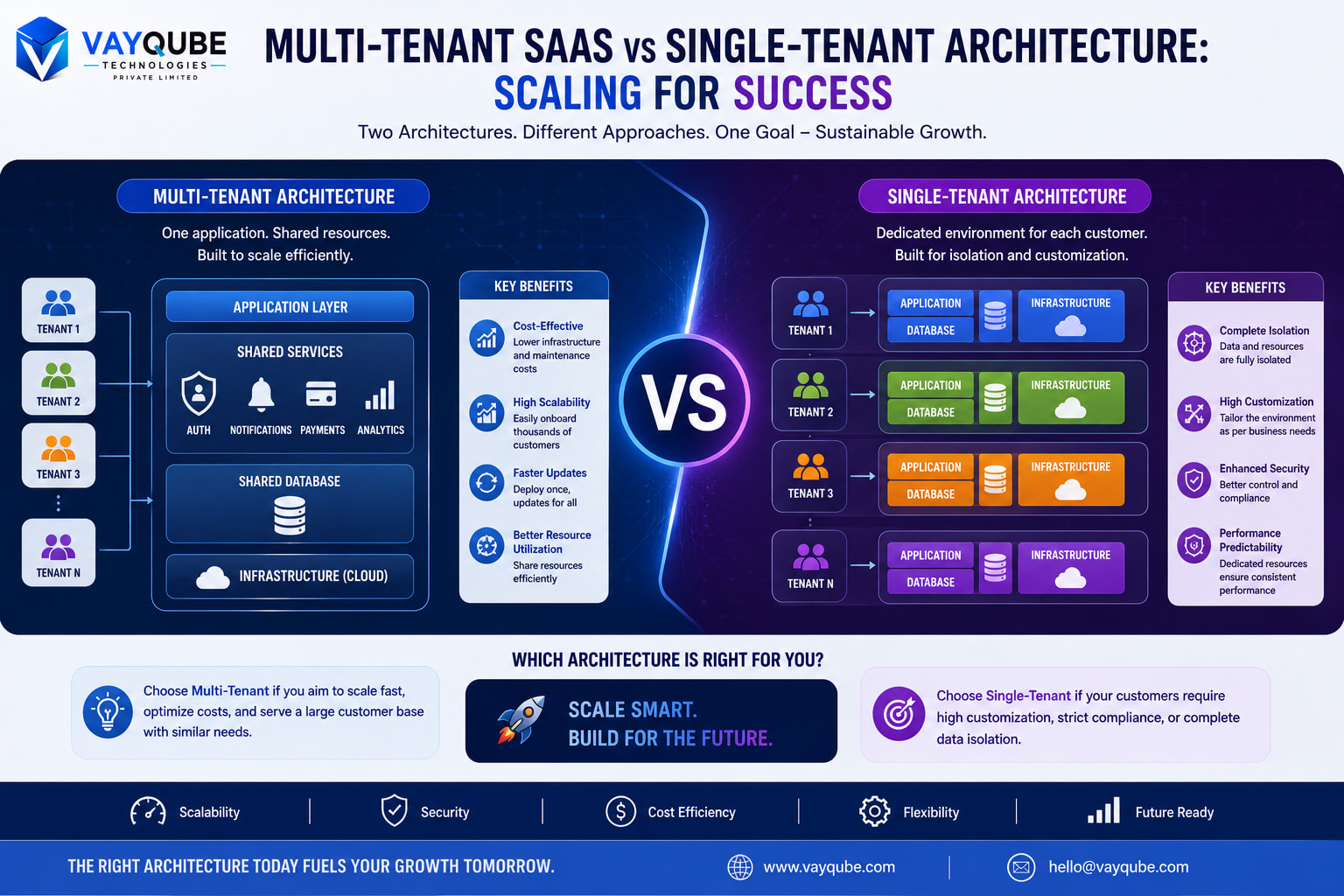
Introduction to Scalability
When it comes to building a SaaS application, one of the most critical decisions is choosing between a multi-tenant and single-tenant architecture. This choice has a significant impact on the scalability and success of the application.
In a multi-tenant architecture, multiple customers share the same instance of the application, with each customer's data isolated from the others. This approach offers several benefits, including reduced costs, easier maintenance, and faster deployment of new features.
Key Considerations
On the other hand, a single-tenant architecture provides each customer with their own dedicated instance of the application. This approach is often preferred by large enterprises or organizations with complex security requirements.
Some key considerations when choosing between these two architectures include:
- Cost: Multi-tenant architectures are generally more cost-effective, as the costs of infrastructure and maintenance are spread across multiple customers.
- Security: Single-tenant architectures may be preferred by organizations with sensitive data or strict security requirements, as each customer's data is isolated from the others.
- Customization: Single-tenant architectures offer more flexibility in terms of customization, as each customer's instance can be tailored to meet their specific needs.
Scalability and Success
Choosing the right architecture is crucial for scalability and success. A multi-tenant architecture can be more scalable, as new customers can be easily added to the existing instance. However, this approach can also lead to increased complexity and potential performance issues if not properly managed.
In contrast, a single-tenant architecture can be more challenging to scale, as each new customer requires a separate instance of the application. However, this approach can also provide more control over performance and security.
Ultimately, the choice between a multi-tenant and single-tenant architecture depends on the specific needs and goals of the organization. By understanding the benefits and drawbacks of each approach, organizations can make an informed decision that sets them up for scalability and success.
Real-World Implications
In real-world scenarios, the choice of architecture can have significant implications. For example, a multi-tenant architecture may be suitable for a SaaS application with a large number of small to medium-sized customers, while a single-tenant architecture may be more suitable for an application with a small number of large enterprise customers.
By considering the specific needs and requirements of the customers, organizations can choose the architecture that best supports their goals and sets them up for long-term success.
Implementation Strategy
When implementing a SaaS application, it's essential to consider the architecture from the outset. This includes considering factors such as:
- Customer requirements: What are the specific needs and requirements of the customers?
- Scalability: How will the application scale to meet the needs of a growing customer base?
- Security: What are the security requirements of the customers, and how will they be met?
- Performance: How will the application perform under heavy loads, and what are the potential bottlenecks?
By considering these factors and choosing the right architecture, organizations can set themselves up for success and create a SaaS application that meets the needs of their customers.
Why It Matters
The choice between multi-tenant and single-tenant architecture has significant implications for a SaaS company's ability to scale and succeed.
Business Growth and Revenue
A well-designed architecture can support rapid growth and increasing revenue streams. Multi-tenant architectures, in particular, offer a cost-effective way to serve a large number of customers, as resources can be pooled and utilized more efficiently. This approach enables businesses to:
- Reduce infrastructure costs per customer
- Increase agility in responding to changing market conditions
- Improve time-to-market for new features and services
Customer Satisfaction and Retention
Customer satisfaction and retention are critical to the long-term success of any SaaS business. A scalable architecture ensures that customers receive a consistent and high-quality experience, even as the user base grows. Key considerations include:
- Ensuring seamless performance and responsiveness
- Providing personalized experiences through configurable settings and features
- Supporting multiple deployment options, such as cloud, on-premises, or hybrid environments
Operational Efficiency and Cost Management
The right architecture can also have a significant impact on operational efficiency and cost management. By optimizing resource utilization and automating routine tasks, businesses can:
- Minimize manual intervention and reduce the risk of human error
- Improve resource allocation and utilization, reducing waste and excess capacity
- Enhance visibility and control over costs, enabling more effective budgeting and forecasting
As SaaS companies continue to evolve and grow, the importance of a scalable and efficient architecture will only continue to increase. By understanding the implications of multi-tenant and single-tenant architectures, businesses can make informed decisions that support their long-term goals and objectives.
Real-World Implications
In real-world scenarios, the choice of architecture can have far-reaching consequences. For example, a company that chooses a multi-tenant architecture may be able to:
- More easily integrate with other SaaS applications and services
- Provide a more consistent and streamlined experience for customers
- Reduce the complexity and overhead associated with managing multiple single-tenant environments
Ultimately, the key to success lies in selecting an architecture that aligns with the company's overall strategy and goals, and that can adapt to changing market conditions and customer needs.
Core Architecture
The core architecture of a SaaS application is crucial in determining its scalability, security, and overall success. In this section, we will delve into the definition and characteristics of multi-tenant and single-tenant architectures, and compare their key differences and similarities.
Multi-Tenant Architecture
A multi-tenant architecture is a design pattern where a single instance of a software application serves multiple customers, or tenants. Each tenant shares the same infrastructure, resources, and codebase, but has their own dedicated space and data storage. The key characteristics of a multi-enant architecture include:
- Shared resources and infrastructure
- Single codebase and instance
- Scalability and cost-effectiveness
- Centralized management and maintenance
Single-Tenant Architecture
A single-tenant architecture, on the other hand, is a design pattern where each customer, or tenant, has their own dedicated instance of the software application. Each instance has its own infrastructure, resources, and codebase, providing a high level of customization and control. The key characteristics of a single-tenant architecture include:
- Dedicated resources and infrastructure
- Customizable and flexible
- Higher level of security and isolation
- Increased complexity and cost
Comparison of Key Differences and Similarities
When comparing multi-tenant and single-tenant architectures, several key differences and similarities emerge. Some of the main differences include:
- Scalability: multi-tenant architectures are generally more scalable and cost-effective
- Security: single-tenant architectures provide a higher level of security and isolation
- Customization: single-tenant architectures offer more flexibility and customization options
- Complexity: single-tenant architectures are often more complex and difficult to manage
Despite these differences, both architectures share some similarities, including:
- Ability to provide on-demand access to software applications
- Support for a wide range of devices and platforms
- Emphasis on user experience and satisfaction
In terms of real-world examples, companies like Salesforce and Microsoft Azure use multi-tenant architectures to provide scalable and cost-effective solutions to their customers. On the other hand, companies like Amazon Web Services (AWS) and Google Cloud Platform (GCP) offer single-tenant architectures to provide a higher level of customization and control.
When considering production readiness, it's essential to evaluate the trade-offs between scalability, security, and customization. A multi-tenant architecture may be more suitable for applications with a large user base and high traffic, while a single-tenant architecture may be more suitable for applications with sensitive data or strict security requirements.
Ultimately, the choice between a multi-tenant and single-tenant architecture depends on the specific needs and goals of the application, as well as the resources and expertise of the development team. By understanding the characteristics and trade-offs of each architecture, developers can make informed decisions and create scalable, secure, and successful SaaS applications.
Business Benefits
The choice between multi-tenant and single-tenant architecture has significant implications for businesses, affecting scalability, cost, and customer satisfaction.
Advantages of Multi-Tenant Architecture
Multi-tenant architecture offers several advantages for businesses, including:
- Reduced costs: shared resources and infrastructure lead to lower operational expenses
- Increased scalability: easily add or remove resources as needed, without affecting individual customers
- Simplified maintenance: updates and patches are applied once, benefiting all customers
- Enhanced collaboration: shared platforms can facilitate communication and data sharing between customers
Advantages of Single-Tenant Architecture
On the other hand, single-tenant architecture provides its own set of benefits, such as:
- Customization: each customer has a dedicated environment, allowing for tailored configurations and integrations
- Security: isolated environments reduce the risk of data breaches and unauthorized access
- Control: customers have full control over their environment, enabling them to make changes as needed
- Compliance: dedicated environments can be designed to meet specific regulatory requirements
Choosing the Best Architecture
To choose the best architecture for specific business needs, consider the following factors:
- Customer requirements: do customers need customized environments or can they share resources?
- Scalability needs: will the business require rapid scaling or can growth be predicted and planned for?
- Security and compliance: are there specific regulatory requirements that must be met?
- Cost and resource constraints: what are the budget and resource limitations that will impact the choice of architecture? By carefully evaluating these factors, businesses can select the architecture that best aligns with their goals and objectives, ensuring a strong foundation for growth and success.
Implementation Considerations
When implementing either architecture, businesses should consider real-world examples and production readiness. For instance, a multi-tenant architecture may be suitable for a SaaS company with a large customer base and standardized requirements, while a single-tenant architecture may be more appropriate for a business with highly customized or secure requirements. Ultimately, the choice of architecture will depend on the specific needs and goals of the business, and should be carefully evaluated to ensure the best possible outcome.
Production Readiness
In terms of production readiness, businesses should consider factors such as:
- Performance and reliability: can the chosen architecture support the required level of performance and reliability?
- Monitoring and analytics: are there adequate tools in place to monitor and analyze the performance of the chosen architecture?
- Disaster recovery: are there plans in place for disaster recovery and business continuity in the event of an outage or disaster? By carefully considering these factors, businesses can ensure that their chosen architecture is production-ready and able to support their growth and success.
Scalability
To achieve scalability, SaaS providers must consider the architectural implications of their chosen approach.
Multi-Tenant Scalability
Multi-tenant architecture supports scalability and growth by allowing multiple customers to share the same instance of the application, with each customer's data isolated from others. This approach enables efficient resource utilization, as a single instance can serve a large number of customers. When the need arises, the provider can simply add more resources, such as servers or storage, to support increasing demand. Key benefits of multi-tenant scalability include:
- Reduced infrastructure costs
- Simplified maintenance and updates
- Faster deployment of new features and updates
Single-Tenant Scalability
Single-tenant architecture, on the other hand, supports scalability and growth by dedicating a separate instance of the application to each customer. While this approach requires more resources, it provides greater control and customization options for each customer. To scale a single-tenant architecture, providers can use techniques such as:
- Horizontal scaling, where more instances are added to support increasing demand
- Vertical scaling, where resources such as CPU or memory are increased for each instance
- Load balancing, to distribute traffic efficiently across multiple instances
Best Practices for Scaling
Regardless of the chosen architecture, there are best practices that can help SaaS providers scale their applications effectively. These include:
- Monitoring performance and resource utilization in real-time
- Implementing automated scaling and deployment processes
- Using cloud-based infrastructure to reduce costs and increase flexibility
- Developing a culture of continuous testing and optimization
- Fostering close relationships with customers to understand their evolving needs and preferences
By following these best practices and understanding the scalability implications of their chosen architecture, SaaS providers can build applications that meet the needs of their customers and support long-term growth and success.
Implementation Considerations
When implementing a scalable SaaS architecture, providers must consider factors such as:
- Data storage and management
- Security and access controls
- Network and infrastructure performance
- Customer support and success processes By carefully evaluating these factors and choosing the right architecture for their needs, SaaS providers can create scalable, efficient, and customer-centric applications that drive business success.
Real-World Examples
Real-world examples of scalable SaaS architectures can be seen in companies such as Salesforce, which uses a multi-tenant approach to support millions of customers, and Amazon Web Services, which offers single-tenant options for customers with unique requirements. By studying these examples and applying the best practices outlined above, SaaS providers can create their own scalable architectures and achieve success in the competitive SaaS market.
Implementation Challenges
Implementing a multi-tenant or single-tenant architecture comes with its own set of challenges. Understanding these challenges is crucial for businesses to make informed decisions and ensure a smooth transition.
Common Multi-Tenant Challenges
When implementing a multi-tenant architecture, common challenges include:
- Data isolation and security: ensuring that each tenant's data is secure and isolated from other tenants
- Scalability: designing a system that can scale horizontally to accommodate growing demand
- Customization: providing customization options for each tenant without compromising the overall system
- Support and maintenance: managing and supporting multiple tenants with varying needs and requirements
Common Single-Tenant Challenges
On the other hand, single-tenant architecture implementation challenges include:
- Higher costs: provisioning and maintaining separate instances for each tenant can be costly
- Increased complexity: managing multiple instances can lead to increased complexity and administrative overhead
- Limited scalability: single-tenant architecture can be less scalable than multi-tenant architecture, making it less suitable for large-scale deployments
- Reduced efficiency: single-tenant architecture can result in reduced efficiency and increased resource waste
Overcoming Implementation Obstacles
To overcome these implementation obstacles, businesses can employ several strategies, including:
- Adopting a cloud-native approach to leverage scalable and on-demand resources
- Implementing automation and orchestration tools to streamline deployment and management
- Using containerization and microservices architecture to improve scalability and customization
- Developing a robust monitoring and analytics system to ensure real-time visibility and proactive issue resolution
- Establishing clear communication channels and feedback loops to ensure tenant needs are met and issues are addressed promptly
By understanding the common challenges associated with multi-tenant and single-tenant architecture implementation, businesses can develop effective strategies to overcome these obstacles and ensure a successful deployment. This, in turn, enables them to focus on delivering high-quality services and driving business growth.
Real-World Considerations
In real-world scenarios, businesses often face additional challenges, such as:
- Integrating with existing systems and infrastructure
- Ensuring compliance with regulatory requirements
- Managing tenant onboarding and offboarding processes
- Providing training and support for tenants
- Continuously monitoring and improving the system to ensure optimal performance and scalability.
Use Cases
To better understand the implications of multi-tenant and single-tenant SaaS architectures, it's essential to examine real-world examples of successful implementations.
Multi-Tenant SaaS Implementations
Multi-tenant SaaS solutions have been successfully deployed in various industries, including:
- Customer relationship management (CRM) tools, where a single instance of the application serves multiple customers, each with their own dedicated space
- Marketing automation platforms, which provide a scalable and cost-effective solution for businesses of all sizes
- Human capital management (HCM) systems, which offer a unified platform for managing HR, payroll, and benefits administration
Companies like Salesforce and HubSpot have leveraged multi-tenant architectures to deliver scalable and feature-rich solutions to their customers.
Single-Tenant SaaS Implementations
Single-tenant SaaS solutions, on the other hand, have been successfully implemented in industries that require high levels of security, compliance, and customization, such as:
- Financial services, where sensitive data and regulatory requirements necessitate dedicated environments
- Healthcare, where HIPAA compliance and data privacy concerns demand isolated infrastructure
- Government agencies, which often require customized solutions with enhanced security features
Examples of successful single-tenant SaaS implementations include customized ERP systems for large enterprises and specialized software solutions for highly regulated industries.
Lessons Learned
Analyzing various use cases and industries reveals valuable lessons for businesses considering SaaS architecture:
- Scalability and cost-effectiveness are critical factors in choosing a multi-tenant approach
- Security, compliance, and customization requirements often dictate the need for single-tenant solutions
- A deep understanding of the target market, industry requirements, and customer needs is essential for making informed architecture decisions
- The ability to balance scalability, security, and customization is crucial for achieving success in the SaaS market
By examining real-world examples and lessons learned, businesses can make informed decisions about their SaaS architecture and ensure a successful implementation that meets their unique needs and goals.
Industry-Specific Considerations
Different industries have distinct requirements and challenges that influence the choice of SaaS architecture. For instance:
- The finance and healthcare industries prioritize security and compliance, often opting for single-tenant solutions
- The technology and software industries, on the other hand, frequently adopt multi-tenant architectures to facilitate scalability and innovation
- The retail and e-commerce industries require a balance between scalability, security, and customization, making hybrid approaches an attractive option
Understanding these industry-specific considerations is vital for developing a SaaS solution that meets the unique needs of the target market.
Real-World Examples
Real-world examples of successful SaaS implementations can be seen in companies like:
- Dropbox, which uses a multi-tenant architecture to provide scalable file storage and sharing solutions
- Zendesk, which offers a single-tenant solution for customer service and support ticketing
- Amazon Web Services (AWS), which provides a range of SaaS solutions, including multi-tenant and single-tenant options, to support various industries and use cases
These examples demonstrate the diversity of SaaS architectures and the importance of choosing the right approach for the specific needs of the business and its customers.
Best Practices
To ensure the successful implementation and maintenance of multi-tenant and single-tenant SaaS architectures, it's essential to follow established guidelines and recommendations.
Designing Multi-Tenant Architecture
When designing a multi-tenant architecture, consider the following guidelines:
- Implement a robust and scalable database design to accommodate multiple tenants
- Utilize a tenant identification mechanism to ensure data isolation and security
- Develop a flexible and customizable application framework to meet the unique needs of each tenant
- Implement automated provisioning and deployment processes to streamline tenant onboarding
Designing Single-Tenant Architecture
In contrast, designing a single-tenant architecture requires a different set of considerations:
- Focus on delivering a highly personalized and tailored experience for each individual tenant
- Implement a dedicated infrastructure and resources to ensure optimal performance and security
- Develop a customized application framework to meet the specific needs and requirements of each tenant
- Establish a close working relationship with each tenant to ensure ongoing support and maintenance
Ongoing Maintenance and Optimization
To ensure the long-term success of either architecture, it's crucial to prioritize ongoing maintenance and optimization:
- Regularly monitor and analyze performance metrics to identify areas for improvement
- Implement automated testing and quality assurance processes to ensure high-quality deployments
- Establish a continuous integration and delivery pipeline to streamline updates and feature releases
- Foster a culture of collaboration and communication between development, operations, and customer support teams to ensure seamless issue resolution and feedback incorporation
By following these guidelines and recommendations, organizations can ensure the successful implementation and maintenance of their chosen SaaS architecture, whether multi-tenant or single-tenant. This, in turn, enables them to focus on delivering high-quality services and support to their customers, driving business growth and success.
Production Readiness
To achieve production readiness, consider the following key factors:
- Ensure compliance with relevant regulatory requirements and industry standards
- Implement robust security measures to protect sensitive data and prevent unauthorized access
- Develop a comprehensive disaster recovery and business continuity plan to minimize downtime and ensure rapid recovery
- Establish a reliable and efficient customer support process to address issues and concerns in a timely and effective manner
By prioritizing these factors and following established best practices, organizations can ensure a smooth and successful transition to production, setting the stage for long-term success and scalability in the competitive SaaS market.
Frequently Asked Questions
To help clarify the differences between multi-tenant and single-tenant architectures, we've compiled a list of answers to common questions.
Addressing Misconceptions
Some common misconceptions surround the security and scalability of multi-tenant architectures.
- Multi-tenant architectures are often mistakenly believed to be less secure than single-tenant architectures due to the shared resources.
- However, with proper implementation and isolation of tenant data, multi-tenant architectures can be just as secure.
Common Questions
Some frequently asked questions about multi-tenant and single-tenant architectures include:
- What is the primary difference between multi-tenant and single-tenant architectures?
- How do I choose between a multi-tenant and single-tenant architecture for my SaaS application?
- What are the scalability implications of each architecture?
- How do I ensure the security and isolation of tenant data in a multi-tenant architecture?
Clarification and Resources
For further clarification and to address any misconceptions, it's essential to understand the core principles of each architecture. Additional resources for learning and exploration include:
- Research papers on multi-tenant and single-tenant architectures
- Case studies of successful implementations
- Technical documentation and guides for popular SaaS platforms
Real-World Examples
Real-world examples of successful multi-tenant and single-tenant architectures can provide valuable insights. For instance, companies like Salesforce and Microsoft Azure have successfully implemented multi-tenant architectures, while others like Amazon Web Services (AWS) offer single-tenant options. These examples demonstrate the feasibility and effectiveness of both architectures in different contexts.
Further Learning
To delve deeper into the world of multi-tenant and single-tenant architectures, consider exploring the following topics:
- Cloud computing and its role in SaaS applications
- Data isolation and security measures in multi-tenant architectures
- Scalability and performance optimization techniques for both architectures
- Real-world use cases and success stories of companies that have implemented each architecture.
Implementation Considerations
When implementing either a multi-tenant or single-tenant architecture, consider the following key factors:
- Business requirements and scalability needs
- Security and compliance regulations
- Technical expertise and resource availability
- Cost implications and return on investment (ROI) expectations.
Production Readiness
To ensure production readiness, it's crucial to:
- Conduct thorough testing and quality assurance
- Implement monitoring and logging mechanisms
- Develop a robust support and maintenance strategy
- Plan for future scalability and growth.
Additional Resources
For more information and in-depth analysis, refer to the following resources:
- Technical blogs and forums discussing SaaS architecture
- Industry reports and research studies on multi-tenant and single-tenant architectures
- Webinars and online courses focused on SaaS implementation and scalability.
Conclusion
In the realm of SaaS, the choice between multi-tenant and single-tenant architecture is pivotal for businesses aiming to scale and succeed. The key to making an informed decision lies in understanding the core differences between these two architectures and how they align with your business goals and scalability requirements.
Summary of Key Takeaways
- Multi-tenant SaaS offers cost efficiency, easier maintenance, and scalability, making it suitable for businesses with a large user base and less stringent security requirements.
- Single-tenant SaaS provides enhanced security, customization, and control, catering to businesses with high-security needs and specific regulatory compliance requirements.
- The choice between multi-tenant and single-tenant SaaS should be based on a thorough analysis of your business needs, growth prospects, and the trade-offs between scalability, security, and customization.
Final Thoughts
Choosing the right SaaS architecture is not a one-time decision but a strategic process that involves continuous evaluation and adaptation. As businesses grow and the landscape of SaaS evolves, the importance of reassessing your architecture strategy cannot be overstated. The ability to scale, adapt to changing market conditions, and meet evolving customer needs is crucial for long-term success.
Call to Action
For businesses currently operating on a SaaS model, it's essential to reassess your architecture strategy in light of your growth plans, security requirements, and customer expectations. Consider the following steps:
- Evaluate your current architecture against your business goals and scalability needs.
- Assess the trade-offs between multi-tenant and single-tenant architectures in the context of your business.
- Develop a strategic roadmap for implementing or transitioning to the most suitable architecture, considering factors such as cost, security, customization, and maintenance.
- Engage with SaaS experts and conduct thorough market research to stay informed about the latest trends and best practices in SaaS architecture.
By taking a proactive and informed approach to SaaS architecture, businesses can position themselves for success, drive scalability, and deliver high-quality services that meet the evolving needs of their customers.
Related Vayqube Resources
- Best Software Development Company In Singapore City
- Best Saas Development Company In Singapore City
- Best Fintech Software Development Company In Singapore City
- Healthcare Software Development Company Singapore City
- Case Study Saas Platform Scaling
- Best Software Development Company In New York
Next Step
If your systems are struggling with scalability, automation, architecture complexity, or operational efficiency, it's time to modernize your infrastructure and workflows.
👉 Talk to a Vayqube solution architect and build systems designed for long-term production growth: