
Deploy Scalable Next.js Apps Fast
Deploying scalable Next.js applications requires careful planning and execution. By following best practices and using the right tools, you can ensure a fast and reliable deployment process.
Vayqube Team
Software architecture and product engineering
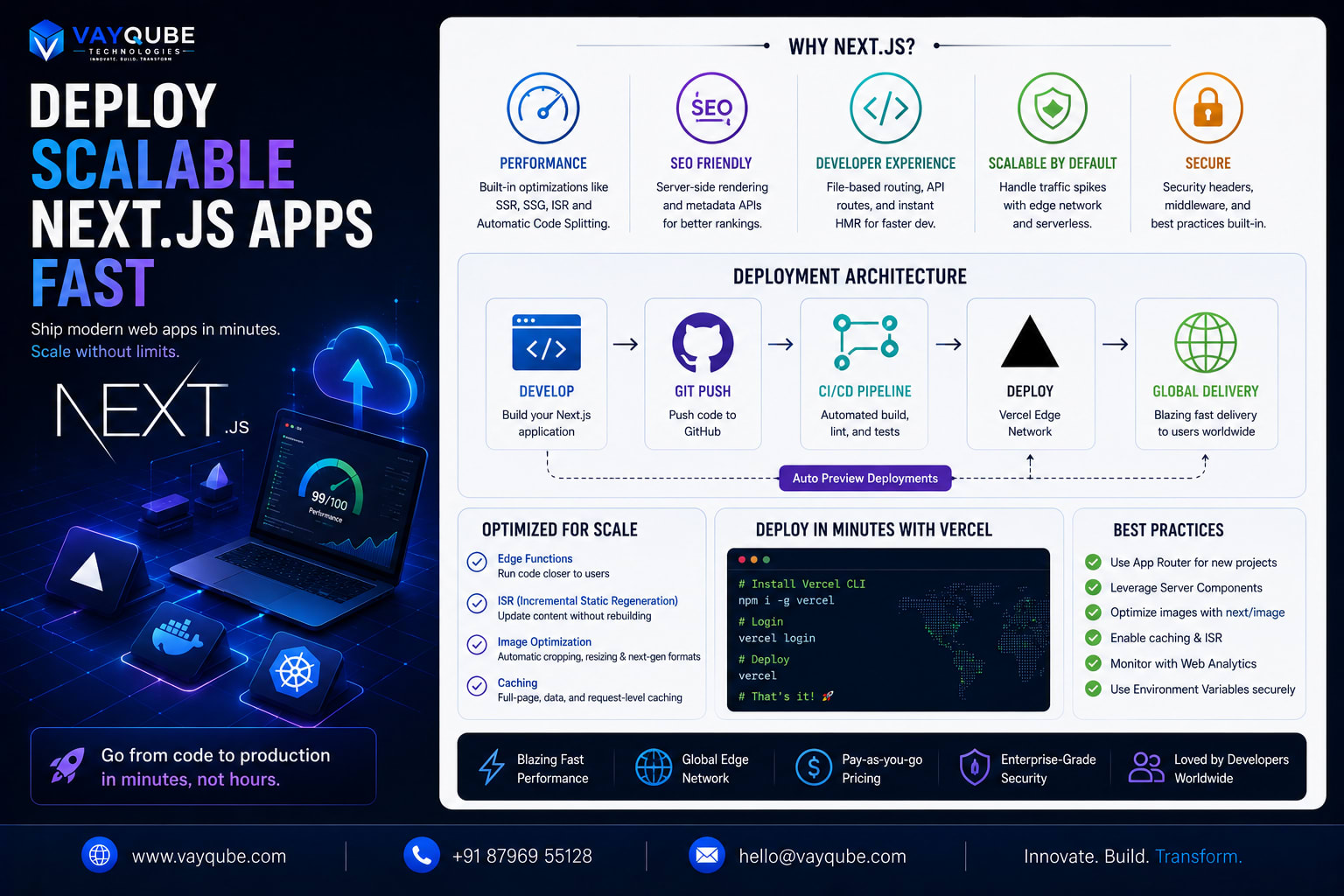
Introduction to Next.js and Scalability
Next.js is a popular React-based framework for building server-rendered, statically generated, and performance-optimized web applications. Its ability to handle complex, data-driven applications has made it a favorite among developers. However, as applications grow in complexity and user base, scalability becomes a critical factor in ensuring a seamless user experience.
Overview of Next.js
Next.js offers a range of features that simplify the development process, including server-side rendering, static site generation, and internationalization support. Its extensibility and customization options make it an attractive choice for building complex web applications. With Next.js, developers can create fast, scalable, and maintainable applications that meet the demands of modern web development.
Importance of Scalability
Scalability is crucial in modern web applications, as it directly impacts user experience and business success. A scalable application can handle increased traffic, data, and user interactions without compromising performance. This is particularly important for businesses, as a slow or unresponsive application can lead to lost revenue, damaged reputation, and decreased customer satisfaction. By prioritizing scalability, developers can ensure their applications remain performant and reliable, even under heavy loads.
To achieve scalability, developers must consider several factors, including:
- Application architecture and design
- Server and infrastructure configuration
- Database optimization and scaling
- Content delivery networks (CDNs) and caching strategies
- Monitoring and analytics tools for performance optimization
By understanding these factors and implementing scalable solutions, developers can build Next.js applications that meet the demands of modern web development and provide a seamless user experience.
Real-World Scalability Considerations
In real-world scenarios, scalability is often a trade-off between complexity, cost, and performance. For example, a simple e-commerce application may not require a complex scalability strategy, but as the user base grows, the application must be able to handle increased traffic and data. By planning for scalability from the outset, developers can avoid costly re-architecting and ensure their applications remain performant and reliable.
Key considerations for real-world scalability include:
- Horizontal scaling (adding more servers) vs. vertical scaling (increasing server power)
- Load balancing and traffic management
- Database sharding and replication
- Caching and content delivery networks (CDNs)
- Automated testing and deployment pipelines
By understanding these considerations and implementing effective scalability strategies, developers can build Next.js applications that meet the demands of modern web development and provide a seamless user experience.
Implementation Strategy
To deploy scalable Next.js applications, developers must consider a range of factors, including application architecture, server configuration, and database optimization. A well-planned implementation strategy can help ensure scalability, performance, and reliability. In the next section, we will explore the implementation strategy for deploying scalable Next.js applications.
Why It Matters
Fast deployment of Next.js apps is crucial for businesses that rely on web applications to drive revenue and customer engagement. The benefits of fast deployment are numerous, including:
- Reduced time-to-market for new features and updates
- Improved user experience through faster page loads and seamless interactions
- Increased competitiveness in a rapidly changing market landscape
- Enhanced collaboration and productivity among development teams
Impact on User Experience
A slow or poorly deployed web application can have a significant impact on user experience, leading to frustration, abandonment, and ultimately, lost revenue. On the other hand, a fast and seamless deployment can:
- Improve page load times, resulting in higher engagement and conversion rates
- Enhance the overall user experience, leading to increased customer satisfaction and loyalty
- Provide a competitive advantage, as users are more likely to return to a fast and reliable application
Business Impact
The impact of fast deployment on business is equally significant. By reducing the time and effort required to deploy new features and updates, businesses can:
- Increase their agility and responsiveness to changing market conditions
- Improve their ability to innovate and experiment with new ideas and features
- Reduce the risk of errors and downtime, resulting in lower costs and improved revenue stability
- Enhance their reputation and credibility, as a fast and reliable application is often seen as a reflection of the company's overall quality and competence.
Some real-world examples of companies that have benefited from fast deployment include e-commerce platforms, online marketplaces, and social media applications, where speed and reliability are critical to user engagement and revenue growth.
In these cases, fast deployment has enabled companies to quickly respond to changing user needs, improve their competitiveness, and drive business growth.
By prioritizing fast deployment, businesses can unlock these benefits and stay ahead of the competition in a rapidly evolving digital landscape.
Core Architecture
To deploy scalable Next.js apps, it's essential to understand the core architecture that enables fast and efficient rendering. This includes server-side rendering, static site generation, and performance optimization.
Server-Side Rendering
Server-side rendering (SSR) is a key feature of Next.js that allows for fast page loads and improved SEO. With SSR, the server generates the HTML of a page on each request, reducing the amount of work the client's browser needs to do. This approach provides several benefits, including:
- Faster page loads, as the browser can render the page immediately
- Improved SEO, as search engines can crawl the server-generated HTML
- Enhanced security, as sensitive data can be handled on the server-side
Static Site Generation
Static site generation (SSG) is another powerful feature of Next.js that allows for fast and scalable deployments. With SSG, the server generates the HTML of a page at build time, and the browser can render the page immediately. This approach provides several benefits, including:
- Fast page loads, as the browser can render the page immediately
- Reduced server load, as the server doesn't need to generate HTML on each request
- Improved performance, as the browser can cache the static HTML
Performance Optimization
Performance optimization is critical to ensuring fast and scalable Next.js deployments. This includes optimizing server-side rendering, static site generation, and client-side rendering. Some key strategies for performance optimization include:
- Minimizing server response times, to reduce the time it takes for the browser to receive the HTML
- Optimizing image and asset loading, to reduce the amount of data transferred over the network
- Leveraging browser caching, to reduce the number of requests made to the server
- Using code splitting and dynamic imports, to reduce the amount of code transferred over the network
By understanding and implementing these core architecture features, developers can deploy scalable Next.js apps that provide fast and efficient user experiences.
Business Benefits
The benefits of deploying scalable Next.js apps extend far beyond the technical realm, with significant impacts on business outcomes. By leveraging the power of Next.js, organizations can drive real growth and improvement in key areas.
Improved user engagement is a critical advantage, as fast and seamless experiences lead to increased satisfaction and loyalty. When users can quickly and easily find what they're looking for, they're more likely to stick around, explore, and ultimately convert. This, in turn, can lead to increased conversions, as users are more likely to take desired actions when the experience is frictionless.
Some key ways that Next.js can improve user engagement include:
- Optimized page loads, reducing bounce rates and improving overall experience
- Enhanced responsiveness, ensuring a seamless experience across devices and browsers
- Streamlined navigation and information architecture, making it easier for users to find what they need
In addition to driving engagement and conversions, scalable Next.js apps can also enhance brand reputation. By providing a fast, reliable, and polished experience, organizations can demonstrate their commitment to quality and user experience. This can be particularly important for businesses that rely on their digital presence to drive growth and revenue.
Real-World Examples
Many organizations have already seen significant benefits from deploying scalable Next.js apps. For example, companies like HashiCorp and Ticketmaster have used Next.js to drive major improvements in user engagement and conversion rates. By leveraging the platform's built-in support for server-side rendering, static site generation, and performance optimization, these organizations have been able to deliver fast, seamless experiences that drive real business results.
Implementation Considerations
To realize the business benefits of scalable Next.js apps, organizations should focus on implementation strategies that prioritize performance, reliability, and user experience. This may involve investing in infrastructure and tooling that support automated testing, continuous integration, and continuous deployment (CI/CD). It may also require developing a deep understanding of Next.js and its ecosystem, as well as the needs and expectations of target users. By taking a thoughtful and strategic approach to implementation, organizations can unlock the full potential of Next.js and drive meaningful growth and improvement.
Scalability
To achieve scalability in Next.js applications, it's essential to consider both horizontal and vertical scaling strategies. Horizontal scaling involves adding more servers or instances to handle increased traffic, while vertical scaling focuses on increasing the power of existing servers.
Horizontal Scaling
Horizontal scaling is particularly useful for handling sudden spikes in traffic or demand. By adding more servers, you can distribute the load and ensure that your application remains responsive. Some key considerations for horizontal scaling include:
- Adding more servers or instances to handle increased traffic
- Using load balancers to distribute traffic across multiple servers
- Implementing automated scaling to add or remove servers as needed
- Ensuring that your application is designed to handle stateless requests, allowing for easy addition of new servers
Vertical Scaling
Vertical scaling, on the other hand, involves increasing the power of existing servers to handle more traffic. This can be achieved by:
- Upgrading server hardware, such as adding more CPU or RAM
- Optimizing server configuration and settings for better performance
- Using more efficient algorithms and data structures to reduce computational overhead
- Implementing caching mechanisms to reduce the load on servers
Load Balancing and Caching
Load balancing and caching are critical components of a scalable Next.js application. Load balancing helps to distribute traffic across multiple servers, ensuring that no single server is overwhelmed and becomes a bottleneck. Caching, on the other hand, helps to reduce the load on servers by storing frequently accessed data in memory or a fast storage layer. Some key considerations for load balancing and caching include:
- Using a load balancer to distribute traffic across multiple servers
- Implementing caching mechanisms, such as Redis or Memcached, to store frequently accessed data
- Configuring cache invalidation strategies to ensure that data remains up-to-date
- Monitoring and optimizing load balancing and caching configurations for optimal performance
Implementation Challenges
When deploying scalable Next.js apps, several challenges can arise. One of the primary concerns is the complexity of setup. As the application grows, the configuration and setup process can become increasingly complicated, requiring significant time and resources to manage.
Complexity of Setup
The setup process for a scalable Next.js app involves multiple components, including serverless functions, APIs, and databases. Each of these components requires careful configuration to ensure seamless integration and optimal performance. Moreover, as the application scales, the complexity of the setup process increases, making it more challenging to manage and maintain.
Some key considerations for managing setup complexity include:
- Simplifying the configuration process through automation and scripting
- Implementing a modular architecture to reduce dependencies and improve maintainability
- Establishing clear documentation and change management processes to ensure consistency and transparency
Serverless Function Management
Serverless functions are a crucial component of scalable Next.js apps, providing a flexible and cost-effective way to handle requests and process data. However, managing serverless functions can be challenging, particularly as the number of functions increases. Key considerations for serverless function management include:
- Monitoring and logging to ensure visibility into function performance and errors
- Implementing automated testing and deployment processes to reduce manual effort and minimize downtime
- Optimizing function configuration and resource allocation to ensure efficient use of resources and minimize costs
Cost Optimization
Cost optimization is a critical aspect of deploying scalable Next.js apps, as the cost of infrastructure and resources can quickly add up. To optimize costs, it's essential to:
- Monitor and analyze resource utilization to identify areas of inefficiency
- Implement cost-effective infrastructure and resource allocation strategies, such as autoscaling and serverless computing
- Establish clear budgeting and cost management processes to ensure transparency and control over expenses
By addressing these implementation challenges, organizations can ensure the successful deployment of scalable Next.js apps that meet the needs of their users while minimizing costs and optimizing performance.
Use Cases
Next.js is a versatile framework that can be applied to various types of applications, each with its unique scalability requirements.
E-commerce Websites
E-commerce websites are a prime example of applications that benefit from Next.js scalability. With features like server-side rendering and static site generation, Next.js enables fast page loads and seamless user experiences, even during high-traffic sales events. For instance, an online fashion retailer can use Next.js to build a scalable e-commerce platform that handles thousands of concurrent users, ensuring that customers can browse and purchase products without interruptions.
Blogs and News Sites
Blogs and news sites also benefit from Next.js scalability. By leveraging Next.js's ability to pre-render pages, these sites can improve their search engine optimization (SEO) and provide faster page loads, resulting in higher engagement and better user retention. A popular news site, for example, can use Next.js to build a scalable platform that handles a large volume of traffic during breaking news events, ensuring that readers can access the latest news without delays.
Complex Web Applications
Complex web applications, such as those used in finance, healthcare, or education, require a high degree of scalability and reliability. Next.js provides the necessary tools to build these applications, including support for internationalization, accessibility, and performance optimization. For example, a financial services company can use Next.js to build a scalable web application that handles sensitive user data and provides real-time updates, ensuring that users can access their financial information securely and efficiently.
Some key considerations when building scalable Next.js applications include:
- Optimizing database queries to reduce latency
- Implementing caching mechanisms to improve performance
- Using load balancing and autoscaling to handle traffic spikes
- Monitoring application performance and adjusting configurations as needed
By understanding the use cases and scalability requirements of different applications, developers can effectively leverage Next.js to build fast, reliable, and scalable web applications that meet the needs of their users.
Best Practices
To ensure the successful deployment of scalable Next.js apps, it's essential to follow best practices that cover key areas such as monitoring, continuous integration, and security.
Monitoring and Analytics
Effective monitoring and analytics are crucial for identifying performance bottlenecks, tracking user behavior, and optimizing the application. This can be achieved by:
- Implementing logging and error tracking tools like Sentry or LogRocket
- Using analytics platforms like Google Analytics or Mixpanel to track user interactions
- Setting up performance monitoring tools like New Relic or Datadog to identify bottlenecks
Continuous Integration and Deployment
Continuous integration and deployment (CI/CD) pipelines enable developers to automate testing, building, and deployment of the application, ensuring faster time-to-market and reduced errors. Key considerations include:
- Using CI/CD tools like Jenkins, CircleCI, or GitHub Actions to automate workflows
- Implementing automated testing and code review processes to ensure quality and consistency
- Configuring deployment strategies like canary releases or blue-green deployments to minimize downtime
Security and Access Control
Robust security and access control measures are vital to protect sensitive data and prevent unauthorized access. This includes:
- Implementing authentication and authorization mechanisms like OAuth or Okta to control access
- Using encryption techniques like SSL/TLS to secure data in transit
- Configuring access controls like role-based access control (RBAC) to restrict permissions and ensure least privilege access
By following these best practices, developers can ensure the successful deployment of scalable Next.js apps that meet the needs of their users while minimizing risks and downtime.
FAQ
Next.js is a popular React-based framework for building server-side rendered and statically generated websites and applications. It provides a set of features and tools that make it easy to build fast, scalable, and performance-optimized applications.
What is Next.js?
Next.js is an open-source framework developed by Vercel that enables developers to build server-side rendered and statically generated React applications. It provides a set of features such as internationalized routing, static site generation, and server-side rendering, making it a popular choice for building fast and scalable applications.
Getting Started with Next.js
To get started with Next.js, you can create a new project using the npx create-next-app command. This will set up a basic Next.js project with the necessary dependencies and configuration. From there, you can start building your application using React components and Next.js features such as pages, routing, and internationalization.
Some key things to keep in mind when getting started with Next.js include:
- Familiarizing yourself with the framework's core concepts and features
- Setting up a robust project structure and organization
- Understanding how to use Next.js's built-in features such as routing and internationalization
- Learning how to optimize and performance-tune your application
Common Pitfalls in Deploying Next.js Apps
When deploying Next.js applications, there are several common pitfalls to watch out for. These include:
- Inadequate server configuration and scaling
- Insufficient caching and content delivery network (CDN) setup
- Poorly optimized images and assets
- Inadequate monitoring and logging
- Failure to implement proper security measures such as SSL encryption and secure headers
By being aware of these potential pitfalls and taking steps to mitigate them, you can ensure a smooth and successful deployment of your Next.js application. Additionally, using a platform like Vercel can help simplify the deployment process and provide a set of built-in features and tools for optimizing and scaling your application.
Conclusion
To recap, deploying scalable Next.js apps requires a thorough understanding of the framework's core architecture, as well as the business benefits and challenges associated with implementation. Key points to consider include:
- Optimizing server-side rendering and static site generation for improved performance
- Implementing effective caching and content delivery networks (CDNs) to reduce latency
- Ensuring seamless integration with existing infrastructure and third-party services
- Monitoring and analyzing application performance to identify areas for improvement
In terms of final thoughts, it's essential to remember that deploying scalable Next.js apps is an ongoing process that requires continuous evaluation and refinement. By prioritizing performance, reliability, and maintainability, businesses can unlock the full potential of Next.js and deliver exceptional user experiences that drive engagement and revenue.
Some additional considerations for businesses looking to deploy scalable Next.js apps include:
- Developing a comprehensive implementation strategy that aligns with business objectives
- Investing in ongoing training and education to ensure development teams are equipped to handle the complexities of Next.js
- Fostering a culture of innovation and experimentation to stay ahead of the curve in terms of emerging trends and technologies
Ultimately, the key to success lies in striking a balance between technical excellence and business acumen. By taking a holistic approach to deploying scalable Next.js apps, businesses can set themselves up for long-term success and drive meaningful growth and innovation.
Final Considerations
When evaluating the effectiveness of a Next.js deployment strategy, it's crucial to consider both quantitative and qualitative metrics, such as:
- Application performance and latency
- User engagement and retention
- Development team velocity and productivity
- Return on investment (ROI) and total cost of ownership (TCO)
By taking a data-driven approach to deployment and continuously refining the strategy based on real-world feedback and results, businesses can ensure that their Next.js apps are optimized for maximum impact and scalability.
Related Vayqube Resources
- Startups Building Ai Products Without Large Teams
- Best Mobile App Development Company In Singapore City
- Best Web Development Company In Singapore City
- The Real Cost Of Building Ai Products
- How To Build Fintech Application Payments Security Scaling
- Best Mobile App Development Company In Usa
Next Step
If your systems are struggling with scalability, automation, architecture complexity, or operational efficiency, it's time to modernize your infrastructure and workflows.
👉 Talk to a Vayqube solution architect and build systems designed for long-term production growth: