
Navigating FinTech Security Challenges in 2026
The FinTech industry faces evolving security threats in 2026. Learn about key challenges and proactive approaches to safeguard financial technology systems
Vayqube Team
FinTech compliance and secure systems engineering
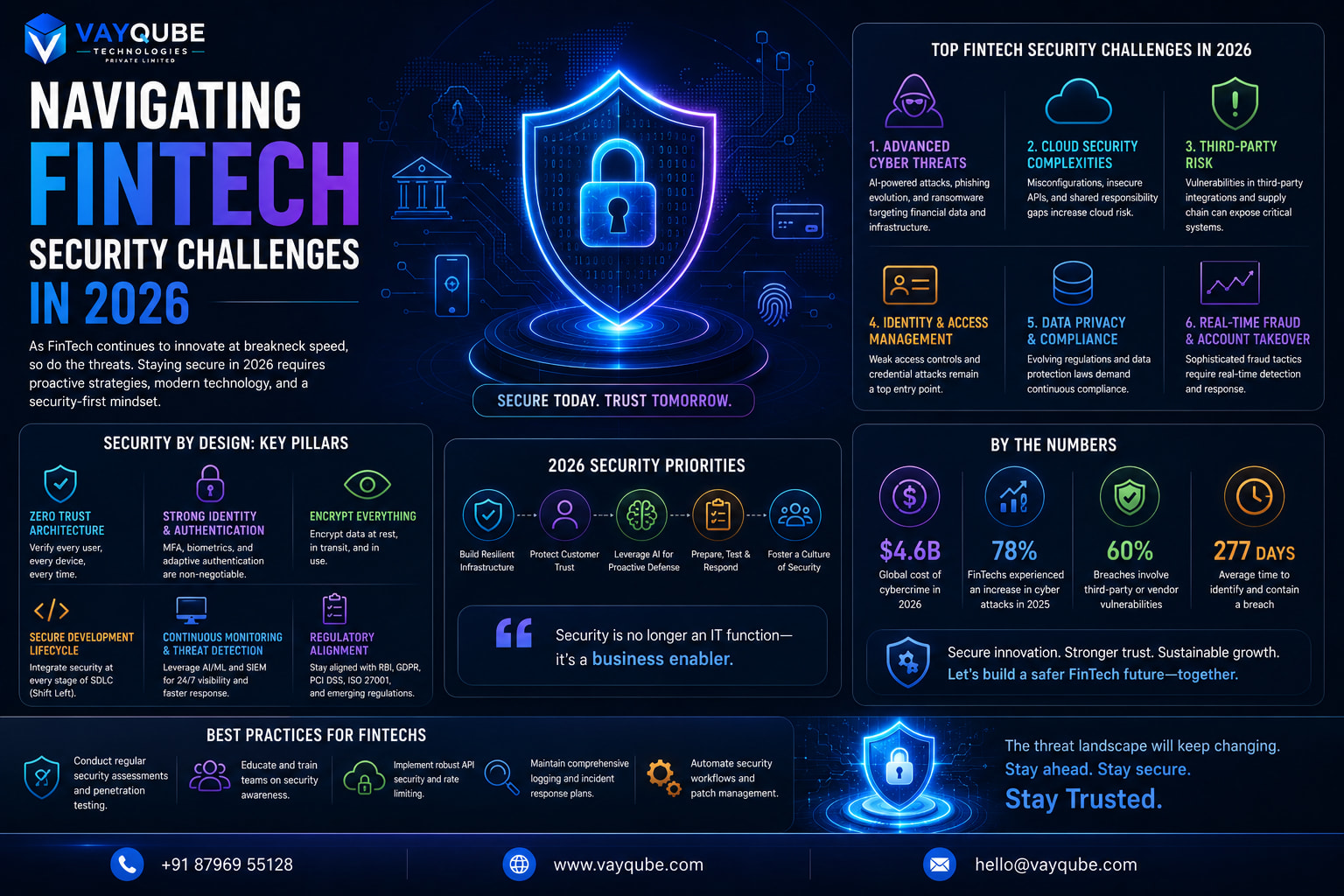
Introduction to FinTech Security Challenges
The FinTech industry has experienced rapid growth in recent years, with an increasing number of financial institutions and organizations adopting digital technologies to enhance their services. However, this growth has also introduced new security challenges that must be addressed to protect sensitive customer data and prevent financial losses. In 2026, the FinTech security landscape is more complex than ever, with emerging threats and evolving regulatory requirements.
Key Security Concerns
Some of the key security concerns in the FinTech industry include:
- Cyberattacks and data breaches
- Identity theft and authentication vulnerabilities
- Compliance with regulatory requirements, such as GDPR and PCI-DSS
- Insider threats and employee negligence
- Third-party vendor risks and supply chain vulnerabilities
The importance of addressing these security challenges cannot be overstated. A single data breach or cyberattack can result in significant financial losses, damage to reputation, and loss of customer trust. Furthermore, failure to comply with regulatory requirements can lead to hefty fines and penalties.
Evolving Threat Landscape
The threat landscape in FinTech is constantly evolving, with new threats and vulnerabilities emerging every day. Some of the emerging threats include:
- Advanced phishing attacks and social engineering tactics
- Ransomware and other types of malware
- Cloud-based attacks and vulnerabilities
- Artificial intelligence and machine learning-based attacks
To stay ahead of these threats, FinTech organizations must adopt a proactive and multi-layered approach to security, incorporating advanced technologies, such as artificial intelligence and machine learning, to detect and prevent threats. They must also prioritize employee education and awareness, as well as incident response planning, to ensure that they are prepared to respond quickly and effectively in the event of a security incident.
Addressing Security Challenges
Addressing FinTech security challenges requires a comprehensive and strategic approach. This includes:
- Conducting regular security assessments and risk analyses
- Implementing robust security controls and protocols
- Investing in advanced security technologies, such as threat intelligence and incident response platforms
- Developing a culture of security awareness and education among employees
- Collaborating with third-party vendors and partners to ensure secure supply chain management
By taking a proactive and strategic approach to security, FinTech organizations can protect their customers, reputation, and bottom line, while also ensuring compliance with regulatory requirements and industry standards. In the following sections, we will delve deeper into the specific security challenges facing the FinTech industry and explore strategies for addressing them.
Consequences of Security Breaches
The consequences of security breaches in FinTech can be severe and far-reaching. A single breach can result in significant financial losses, damage to customer trust, and erosion of business reputation. In the FinTech sector, where sensitive financial information is constantly being transmitted and stored, the stakes are particularly high.
Financial Losses
The financial impact of a security breach can be substantial, with costs including:
- Notification and credit monitoring services for affected customers
- Regulatory fines and penalties
- Legal fees and potential lawsuit settlements
- Costs associated with repairing and reinforcing security measures
- Potential loss of revenue due to decreased customer trust and loyalty
Impact on Customer Trust
Customer trust is a critical component of any FinTech business, and a security breach can have a devastating impact on this trust. When customers' sensitive financial information is compromised, they are likely to lose confidence in the company's ability to protect their data. This can lead to a decline in customer loyalty and retention, ultimately affecting the bottom line.
Business Reputation
A security breach can also have a lasting impact on a FinTech company's reputation. In today's digital age, news of a breach can spread quickly, damaging the company's brand and making it harder to attract new customers. Furthermore, a breach can lead to increased regulatory scrutiny, which can result in additional costs and reputational damage.
Real-World Examples
The consequences of security breaches in FinTech are not just theoretical. In recent years, several high-profile breaches have highlighted the importance of robust security measures. For example, a breach at a major financial institution can result in millions of dollars in losses and a significant decline in customer trust. Similarly, a breach at a FinTech startup can be particularly damaging, as these companies often rely on their reputation and customer trust to attract investors and drive growth.
Production Considerations
To mitigate the consequences of security breaches, FinTech companies must prioritize robust security measures in their production environments. This includes implementing advanced threat detection and response systems, conducting regular security audits and penetration testing, and ensuring that all employees and third-party vendors adhere to strict security protocols. By taking a proactive approach to security, FinTech companies can reduce the risk of a breach and protect their customers' sensitive financial information.
Core Architecture
The core architecture of FinTech security is designed to protect sensitive financial data and prevent unauthorized access. It involves a combination of technologies and components that work together to provide a robust security framework.
Key Components
The key components of FinTech security architecture include:
- Firewalls to prevent unauthorized access to the network
- Intrusion Detection and Prevention Systems (IDPS) to detect and prevent potential threats
- Encryption technologies to protect data in transit and at rest
- Secure authentication and authorization protocols to ensure only authorized access
- Regular security audits and penetration testing to identify vulnerabilities
Technologies Involved
The technologies involved in FinTech security architecture are constantly evolving to keep pace with emerging threats. Some of the key technologies include:
- Cloud security platforms to provide scalable and secure infrastructure
- Artificial Intelligence (AI) and Machine Learning (ML) to detect and respond to threats in real-time
- Blockchain technology to provide a secure and transparent way to conduct transactions
- Secure Software Development Life Cycle (SDLC) to ensure secure coding practices
Implementation Considerations
When implementing a FinTech security architecture, it's essential to consider the production readiness of the system. This includes:
- Ensuring scalability and performance to handle large volumes of transactions
- Implementing robust monitoring and incident response procedures to quickly respond to security incidents
- Providing regular security awareness training to employees to prevent social engineering attacks
- Ensuring compliance with relevant regulatory requirements, such as PCI-DSS and GDPR
Real-World Examples
Real-world examples of FinTech security architecture in action include:
- Mobile payment systems that use tokenization and encryption to secure transactions
- Online banking platforms that use multi-factor authentication and behavioral biometrics to prevent unauthorized access
- Cryptocurrency exchanges that use cold storage and multi-signature wallets to secure assets
Production Readiness
To ensure production readiness, FinTech companies should focus on implementing a security architecture that is designed to scale and adapt to emerging threats. This includes:
- Continuously monitoring and updating security protocols to stay ahead of threats
- Implementing automated security testing and vulnerability management to identify and remediate vulnerabilities quickly
- Providing regular security training and awareness programs to employees to prevent social engineering attacks
- Ensuring compliance with relevant regulatory requirements to avoid fines and reputational damage
Business Benefits
Implementing robust FinTech security measures has numerous benefits for businesses, particularly in enhancing customer trust and loyalty. When customers feel secure in their financial transactions and data, they are more likely to continue using a company's services, leading to increased loyalty and retention. This, in turn, can lead to positive word-of-mouth, online reviews, and referrals, ultimately driving business growth.
Enhanced Customer Trust and Loyalty
To achieve enhanced customer trust, FinTech companies must prioritize transparency in their security practices. This includes clearly communicating data protection policies, encryption methods, and compliance with regulatory standards. By doing so, businesses can demonstrate their commitment to safeguarding customer information, thereby fostering trust and loyalty. Real-world examples include financial institutions that provide regular security updates and alerts to their customers, keeping them informed and involved in the security process.
Regulatory Compliance and Risk Reduction
Regulatory compliance is another significant benefit of robust FinTech security. By adhering to stringent security standards and regulations, such as GDPR, PCI-DSS, and SOC 2, businesses can reduce the risk of non-compliance fines and reputational damage. Key considerations include:
- Implementing robust access controls and authentication mechanisms
- Conducting regular security audits and penetration testing
- Maintaining up-to-date incident response plans
- Ensuring all personnel are trained on security best practices and compliance requirements
By prioritizing regulatory compliance, FinTech companies can minimize the risk of data breaches and cyberattacks, protecting both their business and customers from potential harm. This proactive approach not only enhances security but also supports scalability and production readiness, as it ensures that the infrastructure can handle increased traffic and data volume without compromising security standards.
Scalability
As FinTech companies continue to grow and expand their services, scalability becomes a critical factor in navigating security challenges. A scalable security solution is essential to ensure that the security infrastructure can handle increased traffic, data, and user growth without compromising performance or security.
Importance of Scalable Security Solutions
Scalable security solutions are crucial for FinTech companies to maintain the trust and confidence of their customers. A scalable security infrastructure can help to:
- Handle increased traffic and data without downtime or performance issues
- Support the growth of new services and features
- Ensure compliance with regulatory requirements
- Reduce the risk of security breaches and cyber attacks
Strategies for Scaling FinTech Security Infrastructure
To scale FinTech security infrastructure, companies can implement the following strategies:
- Cloud-based security solutions: Leverage cloud-based security solutions that can scale up or down to meet changing demands
- Microservices architecture: Adopt a microservices architecture that allows for the deployment of multiple, independent services that can be scaled individually
- Automation and orchestration: Implement automation and orchestration tools to streamline security processes and reduce manual errors
- Artificial intelligence and machine learning: Utilize artificial intelligence and machine learning to detect and respond to security threats in real-time
- Continuous monitoring and testing: Continuously monitor and test the security infrastructure to identify vulnerabilities and weaknesses
Real-World Examples
Real-world examples of scalable security solutions in FinTech include:
- Payment processing companies: Implementing scalable security solutions to handle high volumes of transactions and data
- Digital banking platforms: Using cloud-based security solutions to support the growth of online banking services
- Cryptocurrency exchanges: Leveraging microservices architecture to scale security infrastructure and support the growth of cryptocurrency trading
Production Considerations
When implementing scalable security solutions, FinTech companies should consider the following production factors:
- Latency and performance: Ensure that security solutions do not introduce latency or performance issues
- Compliance and regulatory requirements: Ensure that security solutions meet regulatory requirements and compliance standards
- Cost and resource allocation: Allocate sufficient resources and budget to implement and maintain scalable security solutions
- Training and support: Provide training and support to security teams to ensure they can effectively manage and maintain scalable security solutions
Implementation Challenges
Implementing FinTech security measures can be a complex and daunting task, with several common obstacles that can hinder the process. These challenges can range from technical complexities to organizational and cultural barriers.
Common Obstacles
Some of the common obstacles in implementing FinTech security measures include:
- Lack of skilled personnel with expertise in FinTech security
- Insufficient budget allocation for security measures
- Complexity of integrating security solutions with existing systems
- Difficulty in balancing security with user experience and convenience
- Ever-evolving nature of cyber threats, making it challenging to stay ahead of potential attacks
Strategies for Overcoming Challenges
To overcome these challenges, FinTech companies can employ several strategies, including:
- Investing in employee training and development to enhance security skills
- Allocating sufficient budget for security measures and regularly reviewing budget allocations
- Adopting a phased implementation approach to integrate security solutions with existing systems
- Conducting regular security audits and risk assessments to identify vulnerabilities
- Implementing a culture of security awareness throughout the organization, from top to bottom
Real-World Examples
Real-world examples of successful implementation of FinTech security measures include the use of cloud-based security solutions, artificial intelligence-powered threat detection, and blockchain-based authentication. For instance, a leading digital payment provider implemented a cloud-based security solution to enhance the security of its payment processing system, resulting in a significant reduction in cyber attacks and data breaches.
Production Considerations
When implementing FinTech security measures, it is essential to consider production readiness and the potential impact on business operations. This includes ensuring that security solutions are scalable, reliable, and compatible with existing systems, as well as providing adequate support and maintenance to ensure continuous security monitoring and incident response. By carefully planning and executing the implementation of FinTech security measures, companies can minimize disruptions to business operations and ensure a seamless user experience.
Implementation Roadmap
Developing a comprehensive implementation roadmap is crucial to the success of FinTech security measures. This roadmap should include clear milestones, timelines, and resource allocations, as well as a detailed plan for testing, validation, and deployment of security solutions. By following a well-planned implementation roadmap, FinTech companies can ensure that security measures are implemented efficiently and effectively, minimizing the risk of cyber attacks and data breaches.
Use Cases
FinTech security is not just a theoretical concept, but a practical necessity that has been successfully implemented in various real-world scenarios.
Real-world Examples
Some notable examples include:
- Mobile payment platforms that utilize tokenization and encryption to secure transactions
- Digital banking systems that employ multi-factor authentication and behavioral biometrics to prevent unauthorized access
- Cryptocurrency exchanges that use advanced threat detection and incident response mechanisms to protect user assets
Success Stories and Lessons Learned
Companies like PayPal and Stripe have demonstrated the effectiveness of robust FinTech security measures in preventing data breaches and minimizing financial losses. For instance, PayPal's two-factor authentication system has been shown to reduce phishing attacks by up to 90%. Similarly, Stripe's machine learning-based fraud detection algorithm has been able to identify and prevent fraudulent transactions with a high degree of accuracy.
Implementation in Practice
In practice, FinTech security is often implemented through a combination of technological and procedural measures. This can include the use of secure communication protocols, regular security audits, and employee training programs. For example, a FinTech company might use Transport Layer Security (TLS) to encrypt data in transit, while also conducting regular penetration testing to identify vulnerabilities in their system.
Production Considerations
When implementing FinTech security measures in a production environment, it is essential to consider factors such as scalability, usability, and compliance with regulatory requirements. This can involve ensuring that security protocols are flexible enough to accommodate growing user bases, while also providing a seamless user experience. Additionally, FinTech companies must comply with relevant regulations, such as the Payment Card Industry Data Security Standard (PCI-DSS) and the General Data Protection Regulation (GDPR).
Case Studies
Several FinTech companies have published case studies detailing their experiences with implementing security measures. These studies often highlight the importance of a multi-layered approach to security, incorporating both technological and procedural controls. They also emphasize the need for ongoing monitoring and evaluation to ensure that security measures remain effective over time. By examining these case studies, FinTech companies can gain valuable insights into the challenges and opportunities associated with implementing robust security measures.
Best Practices
To ensure the security of FinTech systems, it's essential to adopt proven strategies that align with industry standards and benchmarks. This section will outline the best practices for navigating FinTech security challenges in 2026.
Proven Strategies
Some of the proven strategies for ensuring FinTech security include:
- Implementing robust authentication and authorization mechanisms to prevent unauthorized access
- Conducting regular security audits and penetration testing to identify vulnerabilities
- Using encryption to protect sensitive data both in transit and at rest
- Developing a comprehensive incident response plan to respond to security incidents
- Providing ongoing security awareness training to employees and stakeholders
Industry Standards and Benchmarks
FinTech companies must comply with various industry standards and benchmarks, such as:
- PCI-DSS for payment card industry security
- GDPR for general data protection regulation
- SOC 2 for service organization control
- NIST Cybersecurity Framework for risk management
- ISO 27001 for information security management
These standards and benchmarks provide a framework for ensuring the security and integrity of FinTech systems. By adopting these standards, FinTech companies can demonstrate their commitment to security and build trust with their customers and stakeholders.
Implementation Considerations
When implementing these best practices, FinTech companies should consider the following:
- The importance of scalability and flexibility in security solutions
- The need for continuous monitoring and vulnerability assessment
- The role of artificial intelligence and machine learning in enhancing security
- The importance of collaboration and information sharing between security teams
- The need for ongoing security awareness and training programs
By adopting these best practices and considering the implementation challenges, FinTech companies can navigate the complex security landscape and ensure the integrity of their systems and data.
Real-World Examples
Real-world examples of successful FinTech security implementations include:
- The use of biometric authentication in mobile payment systems
- The implementation of blockchain-based security solutions for supply chain management
- The use of cloud-based security information and event management (SIEM) systems for real-time threat detection
- The development of bug bounty programs to encourage responsible vulnerability disclosure
- The implementation of security orchestration, automation, and response (SOAR) solutions to streamline incident response.
Frequently Asked Questions
The FinTech industry is rapidly evolving, and with it, the security challenges it faces. In this section, we will address some of the most frequently asked questions about FinTech security, providing insights and answers from industry experts.
What are the most significant FinTech security threats in 2026?
Some of the most significant threats include:
- Cyber attacks on cloud-based infrastructure
- Data breaches resulting from inadequate access controls
- Insider threats from employees or contractors
- Advanced persistent threats (APTs) targeting sensitive financial data
- Ransomware attacks on critical systems
How can FinTech companies ensure the security of their applications?
To ensure application security, FinTech companies should:
- Implement robust testing and validation procedures
- Use secure coding practices and adhere to industry standards
- Conduct regular security audits and penetration testing
- Use encryption and secure data storage solutions
- Stay up-to-date with the latest security patches and updates
What role does artificial intelligence play in FinTech security?
Artificial intelligence (AI) and machine learning (ML) can play a significant role in enhancing FinTech security by:
- Detecting and preventing cyber attacks in real-time
- Identifying and mitigating potential security threats
- Improving incident response and remediation
- Enhancing security monitoring and analytics
- Automating security tasks and workflows
How can FinTech companies balance security with innovation and customer experience?
To balance security with innovation and customer experience, FinTech companies should:
- Implement a security-by-design approach
- Use agile development methodologies to quickly respond to emerging threats
- Conduct regular security assessments and risk analyses
- Engage with customers and stakeholders to understand their security concerns
- Stay up-to-date with the latest industry trends and best practices
What are the most important security certifications and compliance requirements for FinTech companies?
Some of the most important security certifications and compliance requirements include:
- SOC 2 (Service Organization Control 2)
- ISO 27001 (International Organization for Standardization 27001)
- PCI-DSS (Payment Card Industry Data Security Standard)
- GDPR (General Data Protection Regulation)
- CCPA (California Consumer Privacy Act)
Conclusion
In navigating the complex landscape of FinTech security in 2026, several key takeaways emerge as crucial for both the current state of the industry and its future trajectory.
Summary of Key Takeaways
- Adoption of Advanced Technologies: The integration of AI, blockchain, and cloud computing is revolutionizing FinTech security, offering enhanced protection and efficiency.
- Regulatory Compliance: Staying abreast of evolving regulatory requirements is essential for FinTech companies to avoid legal and reputational risks.
- Cybersecurity Measures: Implementing robust cybersecurity measures, including encryption, multi-factor authentication, and regular security audits, is vital to protect against increasingly sophisticated cyber threats.
- Collaboration and Information Sharing: The FinTech industry benefits from collaboration and information sharing among stakeholders to address common security challenges and best practices.
Future Outlook and Emerging Trends
As the FinTech sector continues to evolve, several emerging trends are expected to shape its security landscape:
- Quantum Computing: The advent of quantum computing poses both opportunities and challenges for FinTech security, with the potential to break current encryption methods but also to enable unbreakable quantum encryption.
- Artificial Intelligence (AI) and Machine Learning (ML): AI and ML will play increasingly critical roles in detecting and preventing cyber attacks, offering real-time threat analysis and automated response systems.
- Internet of Things (IoT) Security: With the growing integration of IoT devices in financial services, ensuring the security of these devices against hacking and data breaches will become a priority.
- Cloud Security: As more financial data moves to the cloud, enhancing cloud security through secure data storage, access controls, and monitoring will be essential.
The future of FinTech security will be characterized by a continuous race between the development of more sophisticated security measures and the evolution of threats. Staying informed, adaptable, and proactive will be key for FinTech companies aiming to navigate these challenges successfully and securely.
Real-World Applications and Production Readiness
For FinTech companies looking to implement these security measures and technologies, production readiness involves not just the technical integration of these solutions but also ensuring that they align with business goals and regulatory requirements. Real-world applications of advanced security technologies are already being seen in areas such as:
- Secure digital wallets and payment systems
- AI-powered fraud detection and prevention
- Blockchain-based identity verification and data protection
These applications demonstrate the potential of technology to enhance FinTech security, but they also underscore the need for careful planning, implementation, and ongoing monitoring to ensure that security solutions are effective and compliant with evolving standards and regulations.
Related Vayqube Resources
- Best Fintech Software Development Company In Usa
- Best Fintech Software Development Company In New York
- How To Build Fintech Application Payments Security Scaling
- Best Mobile App Development Company In Usa
- Best Mobile App Development Company In New York
- Top Fintech Software Development Company In Usa
Next Step
If your systems are struggling with scalability, automation, architecture complexity, or operational efficiency, it's time to modernize your infrastructure and workflows.
👉 Talk to a Vayqube solution architect and build systems designed for long-term production growth: