
Revolutionizing FinTech: AI-Powered Fraud Detection and Risk Intelligence
Unlock the potential of AI in FinTech to detect and prevent fraud, while gaining valuable risk intelligence to inform business decisions.
Vayqube Team
FinTech compliance and secure systems engineering
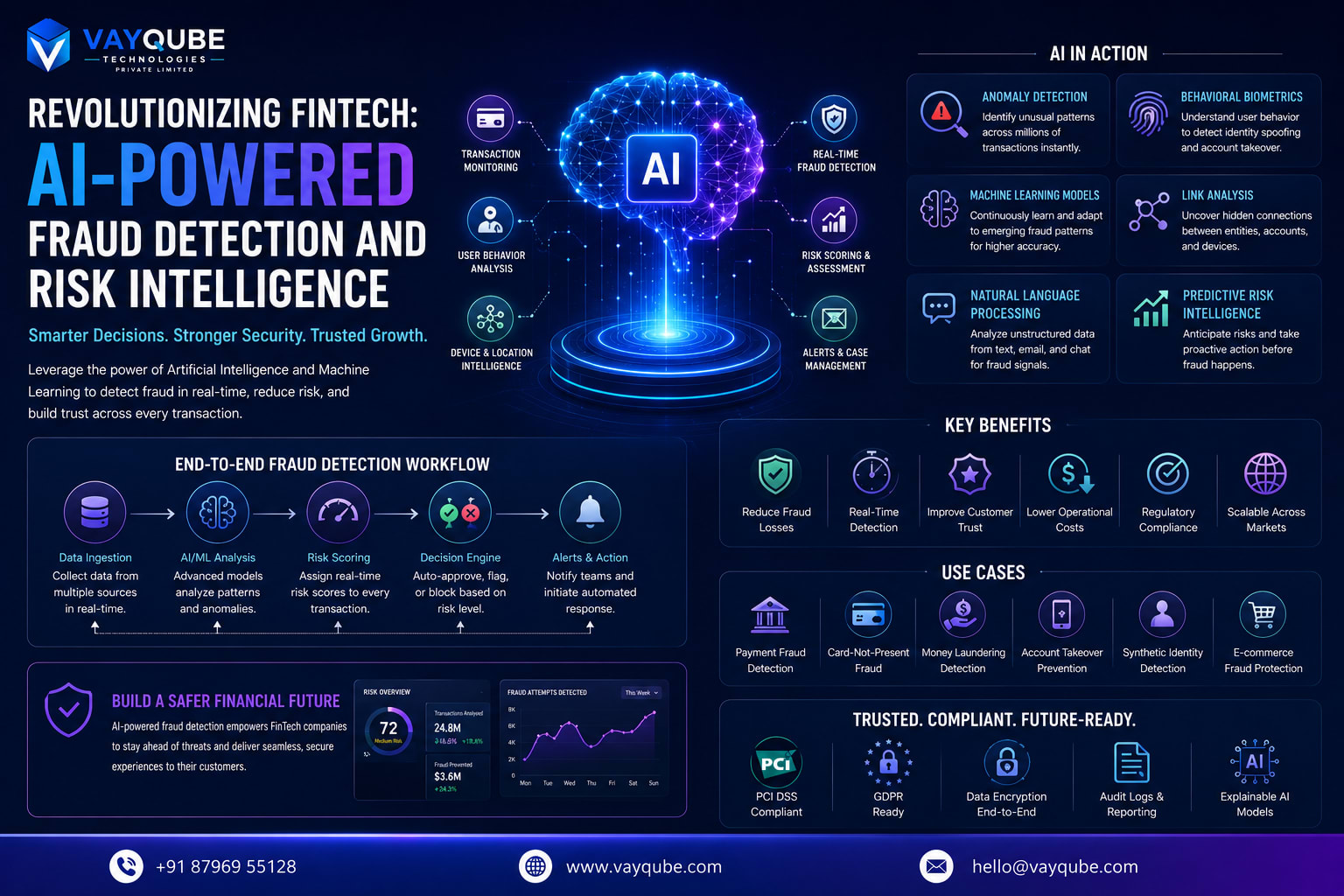
Introduction to AI-Powered Fraud Detection
The financial sector has witnessed a significant surge in fraudulent activities, resulting in substantial losses for institutions and individuals alike. To combat this, FinTech companies have turned to artificial intelligence (AI) as a means to revolutionize fraud detection and risk intelligence. AI-powered fraud detection systems utilize machine learning algorithms to analyze vast amounts of data, identifying patterns and anomalies that may indicate fraudulent behavior.
The Importance of Risk Intelligence
Risk intelligence is a critical component of the financial sector, enabling institutions to make informed decisions and mitigate potential threats. By leveraging AI-powered risk intelligence, financial institutions can gain a deeper understanding of their customers, transactions, and overall risk profile. This intelligence can be used to develop targeted strategies, reducing the likelihood of fraudulent activities and minimizing potential losses.
Key benefits of AI-powered risk intelligence include:
- Enhanced customer due diligence
- Real-time transaction monitoring
- Improved regulatory compliance
- Increased accuracy in fraud detection
The integration of AI-powered fraud detection and risk intelligence has the potential to transform the financial sector, enabling institutions to operate with greater confidence and security. By harnessing the power of machine learning and data analytics, FinTech companies can develop more effective strategies for preventing and detecting fraudulent activities.
Real-World Applications
In practice, AI-powered fraud detection and risk intelligence can be applied in a variety of ways, such as:
- Predictive modeling to identify high-risk customers or transactions
- Anomaly detection to identify suspicious activity
- Network analysis to identify potential fraud rings
- Machine learning-based decision systems to automate fraud detection and prevention
These applications have the potential to significantly reduce the incidence of fraud, resulting in substantial cost savings and improved customer trust. As the financial sector continues to evolve, the importance of AI-powered fraud detection and risk intelligence will only continue to grow.
Implementation Considerations
When implementing AI-powered fraud detection and risk intelligence, financial institutions must consider several key factors, including:
- Data quality and availability
- Model training and validation
- Regulatory compliance
- Integration with existing systems and infrastructure
By carefully considering these factors, institutions can ensure the effective deployment of AI-powered fraud detection and risk intelligence, minimizing potential risks and maximizing benefits. The successful implementation of these systems requires a deep understanding of both the technical and business aspects of AI-powered fraud detection and risk intelligence.
Why It Matters
Financial fraud is a pervasive issue that affects businesses of all sizes, resulting in significant revenue losses and damage to reputation. The prevalence of financial fraud is staggering, with the FBI's Internet Crime Complaint Center (IC3) reporting over $3.5 billion in losses due to cybercrime in 2020 alone. This highlights the need for effective fraud detection and prevention strategies.
The Impact of Financial Fraud
The consequences of financial fraud can be severe, including:
- Financial losses: Fraud can result in significant revenue losses, which can be devastating for small and medium-sized businesses.
- Damage to reputation: A single incident of fraud can damage a company's reputation and erode customer trust.
- Regulatory penalties: Businesses that fail to implement effective anti-fraud measures may face regulatory penalties and fines.
Limitations of Traditional Fraud Detection Methods
Traditional fraud detection methods, such as rule-based systems and manual review, have several limitations. These methods are often:
- Time-consuming: Manual review of transactions can be labor-intensive and prone to human error.
- Ineffective: Rule-based systems can be easily circumvented by sophisticated fraudsters.
- Inflexible: Traditional methods may not be able to adapt to changing fraud patterns and tactics.
Benefits of AI-Powered Fraud Detection
Leveraging AI and machine learning for fraud detection offers several benefits, including:
- Improved accuracy: AI-powered systems can analyze vast amounts of data and identify patterns that may indicate fraudulent activity.
- Real-time detection: AI-powered systems can detect and prevent fraud in real-time, reducing the risk of financial losses.
- Scalability: AI-powered systems can handle large volumes of transactions and adapt to changing fraud patterns and tactics.
- Enhanced customer experience: AI-powered systems can help reduce false positives and minimize the impact on legitimate customers.
Core Architecture
The core architecture of an AI-powered fraud detection system is comprised of several key components that work together to identify and prevent fraudulent activities.
Components of the System
The main components of an AI-powered fraud detection system include:
- Data ingestion and processing modules
- Machine learning algorithms and models
- Data analytics and visualization tools
- Integration layers for existing financial systems and infrastructure
- Decision-making and alert systems
These components enable the system to collect and process large amounts of data, identify patterns and anomalies, and make informed decisions about potential fraudulent activities.
Role of Data Analytics and Machine Learning
Data analytics and machine learning algorithms play a crucial role in an AI-powered fraud detection system. They enable the system to analyze large amounts of data, identify complex patterns and relationships, and make predictions about potential fraudulent activities. Machine learning algorithms can be trained on historical data to identify trends and anomalies, and can be continuously updated and refined as new data becomes available.
Integration with Existing Systems
Integration with existing financial systems and infrastructure is also critical to the success of an AI-powered fraud detection system. This includes integration with core banking systems, payment processing systems, and other relevant infrastructure. The system must be able to collect and process data from these systems, and provide real-time alerts and notifications to prevent fraudulent activities.
Implementation Considerations
When implementing an AI-powered fraud detection system, there are several key considerations to keep in mind. These include:
- Data quality and availability
- System scalability and performance
- Integration with existing systems and infrastructure
- Model training and validation
- Ongoing monitoring and maintenance
By carefully considering these factors, organizations can ensure that their AI-powered fraud detection system is effective, efficient, and scalable.
Real-World Applications
In real-world applications, AI-powered fraud detection systems have been shown to be highly effective in identifying and preventing fraudulent activities. For example, a large bank might use an AI-powered fraud detection system to analyze transaction data and identify potential fraudulent activities, such as money laundering or credit card fraud. The system could provide real-time alerts and notifications to prevent these activities, and help the bank to reduce its risk exposure and improve its overall security posture.
Business Benefits
The integration of AI-powered fraud detection and risk intelligence in FinTech has numerous benefits for businesses.
Enhanced Fraud Detection and Prevention
Enhanced fraud detection and prevention capabilities are a key advantage of AI-powered systems. By analyzing patterns and anomalies in real-time, these systems can identify and flag potential fraud attempts, reducing the risk of financial losses. For instance, a payment processing company can use machine learning algorithms to detect suspicious transactions and prevent them from being processed.
Improved Risk Management and Compliance
Improved risk management and compliance are also critical benefits of AI-powered fraud detection and risk intelligence. By providing a comprehensive view of risk exposure, these systems enable businesses to make informed decisions and ensure regulatory compliance. This is particularly important in the FinTech industry, where non-compliance can result in significant fines and reputational damage.
Increased Operational Efficiency and Reduced Costs
The implementation of AI-powered fraud detection and risk intelligence can also lead to increased operational efficiency and reduced costs. Automated systems can process large volumes of data quickly and accurately, reducing the need for manual review and minimizing the risk of human error. Additionally, by reducing the number of false positives, businesses can avoid unnecessary investigations and associated costs. Some key benefits of increased operational efficiency include:
- Reduced manual review time
- Minimized risk of human error
- Lower investigation costs
- Improved customer experience
By leveraging AI-powered fraud detection and risk intelligence, FinTech companies can improve their overall risk management posture, reduce costs, and enhance customer trust. The ability to detect and prevent fraud in real-time is critical in today's fast-paced digital landscape.
Real-World Implementation
In real-world implementations, AI-powered fraud detection and risk intelligence have been shown to be highly effective. For example, a leading digital payment provider used machine learning algorithms to reduce fraud rates by over 50%. This not only resulted in significant cost savings but also improved customer satisfaction and loyalty.
Production Readiness
To ensure production readiness, FinTech companies must carefully evaluate and implement AI-powered fraud detection and risk intelligence solutions. This includes:
- Conducting thorough risk assessments
- Developing comprehensive implementation plans
- Providing ongoing training and support
- Continuously monitoring and evaluating system performance
By taking a strategic and informed approach to implementation, businesses can maximize the benefits of AI-powered fraud detection and risk intelligence and achieve a strong return on investment.
Scalability
To effectively combat financial fraud, a scalable solution is crucial. This involves the ability to handle large volumes of financial transactions, flexibility to adapt to changing fraud patterns and regulatory requirements, and a scalable architecture to support growing business needs.
Handling Large Volumes of Transactions
A scalable AI-powered fraud detection system must be able to process vast amounts of transaction data in real-time, without compromising on speed or accuracy. This is particularly important in the financial sector, where transactions are executed at high velocities and volumes. The system should be capable of analyzing millions of transactions per second, identifying potential fraud patterns, and flagging suspicious activities for further review.
Adapting to Changing Fraud Patterns
Fraud patterns and techniques are constantly evolving, making it essential for the system to be flexible and adaptable. The AI-powered solution should be able to learn from new data, update its models, and adjust its detection strategies to stay ahead of emerging threats. This can be achieved through continuous machine learning, where the system refines its algorithms and rules based on feedback from analysts, new data sources, and changing market conditions.
Scalable Architecture
A scalable architecture is vital to support growing business needs and increasing transaction volumes. The system should be designed to scale horizontally, allowing for the addition of new nodes or instances as required. This ensures that the system can handle increased traffic, process larger volumes of data, and maintain its performance and accuracy. A cloud-based infrastructure can provide the necessary scalability, flexibility, and reliability to support the growing demands of FinTech organizations.
Key considerations for a scalable architecture include:
- Distributed processing and data storage
- Automated scaling and load balancing
- Real-time data processing and analytics
- Integration with existing systems and infrastructure
- Continuous monitoring and maintenance to ensure optimal performance
By incorporating these elements, FinTech organizations can ensure that their AI-powered fraud detection systems are scalable, flexible, and capable of supporting their growing business needs. This enables them to stay ahead of emerging fraud threats, reduce risk, and maintain the trust of their customers.
Implementation Strategy
Implementing a scalable AI-powered fraud detection system requires careful planning, execution, and ongoing maintenance. This involves:
- Collaborating with stakeholders to define requirements and goals
- Designing a scalable architecture that meets current and future needs
- Developing and integrating AI-powered detection models and rules
- Testing and refining the system to ensure accuracy and performance
- Providing ongoing training and support for analysts and users
- Continuously monitoring and updating the system to stay ahead of emerging threats and changing market conditions.
Implementation Challenges
Implementing AI-powered fraud detection and risk intelligence in FinTech requires careful consideration of several key challenges.
Data Quality and Integration Issues
Data quality and integration are critical components of a successful implementation. Poor data quality can lead to biased models, resulting in false positives or false negatives, which can have significant business implications. Additionally, integrating with existing systems and data sources can be complex and time-consuming. To overcome these challenges, it's essential to:
- Develop a robust data governance framework
- Implement data validation and cleansing processes
- Ensure seamless integration with existing systems and data sources
Regulatory Compliance and Security Concerns
Regulatory compliance and security are paramount in FinTech. AI-powered fraud detection and risk intelligence systems must comply with relevant regulations, such as GDPR and PCI-DSS. Moreover, these systems must be designed with security in mind to prevent data breaches and cyber attacks. Key considerations include:
- Ensuring compliance with relevant regulations and industry standards
- Implementing robust security measures, such as encryption and access controls
- Conducting regular security audits and penetration testing
Change Management and Training Requirements
Change management and training are critical to the successful adoption of AI-powered fraud detection and risk intelligence. These systems often require significant changes to business processes and workflows, which can be challenging for employees to adapt to. Furthermore, employees require training to effectively use and interpret the outputs of these systems. To address these challenges, it's essential to:
- Develop a comprehensive change management plan
- Provide ongoing training and support to employees
- Encourage a culture of innovation and experimentation within the organization
Effective management of these implementation challenges is crucial to realizing the business benefits of AI-powered fraud detection and risk intelligence in FinTech. By addressing these challenges head-on, organizations can ensure a smooth and successful implementation, and ultimately improve their ability to detect and prevent fraud.
Real-World Examples
Several FinTech companies have successfully implemented AI-powered fraud detection and risk intelligence, achieving significant reductions in fraud losses and improvements in operational efficiency. For example, a leading digital payments company used machine learning algorithms to detect and prevent fraudulent transactions, resulting in a 30% reduction in fraud losses. Similarly, a major bank used AI-powered risk intelligence to improve its credit risk assessment, resulting in a 25% reduction in bad debt provisions.
Production Considerations
When implementing AI-powered fraud detection and risk intelligence in production, it's essential to consider several key factors, including:
- Model drift and concept drift
- Data quality and availability
- System scalability and performance
- Regulatory compliance and security By carefully considering these factors, organizations can ensure that their AI-powered fraud detection and risk intelligence systems operate effectively and efficiently in production, and provide significant business benefits.
Use Cases
The application of AI-powered fraud detection and risk intelligence in FinTech has numerous use cases that can significantly enhance the security and efficiency of financial transactions.
Real-Time Transaction Monitoring
Real-time transaction monitoring is a critical use case, enabling financial institutions to detect and prevent fraudulent activities as they occur. By analyzing transaction data in real-time, AI algorithms can identify patterns and anomalies that may indicate fraudulent behavior, allowing for swift action to be taken.
Predictive Analytics
Predictive analytics is another key use case, where AI algorithms analyze historical data and real-time market trends to assess the risk of fraudulent activities. This enables financial institutions to take proactive measures to prevent fraud, reducing the risk of financial losses.
AI-Powered Investigation
AI-powered investigation and incident response is a use case that streamlines the process of investigating and responding to fraudulent activities. By analyzing data and identifying patterns, AI algorithms can help investigators to quickly identify the source and scope of fraudulent activities, enabling swift and effective action to be taken.
Some of the benefits of these use cases include:
- Enhanced security and risk management
- Improved efficiency and reduced costs
- Real-time insights and decision-making
- Personalized customer experiences
- Compliance with regulatory requirements
In real-world scenarios, these use cases can be applied in various ways, such as:
- Detecting and preventing credit card fraud
- Identifying and mitigating phishing attacks
- Analyzing and preventing money laundering activities
- Enhancing the security of online banking and mobile payment systems
The implementation of these use cases requires careful consideration of production readiness, including:
- Data quality and availability
- Algorithmic accuracy and reliability
- Scalability and performance
- Integration with existing systems and infrastructure
- Ongoing monitoring and maintenance to ensure optimal performance and adapt to emerging threats.
By leveraging AI-powered fraud detection and risk intelligence, financial institutions can stay ahead of emerging threats and enhance the security and efficiency of their operations.
Best Practices
To maximize the effectiveness of AI-powered fraud detection and risk intelligence, financial institutions must adopt a set of best practices that ensure the integrity and reliability of these systems.
Data-Driven Approach
A data-driven approach is crucial in fraud detection and risk intelligence. This involves leveraging large datasets to train and refine AI models, enabling them to identify complex patterns and anomalies that may indicate fraudulent activity. By continuously updating and expanding these datasets, financial institutions can enhance the accuracy and effectiveness of their AI-powered systems.
Continuous Monitoring and Evaluation
Continuous monitoring and evaluation of AI-powered systems are essential to ensure they remain effective and adapt to emerging threats. This involves regularly assessing the performance of these systems, updating models as necessary, and addressing any potential biases or vulnerabilities. By doing so, financial institutions can maintain the integrity of their fraud detection and risk intelligence capabilities.
Collaboration and Regulatory Compliance
Collaboration between financial institutions and regulatory bodies is vital for the development and implementation of effective AI-powered fraud detection and risk intelligence systems. This collaboration enables the sharing of best practices, the establishment of common standards, and the alignment of these systems with regulatory requirements. By working together, financial institutions and regulatory bodies can create a more secure and transparent financial ecosystem.
Key considerations for effective collaboration include:
- Establishing clear communication channels and protocols
- Defining common goals and objectives
- Sharing knowledge and expertise
- Aligning with regulatory requirements and industry standards
- Fostering a culture of transparency and trust
By adopting these best practices, financial institutions can harness the full potential of AI-powered fraud detection and risk intelligence, minimizing the risk of fraud and enhancing the overall security and integrity of the financial system.
Implementation Strategy
When implementing AI-powered fraud detection and risk intelligence systems, financial institutions should consider a phased approach, starting with a thorough assessment of their current capabilities and vulnerabilities. This assessment should inform the development of a tailored implementation strategy, addressing specific needs and requirements.
The implementation strategy should also include:
- A detailed roadmap for deployment and integration
- A comprehensive training program for personnel
- Ongoing monitoring and evaluation to ensure system effectiveness
- Regular updates and refinements to address emerging threats and vulnerabilities
By taking a structured and informed approach to implementation, financial institutions can ensure the successful integration of AI-powered fraud detection and risk intelligence systems, minimizing disruption and maximizing benefits.
Real-World Applications
In real-world applications, AI-powered fraud detection and risk intelligence systems have proven highly effective in identifying and preventing fraudulent activity. For example, a leading bank implemented an AI-powered system that analyzed transaction data in real-time, identifying and flagging suspicious activity for further review. This system enabled the bank to reduce false positives by 30% and increase the detection rate of actual fraud by 25%.
Such examples demonstrate the tangible benefits of AI-powered fraud detection and risk intelligence, highlighting the potential for significant improvements in security, efficiency, and customer protection.
Production Readiness
To ensure production readiness, financial institutions must thoroughly test and validate their AI-powered fraud detection and risk intelligence systems. This involves simulating real-world scenarios, assessing system performance under various conditions, and addressing any potential issues or vulnerabilities.
By prioritizing production readiness, financial institutions can guarantee the reliability and effectiveness of their AI-powered systems, maintaining the trust and confidence of their customers and stakeholders.
Frequently Asked Questions
The implementation of AI-powered fraud detection and risk intelligence raises several questions and concerns. This section addresses common misconceptions and provides clarity on the future of this technology.
Common Misconceptions
Some of the common questions about AI-powered fraud detection include:
- How does AI-powered fraud detection impact the customer experience?
- Can AI-powered systems replace human analysts entirely?
- What is the potential for AI systems to introduce new biases into the fraud detection process? These questions highlight the need for a balanced approach that leverages the strengths of both human analysis and AI-driven insights.
Data Privacy and Security Concerns
Addressing concerns about data privacy and security is crucial for the widespread adoption of AI-powered fraud detection. Key considerations include:
- Ensuring compliance with relevant data protection regulations
- Implementing robust encryption and access controls
- Regularly auditing and testing systems for vulnerabilities By prioritizing data privacy and security, organizations can build trust in their AI-powered fraud detection systems.
Future Developments and Advancements
The future of AI-powered risk intelligence holds much promise, with potential advancements including:
- Increased use of machine learning and deep learning algorithms
- Integration with other emerging technologies, such as blockchain and IoT
- Development of more sophisticated analytics and visualization tools As the technology continues to evolve, we can expect to see even more effective and efficient fraud detection and risk intelligence solutions.
Real-World Implications
In real-world scenarios, AI-powered fraud detection and risk intelligence can have a significant impact on an organization's bottom line. For example:
- A financial institution can use AI-powered systems to detect and prevent fraudulent transactions, reducing losses and improving customer trust
- An e-commerce company can leverage AI-driven insights to identify and mitigate potential risks, protecting its reputation and revenue By understanding the potential benefits and challenges of AI-powered fraud detection, organizations can make informed decisions about implementation and strategy.
Conclusion
In the rapidly evolving FinTech landscape, AI-powered fraud detection and risk intelligence have emerged as transformative forces. By harnessing the power of artificial intelligence, financial institutions can significantly enhance their ability to identify and mitigate fraudulent activities, thereby protecting their customers and their bottom line.
Key Takeaways and Benefits
The integration of AI in fraud detection offers numerous benefits, including:
- Enhanced accuracy and speed in identifying fraudulent patterns
- Real-time monitoring and response to emerging threats
- Personalized risk assessment for each customer
- Improved compliance with regulatory requirements
- Reduced false positives and enhanced customer experience
Future Outlook and Potential Applications
As AI technology continues to advance, we can expect to see even more sophisticated applications of AI-powered fraud detection. Potential areas of development include:
- Integration with Internet of Things (IoT) devices to detect and prevent fraud in real-time
- Use of machine learning algorithms to predict and prevent fraud based on behavioral patterns
- Development of more advanced biometric authentication methods to prevent identity theft
Call to Action
Financial institutions that adopt AI-powered risk intelligence can gain a significant competitive advantage in the market. By leveraging the power of AI, these institutions can:
- Enhance customer trust and loyalty
- Reduce financial losses due to fraud
- Improve operational efficiency and reduce costs
- Stay ahead of emerging threats and regulatory requirements
To stay ahead of the curve, financial institutions should consider the following steps:
- Assess their current fraud detection capabilities and identify areas for improvement
- Explore AI-powered solutions and evaluate their potential benefits and challenges
- Develop a strategic implementation plan that addresses potential challenges and ensures seamless integration with existing systems
- Continuously monitor and evaluate the effectiveness of their AI-powered fraud detection systems to ensure they remain effective and up-to-date.
Related Vayqube Resources
- How To Build Fintech Application Payments Security Scaling
- Best Mobile App Development Company In New York
- Ai Powered Crm Systems Future Of Customer Management
- Best Mobile App Development Company In India
- Best Mobile App Development Company In Usa
- Best Mobile App Development Company In Uk
Next Step
If your systems are struggling with scalability, automation, architecture complexity, or operational efficiency, it's time to modernize your infrastructure and workflows.
👉 Talk to a Vayqube solution architect and build systems designed for long-term production growth: