
Scaling Payment Processing: How Modern Gateways Handle Millions of Transactions
Learn about the cutting-edge technologies and strategies that enable modern payment gateways to handle massive volumes of transactions, supporting business growth and customer satisfaction.
Vayqube Team
FinTech compliance and secure systems engineering
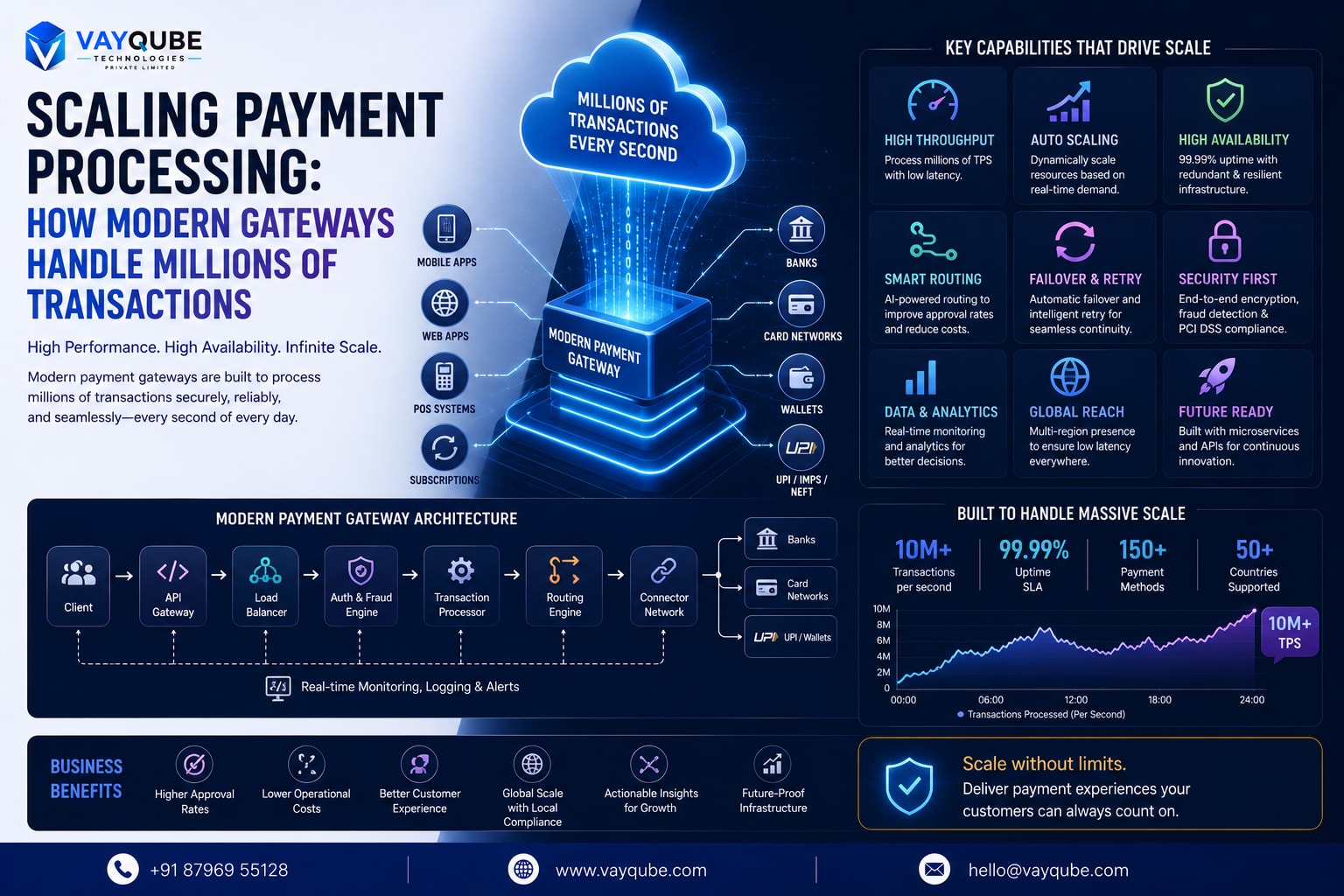
Introduction to Scalable Payment Processing
The payment processing landscape has undergone significant transformations in recent years, driven by the rapid growth of e-commerce and the increasing demand for seamless transaction experiences. At the heart of this evolution are payment gateways, which play a critical role in facilitating transactions between merchants and customers.
The Importance of Payment Processing
Payment processing is the backbone of any business that operates online or offline, enabling companies to receive payments from their customers securely and efficiently. It involves a complex series of steps, from authorization and authentication to settlement and funding, each of which must be executed flawlessly to ensure a smooth transaction experience.
Scalability in Payment Gateways
Scalable payment gateways are essential for businesses that experience high volumes of transactions, especially during peak periods or special events. These gateways must be capable of handling millions of transactions without compromising on speed, security, or reliability. The importance of scalability cannot be overstated, as it directly impacts a business's ability to capitalize on sales opportunities and maintain customer satisfaction.
Key characteristics of scalable payment gateways include:
- High transaction throughput
- Low latency
- Advanced security features
- Real-time reporting and analytics
- Integration with multiple payment methods and processors
Real-World Implications
In real-world scenarios, the inability to scale payment processing can lead to lost sales, damaged brand reputation, and significant financial losses. For instance, during holiday seasons or special promotions, businesses may experience a surge in transactions. If their payment gateway is not designed to handle this increased volume, it can result in declined transactions, frustrated customers, and ultimately, a loss of revenue.
As the digital payment ecosystem continues to evolve, the demand for scalable, secure, and reliable payment gateways will only continue to grow. Businesses must prioritize the implementation of modern payment gateways that can adapt to their growing needs, ensure seamless transaction experiences, and drive long-term growth and profitability.
Implementation Considerations
When implementing a scalable payment gateway, businesses should consider several factors, including:
- Compatibility with existing infrastructure
- Support for multiple payment methods
- Advanced security and compliance features
- Real-time monitoring and analytics capabilities
- Scalability and reliability under high traffic conditions
By carefully evaluating these factors and selecting a payment gateway that aligns with their business needs, companies can ensure a seamless and secure transaction experience for their customers, while also positioning themselves for long-term success in an increasingly competitive market.
Why It Matters
Inadequate payment processing can have severe consequences on a business, including lost sales, damaged reputation, and decreased customer satisfaction. When a payment gateway is unable to handle a high volume of transactions, it can lead to declined payments, slow processing times, and frustrated customers. This can result in a loss of revenue and a competitive disadvantage in the market.
Consequences of Inadequate Payment Processing
Some of the consequences of inadequate payment processing include:
- Declined payments and lost sales
- Increased customer complaints and support requests
- Damage to brand reputation and customer trust
- Decreased customer satisfaction and loyalty
- Inefficient use of resources and increased operational costs
In contrast, efficient transaction handling can have numerous benefits for a business. By implementing a modern payment gateway, companies can improve their payment processing capabilities, reduce the risk of declined payments, and enhance the overall customer experience.
Benefits of Efficient Transaction Handling
The benefits of efficient transaction handling include:
- Increased revenue and reduced lost sales
- Improved customer satisfaction and loyalty
- Enhanced brand reputation and customer trust
- Reduced operational costs and improved resource allocation
- Ability to handle high volumes of transactions and scale business operations
Efficient payment processing is critical for businesses that operate in high-volume industries, such as e-commerce, gaming, and financial services. By investing in a modern payment gateway, companies can ensure that their payment processing systems are scalable, reliable, and secure, and can handle millions of transactions per day. This can help businesses to stay competitive, improve their bottom line, and provide a better experience for their customers.
In real-world scenarios, efficient payment processing can be the difference between a successful business and one that struggles to stay afloat. For example, a company that processes payments for online transactions needs to be able to handle a high volume of payments in a short amount of time, while also ensuring that each payment is secure and reliable. By implementing a modern payment gateway, this company can improve its payment processing capabilities, reduce the risk of declined payments, and enhance the overall customer experience.
The implementation of a modern payment gateway requires careful consideration of several factors, including scalability, security, and compliance with industry regulations. Businesses must ensure that their payment processing systems are able to handle high volumes of transactions, while also protecting sensitive customer information and complying with relevant laws and regulations. By taking a strategic approach to payment processing, companies can improve their efficiency, reduce their costs, and provide a better experience for their customers.
Core Architecture
The core architecture of modern payment gateways is designed to handle millions of transactions efficiently and securely. At its core, a payment gateway consists of several key components and technologies that work together to facilitate seamless transactions.
Key Components
The main components of a modern payment gateway include:
- Payment processing engines
- Transaction databases
- Security and compliance modules
- Integration layers for merchant and bank connectivity
- Scalable infrastructure and load balancing systems
These components are interconnected to ensure that transactions are processed quickly, securely, and reliably. The payment processing engines handle the core transaction logic, while the transaction databases store and manage transaction data.
Technologies and Infrastructure
Modern payment gateways leverage a range of technologies and infrastructure to ensure scalability and performance. These include:
- Cloud-based infrastructure for scalability and reliability
- Containerization and orchestration tools for efficient deployment and management
- Advanced security protocols and encryption methods to protect sensitive data
- Real-time analytics and monitoring tools to optimize performance and detect potential issues
The use of cloud-based infrastructure and containerization enables payment gateways to scale quickly and efficiently, handling large volumes of transactions without compromising performance. Advanced security protocols and encryption methods ensure that sensitive data is protected, reducing the risk of fraud and data breaches.
Implementation Considerations
When implementing a modern payment gateway, several factors must be considered to ensure successful deployment and operation. These include:
- Compliance with regulatory requirements and industry standards
- Integration with existing merchant and bank systems
- Scalability and performance testing to ensure reliability under heavy loads
- Ongoing monitoring and maintenance to detect and resolve potential issues
By carefully considering these factors and leveraging the right technologies and infrastructure, payment gateways can be designed and implemented to handle millions of transactions efficiently and securely. This enables businesses to focus on growth and development, rather than worrying about the complexities of payment processing.
Real-World Examples
In real-world scenarios, modern payment gateways have been successfully deployed by companies such as Stripe, PayPal, and Square. These companies have leveraged advanced technologies and infrastructure to build scalable and secure payment processing systems, handling millions of transactions daily. By studying these examples and understanding the key components and technologies involved, businesses can gain valuable insights into the design and implementation of modern payment gateways.
Production Readiness
To ensure production readiness, payment gateways must undergo rigorous testing and validation. This includes performance testing, security testing, and compliance testing to ensure that the system meets regulatory requirements and industry standards. By carefully testing and validating the payment gateway, businesses can ensure that it is reliable, secure, and scalable, handling millions of transactions efficiently and effectively.
Business Benefits
The implementation of modern payment gateways can have a significant impact on a business's bottom line. By handling millions of transactions efficiently, companies can experience increased revenue through improved transaction processing. This is achieved by reducing declined transactions, minimizing latency, and providing a seamless payment experience for customers.
Revenue Growth
Increased revenue is a direct result of improved transaction processing. Modern payment gateways can handle a high volume of transactions, reducing the likelihood of declined payments and lost sales. This, in turn, leads to increased customer satisfaction and loyalty, as customers are more likely to return to a business that provides a hassle-free payment experience.
Enhanced Customer Experience
A modern payment gateway provides an enhanced customer experience, leading to increased loyalty and retention. By offering a range of payment options, businesses can cater to different customer preferences, making it easier for them to complete transactions. Some key features that contribute to an enhanced customer experience include:
- Fast and secure payment processing
- Real-time payment tracking and updates
- Support for multiple payment methods
- Personalized payment experiences through data analytics
Loyalty and Retention
Customer loyalty and retention are critical components of a successful business strategy. By providing a seamless and efficient payment experience, businesses can build trust with their customers, leading to increased loyalty and retention. This, in turn, can lead to positive word-of-mouth, online reviews, and repeat business, all of which are essential for driving revenue growth and expansion.
Real-World Examples
In real-world scenarios, businesses that have implemented modern payment gateways have seen significant improvements in transaction processing and customer satisfaction. For example, companies like Stripe and PayPal have developed payment gateways that can handle millions of transactions per day, providing businesses with a reliable and efficient way to process payments. By leveraging these gateways, businesses can focus on growth and expansion, rather than worrying about the technical aspects of payment processing.
Production Considerations
When implementing a modern payment gateway, there are several production considerations that businesses must take into account. These include ensuring scalability, security, and compliance with regulatory requirements. By carefully evaluating these factors, businesses can ensure a smooth and efficient payment experience for their customers, leading to increased revenue and loyalty. Some key production considerations include:
- Scalability and performance
- Security and compliance
- Integration with existing systems
- Support and maintenance
- Continuous monitoring and optimization
Scalability
To handle millions of transactions, modern payment gateways rely on two key strategies: horizontal scaling and load balancing, as well as database optimization for high-volume transactions.
Horizontal Scaling and Load Balancing
Horizontal scaling allows payment gateways to increase their processing capacity by adding more servers to their infrastructure. This approach enables them to distribute the workload across multiple machines, ensuring that no single server becomes a bottleneck. Load balancing plays a critical role in this setup, as it directs incoming traffic to the most available server, minimizing downtime and ensuring optimal performance. By combining horizontal scaling with load balancing, payment gateways can efficiently manage large volumes of transactions, even during peak periods.
Database Optimization
Database optimization is crucial for handling high-volume transactions. Payment gateways use various techniques to optimize their databases, including:
- Indexing and caching to reduce query times
- Partitioning to distribute data across multiple servers
- Using in-memory databases to reduce latency
- Implementing connection pooling to manage a large number of concurrent connections By optimizing their databases, payment gateways can ensure that transactions are processed quickly and efficiently, even when dealing with massive volumes of data.
Real-World Implementation
In real-world scenarios, payment gateways often implement a combination of these strategies to achieve scalability. For example, a payment gateway might use a cloud-based infrastructure to scale horizontally, while also implementing database optimization techniques to ensure fast transaction processing. By taking a multi-faceted approach to scalability, payment gateways can ensure that they can handle millions of transactions without compromising performance or reliability.
Production Considerations
When implementing scalability solutions in production, payment gateways must consider several key factors, including:
- Monitoring and analytics to detect bottlenecks and areas for improvement
- Automated testing and deployment to ensure smooth rollout of new features and updates
- Disaster recovery and business continuity planning to minimize downtime in the event of an outage
- Security and compliance measures to protect sensitive transaction data By carefully considering these production factors, payment gateways can ensure that their scalability solutions are effective, reliable, and secure.
Implementation Challenges
When implementing a modern payment gateway to handle millions of transactions, several challenges arise that can impact the success of the project. Two key considerations are security and compliance, as well as integration with existing systems and infrastructure.
Security and Compliance Considerations
Security and compliance are paramount in payment processing, as sensitive customer information is involved. Gateways must adhere to industry standards such as PCI-DSS, GDPR, and HIPAA, depending on the region and type of data being processed. Ensuring the security of transactions and the compliance of the gateway with these regulations is crucial to avoid data breaches and hefty fines. This includes implementing robust encryption methods, secure tokenization, and regular security audits to identify and address potential vulnerabilities.
Integration with Existing Systems
Integrating the payment gateway with existing systems and infrastructure can be complex and time-consuming. This includes connecting with e-commerce platforms, ERP systems, and other software applications that are critical to business operations. A well-planned integration strategy is necessary to ensure seamless communication between systems, minimize downtime, and reduce the risk of errors or lost transactions. Using APIs, webhooks, and other integration tools can facilitate this process, but careful consideration must be given to the specific requirements of each system and the potential impact on overall system performance.
Some key factors to consider when integrating a payment gateway with existing systems include:
- Compatibility with various payment methods and currencies
- Support for recurring payments and subscriptions
- Ability to handle refunds, chargebacks, and disputes
- Real-time reporting and analytics capabilities
- Scalability to handle increased transaction volumes
By carefully addressing these implementation challenges, businesses can ensure a smooth and successful integration of their payment gateway, providing a solid foundation for handling millions of transactions securely and efficiently.
Use Cases
The modern payment gateway has become an essential component of various industries, enabling businesses to process millions of transactions efficiently. Two significant use cases for these gateways are e-commerce and online retail, as well as financial institutions and banking.
E-commerce and Online Retail
In the e-commerce and online retail space, modern payment gateways play a crucial role in facilitating smooth transactions. Key aspects of their implementation include:
- Handling high volumes of transactions during peak shopping seasons
- Supporting multiple payment methods, such as credit cards, PayPal, and Apple Pay
- Ensuring security and compliance with regulations like PCI-DSS
- Providing real-time transaction monitoring and analytics
For instance, an online retailer can integrate a modern payment gateway into their platform to offer a seamless checkout experience for customers. This integration enables the retailer to process transactions quickly, reduce cart abandonment rates, and increase overall sales.
Financial Institutions and Banking
Financial institutions and banks also leverage modern payment gateways to enhance their payment processing capabilities. Some notable applications include:
- Facilitating real-time fund transfers between accounts
- Supporting cross-border transactions and currency conversions
- Implementing robust security measures to prevent fraud and money laundering
- Providing customers with convenient payment options, such as mobile banking and online bill pay
In the banking sector, modern payment gateways can help institutions improve their operational efficiency, reduce costs, and enhance customer satisfaction. By integrating these gateways into their existing infrastructure, banks can offer a wide range of payment services, from credit card processing to wire transfers, and stay competitive in the market.
The implementation of modern payment gateways in these industries requires careful consideration of factors like scalability, security, and compliance. By understanding the specific use cases and requirements of each industry, businesses can choose the most suitable payment gateway and ensure a successful integration.
As the payment landscape continues to evolve, modern gateways must adapt to emerging trends, such as contactless payments, cryptocurrencies, and open banking. By doing so, they can provide businesses with the flexibility and agility needed to stay ahead in the market and capitalize on new opportunities.
In terms of production readiness, modern payment gateways must be designed to handle high volumes of transactions, ensure low latency, and maintain high availability. This requires careful planning, testing, and optimization to guarantee a seamless payment experience for customers.
Ultimately, the successful implementation of modern payment gateways in e-commerce, online retail, financial institutions, and banking depends on a deep understanding of the underlying technology, industry requirements, and emerging trends. By prioritizing scalability, security, and compliance, businesses can unlock the full potential of these gateways and drive growth in their respective markets.
Best Practices
To ensure seamless payment processing, modern gateways employ several best practices that enable them to handle millions of transactions efficiently.
Optimized Performance
Monitoring and analytics play a crucial role in optimizing performance. By leveraging real-time analytics, payment gateways can identify bottlenecks, detect anomalies, and make data-driven decisions to improve their systems. This includes:
- Tracking key performance indicators (KPIs) such as transaction success rates, latency, and error rates
- Analyzing user behavior and transaction patterns to anticipate and prepare for peak periods
- Implementing automated alert systems to notify teams of potential issues before they become critical
Quality Assurance
Continuous testing and quality assurance are essential for ensuring the reliability and security of payment gateways. This involves:
- Conducting regular load testing to simulate high-traffic scenarios and identify potential weaknesses
- Implementing automated testing frameworks to validate the functionality and performance of new features and updates
- Performing thorough security audits and penetration testing to identify vulnerabilities and ensure compliance with industry standards
By adopting these best practices, payment gateways can minimize downtime, reduce errors, and provide a seamless payment experience for users. This, in turn, helps to build trust, increase customer satisfaction, and drive business growth.
Implementation Considerations
When implementing these best practices, it's essential to consider the specific needs and requirements of your payment gateway. This includes:
- Evaluating the scalability and flexibility of your monitoring and analytics tools
- Developing a comprehensive testing strategy that balances automation with manual testing
- Ensuring that your quality assurance processes are integrated into your overall development workflow and aligned with industry standards and regulations.
By taking a proactive and strategic approach to monitoring, testing, and quality assurance, payment gateways can ensure optimal performance, reliability, and security – even at scale. This enables them to handle millions of transactions efficiently, provide a seamless user experience, and drive business success.
Real-World Applications
In real-world scenarios, these best practices have been successfully applied by payment gateways to improve their performance, reliability, and security. For example:
- A leading payment gateway used real-time analytics to identify and resolve a critical issue that was causing a significant number of failed transactions
- A fintech company implemented automated testing and quality assurance processes to reduce their testing time by 50% and improve their overall code quality
- A payment processor used continuous monitoring and analytics to detect and prevent a potential security breach, protecting sensitive user data and preventing financial losses.
These examples demonstrate the importance of implementing best practices in payment processing and highlight the benefits of optimized performance, continuous testing, and quality assurance.
Frequently Asked Questions
To address common concerns and misconceptions about payment gateway scalability, we've compiled a list of frequently asked questions.
Common Questions About Scalability
Some of the most common questions about payment gateway scalability include:
- How do modern payment gateways handle sudden spikes in transaction volume?
- What measures are in place to prevent downtime and ensure continuous processing?
- How do payment gateways ensure security and compliance while scaling?
- What is the impact of scalability on payment processing fees and costs?
Addressing Concerns and Misconceptions
Many businesses have concerns about the scalability of payment gateways, including the potential for downtime, security risks, and increased costs. However, modern payment gateways are designed to handle millions of transactions per day, with built-in redundancy and failover systems to prevent downtime. Additionally, payment gateways must comply with strict security and compliance standards, such as PCI-DSS and GDPR, to ensure the protection of sensitive payment information.
Real-World Examples
Real-world examples of scalable payment gateways include those used by large e-commerce platforms, online marketplaces, and financial institutions. These gateways are capable of handling massive volumes of transactions, while maintaining high levels of security, compliance, and uptime. For instance, a large online retailer may use a payment gateway that can handle tens of thousands of transactions per minute, with automatic scaling to handle sudden spikes in volume.
Production Considerations
When evaluating the scalability of a payment gateway, businesses should consider several key factors, including:
- Transaction volume and velocity
- System uptime and availability
- Security and compliance measures
- Payment processing fees and costs
- Integration requirements and compatibility By carefully evaluating these factors, businesses can ensure that their payment gateway is scalable, secure, and reliable, and can handle the demands of a growing customer base.
Implementation Strategies
To ensure a smooth implementation of a scalable payment gateway, businesses should develop a comprehensive implementation strategy, including:
- Conducting thorough testing and quality assurance
- Developing a robust integration plan
- Providing ongoing training and support
- Monitoring system performance and uptime By following these strategies, businesses can ensure a successful implementation of a scalable payment gateway, and provide a seamless payment experience for their customers.
Conclusion
In scaling payment processing, modern gateways play a crucial role in handling millions of transactions efficiently. The key to their success lies in their ability to adapt, innovate, and ensure seamless integration with various payment systems.
Summary of Key Takeaways
The core architecture of modern payment gateways is designed to facilitate scalability, security, and reliability. This includes:
- Distributed systems to handle high volumes of transactions
- Advanced security protocols to protect sensitive information
- Real-time analytics for monitoring and optimization
- Flexible integration options for merchants and developers
Future of Payment Processing and Scalability
As the digital payment landscape continues to evolve, the demand for scalable and secure payment processing solutions will only increase. Emerging technologies like blockchain, artificial intelligence, and the Internet of Things (IoT) will play a significant role in shaping the future of payment processing. The ability of modern gateways to adapt to these changes and innovate will be crucial in meeting the evolving needs of businesses and consumers.
Production Readiness and Real-World Examples
In real-world scenarios, the implementation of scalable payment processing solutions has enabled businesses to expand their customer base, increase revenue, and improve overall customer experience. For instance, companies like Stripe and PayPal have successfully demonstrated the power of modern payment gateways in handling millions of transactions daily. Their success can be attributed to a combination of robust architecture, strategic partnerships, and a customer-centric approach.
Looking Ahead
The future of payment processing is exciting and full of possibilities. As technology advances and new innovations emerge, the potential for growth and expansion in the digital payment space is vast. By understanding the importance of scalability, security, and innovation in payment processing, businesses can position themselves for success in an increasingly competitive market. The key to achieving this success lies in the ability to adapt, innovate, and stay ahead of the curve in an ever-evolving landscape.
Related Vayqube Resources
- How To Build Fintech Application Payments Security Scaling
- Best Fintech Software Development Company In Singapore City
- Best Mobile App Development Company In Singapore City
- Best Fintech Software Development Company In Usa
- Best Fintech Software Development Company In New York
- Best Mobile App Development Company In Usa
Next Step
If your systems are struggling with scalability, automation, architecture complexity, or operational efficiency, it's time to modernize your infrastructure and workflows.
👉 Talk to a Vayqube solution architect and build systems designed for long-term production growth: