
Unlocking the Power of UPI: A Behind-the-Scenes Look
Get an in-depth look at the UPI infrastructure and understand how it facilitates fast, secure, and reliable transactions.
Vayqube Team
FinTech compliance and secure systems engineering
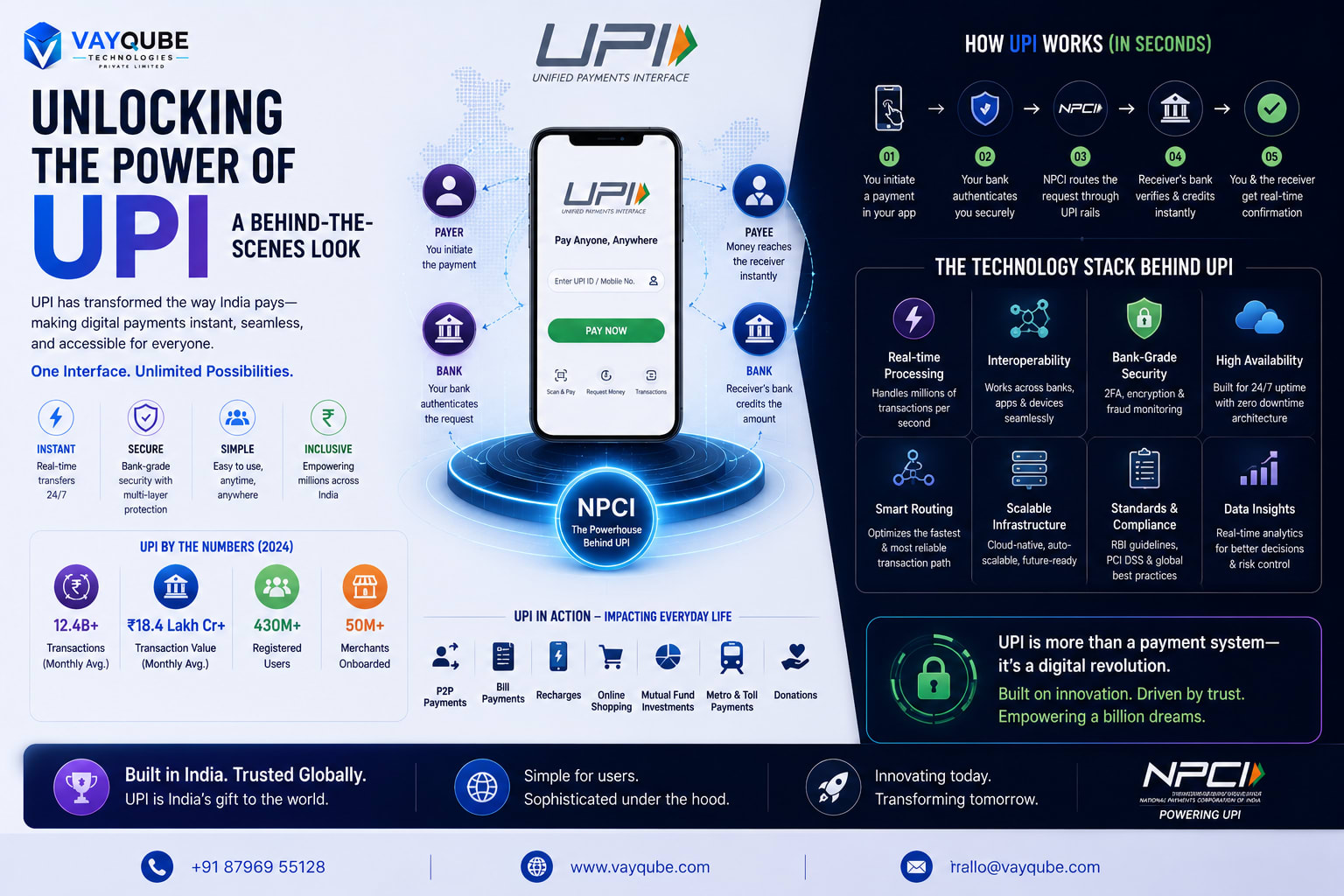
Introduction to UPI
The Unified Payments Interface (UPI) has revolutionized the way individuals and businesses make transactions in India. With its simplicity, speed, and convenience, UPI has become an essential part of the country's digital payment ecosystem. In this section, we will delve into the significance of UPI and its brief history.
Overview of UPI
UPI is a real-time payment system that enables users to transfer funds between bank accounts using a virtual address. This innovative system has made transactions faster, cheaper, and more accessible, contributing significantly to India's digital economy. The impact of UPI can be seen in various aspects of the economy, from person-to-person transactions to business-to-business payments.
Brief History and Evolution of UPI
The concept of UPI was first introduced by the National Payments Corporation of India (NPCI) in 2016. Since its launch, UPI has undergone significant transformations, with continuous updates and improvements to its infrastructure. The introduction of UPI 2.0 in 2018, for example, added new features such as overdraft accounts and invoice sharing, further enhancing the user experience. Today, UPI is one of the most widely used payment systems in India, with millions of transactions taking place every day.
Key factors that have contributed to the success of UPI include:
- Simplified transaction process
- Increased accessibility through mobile devices
- Reduced transaction costs
- Enhanced security features
- Collaboration between banks, fintech companies, and the government
The evolution of UPI is a testament to the power of collaboration and innovation in the financial technology sector. As UPI continues to grow and expand its reach, it is essential to understand the behind-the-scenes mechanisms that drive this system and explore its potential for future growth and development.
Why It Matters
The importance of UPI in digital payments cannot be overstated. As a payment system, UPI has revolutionized the way individuals and businesses transact online. Its impact on financial inclusion and the economy as a whole has been significant, with far-reaching consequences for the country's economic growth and development.
Financial Inclusion
UPI has played a crucial role in promoting financial inclusion, particularly in rural and underserved areas. By providing a simple, secure, and low-cost payment system, UPI has enabled millions of people to access financial services and participate in the digital economy. This, in turn, has helped to reduce poverty and inequality, and has created new opportunities for economic growth and development.
Some of the key benefits of UPI in terms of financial inclusion include:
- Increased access to financial services for underserved populations
- Reduced transaction costs and improved affordability
- Enhanced security and convenience for users
- Increased financial literacy and awareness among users
Economic Impact
The impact of UPI on the economy has been substantial, with significant benefits for businesses, governments, and individuals. Some of the key economic benefits of UPI include:
- Increased efficiency and reduced transaction costs for businesses
- Improved tax compliance and revenue collection for governments
- Enhanced consumer protection and security for individuals
- Increased economic growth and development, driven by increased digital transactions and financial inclusion
Real-World Examples
The impact of UPI can be seen in various real-world examples, such as:
- The growth of e-commerce and digital payments in rural areas
- The increased use of UPI for bill payments, ticketing, and other transactions
- The development of new financial products and services, such as digital wallets and payment apps
- The improvement in financial literacy and awareness among users, particularly in underserved areas
Production Considerations
As UPI continues to grow and evolve, there are several production considerations that need to be taken into account. These include:
- Ensuring the security and integrity of transactions
- Improving the user experience and interface
- Enhancing the scalability and reliability of the system
- Addressing regulatory and compliance requirements
By understanding the importance of UPI and its impact on financial inclusion and the economy, we can better appreciate the need for continued innovation and investment in this area. As we move forward, it will be essential to address the production considerations and challenges associated with UPI, in order to ensure its continued growth and success.
Core Architecture
The Unified Payments Interface (UPI) is built on a robust infrastructure that enables seamless transactions between banks, merchants, and customers. At its core, UPI is a payment system that facilitates the transfer of funds between bank accounts using a virtual address.
Technical Overview
The UPI infrastructure is designed to be scalable, secure, and efficient. It uses a combination of existing payment systems and new technologies to enable fast and convenient transactions. The technical overview of UPI infrastructure involves multiple stakeholders, including:
- Banks: Provide the underlying payment infrastructure and manage customer accounts
- Payment Service Providers (PSPs): Facilitate transactions between banks and merchants
- Third-Party Application Providers (TPAPs): Offer UPI-enabled apps for customers to make transactions
- National Payments Corporation of India (NPCI): Oversees the UPI ecosystem and provides the necessary infrastructure
Key Components
The key components of the UPI infrastructure include:
- Virtual Address: A unique identifier that maps to a customer's bank account, allowing for secure and convenient transactions
- Payment Service Provider (PSP) infrastructure: Enables the routing of transactions between banks and merchants
- UPI Server: Manages the flow of transactions and ensures secure authentication and authorization
- Bank Interface: Enables communication between the UPI server and the bank's core banking system
Stakeholders Involved
The UPI ecosystem involves multiple stakeholders, each playing a critical role in the transaction process. These stakeholders include:
- Customers: Use UPI-enabled apps to make transactions
- Merchants: Accept UPI payments for goods and services
- Banks: Provide the underlying payment infrastructure and manage customer accounts
- Regulators: Oversee the UPI ecosystem and ensure compliance with regulatory requirements
Implementation Strategy
To implement UPI, banks and merchants must integrate their systems with the UPI infrastructure. This involves:
- Developing UPI-enabled apps and interfaces
- Integrating with the UPI server and PSP infrastructure
- Ensuring compliance with regulatory requirements and security standards
- Testing and certifying the implementation to ensure seamless transactions and customer experience.
Business Benefits
The introduction of UPI has revolutionized the way businesses and individuals conduct transactions. One of the primary advantages of UPI is the significant cost savings it offers. By eliminating the need for physical currency and reducing the reliance on traditional banking systems, UPI enables faster and more efficient transactions.
Cost Savings and Efficiency
The cost savings associated with UPI are substantial, particularly for businesses that process a high volume of transactions. With UPI, businesses can reduce their transaction fees, which can lead to significant savings over time. Additionally, UPI enables businesses to streamline their payment processes, reducing the time and resources required to manage transactions. This increased efficiency can have a direct impact on a company's bottom line, allowing them to allocate resources more effectively.
Some of the key benefits of UPI for businesses include:
- Reduced transaction fees
- Increased transaction efficiency
- Improved cash flow management
- Enhanced customer experience
- Simplified payment processing
Increased Transaction Efficiency
UPI's real-time payment processing capability is a game-changer for businesses. It enables them to receive payments instantly, reducing the wait time for transactions to be processed. This increased efficiency can have a significant impact on a company's cash flow, allowing them to manage their finances more effectively. Furthermore, UPI's automated payment processing reduces the risk of human error, minimizing the likelihood of transaction disputes and related issues.
In real-world scenarios, UPI has been instrumental in transforming the way businesses operate. For instance, e-commerce companies have seen a significant reduction in transaction failures, resulting in improved customer satisfaction and increased sales. Similarly, small and medium-sized enterprises (SMEs) have benefited from UPI's cost-effective and efficient payment processing, enabling them to compete more effectively in the market.
Implementation and Production Readiness
To leverage the benefits of UPI, businesses must ensure they are production-ready. This involves implementing UPI-compatible payment systems, training staff, and developing strategies to optimize transaction efficiency. By doing so, businesses can unlock the full potential of UPI, driving growth, improving customer satisfaction, and gaining a competitive edge in the market.
Scalability
To support the growing demand for digital payments, the Unified Payments Interface (UPI) must be able to handle high transaction volumes. The ability of UPI to scale and accommodate increasing traffic is crucial for its success.
Handling High Transaction Volumes
UPI's architecture is designed to handle large volumes of transactions, making it an attractive option for businesses and individuals alike. With its robust infrastructure, UPI can process thousands of transactions per second, ensuring seamless and efficient payments. This scalability feature enables UPI to support a wide range of use cases, from small peer-to-peer transactions to large business-to-business payments.
Scalability Features
Some of the key scalability features of UPI include:
- Load balancing to distribute traffic evenly across multiple servers
- Auto-scaling to dynamically adjust resources based on demand
- Redundancy to ensure high availability and minimize downtime
- Advanced caching mechanisms to reduce latency and improve performance
Future Roadmap
The National Payments Corporation of India (NPCI), the governing body behind UPI, has a clear roadmap for future scalability enhancements. Some of the planned initiatives include:
- Implementing advanced technologies like artificial intelligence and machine learning to optimize payment processing
- Enhancing security features to protect against emerging threats
- Expanding UPI's reach to new markets and geographies
- Introducing new features and services to improve user experience and increase adoption
Production Considerations
As UPI continues to grow and evolve, it's essential to consider production readiness and the ability to handle large volumes of transactions in a live environment. This includes:
- Ensuring adequate infrastructure and resources to support high traffic
- Implementing robust monitoring and analytics to detect and respond to issues
- Conducting regular stress testing and performance optimization to identify bottlenecks
- Maintaining a strong focus on security and compliance to protect sensitive user data
Real-World Examples
Several businesses and organizations have already leveraged UPI's scalability features to support their payment needs. For example, popular e-commerce platforms and ride-hailing services use UPI to process millions of transactions daily. These use cases demonstrate the power and flexibility of UPI, highlighting its potential to support a wide range of applications and industries.
Implementation Challenges
Implementing UPI can be a complex process, and businesses often encounter several challenges along the way. Some of the common obstacles faced during UPI implementation include:
- Technical integration issues, such as ensuring seamless communication between different systems and networks
- Security concerns, like protecting sensitive user data and preventing fraudulent transactions
- Compliance with regulatory requirements, such as adhering to guidelines set by the National Payments Corporation of India (NPCI)
- User adoption and education, as many consumers may be unfamiliar with UPI and its benefits
Overcoming Technical Hurdles
To overcome these technical challenges, businesses can leverage the expertise of experienced implementation partners. These partners can provide guidance on integrating UPI with existing systems, ensuring a smooth and secure transaction process. Additionally, businesses can invest in robust testing and quality assurance processes to identify and resolve any technical issues before they become major problems.
Best Practices for Success
Some best practices for overcoming UPI implementation challenges include:
- Conducting thorough risk assessments to identify potential security vulnerabilities
- Developing comprehensive user education programs to promote adoption and reduce support queries
- Collaborating with regulators and industry bodies to ensure compliance with relevant guidelines and standards
- Continuously monitoring and evaluating the performance of UPI systems to identify areas for improvement
Real-World Examples
In real-world scenarios, businesses have successfully overcome UPI implementation challenges by taking a phased approach, focusing on one aspect of the system at a time. For example, a large e-commerce company may start by integrating UPI with its payment gateway, before expanding to other areas of its platform. By taking a structured and incremental approach, businesses can reduce the complexity and risk associated with UPI implementation.
Production Considerations
When implementing UPI in a production environment, businesses must consider factors such as scalability, reliability, and performance. This includes ensuring that systems can handle high volumes of transactions, as well as providing robust support and maintenance processes to minimize downtime and resolve issues quickly. By prioritizing these production considerations, businesses can ensure a seamless and efficient UPI experience for their users.
Use Cases
The adoption of UPI has been widespread across various industries, with numerous real-world examples showcasing its success.
Industry-Specific Applications
UPI's versatility has led to its implementation in multiple sectors, including:
- E-commerce: enabling seamless checkout experiences and reducing transaction failures
- Banking: facilitating instant fund transfers and account-to-account transactions
- Healthcare: streamlining bill payments and insurance claims
- Education: allowing easy fee payments and reducing administrative burdens
Real-World Examples
Several organizations have successfully integrated UPI into their operations, resulting in improved customer experiences and increased efficiency. For instance:
- A leading e-commerce platform saw a significant reduction in cart abandonment rates after implementing UPI as a payment option
- A major bank reported a substantial increase in mobile banking transactions after introducing UPI-based fund transfers
- A healthcare provider simplified its billing process by adopting UPI, resulting in faster payment settlements and reduced administrative costs
Production Considerations
When implementing UPI in a production environment, it's essential to consider factors such as:
- Security: ensuring the integrity of transactions and protecting sensitive user data
- Scalability: designing systems to handle high volumes of transactions and sudden spikes in traffic
- User experience: providing intuitive and seamless payment experiences across various devices and platforms
Success Stories
Companies like Paytm, Google Pay, and PhonePe have successfully leveraged UPI to revolutionize the digital payments landscape in India. These organizations have demonstrated the potential of UPI to drive business growth, improve customer satisfaction, and increase market share. By understanding the use cases and applications of UPI, businesses can unlock new opportunities for innovation and expansion.
Implementation Strategy
To maximize the benefits of UPI, businesses should develop a strategic implementation plan that takes into account their specific industry requirements, technical infrastructure, and customer needs. This may involve:
- Collaborating with UPI experts and technology providers to design and develop customized solutions
- Conducting thorough testing and quality assurance to ensure seamless integration and transaction processing
- Providing ongoing support and maintenance to ensure the continued stability and security of UPI-based systems.
Best Practices
To ensure seamless and secure UPI transactions, it's essential to follow recommended guidelines for implementation and usage. This section outlines the best practices for UPI adoption, focusing on security and compliance considerations.
Security Considerations
When implementing UPI, security should be the top priority. Some key considerations include:
- Encrypting sensitive data, such as user credentials and transaction information
- Implementing robust authentication and authorization mechanisms
- Regularly updating and patching software to prevent vulnerabilities
- Conducting thorough penetration testing and security audits
Compliance Considerations
UPI implementations must also comply with relevant regulations and standards, such as:
- Payment Card Industry Data Security Standard (PCI-DSS)
- General Data Protection Regulation (GDPR)
- Reserve Bank of India (RBI) guidelines for digital payments
- Adhering to these standards ensures the protection of user data and prevents potential legal and financial repercussions
Implementation Guidelines
To ensure a smooth UPI implementation, consider the following guidelines:
- Collaborate with experienced payment gateway providers and UPI experts
- Conduct thorough testing and quality assurance to identify and address potential issues
- Develop a comprehensive user interface that provides a seamless transaction experience
- Establish a robust customer support system to handle user inquiries and concerns
Real-World Examples
Several organizations have successfully implemented UPI, demonstrating its potential for secure and efficient transactions. For instance:
- A leading Indian bank implemented UPI to enable customers to make instant payments using their mobile devices
- A popular e-commerce platform integrated UPI to provide customers with a convenient and secure payment option
- A mobile wallet provider adopted UPI to enable users to make transactions without the need for physical currency
Production Readiness
To ensure production readiness, consider the following factors:
- Scalability: Design the UPI implementation to handle a large volume of transactions and user traffic
- Reliability: Implement robust error handling and redundancy mechanisms to prevent downtime and ensure continuous availability
- Performance: Optimize the system for fast transaction processing and minimal latency
- Monitoring: Establish a comprehensive monitoring system to detect and address potential issues before they impact users
Frequently Asked Questions
The Unified Payments Interface (UPI) has been a game-changer in the digital payments landscape, but it also raises several questions about its usage, benefits, and limitations. In this section, we will address some of the most frequently asked questions about UPI and provide answers and clarifications on common misconceptions.
Security Concerns
One of the most common concerns about UPI is its security. Some of the frequently asked questions include:
- Is UPI secure?
- How does UPI protect user data?
- What happens if a user's phone is lost or stolen?
UPI uses a combination of encryption, two-factor authentication, and secure banking protocols to protect user data and ensure secure transactions. Additionally, UPI allows users to set a unique virtual address, which adds an extra layer of security and makes it difficult for hackers to access user accounts.
Transaction Limits
Another common question about UPI is its transaction limits. Some of the frequently asked questions include:
- What is the maximum transaction limit for UPI?
- Can users increase their transaction limits?
- Are there any charges for transactions above a certain limit?
The transaction limits for UPI vary depending on the bank and the type of account. Generally, the maximum transaction limit for UPI is ₹1 lakh per transaction, but this can vary depending on the bank's policies. Users can increase their transaction limits by contacting their bank and providing additional documentation.
Interoperability
UPI's interoperability is another area of concern for many users. Some of the frequently asked questions include:
- Can users transfer money from one bank to another using UPI?
- Is UPI compatible with all banks?
- Can users use UPI to transfer money to international accounts?
UPI allows users to transfer money from one bank to another, as long as both banks are part of the UPI network. UPI is compatible with most major banks in India, and users can use it to transfer money to any bank account that is linked to a mobile number or a virtual address. However, UPI does not currently support international transactions.
Error Resolution
Despite its many benefits, UPI is not immune to errors and glitches. Some of the frequently asked questions include:
- What happens if a UPI transaction fails?
- How can users resolve errors and glitches with UPI transactions?
- Is there a customer support team available to help with UPI-related issues?
If a UPI transaction fails, users can try to repeat the transaction or contact their bank's customer support team for assistance. UPI has a dedicated customer support team that can help users resolve errors and glitches with UPI transactions. Users can also use the UPI app's built-in support features to report issues and get help.
Conclusion
In conclusion, the power of UPI has revolutionized the payments landscape, offering a seamless and efficient way to transfer funds. The key takeaways from our exploration of UPI include its robust core architecture, numerous business benefits, and scalability.
Summary of Key Takeaways
The main insights gained from delving into UPI are:
- Its ability to facilitate real-time transactions
- The enhanced security measures in place to protect user data
- The significant reduction in transaction costs
- The potential for widespread adoption across various industries
Future Outlook
Looking ahead, the future of UPI holds immense potential. As the payments landscape continues to evolve, UPI is poised to play a pivotal role in shaping the future of digital transactions. With its ease of use, security, and efficiency, UPI is likely to become an indispensable tool for businesses and individuals alike.
Potential of UPI
The potential applications of UPI extend far beyond its current use cases. Some potential areas of growth include:
- Cross-border transactions
- Micro-payments
- Integration with emerging technologies such as blockchain and artificial intelligence
- Expansion into new markets and industries
Real-World Implications
As UPI continues to gain traction, its impact on the payments landscape will be significant. Businesses that adopt UPI will be able to streamline their transactions, reduce costs, and enhance customer experience. Furthermore, the increased adoption of UPI will drive innovation and growth in the fintech sector, leading to new opportunities and applications.
Production Readiness
To ensure production readiness, businesses must carefully consider their implementation strategy, scalability requirements, and potential challenges. By doing so, they can unlock the full potential of UPI and stay ahead of the curve in the rapidly evolving payments landscape.
Next Steps
As we move forward, it is essential to continue monitoring the development and adoption of UPI. By staying informed and adapting to the changing landscape, businesses can harness the power of UPI to drive growth, innovation, and success.
Related Vayqube Resources
- Best Fintech Software Development Company In India
- Best Fintech Software Development Company In Singapore City
- Best Mobile App Development Company In India
- Best Mobile App Development Company In Singapore City
- Top Fintech Software Development Company In India
- Best Fintech Software Development Company In Usa
Next Step
If your systems are struggling with scalability, automation, architecture complexity, or operational efficiency, it's time to modernize your infrastructure and workflows.
👉 Talk to a Vayqube solution architect and build systems designed for long-term production growth: