
Estimating Fintech Software Development Costs
Get insights into the key drivers of fintech software development costs and explore strategies to optimize your budget
Vayqube Team
Author
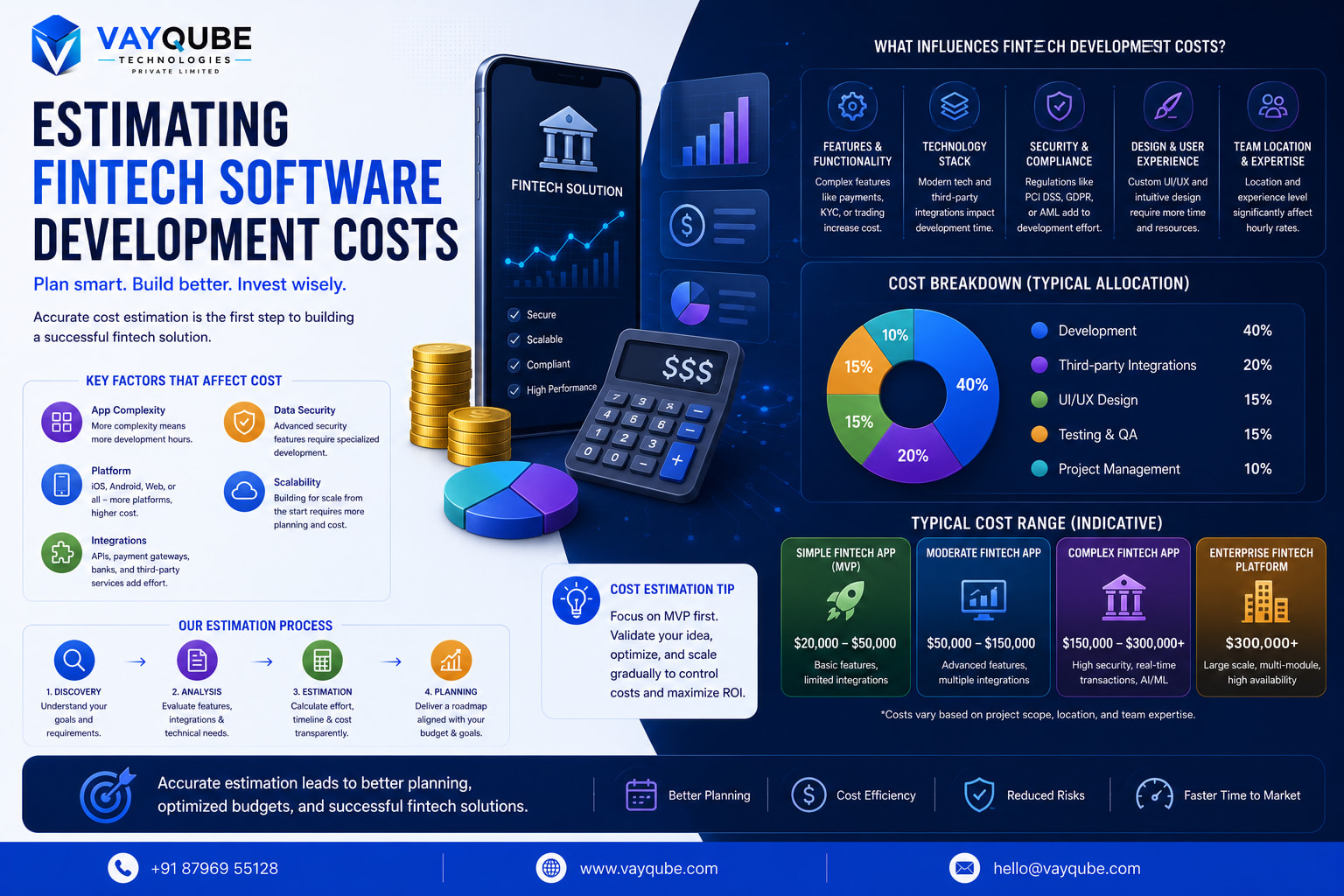
Introduction to Fintech Software Development Costs
The fintech industry has experienced rapid growth in recent years, driven by the increasing demand for digital financial services. As a result, the development of fintech software has become a crucial aspect of this growth, enabling companies to provide innovative and secure financial solutions.
The importance of accurate cost estimation in fintech software development cannot be overstated. Inaccurate estimates can lead to project delays, budget overruns, and ultimately, a loss of competitive advantage.
This article aims to provide a comprehensive guide to estimating fintech software development costs, helping businesses and developers navigate the complex process of planning and budgeting for their fintech projects.
Overview of Fintech Software Development
Fintech software development involves the creation of specialized software applications that cater to the financial sector. These applications can range from mobile payment systems to complex trading platforms, each requiring a unique set of skills and expertise.
Some of the key factors that contribute to the complexity of fintech software development include:
- Stringent regulatory requirements
- High security standards
- Complex data analytics
- Integration with existing financial systems
Importance of Accurate Cost Estimation
Accurate cost estimation is critical in fintech software development, as it enables businesses to:
- Plan and budget effectively
- Make informed decisions about project scope and timelines
- Manage stakeholder expectations
- Ensure the financial viability of the project
Inaccurate cost estimates, on the other hand, can have severe consequences, including:
- Project delays and cancellations
- Budget overruns and cost blowouts
- Loss of competitive advantage
- Damage to reputation and brand
Purpose of the Article
The purpose of this article is to provide a detailed guide to estimating fintech software development costs, including the key factors that influence costs, the different estimation methodologies, and the best practices for ensuring accurate estimates.
By the end of this article, readers will have a comprehensive understanding of the fintech software development cost estimation process, enabling them to make informed decisions about their fintech projects and ensure their successful delivery.
The article will also explore real-world examples of fintech software development projects, highlighting the challenges and opportunities that arise during the estimation and development process.
Additionally, it will discuss the importance of production readiness and scalability in fintech software development, and how these factors can impact the overall cost of the project.
The goal is to provide a practical and informative guide that helps businesses and developers navigate the complex world of fintech software development, and ensures that their projects are delivered on time, within budget, and to the required quality standards.
Why It Matters
Estimating fintech software development costs is a critical aspect of project planning, as it has significant financial implications. Incorrect cost estimation can lead to project delays, resource misallocation, and ultimately, cost overruns.
Financial Implications
The financial implications of incorrect cost estimation can be severe. A project that exceeds its budget can lead to reduced profit margins, strained relationships with investors, and even bankruptcy. Furthermore, cost overruns can also lead to a decrease in the overall quality of the software, as developers may be forced to cut corners to meet the original deadline.
Impact on Project Timelines and Resource Allocation
In addition to financial implications, incorrect cost estimation can also impact project timelines and resource allocation. When a project's budget is exceeded, timelines are often extended, and resources are reallocated to accommodate the increased costs. This can lead to a ripple effect, impacting other projects and initiatives within the organization.
Consequences of Cost Overruns
The consequences of cost overruns can be far-reaching. They can lead to a loss of stakeholder confidence, damage to the organization's reputation, and even legal issues. Moreover, cost overruns can also lead to a decrease in the overall competitiveness of the organization, as resources are diverted from other critical initiatives to cover the excess costs.
Some of the key consequences of cost overruns include:
- Reduced stakeholder confidence
- Damage to the organization's reputation
- Legal issues
- Decreased competitiveness
- Reduced quality of the software
To mitigate these risks, it is essential to develop a comprehensive cost estimation strategy that takes into account all aspects of the project, including development, testing, deployment, and maintenance. By doing so, organizations can ensure that their fintech software development projects are completed on time, within budget, and to the required quality standards.
Real-World Examples
In real-world scenarios, the consequences of cost overruns can be devastating. For instance, a fintech company that exceeds its budget may be forced to lay off employees, reduce its marketing efforts, or even abandon the project altogether. On the other hand, a company that accurately estimates its costs can allocate its resources more effectively, leading to increased efficiency, productivity, and competitiveness.
By understanding the importance of accurate cost estimation, organizations can take a proactive approach to managing their fintech software development projects, minimizing the risk of cost overruns, and ensuring the long-term success of their initiatives.
Production Considerations
In a production environment, the consequences of cost overruns can be even more severe. The pressure to meet deadlines and stay within budget can lead to a decrease in the overall quality of the software, which can have serious consequences in a fintech environment where security and reliability are paramount. Therefore, it is essential to consider production costs and timelines when estimating the overall cost of a fintech software development project.
By taking a holistic approach to cost estimation, organizations can ensure that their fintech software development projects are completed on time, within budget, and to the required quality standards, ultimately leading to increased efficiency, productivity, and competitiveness in the market.
Implementation Strategy
To develop an effective cost estimation strategy, organizations should consider the following:
- Define project scope and requirements
- Identify and allocate resources
- Develop a comprehensive project timeline
- Establish a budget and cost tracking mechanism
- Monitor and adjust the project plan as needed
By following these steps, organizations can ensure that their fintech software development projects are well-planned, well-executed, and completed within the estimated budget and timeline.
Scalability and Business Impact
The scalability and business impact of accurate cost estimation should not be underestimated. By accurately estimating costs, organizations can ensure that their fintech software development projects are aligned with their overall business strategy, leading to increased efficiency, productivity, and competitiveness. Furthermore, accurate cost estimation can also help organizations to identify areas for cost savings, leading to increased profitability and reduced waste.
In the next section, we will explore the factors that affect fintech software development costs, providing a comprehensive overview of the key considerations that organizations should take into account when estimating costs.
Core Architecture
The core architecture of fintech software development is a critical component in determining the overall cost of the project. It encompasses several key elements that must be carefully considered to ensure the development of a robust, scalable, and secure system.
Key Components
The core architecture of fintech software development typically includes:
- Front-end and back-end development
- Database management systems
- Application programming interfaces (APIs)
- Third-party integrations
- Cloud infrastructure and hosting
These components must be designed and implemented in a way that ensures seamless integration, high performance, and robust security.
Technology Stack and Infrastructure Requirements
The technology stack and infrastructure requirements for fintech software development can vary widely depending on the specific needs of the project. However, some common requirements include:
- Programming languages such as Java, Python, or JavaScript
- Frameworks such as Spring, Django, or React
- Databases such as MySQL, PostgreSQL, or MongoDB
- Cloud platforms such as Amazon Web Services (AWS), Microsoft Azure, or Google Cloud Platform (GCP)
The choice of technology stack and infrastructure can have a significant impact on the overall cost of the project, as well as its scalability, performance, and security.
Security and Compliance Considerations
Security and compliance are critical considerations in fintech software development, as sensitive financial data must be protected from unauthorized access and cyber threats. Some key security and compliance considerations include:
- Data encryption and secure storage
- Access controls and authentication
- Regular security audits and testing
- Compliance with regulatory requirements such as PCI-DSS, GDPR, and AML
Ensuring the security and compliance of fintech software development requires specialized expertise and can add significant cost to the project. However, it is essential to protect sensitive financial data and prevent costly cyber attacks.
Implementation Strategy
A well-planned implementation strategy is essential to ensure the successful development and deployment of fintech software. This includes:
- Defining project requirements and scope
- Developing a detailed project timeline and budget
- Assembling a skilled development team
- Conducting regular testing and quality assurance
- Deploying the software in a controlled and secure environment
By carefully considering these factors, organizations can develop a robust and scalable fintech software system that meets their business needs and ensures the security and compliance of sensitive financial data.
Business Benefits
The development of fintech software can have a significant impact on a company's bottom line. By leveraging technology, businesses can streamline their operations, improve customer satisfaction, and gain a competitive edge in the market.
Increased Efficiency and Productivity
Fintech software can automate manual processes, reduce errors, and enhance data analysis. This leads to increased efficiency and productivity, allowing businesses to allocate resources more effectively. For instance, automated payment processing systems can reduce the time spent on manual transactions, freeing up staff to focus on higher-value tasks.
Enhanced Customer Experience
A well-designed fintech software can provide a seamless and intuitive user experience, enabling customers to easily manage their financial transactions and access relevant information. This can lead to increased customer satisfaction, loyalty, and retention. Features such as personalized dashboards, real-time notifications, and mobile accessibility can further enhance the customer experience.
Competitive Advantage through Innovation
By embracing fintech innovation, businesses can differentiate themselves from competitors and establish a leadership position in the market. For example, the use of artificial intelligence (AI) and machine learning (ML) can enable businesses to offer more accurate credit scoring, personalized financial recommendations, and proactive fraud detection. Some key benefits of fintech innovation include:
- Improved risk management
- Enhanced regulatory compliance
- Increased agility and responsiveness to changing market conditions
- Ability to offer new and innovative financial products and services
The successful implementation of fintech software requires careful consideration of various factors, including the business requirements, technical infrastructure, and production readiness. By understanding these factors and leveraging the benefits of fintech innovation, businesses can unlock new opportunities for growth, improve their competitive position, and achieve long-term success.
Implementation Considerations
When implementing fintech software, businesses should consider the following key factors:
- Scalability and flexibility to accommodate growing customer bases and evolving market conditions
- Integration with existing systems and infrastructure to ensure seamless data exchange and minimize disruptions
- Security and compliance to protect sensitive customer data and maintain regulatory adherence
- User experience and adoption to ensure that the software is intuitive, accessible, and meets the needs of diverse customer segments.
Scalability
To ensure the long-term success of a fintech software development project, scalability is a critical factor to consider. Scalability refers to the ability of a system to handle increased load and usage without compromising performance.
Factors Influencing Scalability
Several factors can influence the scalability of a fintech software development project, including:
- The choice of technology stack and architecture
- The design of the system's infrastructure
- The ability to adapt to changing market conditions and user needs
- The implementation of automated testing and deployment processes
Designing for Growth and Flexibility
Designing a fintech software development project with scalability in mind requires careful consideration of the system's architecture and infrastructure. This includes:
- Using modular and microservices-based architectures to enable easy addition of new features and services
- Implementing cloud-based infrastructure to enable easy scaling of resources
- Using agile development methodologies to enable rapid response to changing market conditions and user needs
Cloud-Based Infrastructure and its Benefits
Cloud-based infrastructure provides a number of benefits for fintech software development projects, including:
- On-demand access to scalable resources, such as computing power and storage
- Reduced capital and operational expenses, as resources can be easily scaled up or down as needed
- Improved reliability and uptime, as cloud-based infrastructure provides built-in redundancy and failover capabilities
- Enhanced security, as cloud-based infrastructure provides advanced security features and monitoring capabilities
By considering these factors and designing a fintech software development project with scalability in mind, businesses can ensure that their system is able to handle increased load and usage without compromising performance, and can adapt to changing market conditions and user needs.
Production Readiness
To ensure production readiness, fintech software development projects should prioritize scalability, reliability, and performance. This includes:
- Conducting thorough load testing and performance optimization to ensure the system can handle expected usage
- Implementing monitoring and logging capabilities to enable rapid identification and resolution of issues
- Developing a comprehensive disaster recovery plan to ensure business continuity in the event of an outage or disaster.
Implementation Challenges
Fintech software development projects often encounter unique challenges that can impact the overall cost and success of the implementation. Common obstacles in fintech software development include integrating with legacy systems, ensuring security and compliance, and managing complex project timelines.
Regulatory and Compliance Issues
Addressing regulatory and compliance issues is a critical aspect of fintech software development. Fintech companies must comply with a range of regulations, including anti-money laundering (AML) and know-your-customer (KYC) laws. This requires significant investment in compliance infrastructure, including data storage and security measures. Some key considerations include:
- Ensuring data encryption and secure storage
- Implementing robust access controls and authentication protocols
- Conducting regular security audits and penetration testing
Managing Project Complexity and Timelines
Managing project complexity and timelines is essential to ensuring the successful implementation of fintech software development projects. This involves:
- Breaking down complex projects into manageable components
- Establishing clear project timelines and milestones
- Ensuring effective communication and collaboration between development teams and stakeholders
- Conducting regular project reviews and progress updates to identify and address potential issues
Effective management of project complexity and timelines can help to reduce the risk of cost overruns and delays, and ensure that the final product meets the required specifications and regulatory requirements. By understanding the common obstacles in fintech software development and taking steps to address them, companies can better navigate the implementation process and achieve their business goals.
Real-World Examples
In real-world scenarios, fintech companies have successfully addressed implementation challenges by investing in agile development methodologies, leveraging cloud-based infrastructure, and partnering with experienced development teams. For example, a fintech company developing a mobile payment platform may use agile development to rapidly iterate and test new features, while also ensuring compliance with relevant regulations and security standards. By taking a proactive and flexible approach to implementation, fintech companies can reduce costs, improve time-to-market, and achieve greater business success.
Use Cases
The fintech industry has witnessed numerous successful projects that have leveraged effective cost estimation and management to drive business growth.
Real-World Examples
Some notable examples include:
- Mobile payment platforms that have streamlined transaction processes, reducing costs and enhancing user experience
- Digital lending platforms that have optimized loan disbursement and repayment processes, minimizing default risks
- Blockchain-based systems that have improved security and transparency in financial transactions
These projects demonstrate the importance of accurate cost estimation and management in fintech software development.
Case Studies
Several case studies have highlighted the significance of cost estimation and management in fintech projects. For instance:
- A digital payment company was able to reduce its development costs by 30% by adopting an agile development methodology
- A fintech startup was able to launch its product 20% faster than expected by using cloud-based infrastructure and leveraging cost estimation tools
These case studies provide valuable lessons for fintech companies looking to optimize their software development costs.
Lessons Learned
Industry experiences have shown that effective cost estimation and management are crucial to the success of fintech projects. Some key takeaways include:
- The importance of breaking down complex projects into smaller, manageable tasks to ensure accurate cost estimation
- The need for continuous monitoring and evaluation of project progress to identify potential cost overruns
- The benefits of adopting flexible development methodologies that can adapt to changing project requirements
By learning from these experiences, fintech companies can develop more effective cost estimation and management strategies, ultimately driving business growth and competitiveness.
Production Considerations
When implementing fintech software development projects, companies must consider production readiness and scalability. This includes:
- Ensuring that the developed software can handle increased traffic and user demand
- Implementing robust security measures to protect sensitive financial data
- Developing a reliable maintenance and support strategy to minimize downtime and ensure continuous operation
By prioritizing production considerations, fintech companies can ensure that their software development projects meet the required standards of quality, security, and scalability.
Best Practices
To ensure successful fintech software development, it's essential to follow best practices that promote efficiency, quality, and collaboration.
Agile Development Methodologies
Adopting agile development methodologies is crucial for fintech software development. This approach enables teams to respond quickly to changing requirements, prioritize features, and deliver working software in iterations. By doing so, developers can ensure that the final product meets the stakeholders' expectations and is production-ready.
Continuous Testing and Quality Assurance
Continuous testing and quality assurance are vital components of fintech software development. By integrating automated testing into the development pipeline, teams can identify and fix defects early, reducing the overall cost and time required for testing. This approach also ensures that the software meets the required standards and is reliable, secure, and scalable.
Effective Communication and Stakeholder Management
Effective communication and stakeholder management are critical to the success of fintech software development projects. It's essential to establish clear communication channels, define project goals and objectives, and ensure that all stakeholders are aligned and informed throughout the development process. This includes identifying and managing stakeholder expectations, providing regular progress updates, and addressing any concerns or issues promptly.
Some key considerations for effective communication and stakeholder management include:
- Defining clear project goals and objectives
- Establishing open and transparent communication channels
- Identifying and managing stakeholder expectations
- Providing regular progress updates and reports
- Addressing concerns and issues promptly
By following these best practices, fintech companies can ensure that their software development projects are delivered on time, within budget, and to the required quality standards. This, in turn, can help them to stay competitive, improve customer satisfaction, and achieve their business objectives.
Implementation Strategy
A well-planned implementation strategy is essential for successful fintech software development. This includes defining the project scope, identifying the required resources, and establishing a realistic timeline. It's also crucial to consider the production readiness of the software, including factors such as scalability, security, and compliance with regulatory requirements.
By considering these factors and following best practices, fintech companies can ensure that their software development projects are successful, efficient, and effective. This can help them to achieve their business objectives, improve customer satisfaction, and stay competitive in a rapidly evolving market.
Real-World Examples
Real-world examples of successful fintech software development projects demonstrate the importance of following best practices. For instance, a digital payment platform that adopts agile development methodologies and continuous testing can ensure that its software is reliable, secure, and scalable. Similarly, a mobile banking app that prioritizes effective communication and stakeholder management can ensure that its development project is delivered on time, within budget, and to the required quality standards.
By learning from these examples and following best practices, fintech companies can improve their chances of success and achieve their business objectives. This can help them to stay competitive, improve customer satisfaction, and achieve their goals in a rapidly evolving market.
Production Considerations
Production considerations are critical to the success of fintech software development projects. This includes ensuring that the software is scalable, secure, and compliant with regulatory requirements. It's also essential to consider factors such as data storage, network infrastructure, and disaster recovery.
By considering these production considerations and following best practices, fintech companies can ensure that their software development projects are successful, efficient, and effective. This can help them to achieve their business objectives, improve customer satisfaction, and stay competitive in a rapidly evolving market.
FAQ
To provide clarity on fintech software development costs, we address common questions and concerns that arise during the planning and implementation phases.
Common Questions
Some of the frequently asked questions about fintech software development costs include:
- What are the key factors that influence the cost of developing fintech software?
- How can businesses estimate the total cost of ownership for fintech software solutions?
- What role does scalability play in determining the long-term costs of fintech software development?
- Are there any industry benchmarks or standards for estimating fintech software development costs?
Addressing Concerns
Addressing these questions and concerns requires a deep understanding of the fintech industry, software development processes, and the specific needs of the business. By considering factors such as the complexity of the software, the technology stack, and the development team's expertise, businesses can make more accurate estimates of the costs involved.
Additional Resources
For further information on estimating fintech software development costs, businesses can consult industry reports, research studies, and expert analyses. Some recommended resources include:
- Fintech industry associations and networking groups
- Software development companies with expertise in fintech solutions
- Research firms and consulting agencies that specialize in fintech and software development
- Online forums and communities where fintech professionals and software developers share their experiences and insights
Estimation Strategies
When estimating fintech software development costs, businesses should consider a range of strategies, including:
- Breaking down the development process into smaller, more manageable components
- Identifying and prioritizing the most critical features and functionalities
- Developing a detailed project plan and timeline
- Establishing a budget and resource allocation framework
- Continuously monitoring and evaluating the development process to ensure it stays on track and within budget
Real-World Examples
Real-world examples of fintech software development projects can provide valuable insights into the cost estimation process. For instance, a mobile payment app development project may involve costs such as:
- Development team salaries and benefits
- Technology and infrastructure expenses
- Testing and quality assurance costs
- Marketing and launch expenses
- Ongoing maintenance and support costs
Production Considerations
When developing fintech software, businesses must also consider production-related costs, such as:
- Data storage and management expenses
- Security and compliance costs
- Scalability and performance optimization expenses
- User support and training costs
- Continuous integration and delivery expenses
Implementation Strategy
A well-planned implementation strategy is crucial to ensuring the successful deployment of fintech software solutions. This includes:
- Developing a comprehensive project plan and timeline
- Establishing clear goals and objectives
- Identifying and mitigating potential risks and challenges
- Ensuring effective communication and collaboration among team members
- Continuously monitoring and evaluating the implementation process to ensure it stays on track and within budget.
Conclusion
In estimating fintech software development costs, several key factors come into play, including the complexity of the project, the technology stack, and the team's expertise.
Summary of Key Takeaways
The core architecture of a fintech application, including security, compliance, and scalability, significantly impacts the overall cost. Business benefits such as increased efficiency, improved customer experience, and enhanced competitiveness also play a crucial role in determining the budget. Implementation challenges, use cases, and best practices must be carefully considered to ensure a successful and cost-effective project.
Final Thoughts
Estimating fintech software development costs requires a deep understanding of the project's requirements, the technology landscape, and the development team's capabilities. It's essential to adopt a flexible and iterative approach, incorporating feedback from stakeholders and end-users to ensure the final product meets the desired outcomes.
Some key considerations include:
- Defining clear project requirements and goals
- Selecting the right technology stack and architecture
- Assembling a skilled and experienced development team
- Establishing a robust testing and quality assurance process
- Planning for scalability, security, and compliance
Next Steps for Readers
To move forward with estimating fintech software development costs, readers should:
- Conduct a thorough analysis of their project requirements and goals
- Research and evaluate different technology stacks and architectures
- Engage with experienced development teams and consultants to discuss their project and receive guidance on estimating costs
- Develop a detailed project plan, including timelines, budgets, and resource allocation
- Continuously monitor and adjust their project plan as needed to ensure successful and cost-effective implementation.
By following these steps and considering the key factors discussed, readers can create a comprehensive and accurate estimate for their fintech software development project, setting themselves up for success in the competitive fintech landscape.
Related Vayqube Resources
- Best Fintech Software Development Company In Usa
- Best Fintech Software Development Company In New York
- Best Mobile App Development Company In Usa
- Best Mobile App Development Company In New York
- Best Fintech Software Development Company In India
- Best Fintech Software Development Company In Uk
Next Step
If your systems are struggling with scalability, automation, architecture complexity, or operational efficiency, it's time to modernize your infrastructure and workflows.
👉 Talk to a Vayqube solution architect and build systems designed for long-term production growth: