
Microservices vs Monolith for SaaS Success
Microservices and monolith architectures have their own strengths and weaknesses. Choosing the right one for your SaaS application can significantly impact its scalability and reliability.
Vayqube Team
Author
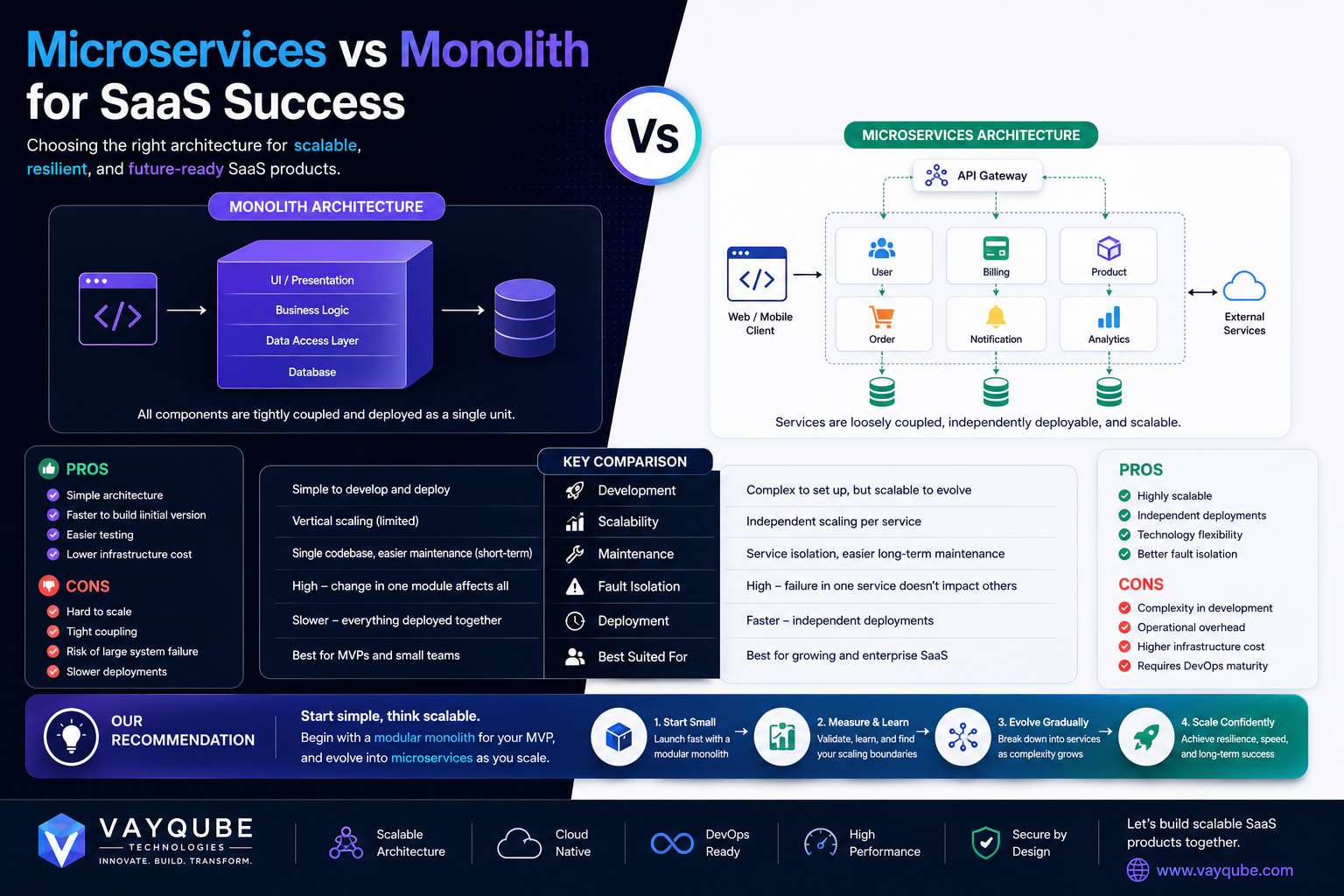
Introduction to Architecture Choices
When building a SaaS application, one of the most critical decisions is choosing the right architecture. Two popular approaches are microservices and monolith architecture. Understanding the differences between these two architectures is crucial for SaaS success.
Overview of Microservices and Monolith
Microservices architecture involves breaking down an application into smaller, independent services that communicate with each other. Each service is responsible for a specific business capability and can be developed, tested, and deployed independently. On the other hand, monolith architecture involves building a self-contained application with all components tightly coupled.
Importance of Choosing the Right Architecture
Choosing the right architecture is essential for SaaS success because it directly impacts the scalability, maintainability, and reliability of the application. A well-designed architecture can help SaaS companies to quickly adapt to changing market conditions, reduce downtime, and improve customer satisfaction. In contrast, a poorly designed architecture can lead to technical debt, slow development cycles, and decreased competitiveness.
Some key considerations when choosing between microservices and monolith architecture include:
- Scalability requirements
- Development team size and structure
- Complexity of the application
- Time-to-market constraints
- Operational and maintenance costs
Real-World Implications
In real-world scenarios, companies like Netflix and Amazon have successfully adopted microservices architecture to achieve scalability and flexibility. On the other hand, companies like GitHub and Shopify have opted for monolith architecture due to the simplicity and ease of maintenance it offers. Ultimately, the choice between microservices and monolith architecture depends on the specific needs and goals of the SaaS company.
Implementation Considerations
When implementing either microservices or monolith architecture, it's essential to consider factors like service discovery, communication protocols, and data consistency. Additionally, companies should prioritize continuous integration and delivery, monitoring, and logging to ensure the application is running smoothly and efficiently. By carefully evaluating these factors and choosing the right architecture, SaaS companies can set themselves up for long-term success and competitiveness in the market.
Why It Matters
The choice between microservices and monolithic architecture has a significant impact on the scalability and maintainability of a SaaS application. As the application grows, a well-designed architecture can make all the difference in ensuring the system can handle increased traffic, data, and user demands.
Scalability Considerations
A monolithic architecture can become a bottleneck as the application scales, leading to decreased performance, increased latency, and higher risk of downtime. On the other hand, microservices allow for greater flexibility and scalability, as each service can be scaled independently to meet changing demands. This enables SaaS providers to quickly respond to changes in the market, customer needs, or unexpected spikes in usage.
Consequences of a Poor Choice
Choosing the wrong architecture can have severe consequences, including:
- Reduced customer satisfaction due to poor performance or frequent downtime
- Increased maintenance costs and complexity
- Difficulty in implementing new features or updates
- Inability to handle increased traffic or data, leading to lost revenue and opportunities
- Negative impact on the company's reputation and brand
Real-World Implications
In real-world scenarios, the consequences of choosing the wrong architecture can be far-reaching. For example, a SaaS provider experiencing rapid growth may find that their monolithic architecture is unable to handle the increased traffic, leading to frequent downtime and frustrated customers. In contrast, a microservices-based architecture can be designed to scale more easily, ensuring high availability and performance even under heavy loads.
Key Considerations
When evaluating the choice between microservices and monolithic architecture, SaaS providers should consider the following key factors:
- Business goals and growth projections
- Technical requirements and complexity
- Team size, structure, and expertise
- Customer expectations and needs
- Operational and maintenance costs
By carefully evaluating these factors and considering the potential consequences of a poor choice, SaaS providers can make an informed decision about which architecture is best suited to their needs, ensuring the long-term success and scalability of their application.
Core Architecture
The core architecture of a SaaS application is crucial in determining its scalability, maintainability, and overall success. Two popular architectural styles are microservices and monolith. Understanding the definition, characteristics, and comparison of these architectures is essential for making informed decisions.
Microservices Architecture
Microservices architecture is a design approach that structures an application as a collection of small, independent services. Each service is responsible for a specific business capability and can be developed, tested, and deployed independently. The characteristics of microservices architecture include:
- Loose coupling: services are designed to be independent and modular
- Autonomy: each service is responsible for its own behavior and decision-making
- Organized around business capabilities: services are aligned with the business functions they support
- Scaling: services can be scaled independently to meet changing demands
- Decentralized data management: each service manages its own data, which can lead to data duplication and inconsistency if not managed properly
Monolith Architecture
Monolith architecture, on the other hand, is a traditional design approach that structures an application as a single, self-contained unit. All components of the application are part of a single, cohesive codebase, and changes to the application require a full rebuild and redeployment. The characteristics of monolith architecture include:
- Tight coupling: components are highly interconnected and interdependent
- Centralized data management: a single, centralized database manages all application data
- Scalability limitations: the entire application must be scaled as a single unit, which can be inefficient and costly
Comparison of Microservices and Monolith Architecture
When comparing microservices and monolith architecture, several key differences emerge:
- Scalability: microservices allow for more efficient scaling, as individual services can be scaled independently to meet changing demands. Monoliths, on the other hand, require the entire application to be scaled as a single unit.
- Maintainability: microservices are generally easier to maintain, as changes to individual services do not affect the entire application. Monoliths can be more challenging to maintain, as changes to one component can have unintended consequences throughout the application.
- Complexity: microservices introduce additional complexity, as multiple services must be managed and coordinated. Monoliths, while simpler in design, can become increasingly complex as the application grows and evolves.
- Development and deployment: microservices enable more agile development and deployment, as individual services can be developed and deployed independently. Monoliths require a more traditional, waterfall approach to development and deployment.
Business Benefits
The choice between microservices and monolith architecture has significant implications for the business success of a SaaS company.
Advantages of Microservices
Microservices offer several business benefits, including:
- Improved scalability: microservices allow for the scaling of individual components, reducing the risk of bottlenecks and improving overall system performance
- Enhanced resilience: with microservices, if one component fails, it won't bring down the entire system, reducing downtime and improving customer satisfaction
- Faster time-to-market: microservices enable developers to work on individual components independently, reducing the time it takes to develop and deploy new features
Advantages of Monolith
On the other hand, monolith architecture also has its advantages, including:
- Simplified development and maintenance: monoliths are typically easier to develop, test, and maintain, as all components are part of a single, cohesive unit
- Better performance: monoliths can offer better performance, as all components are hosted on the same server, reducing communication overhead
- Lower operational complexity: monoliths require less operational overhead, as there are fewer moving parts to manage and monitor
Trade-Offs
However, there are trade-offs to consider when choosing between microservices and monolith architecture. For example, while microservices offer improved scalability and resilience, they also introduce additional complexity and operational overhead. In contrast, monoliths are simpler to develop and maintain, but may become unwieldy and difficult to scale as the system grows. Ultimately, the choice between microservices and monolith architecture will depend on the specific needs and goals of the business. By carefully considering these trade-offs, SaaS companies can make an informed decision that supports their long-term success.
Implementation Considerations
When implementing a microservices or monolith architecture, it's essential to consider the business implications of each approach. For instance, microservices require a high degree of automation and monitoring to ensure smooth operation, while monoliths require careful planning and design to avoid becoming overly complex. By taking a thoughtful and intentional approach to architecture design, SaaS companies can create a foundation for long-term success and scalability. Some key considerations include:
- Defining clear boundaries and interfaces between components
- Implementing robust monitoring and logging mechanisms
- Developing a culture of automation and continuous improvement
- Carefully evaluating the trade-offs between scalability, performance, and complexity.
Scalability
Scalability is a critical factor in the success of SaaS applications. As the user base grows, the application must be able to handle increased traffic and data processing demands. Monolith architecture can become a bottleneck in scalability, leading to decreased performance and increased downtime.
Monolith Scalability Challenges
Monolith architecture faces several scalability challenges, including:
- Limited flexibility in scaling individual components
- Tight coupling between components, making it difficult to isolate and scale specific parts of the application
- Increased complexity as the application grows, leading to longer development and deployment cycles
- Higher risk of cascading failures, where a single component failure can bring down the entire application
Microservices Scalability Advantages
In contrast, microservices architecture offers several scalability advantages, including:
- Ability to scale individual services independently, allowing for more efficient use of resources
- Looser coupling between services, making it easier to develop, deploy, and scale specific components
- Improved fault tolerance, as a failure in one service does not necessarily affect other services
- Greater flexibility in choosing technologies and frameworks for each service, allowing for more efficient development and deployment
Strategies for Scaling Microservices
To scale microservices effectively, several strategies can be employed, including:
- Horizontal scaling: adding more instances of a service to handle increased traffic
- Vertical scaling: increasing the resources (e.g., CPU, memory) allocated to a service to handle increased load
- Load balancing: distributing traffic across multiple instances of a service to ensure efficient use of resources
- Caching: storing frequently accessed data in memory or a caching layer to reduce the load on services
- Autoscaling: automatically adding or removing instances of a service based on traffic demands, to ensure efficient use of resources and minimize downtime.
Implementation Challenges
Implementing microservices and monolith architectures comes with distinct challenges. Understanding these challenges is crucial for SaaS success.
Microservices Challenges
When implementing microservices, common challenges include:
- Increased complexity due to multiple services
- Higher operational overhead for managing multiple services
- Greater difficulty in debugging and tracing issues across services
- Potential for inconsistent data models and schemas across services
- Higher risk of cascading failures if not designed for resilience
Monolith Challenges
In contrast, monolith architecture implementation challenges include:
- Limited scalability, as the entire application must be scaled together
- Tight coupling between components, making changes more difficult
- Potential for a single point of failure, bringing down the entire application
- Limited flexibility in technology stack choices
- Difficulty in implementing continuous delivery and deployment
Mitigating Risks
To mitigate implementation risks, SaaS companies should:
- Adopt a phased approach to microservices adoption, starting with small, low-risk services
- Implement robust monitoring, logging, and tracing to facilitate debugging
- Establish clear data models and schemas across services
- Design for resilience and fault tolerance in microservices
- Consider a hybrid approach, combining elements of both microservices and monolith architectures
- Invest in automation and continuous integration/continuous deployment (CI/CD) pipelines to streamline testing and deployment
Effective mitigation strategies can help SaaS companies navigate the challenges of both microservices and monolith architectures, ultimately achieving greater scalability, reliability, and success.
Use Cases
Successful implementations of microservices and monolith architectures can be seen in various real-world examples.
Microservices Implementations
Some notable examples of successful microservices implementations include:
- Netflix, which uses a microservices architecture to handle its large volume of user requests and provide a seamless viewing experience.
- Amazon, which has adopted a microservices approach to enable faster innovation and scalability in its e-commerce platform.
- Uber, which uses microservices to manage its complex network of drivers, riders, and services.
These companies have achieved significant benefits from microservices, including increased scalability, faster time-to-market, and improved fault tolerance.
Monolith Implementations
On the other hand, some companies have successfully implemented monolith architectures, including:
- Dropbox, which initially built its file-sharing service as a monolith and later scaled it to handle large volumes of user data.
- Airbnb, which started with a monolith architecture and later evolved it to a hybrid model, combining the benefits of monoliths and microservices.
- GitHub, which has largely maintained its monolith architecture, leveraging its simplicity and ease of maintenance to deliver a high-quality developer experience.
These companies have achieved success with monoliths due to their relatively simple and well-defined requirements, which allowed them to focus on core functionality and user experience.
Lessons Learned
From these successful implementations, several key lessons can be learned:
- Start with a monolith: Many successful companies began with a monolith architecture and later evolved to microservices as their requirements became more complex.
- Assess your needs: Carefully evaluate your business requirements, scalability needs, and technical complexity to determine whether a microservices or monolith architecture is the best fit.
- Be prepared to evolve: As your business grows and requirements change, be prepared to adapt your architecture to ensure it continues to support your goals and objectives.
- Focus on core competencies: Regardless of the chosen architecture, prioritize building a strong foundation in areas such as data management, security, and user experience.
Best Practices
To ensure the success of a SaaS application, whether built using microservices or monolith architecture, it's crucial to follow guiding principles for design and implementation.
Designing Microservices Architecture
When designing a microservices architecture, consider the following principles:
- Define clear boundaries and responsibilities for each service
- Implement loose coupling to enable independent development and deployment
- Use APIs and messaging systems for communication between services
- Prioritize scalability, fault tolerance, and high availability
- Establish a robust monitoring and logging system for effective troubleshooting
Designing Monolith Architecture
For a monolith architecture, the guiding principles are:
- Keep the codebase organized, modular, and easy to maintain
- Implement a robust and scalable database design
- Use caching mechanisms to improve performance
- Prioritize code reusability and minimize duplication
- Establish a comprehensive testing framework to ensure reliability
Evaluation and Optimization
To evaluate and optimize the chosen architecture, consider the following strategies:
- Monitor key performance indicators (KPIs) such as latency, throughput, and error rates
- Conduct regular code reviews and refactorings to maintain a clean and efficient codebase
- Implement automated testing and deployment pipelines to reduce manual errors and increase efficiency
- Use load testing and simulation tools to identify bottlenecks and optimize system performance
- Continuously gather feedback from users and stakeholders to inform architecture and design decisions
By following these guiding principles and strategies, SaaS companies can ensure their applications are well-designed, scalable, and meet the needs of their users.
Real-World Examples
Many successful SaaS companies have implemented microservices or monolith architectures, each with their own strengths and weaknesses. For example, companies like Netflix and Amazon have successfully implemented microservices architectures, while companies like GitHub and Dropbox have built successful monoliths.
Production Considerations
When implementing a microservices or monolith architecture in production, consider factors such as:
- Infrastructure and resource allocation
- Security and access control
- Data storage and management
- Network and communication protocols
- Monitoring and logging mechanisms
By carefully evaluating these factors and following best practices, SaaS companies can ensure their applications are reliable, scalable, and meet the needs of their users.
FAQ
Frequently asked questions about microservices and monolith architecture can help clarify the differences between these two approaches. Here are some common questions and answers to help you make an informed decision for your SaaS application.
Common Misconceptions
Some common misconceptions about microservices and monolith architecture include:
- Microservices are only for large, complex applications
- Monolith architecture is outdated and should never be used
- Microservices are more secure than monolith architecture
- Monolith architecture is easier to implement and maintain
Realities of Microservices and Monolith Architecture
In reality, microservices and monolith architecture have their own strengths and weaknesses. Microservices offer greater scalability and flexibility, but can be more complex to implement and maintain. Monolith architecture, on the other hand, is often easier to implement and maintain, but can become cumbersome and inflexible as the application grows.
When to Choose Microservices
Microservices are a good choice when:
- You have a large, complex application with multiple components
- You need to scale individual components independently
- You want to take advantage of containerization and orchestration tools
- You have a team with experience in microservices architecture
When to Choose Monolith Architecture
Monolith architecture is a good choice when:
- You have a small to medium-sized application with simple requirements
- You want to quickly develop and deploy a prototype or minimum viable product (MVP)
- You have a limited budget and resources
- You want to minimize the complexity of your application architecture
Real-World Examples
Real-world examples of successful microservices and monolith architecture implementations include:
- Netflix, which uses a microservices architecture to support its large, complex application
- Dropbox, which uses a monolith architecture to support its simple, file-sharing application
- Amazon, which uses a combination of microservices and monolith architecture to support its large, complex e-commerce platform
Production Considerations
When implementing microservices or monolith architecture in production, consider the following factors:
- Scalability and performance requirements
- Security and compliance requirements
- Team experience and expertise
- Budget and resource constraints
- Time-to-market and deployment frequency requirements
Conclusion
In summary, the choice between microservices and monolithic architecture for SaaS success depends on several key factors, including scalability requirements, development team size and expertise, and business goals.
Key Takeaways
- Microservices offer greater scalability and flexibility, but introduce additional complexity and communication overhead.
- Monolithic architecture provides a simpler, more straightforward approach, but can become cumbersome and difficult to maintain as the application grows.
- Ultimately, the decision between microservices and monolith depends on the specific needs and constraints of the SaaS application.
Final Thoughts
When choosing the right architecture for SaaS success, it's essential to consider the trade-offs between scalability, complexity, and maintainability. By carefully evaluating these factors and considering real-world examples, SaaS companies can make informed decisions that support their long-term growth and success.
Some key considerations for SaaS companies include:
- Evaluating the scalability requirements of the application and choosing an architecture that can support growth.
- Assessing the development team's size, expertise, and experience, and selecting an architecture that aligns with their capabilities.
- Prioritizing business goals, such as time-to-market, customer experience, and revenue growth, and choosing an architecture that supports these objectives.
By taking a thoughtful and intentional approach to architecture selection, SaaS companies can set themselves up for success and build a strong foundation for long-term growth and profitability.
In the end, whether a SaaS company chooses a microservices or monolithic architecture, the key to success lies in careful planning, intentional design, and a deep understanding of the trade-offs and implications of each approach.
SaaS companies that prioritize scalability, flexibility, and maintainability, and choose an architecture that aligns with their business goals and development capabilities, are well-positioned to achieve success and drive long-term growth.
The decision between microservices and monolith is not a one-size-fits-all solution, and SaaS companies must carefully evaluate their unique needs and constraints to make an informed decision that supports their long-term success.
By doing so, SaaS companies can build a strong foundation for growth, drive innovation, and deliver exceptional customer experiences that drive revenue and profitability.
In the fast-paced and competitive SaaS landscape, making the right architecture choice is critical to achieving success, and companies that prioritize careful planning, intentional design, and a deep understanding of the trade-offs and implications of each approach will be well-positioned to thrive.
The importance of careful architecture selection cannot be overstated, as it has a direct impact on the scalability, maintainability, and overall success of the SaaS application.
SaaS companies that prioritize architecture selection and make informed decisions based on their unique needs and constraints will be better equipped to drive growth, innovation, and customer satisfaction, and achieve long-term success in the competitive SaaS market.
Ultimately, the choice between microservices and monolith is a critical decision that requires careful consideration and intentional planning, and SaaS companies that prioritize this decision will be well-positioned to achieve success and drive long-term growth.
The decision between microservices and monolith is a complex one, and SaaS companies must carefully evaluate their unique needs and constraints to make an informed decision that supports their long-term success.
By prioritizing careful planning, intentional design, and a deep understanding of the trade-offs and implications of each approach, SaaS companies can make informed decisions that drive growth, innovation, and customer satisfaction, and achieve long-term success in the competitive SaaS market.
In the end, the key to success lies in careful planning, intentional design, and a deep understanding of the trade-offs and implications of each approach, and SaaS companies that prioritize this will be well-positioned to thrive in the fast-paced and competitive SaaS landscape.
By making informed decisions based on their unique needs and constraints, SaaS companies can build a strong foundation for growth, drive innovation, and deliver exceptional customer experiences that drive revenue and profitability.
The choice between microservices and monolith is a critical decision that requires careful consideration and intentional planning, and SaaS companies that prioritize this decision will be well-positioned to achieve success and drive long-term growth.
SaaS companies that carefully evaluate their unique needs and constraints, and make informed decisions based on their business goals and development capabilities, will be better equipped to drive growth, innovation, and customer satisfaction, and achieve long-term success in the competitive SaaS market.
In the fast-paced and competitive SaaS landscape, careful architecture selection is critical to achieving success, and companies that prioritize careful planning, intentional design, and a deep understanding of the trade-offs and implications of each approach will be well-positioned to thrive.
By prioritizing architecture selection and making informed decisions based on their unique needs and constraints, SaaS companies can build a strong foundation for growth, drive innovation, and deliver exceptional customer experiences that drive revenue and profitability.
The importance of careful architecture selection cannot be overstated, as it has a direct impact on the scalability, maintainability, and overall success of the SaaS application.
SaaS companies that prioritize architecture selection and make informed decisions based on their business goals and development capabilities will be better equipped to drive growth, innovation, and customer satisfaction, and achieve long-term success in the competitive SaaS market.
Ultimately, the choice between microservices and monolith is a complex one, and SaaS companies must carefully evaluate their unique needs and constraints to make an informed decision that supports their long-term success.
By doing so, SaaS companies can build a strong foundation for growth, drive innovation, and deliver exceptional customer experiences that drive revenue and profitability, and achieve long-term success in the competitive SaaS market.
The decision between microservices and monolith is a critical decision that requires careful consideration and intentional planning, and SaaS companies that prioritize this decision will be well-positioned to achieve success and drive long-term growth.
In the end, the key to success lies in careful planning, intentional design, and a deep understanding of the trade-offs and implications of each approach, and SaaS companies that prioritize this will be well-positioned to thrive in the fast-paced and competitive SaaS landscape.
By making informed decisions based on their unique needs and constraints, SaaS companies can make informed decisions that drive growth, innovation, and customer satisfaction, and achieve long-term success in the competitive SaaS market.
The choice between microservices and monolith is a complex one, and SaaS companies must carefully evaluate their unique needs and constraints to make an informed decision that supports their long-term success.
By prioritizing careful planning, intentional design, and a deep understanding of the trade-offs and implications of each approach, SaaS companies can make informed decisions that drive growth, innovation, and customer satisfaction, and achieve long-term success in the competitive SaaS market.
In the fast-paced and competitive SaaS landscape, careful architecture selection is critical to achieving success, and companies that prioritize careful planning, intentional design, and a deep understanding of the trade-offs and implications of each approach will be well-positioned to thrive.
By prioritizing architecture selection and making informed decisions based on their unique needs and constraints, SaaS companies can build a strong foundation for growth, drive innovation, and deliver exceptional customer experiences that drive revenue and profitability.
The importance of careful architecture selection cannot be overstated, as it has a direct impact on the scalability, maintainability, and overall success of the SaaS application.
SaaS companies that prioritize architecture selection and make informed decisions based on their business goals and development capabilities will be better equipped to drive growth, innovation, and customer satisfaction, and achieve long-term success in the competitive SaaS market.
Ultimately, the choice between microservices and monolith is a critical decision that requires careful consideration and intentional planning, and SaaS companies that prioritize this decision will be well-positioned to achieve success and
Related Vayqube Resources
- Best Saas Development Company In Singapore City
- Best Mobile App Development Company In Singapore City
- Best Saas Development Company In Usa
- Best Saas Development Company In New York
- Cloud Cost Optimization Strategies For Saas Startups
- How To Build Fintech Application Payments Security Scaling
Next Step
If your systems are struggling with scalability, automation, architecture complexity, or operational efficiency, it's time to modernize your infrastructure and workflows.
👉 Talk to a Vayqube solution architect and build systems designed for long-term production growth: