
How to Optimize Your Website for Google AI Overviews and AI Mode
As Google shifts toward AI-powered search results, traditional SEO isn’t enough. Discover how to structure content, earn citations, and align with AI-driven ranking factors to stay visible in AI Overviews and AI Mode.
Vayqube Team
Software architecture and product engineering
Introduction
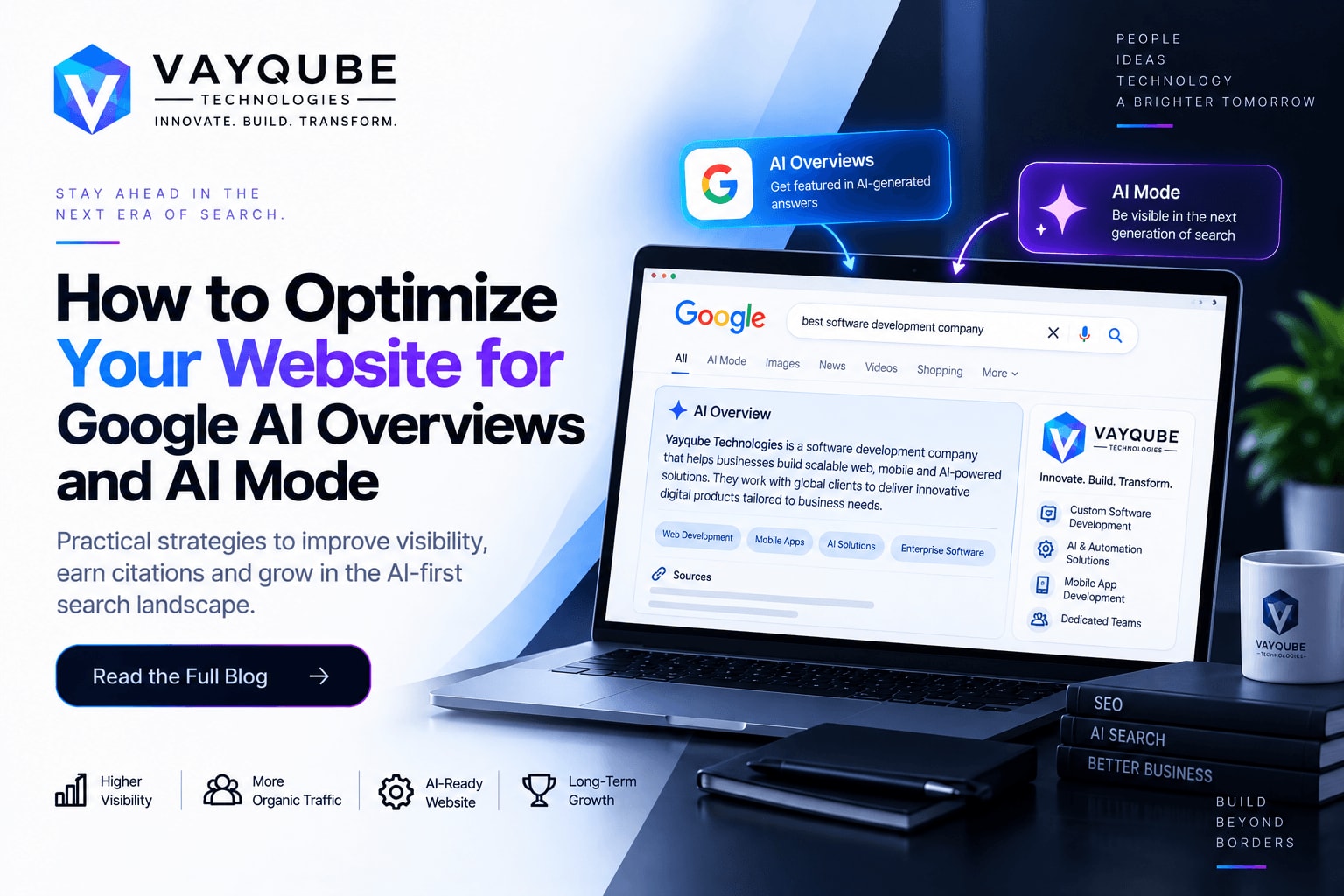
Google AI Overviews generate concise, multi‑source answers directly in the search results, pushing traditional links lower on the page. AI Mode extends this with conversational, turn‑based interactions that favor coherent understanding over exact keyword matches.
Because AI evaluates content for clarity, authority, and machine‑readable structure—not just keyword relevance—pages that rank well but lack citable, well‑organized answers can be overlooked. Adapting to this shift means organizing information so AI can quickly extract problem, context, solution, and evidence, giving early adopters a visibility edge, especially in high‑intent verticals.
Why It Matters
Early observations indicate AI Overviews can affect click distribution for informational queries, often pushing traditional results lower on the page. AI Mode encourages multi‑turn interactions that favor sites providing comprehensive, citable answers.
Conversely, pages with weak structure, thin sourcing, or semantic gaps are deprioritized in AI‑generated responses, regardless of legacy rankings. Sites that act now may capture early visibility in sectors like healthcare, finance, and technology, while delayed optimization may result in reduced visibility as AI‑driven search evolves.
Core Architecture
Hierarchical headings
Use a single H1 that matches the primary query, followed by H2s for major subtopics and H3s for granular questions. This mirrors the problem → context → solution flow LLMs prefer when synthesizing answers. Avoid skipping levels (e.g., H1 to H3) as it hinders outline extraction.
Schema markup for explicit signaling
- FAQPage – marks each Q&A pair for direct extraction.
- HowTo – breaks step‑by‑step guidance into citable units.
- Article – includes author, datePublished, and publisher to reinforce EEAT.
Place JSON‑LD in the page head or via CMS plugins; validate with Google’s Rich Results Test.
Concise, self‑contained paragraphs
Aim for 40‑60 words per paragraph, each answering a single implied or explicit question. Lead with the answer, then add supporting detail. This fits within LLM extraction windows and reduces irrelevant pulls.
Plain language with definitions
Explain jargon on first use (e.g., “Expertise, Authoritativeness, Trustworthiness (EEAT)”). Inline definitions lower hallucination risk and improve AI comprehension.
Logical flow for LLM synthesis
Structure each section as:
- Problem – state the user’s pain point or query.
- Context – explain why it matters.
- Solution – give the actionable recommendation.
- Evidence – cite data, authoritative sources, or examples.
- Implication – note the outcome or next step.
This progression matches how LLMs combine information from multiple sources, increasing citation likelihood.
Business Benefits
Being selected as an AI Overview source may be perceived as a signal of authority. Users interacting with AI‑generated answers often seek clarification or next steps.
Appearing in AI Mode may increase visibility alongside traditional results. Citations in AI Overviews can contribute to perceived authority.
Ultimately, optimizing for AI search emphasizes clear structure, verifiable facts, and semantic richness.
Scalability
Standardized templates
Create page templates that enforce:
- An answer‑first opening paragraph (40‑60 words).
- Mandatory FAQ or HowTo sections with structured‑data placeholders.
- Pre‑filled schema slots for FAQPage, HowTo, and Article.
Writers supply specifics; the template guarantees semantic clarity and machine‑readable structure.
NLP‑driven audits
Run natural language processing scans to identify:
- Semantic mismatches with query intent.
- EEAT gaps such as missing author bios or thin evidence.
- Paragraph lengths outside the optimal range.
Prioritize high‑traffic or high‑value pages for remediation, using audit scores to guide sprints.
Automated schema generation
Leverage CMS plugins or custom APIs that:
- Pull structured data from existing fields (author bios, product specs) and inject JSON‑LD.
- Validate markup against Google’s Rich Results Test before publish.
- Update schema in bulk when content models change, reducing manual effort and errors.
Team enablement
Hold brief workshops on AI writing principles:
- Favor clarity over cleverness; replace jargon with plain explanations.
- Prioritize evidence‑driven statements.
- Use the problem → context → solution → evidence → implication flow as a checklist.
Provide style guides and cheat sheets for consistent application.
AI‑assisted drafting with human oversight
Use generative tools to produce outlines or first drafts that already follow the answer‑first format and include placeholder citations. Human editors then:
- Verify factual accuracy and authority sources.
- Adjust tone to match brand voice.
- Add internal links and contextual examples that enrich EEAT.
This hybrid approach can speed production while maintaining accuracy.
Start optimizing your site for AI search today—audit your content for clarity, authority, and structure to capture AI Overview opportunities.
Frequently Asked Questions
How do I measure whether my content is being selected for Google AI Overviews?
Track impressions and click-through rates in Google Search Console for queries triggering AI Overviews, then compare pre- and post-optimization performance. Use the 'AI Overviews' filter in Search Console (if available) or monitor SERP features via third-party tools like SEMrush or Ahrefs to detect when your page appears as a cited source. Correlate changes with dwell time and engagement metrics in Google Analytics to assess intent alignment.
Can optimizing for AI Overviews hurt my traditional SEO rankings?
No—AI Overview optimization aligns with core SEO best practices like clear structure, authoritative sourcing, and semantic clarity, which support both AI and traditional rankings. There is no evidence that adding FAQPage schema, improving paragraph conciseness, or enhancing EEAT signals negatively impacts organic rankings; in fact, these improvements often reinforce them by increasing content quality and crawl efficiency.
What types of content benefit most from AI Overview optimization?
Informational content in high-intent verticals such as healthcare, finance, and technology sees the greatest impact, especially pages answering specific user questions (e.g., 'how to', 'what is', 'best practices'). Content that lacks clear answers, has thin sourcing, or poor hierarchical structure is most likely to be overlooked by AI, regardless of keyword rankings.
Do I need to rewrite all my existing content to optimize for AI Mode?
No—start with high-traffic or high-value pages using NLP-driven audits to identify structural gaps, missing EEAT signals, or semantic mismatches. Apply templates and schema incrementally, prioritizing pages where AI Overviews already appear or where user intent aligns with conversational, multi-turn queries. Use AI-assisted drafting for efficiency, but retain human oversight for accuracy and brand voice.
Is FAQPage schema sufficient for AI Overview eligibility, or do I need other markup?
FAQPage schema helps but is not sufficient on its own. AI Overviews favor content with clear hierarchical headings, answer-first paragraphs, logical flow (problem → context → solution → evidence → implication), and supporting EEAT signals like author bios and datePublished. Combine FAQPage with Article and HowTo schema where relevant, and validate all markup using Google’s Rich Results Test.
Related Vayqube Resources
- Why Most Ai Projects Fail Before Production
- Multi Tenant Saas Vs Single Tenant Architecture
- Legacy Application Modernization
- Data Analytics
- Best Practices For Managing Distributed Teams
- Next Js Improves Seo Performance
Next Step
Talk to a Vayqube solution architect about a production-ready implementation plan.