
Comprehensive Payment Gateway Development Guide
Unlock efficient payment processing with our expert payment gateway development guide, designed to enhance business scalability and customer experience.
Vayqube Team
Author
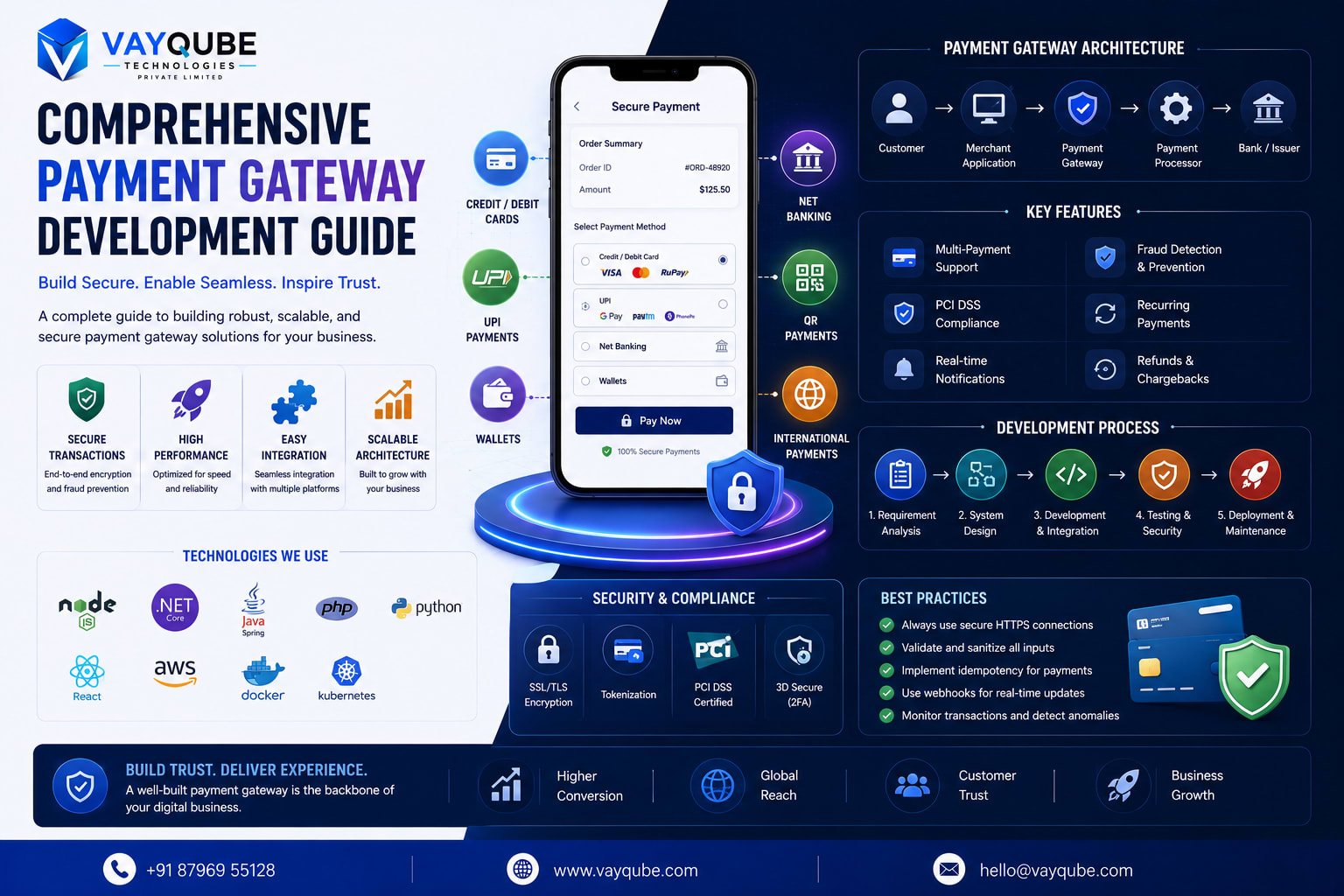
Introduction to Payment Gateway Development
Payment gateway development is a critical aspect of e-commerce and online transactions, enabling businesses to accept and process payments securely and efficiently. The importance of secure and efficient payment processing cannot be overstated, as it directly impacts the reputation and revenue of an organization.
Overview of Payment Gateway Development
A payment gateway is a technology platform that facilitates the transfer of payment information between a customer's payment instrument, such as a credit card, and a merchant's bank account. The development of a payment gateway involves several key components, including payment processing, security, and compliance. A well-designed payment gateway must balance the needs of both merchants and customers, providing a seamless and secure payment experience.
Importance of Secure Payment Processing
Secure payment processing is essential for protecting sensitive customer information and preventing fraudulent transactions. A payment gateway must implement robust security measures, such as encryption, tokenization, and two-factor authentication, to ensure the integrity of payment data. Additionally, payment gateways must comply with industry standards and regulations, such as PCI-DSS and GDPR, to maintain the trust of customers and merchants.
Key considerations for secure payment processing include:
- Data encryption and tokenization
- Compliance with industry standards and regulations
- Implementation of two-factor authentication and other security measures
- Regular security audits and testing to identify vulnerabilities
Efficient Payment Processing
Efficient payment processing is critical for providing a seamless customer experience and reducing the risk of abandoned transactions. A payment gateway must be able to process transactions quickly and accurately, handling high volumes of payments without downtime or errors. This requires a scalable and reliable infrastructure, as well as advanced payment processing algorithms and machine learning techniques.
Some benefits of efficient payment processing include:
- Increased customer satisfaction and loyalty
- Reduced risk of abandoned transactions and lost revenue
- Improved merchant reputation and trust
- Enhanced competitiveness in the market
By understanding the importance of secure and efficient payment processing, businesses can develop effective payment gateway strategies that meet the needs of their customers and drive revenue growth. In the next section, we will explore the key components of payment gateway development in more detail, including payment processing, security, and compliance.
Why It Matters
A well-designed payment gateway is crucial for businesses to stay competitive in today's digital landscape. By implementing a seamless and secure payment processing system, companies can significantly enhance the overall customer experience. This, in turn, leads to increased customer satisfaction and loyalty, driving long-term growth and revenue.
Enhanced Customer Experience
A payment gateway that is easy to use, intuitive, and provides a smooth checkout process can make all the difference in converting browsers into buyers. Some key benefits of a well-designed payment gateway include:
- Reduced friction during the payment process
- Clear and concise payment instructions
- Support for multiple payment methods
- Mobile optimization for on-the-go payments
Increased Revenue
A payment gateway that minimizes cart abandonment can significantly increase revenue for businesses. Some ways to achieve this include:
- Streamlining the payment process to reduce drop-offs
- Offering flexible payment options to cater to different customer preferences
- Implementing features like saved payment methods and one-click checkout
- Providing transparent and clear payment information to build trust with customers
Improved Security and Compliance
Security and compliance are critical components of a payment gateway. Businesses must ensure that their payment processing system meets the required standards and regulations, such as PCI-DSS and GDPR. Some key considerations include:
- Implementing robust security measures to protect sensitive customer data
- Maintaining compliance with industry standards and regulations
- Regularly updating and patching the payment gateway to prevent vulnerabilities
- Providing customers with clear and concise information about security and compliance measures
By prioritizing these aspects, businesses can create a payment gateway that not only enhances the customer experience but also drives revenue growth and ensures the security and compliance of sensitive customer data. This foundation is essential for building a scalable and production-ready payment processing system that can support the needs of a growing business.
Core Architecture
The core architecture of a payment gateway is comprised of several key components that work together to facilitate secure and efficient transactions.
Payment Gateway Components
The primary components of a payment gateway include:
- Payment processing modules
- Merchant account management systems
- Transaction routing and switching systems
- Security and fraud detection modules
- Reporting and analytics tools
These components enable payment gateways to connect merchants with various payment methods, process transactions, and provide valuable insights into payment trends and customer behavior.
Integration with Merchant Systems
To facilitate seamless transactions, payment gateways must integrate with merchant systems, including:
- E-commerce platforms
- Point-of-sale (POS) systems
- Mobile payment applications
- Online marketplaces
This integration enables merchants to accept various payment methods, manage orders and inventory, and provide a seamless checkout experience for customers.
Security Measures and Protocols
Payment gateways must implement robust security measures and protocols to protect sensitive payment information and prevent fraud.
- Encryption technologies, such as SSL/TLS and tokenization
- Secure authentication and authorization protocols, including 3D Secure and two-factor authentication
- Regular security audits and compliance with industry standards, such as PCI-DSS and GDPR
By implementing these security measures, payment gateways can ensure the integrity and confidentiality of payment data, maintain customer trust, and reduce the risk of fraud and cyber attacks.
Implementation Considerations
When developing a payment gateway, it is essential to consider the implementation strategy, including:
- Scalability and performance requirements
- Integration with existing systems and infrastructure
- Compliance with industry regulations and standards
- Ongoing maintenance and support requirements
By carefully evaluating these factors, payment gateway developers can create a robust, scalable, and secure platform that meets the needs of merchants and customers alike.
Real-World Applications
In real-world scenarios, payment gateways are used in various industries, including:
- E-commerce and retail
- Financial services and banking
- Healthcare and insurance
- Travel and hospitality
By understanding the specific requirements and challenges of each industry, payment gateway developers can create tailored solutions that meet the unique needs of merchants and customers.
Production Readiness
To ensure production readiness, payment gateways must undergo thorough testing and quality assurance, including:
- Functional and performance testing
- Security and penetration testing
- User acceptance testing (UAT) and pilot programs
By following a rigorous testing and deployment process, payment gateway developers can ensure that their platform is stable, secure, and ready for production use.
Business Benefits
The implementation of a comprehensive payment gateway can have a significant impact on a business's bottom line. By streamlining payment processing, reducing transaction costs, and improving customer retention, companies can experience a substantial increase in revenue and customer satisfaction.
Streamlined Payment Processing
Streamlined payment processing is a key benefit of a well-designed payment gateway. This can be achieved through the implementation of automated payment workflows, real-time payment processing, and seamless integration with existing systems. For example, a company like Stripe has been able to simplify payment processing for businesses, allowing them to focus on their core operations.
- Reduced manual errors
- Faster payment processing times
- Improved payment security
Reduced Transaction Costs
Reduced transaction costs are another significant advantage of a comprehensive payment gateway. By negotiating better rates with payment processors and reducing the number of failed transactions, businesses can save a substantial amount of money on transaction fees. For instance, a company like PayPal has been able to reduce transaction costs for businesses by providing competitive pricing and flexible payment options.
- Lower payment processing fees
- Reduced failed transaction rates
- Improved cash flow management
Improved Customer Retention
Improved customer retention is a critical benefit of a well-designed payment gateway. By providing a seamless and secure payment experience, businesses can increase customer satisfaction and loyalty. For example, a company like Amazon has been able to improve customer retention through its streamlined payment processing and personalized payment options.
- Increased customer satisfaction
- Improved customer loyalty
- Reduced churn rates
By focusing on these key areas, businesses can create a payment gateway that meets the needs of their customers and drives long-term growth. The next step is to consider the technical implementation of the payment gateway, including the integration of payment processors and the development of a secure payment infrastructure.
Scalability
To ensure a payment gateway can handle the demands of a growing business, scalability is crucial. This involves designing the infrastructure to handle high volumes of transactions, optimizing performance, and future-proofing the system.
Handling High Volumes of Transactions
A scalable payment gateway must be able to process a large number of transactions per second without compromising performance. This can be achieved by:
- Implementing a distributed architecture that allows for easy addition of new nodes as transaction volume increases
- Using load balancing techniques to distribute traffic evenly across multiple servers
- Optimizing database queries and indexing to reduce latency and improve throughput
Load Balancing and Performance Optimization
Load balancing is critical to ensuring that no single server becomes a bottleneck, causing delays or errors. Techniques such as:
- Round-robin DNS
- IP hashing
- Least connection method can be used to distribute traffic efficiently. Additionally, performance optimization techniques like caching, content delivery networks (CDNs), and compression can help reduce latency and improve user experience.
Future-Proofing Payment Infrastructure
A future-proof payment infrastructure should be designed with flexibility and adaptability in mind. This can be achieved by:
- Using modular, microservices-based architecture that allows for easy integration of new payment methods or services
- Implementing APIs that enable easy integration with third-party services and merchants
- Staying up-to-date with the latest security and compliance standards, such as PCI-DSS and GDPR, to ensure the payment gateway remains secure and trustworthy.
By prioritizing scalability, businesses can ensure their payment gateway can handle increased traffic and transaction volume, providing a seamless user experience and supporting long-term growth.
Implementation Challenges
When developing a comprehensive payment gateway, several challenges can arise, affecting the overall success of the project.
Technical Complexities and Integration Issues
Technical complexities and integration issues are common challenges in payment gateway development. These can include:
- Integrating with multiple payment processors and banks
- Handling different payment methods and currencies
- Ensuring seamless interactions between various systems and services
- Managing and resolving potential errors and exceptions
To overcome these challenges, it's essential to have a deep understanding of the technical requirements and to design a scalable and flexible architecture. This can involve:
- Using APIs and SDKs to simplify integration with payment processors and other services
- Implementing robust error handling and logging mechanisms
- Conducting thorough testing and quality assurance to identify and resolve potential issues
Security and Compliance Requirements
Security and compliance are critical considerations in payment gateway development.
- Payment gateways must comply with relevant regulations, such as PCI-DSS and GDPR
- Implementing robust security measures to protect sensitive data and prevent fraud
- Ensuring the payment gateway is regularly updated and patched to prevent vulnerabilities
To address these requirements, it's essential to:
- Implement robust security protocols, such as encryption and tokenization
- Conduct regular security audits and penetration testing
- Ensure compliance with relevant regulations and industry standards
Testing and Quality Assurance
Thorough testing and quality assurance are crucial to ensuring the payment gateway functions correctly and meets the required standards.
- Testing should include:
- Functional testing to ensure the payment gateway processes transactions correctly
- Performance testing to ensure the payment gateway can handle high volumes of transactions
- Security testing to identify potential vulnerabilities
- Quality assurance should involve:
- Conducting regular code reviews and testing
- Implementing continuous integration and continuous deployment (CI/CD) pipelines
- Ensuring the payment gateway is regularly updated and maintained to prevent issues and ensure compatibility with changing payment landscapes.
Use Cases
Payment gateway development has a wide range of applications across various industries. The key to a successful implementation lies in understanding the specific use cases and tailoring the solution to meet the unique requirements of each.
E-commerce and Retail Applications
E-commerce and retail applications are one of the primary use cases for payment gateways. A well-designed payment gateway can streamline the checkout process, reduce cart abandonment rates, and increase sales. For instance, a payment gateway that supports multiple payment methods, such as credit cards, PayPal, and Apple Pay, can cater to a broader customer base. Additionally, features like tokenization and recurring payments can enhance the overall shopping experience and encourage repeat business.
Mobile Payments and Wallets
Mobile payments and wallets are another significant use case for payment gateways. With the increasing adoption of mobile devices, consumers expect a seamless and secure payment experience on-the-go. A payment gateway that supports mobile payments can enable businesses to tap into this growing market. For example, a payment gateway that integrates with popular mobile wallets like Google Pay, Samsung Pay, and Apple Pay can provide customers with a convenient and secure way to make payments.
Cross-border Transactions and International Payments
Cross-border transactions and international payments are a critical use case for payment gateways. Businesses that operate globally require a payment gateway that can handle multiple currencies, languages, and payment methods. A payment gateway that supports cross-border transactions can enable businesses to expand their customer base and increase revenue. For instance, a payment gateway that supports payment methods like Alipay, WeChat Pay, and PayPal can cater to customers in different regions and provide a competitive edge in the global market.
Some of the key considerations for payment gateway development in these use cases include:
- Security and compliance with industry standards
- Support for multiple payment methods and currencies
- Scalability and reliability to handle high transaction volumes
- User experience and interface design to reduce friction and increase conversion rates
- Integration with existing systems and platforms to streamline operations
By understanding these use cases and considerations, businesses can develop a payment gateway that meets their specific needs and provides a competitive edge in the market.
Best Practices
To ensure the development of a reliable and secure payment gateway, it's essential to follow best practices that prioritize security, compliance, and maintenance.
Secure Coding and Testing Practices
Secure coding and testing practices are crucial in preventing vulnerabilities and protecting sensitive user data. This includes implementing secure protocols for data transmission, using encryption to protect sensitive information, and conducting regular security audits and penetration testing. By doing so, developers can identify and address potential security risks before they become major issues.
Compliance with Industry Standards and Regulations
Compliance with industry standards and regulations, such as PCI-DSS, GDPR, and HIPAA, is vital for payment gateways. This involves adhering to strict guidelines for data storage, processing, and transmission, as well as ensuring transparency and user consent. By complying with these regulations, payment gateways can maintain user trust and avoid costly fines and penalties.
Ongoing Maintenance and Updates
Ongoing maintenance and updates are critical for ensuring the continued security and functionality of payment gateways. This includes regularly updating software and plugins, monitoring for security vulnerabilities, and performing routine backups and disaster recovery procedures. By prioritizing maintenance and updates, developers can prevent downtime, reduce the risk of security breaches, and ensure a seamless user experience.
Some key considerations for ongoing maintenance and updates include:
- Regularly reviewing and updating security protocols to address emerging threats
- Implementing automated testing and deployment scripts to streamline updates
- Conducting thorough impact assessments before deploying new features or updates
- Maintaining detailed documentation of updates, changes, and security measures
By following these best practices, payment gateway developers can ensure the creation of a secure, compliant, and reliable payment processing system that meets the needs of users and merchants alike.
Real-World Implementation
In real-world scenarios, payment gateway development involves collaborating with various stakeholders, including merchants, users, and regulatory bodies. By prioritizing secure coding and testing practices, compliance with industry standards, and ongoing maintenance and updates, developers can create payment gateways that are both functional and secure. This, in turn, can help build user trust, drive business growth, and ensure a competitive edge in the market.
Key benefits of implementing these best practices include:
- Enhanced security and reduced risk of data breaches
- Improved compliance with industry regulations and standards
- Increased user trust and confidence in the payment gateway
- Reduced downtime and improved system availability
- Streamlined updates and maintenance procedures
FAQ
Common Questions and Concerns
Payment gateway development raises several questions and concerns, particularly regarding security, compliance, and troubleshooting. Some of the most common questions include:
- What are the most secure payment protocols to use?
- How do I ensure compliance with industry regulations, such as PCI-DSS?
- What are the best practices for troubleshooting payment gateway issues?
- How can I optimize payment processing for better performance and user experience?
Addressing Security and Compliance Issues
Security and compliance are top priorities in payment gateway development. To address these concerns, developers should:
- Implement robust encryption methods, such as TLS and SSL
- Use secure payment protocols, like 3D Secure and tokenization
- Ensure compliance with industry regulations, such as PCI-DSS, GDPR, and HIPAA
- Conduct regular security audits and penetration testing to identify vulnerabilities
Troubleshooting and Support
Troubleshooting and support are critical components of payment gateway development. To ensure seamless payment processing, developers should:
- Implement logging and monitoring tools to track payment transactions and identify issues
- Develop a comprehensive troubleshooting guide to help resolve common issues
- Provide multichannel support, including phone, email, and chat, to assist users with payment-related issues
- Establish a knowledge base with FAQs, tutorials, and documentation to help users resolve issues independently
Real-World Examples and Production Considerations
In real-world scenarios, payment gateway development requires careful consideration of production readiness. For example:
- A large e-commerce platform may require a payment gateway that can handle high volumes of transactions per second
- A mobile payment app may need to integrate with multiple payment processors and wallets
- A business-to-business payment platform may require advanced security features, such as multi-factor authentication and IP whitelisting
- A payment gateway for a global marketplace may need to support multiple currencies, languages, and payment methods
Implementation Strategy and Best Practices
To ensure successful payment gateway development, businesses should:
- Develop a clear implementation strategy, including timelines, budgets, and resource allocation
- Follow best practices, such as secure coding, regular testing, and continuous monitoring
- Collaborate with payment industry experts, such as payment processors, gateways, and security specialists
- Stay up-to-date with industry trends, regulations, and emerging technologies, such as blockchain and artificial intelligence
Conclusion
In conclusion, developing a comprehensive payment gateway is a complex task that requires careful consideration of core architecture, business benefits, scalability, and implementation challenges.
Summary of Key Takeaways
The key takeaways from this guide include:
- Understanding the core architecture of a payment gateway and its components
- Recognizing the business benefits of a payment gateway, such as increased revenue and improved customer experience
- Ensuring scalability and reliability to handle high volumes of transactions
- Overcoming implementation challenges, such as security and compliance
- Leveraging best practices and real-world use cases to inform development decisions
Future of Payment Gateway Development
The future of payment gateway development will be shaped by emerging trends, such as:
- Increased adoption of mobile payments and digital wallets
- Growing demand for real-time payments and instant settlements
- Rising importance of security and compliance in the face of evolving threats and regulations
- Expanding role of artificial intelligence and machine learning in payment processing and risk management
Final Thoughts and Recommendations
As payment gateway development continues to evolve, it's essential to stay focused on the needs of businesses and consumers. Some final recommendations include:
- Prioritizing scalability, security, and reliability in payment gateway development
- Staying up-to-date with emerging trends and technologies, such as blockchain and cryptocurrency
- Collaborating with industry experts and partners to ensure compliance and best practices
- Continuously monitoring and evaluating payment gateway performance to inform future development and optimization decisions.
By following these guidelines and staying informed about the latest developments in payment gateway technology, businesses can create comprehensive and effective payment gateways that meet the needs of their customers and drive long-term growth and success.
The development of a payment gateway is not a one-time task, but rather an ongoing process that requires continuous monitoring, evaluation, and improvement. By adopting a forward-thinking approach and prioritizing scalability, security, and reliability, businesses can create payment gateways that are well-equipped to handle the challenges and opportunities of the future.
In the end, a well-designed payment gateway can be a key differentiator for businesses, enabling them to provide a seamless and secure payment experience that drives customer loyalty and retention. By investing in the development of a comprehensive payment gateway, businesses can position themselves for long-term success and stay ahead of the competition in an increasingly complex and rapidly evolving payments landscape.
Related Vayqube Resources
- Best Mobile App Development Company In New York
- Top Mobile App Development Company In New York
- Best Software Development Company In New York
- Best Mobile App Development Company In India
- Best Mobile App Development Company In Usa
- Best Mobile App Development Company In Uk
Next Step
If your systems are struggling with scalability, automation, architecture complexity, or operational efficiency, it's time to modernize your infrastructure and workflows.
👉 Talk to a Vayqube solution architect and build systems designed for long-term production growth: