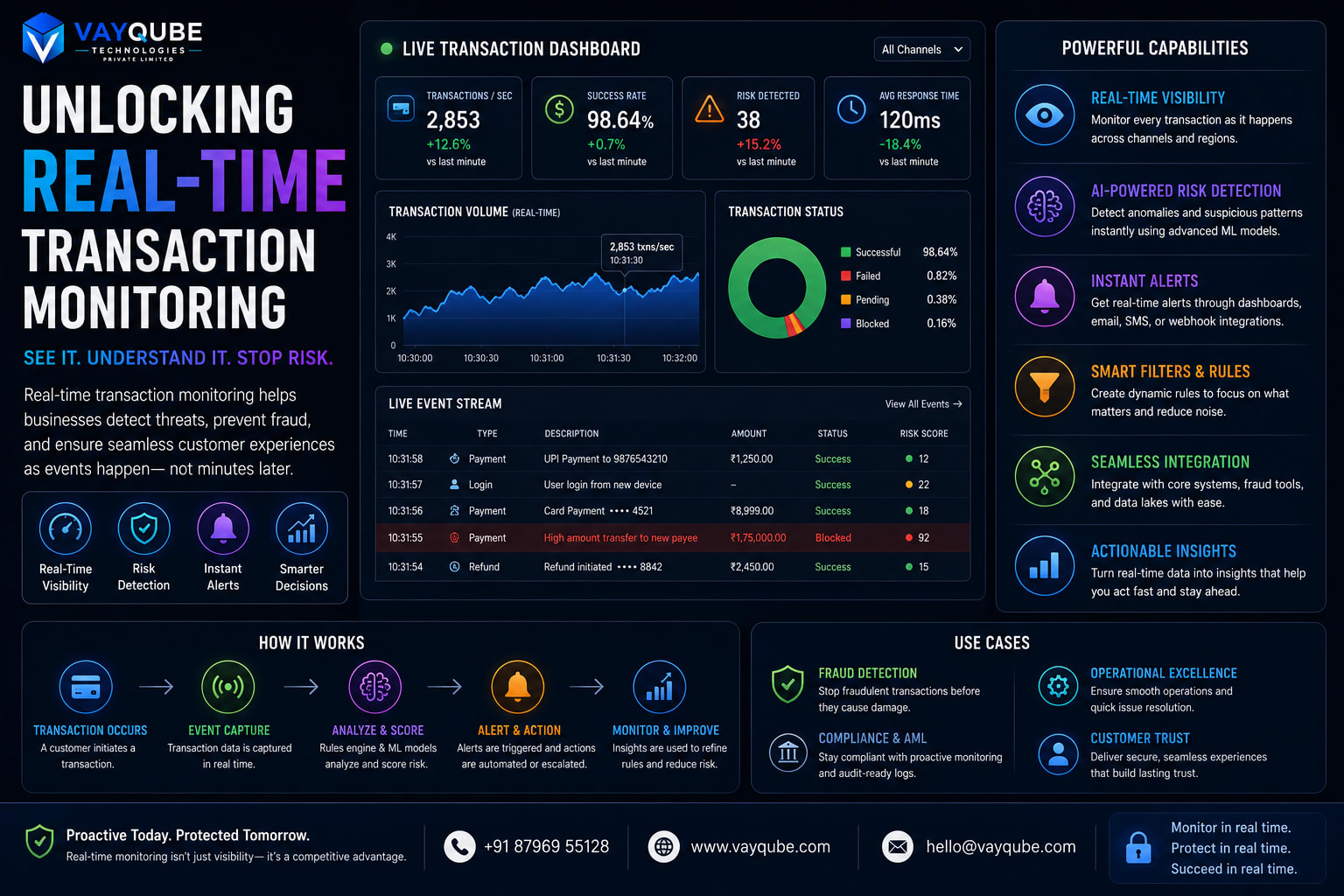
Unlocking Real-Time Transaction Monitoring
Real-time transaction monitoring is a game-changer for businesses, enabling them to track and analyze transactions as they happen, making it easier to detect anomalies, prevent fraud, and optimize operations.
Vayqube Team
Author


Introduction to Real-Time Transaction Monitoring
Real-time transaction monitoring is a critical component of modern financial systems, enabling organizations to track and analyze transactions as they occur. This capability provides timely insights into transactional activity, allowing businesses to respond quickly to emerging trends, identify potential issues, and optimize their operations.
Overview of Real-Time Transaction Monitoring
Real-time transaction monitoring involves the use of advanced technologies, such as machine learning and data analytics, to process and analyze large volumes of transactional data in real-time. This enables organizations to gain a deeper understanding of their transactional activity, including patterns, anomalies, and areas for improvement. By leveraging real-time transaction monitoring, businesses can improve their responsiveness, reduce risk, and enhance the overall customer experience.
Importance of Timely Transaction Insights
Timely transaction insights are essential for businesses operating in today's fast-paced, digital economy. With real-time transaction monitoring, organizations can identify and respond to emerging issues, such as fraudulent activity or technical glitches, before they have a significant impact on operations. Additionally, real-time insights enable businesses to optimize their transactional processes, improving efficiency, reducing costs, and enhancing the customer experience. Key benefits of timely transaction insights include:
- Improved risk management and fraud detection
- Enhanced customer experience through personalized services
- Increased operational efficiency and reduced costs
- Better decision-making through data-driven insights
Real-World Applications of Real-Time Transaction Monitoring
Real-time transaction monitoring has a wide range of real-world applications, from fraud detection and prevention to customer experience enhancement. For example, a financial institution can use real-time transaction monitoring to identify and flag suspicious transactions, reducing the risk of financial losses. Similarly, an e-commerce company can leverage real-time transaction monitoring to optimize its checkout process, improving the customer experience and reducing cart abandonment rates. By applying real-time transaction monitoring in these ways, businesses can drive growth, improve efficiency, and enhance competitiveness.
Implementation Considerations
When implementing real-time transaction monitoring, organizations must consider several key factors, including data quality, system scalability, and integration with existing systems. It is essential to ensure that the monitoring system can handle large volumes of transactional data in real-time, without compromising performance or accuracy. Additionally, businesses must consider the security and compliance implications of real-time transaction monitoring, ensuring that sensitive data is protected and regulatory requirements are met. By carefully evaluating these factors, organizations can ensure a successful implementation of real-time transaction monitoring, driving business value and competitive advantage.
Why It Matters
Real-time transaction monitoring is crucial for businesses to stay competitive and secure in today's fast-paced digital landscape. By leveraging advanced technologies, companies can unlock numerous benefits that directly impact their bottom line.
Enhanced Fraud Detection and Prevention
Effective real-time transaction monitoring enables businesses to detect and prevent fraudulent activities swiftly. This is achieved through:
- Advanced machine learning algorithms that analyze transaction patterns and identify anomalies
- Integration with external data sources to verify customer information and transaction legitimacy
- Automated alert systems that notify teams of potential threats, allowing for prompt action
Improved Customer Experience
Real-time transaction monitoring also plays a significant role in enhancing customer experience. By:
- Reducing false positives and minimizing unnecessary transaction holds
- Providing instant feedback and updates on transaction status
- Enabling seamless and secure transactions, businesses can build trust and loyalty with their customers
Regulatory Compliance
In addition to fraud detection and customer experience, real-time transaction monitoring is essential for meeting regulatory requirements. Companies must:
- Comply with anti-money laundering (AML) and know-your-customer (KYC) regulations
- Adhere to payment card industry data security standards (PCI DSS)
- Maintain accurate and transparent transaction records to facilitate audits and investigations
By implementing a robust real-time transaction monitoring system, businesses can ensure they are well-equipped to handle the complexities of modern commerce, while also protecting their customers and reputation. This, in turn, can lead to increased revenue, improved customer satisfaction, and a competitive edge in the market.
Implementation Considerations
When implementing real-time transaction monitoring, businesses should consider:
- Scalability and flexibility to accommodate growing transaction volumes and evolving regulatory requirements
- Integration with existing systems and infrastructure to minimize disruptions and ensure seamless data flow
- Ongoing maintenance and updates to stay ahead of emerging threats and technologies
By carefully evaluating these factors and investing in a robust real-time transaction monitoring system, companies can unlock the full potential of their business and thrive in a rapidly changing environment.
Core Architecture
To unlock real-time transaction monitoring, a robust core architecture is essential. This architecture should be designed to handle high volumes of transactions, process them in real-time, and provide actionable insights.
Stream Processing and Event-Driven Design
A stream processing and event-driven design is crucial for real-time transaction monitoring. This approach allows for the processing of transactions as they occur, enabling immediate detection of anomalies and potential security threats. Key benefits of this design include:
- Scalability: Handle large volumes of transactions without compromising performance
- Flexibility: Easily integrate with existing systems and adapt to changing business needs
- Real-time insights: Provide immediate visibility into transaction activity, enabling swift decision-making
Integration with Existing Infrastructure
Seamless integration with existing infrastructure is vital for effective real-time transaction monitoring. This includes integration with:
- Payment gateways
- Core banking systems
- Fraud detection systems
- Data warehouses By integrating with these systems, businesses can leverage their existing infrastructure, reduce implementation costs, and ensure a unified view of transaction activity.
Data Storage and Analytics
A robust data storage and analytics solution is necessary to support real-time transaction monitoring. This solution should be capable of handling large volumes of transaction data, providing fast query performance, and supporting advanced analytics. Key considerations include:
- Data warehousing: Store and manage large volumes of transaction data
- Data lakes: Provide a centralized repository for raw, unprocessed data
- Analytics tools: Enable advanced analytics and data visualization, providing insights into transaction trends and patterns
- Machine learning: Apply machine learning algorithms to identify anomalies and predict potential security threats
By designing a core architecture that incorporates stream processing, event-driven design, integration with existing infrastructure, and robust data storage and analytics, businesses can unlock real-time transaction monitoring and stay ahead of emerging security threats.
Business Benefits
Implementing real-time transaction monitoring can have a significant impact on a business's bottom line. By leveraging advanced technologies, companies can reduce risk and financial losses associated with fraudulent activities.
Reduced Risk and Financial Losses
Real-time monitoring enables businesses to detect and prevent fraudulent transactions as they occur, minimizing the potential for financial loss. This is particularly important for industries that handle high-volume transactions, such as banking and e-commerce. By reducing the risk of fraud, companies can also lower their operational costs and improve customer trust.
Increased Operational Efficiency
Automating transaction monitoring processes can also lead to increased operational efficiency. With real-time monitoring, businesses can streamline their workflows, reducing the need for manual intervention and minimizing the risk of human error. This enables companies to process transactions faster and more accurately, resulting in improved customer satisfaction and loyalty.
Data-Driven Decision Making
Real-time transaction monitoring provides businesses with valuable insights into customer behavior and transaction patterns. By analyzing this data, companies can make informed decisions about their products and services, tailoring their offerings to meet the evolving needs of their customers. This data-driven approach enables businesses to stay competitive in a rapidly changing market, driving growth and revenue.
Some key benefits of data-driven decision making in real-time transaction monitoring include:
- Improved customer segmentation and targeting
- Enhanced product and service development
- More effective risk management and compliance
- Better allocation of resources and investments
By leveraging real-time transaction monitoring, businesses can unlock new opportunities for growth, improve their operational efficiency, and reduce the risk of financial losses. This enables companies to stay ahead of the competition and achieve long-term success in an increasingly complex and regulated market.
Implementation Considerations
When implementing real-time transaction monitoring, businesses should consider several key factors, including:
- Scalability and performance
- Data quality and integration
- Security and compliance
- User experience and adoption
By carefully evaluating these factors and developing a tailored implementation strategy, companies can ensure a smooth and successful rollout of real-time transaction monitoring, driving business value and competitive advantage.
Scalability
To ensure seamless real-time transaction monitoring, scalability is a critical factor. Handling high-volume transactions requires a robust infrastructure that can adapt to changing demands.
Distributed Architecture
A distributed architecture is essential for scalability, allowing the system to process transactions in parallel across multiple nodes. This design enables the system to handle increased traffic without compromising performance. By distributing the workload, the system can maintain low latency and high throughput, even during peak periods.
Cloud Scalability
Cloud scalability provides the flexibility to quickly scale up or down to match changing transaction volumes. This elasticity ensures that the system can handle sudden spikes in traffic without sacrificing performance. By leveraging cloud-based infrastructure, organizations can reduce the complexity and cost associated with managing on-premises hardware.
Autoscaling and Load Balancing
Autoscaling and load balancing are crucial components of a scalable architecture. Autoscaling enables the system to automatically adjust its capacity based on current demand, while load balancing ensures that incoming transactions are distributed evenly across available nodes. This combination allows the system to maintain optimal performance, even during periods of high traffic.
Key considerations for implementing autoscaling and load balancing include:
- Defining scaling thresholds and triggers
- Selecting the right load balancing algorithm
- Ensuring seamless integration with the distributed architecture
- Monitoring and optimizing system performance in real-time
By addressing these considerations, organizations can create a scalable real-time transaction monitoring system that handles high-volume transactions with ease. This, in turn, enables businesses to respond quickly to changing market conditions and stay ahead of the competition.
Production Readiness
To ensure production readiness, organizations must carefully evaluate their scalability strategy in the context of real-world use cases. This involves testing the system under various load conditions, simulating peak traffic periods, and analyzing performance metrics. By doing so, businesses can identify potential bottlenecks and optimize their infrastructure for maximum scalability and reliability.
Some key benefits of a scalable real-time transaction monitoring system include:
- Improved responsiveness to changing market conditions
- Enhanced customer experience through reduced latency
- Increased competitiveness through data-driven insights
- Better risk management through real-time anomaly detection
By prioritizing scalability and implementing a distributed architecture, cloud scalability, autoscaling, and load balancing, organizations can unlock the full potential of real-time transaction monitoring and drive business growth.
Implementation Challenges
Implementing real-time transaction monitoring can be complex, and several challenges must be addressed to ensure a successful deployment.
Data Quality and Standardization
Data quality and standardization are critical components of real-time transaction monitoring. Inconsistent or inaccurate data can lead to false positives, false negatives, or incomplete insights, ultimately undermining the effectiveness of the monitoring system. To overcome this challenge, organizations must establish robust data governance policies, ensuring that all data is accurate, complete, and standardized across different systems and sources.
System Integration and Interoperability
System integration and interoperability are also significant challenges in implementing real-time transaction monitoring. Most organizations have heterogeneous IT environments, with multiple systems and applications that must be integrated to provide a comprehensive view of transactions. Ensuring seamless communication and data exchange between these systems is crucial for real-time monitoring. This can be achieved through the use of APIs, messaging queues, or other integration technologies that enable the free flow of data between systems.
Security and Access Control
Security and access control are essential considerations in real-time transaction monitoring. The monitoring system must be designed to protect sensitive transaction data and prevent unauthorized access. This can be achieved through the implementation of robust security measures, such as encryption, authentication, and authorization. Additionally, access control policies must be established to ensure that only authorized personnel can access and analyze transaction data.
Some key considerations for security and access control include:
- Encrypting data both in transit and at rest
- Implementing multi-factor authentication for all users
- Establishing role-based access control to restrict access to sensitive data
- Regularly monitoring and auditing system activity to detect potential security threats
By addressing these implementation challenges, organizations can ensure that their real-time transaction monitoring systems are effective, efficient, and secure, providing valuable insights that can inform business decisions and drive growth.
Production Readiness
To ensure production readiness, organizations must thoroughly test their real-time transaction monitoring systems, simulating various scenarios and transaction volumes to identify potential issues and optimize system performance. This includes testing the system's ability to handle high volumes of transactions, as well as its capacity to detect and respond to anomalies and security threats.
Some key considerations for production readiness include:
- Conducting thorough system testing and quality assurance
- Establishing clear incident response policies and procedures
- Providing ongoing training and support for system users
- Continuously monitoring system performance and making adjustments as needed to ensure optimal functionality.
Use Cases
Real-time transaction monitoring has numerous applications across various industries, driving business growth, and mitigating risks.
Fraud Detection in Financial Institutions
Financial institutions face significant challenges in detecting and preventing fraudulent activities. Real-time transaction monitoring enables them to identify suspicious patterns and anomalies, allowing for swift action to prevent financial losses. By integrating machine learning algorithms and data analytics, financial institutions can enhance their fraud detection capabilities, reducing false positives and improving response times.
Real-Time Analytics for E-commerce Platforms
E-commerce platforms can leverage real-time transaction monitoring to gain valuable insights into customer behavior, preferences, and purchasing patterns. This enables them to optimize their marketing strategies, improve customer experience, and increase sales. Moreover, real-time analytics helps e-commerce platforms to detect and respond to potential security threats, ensuring a secure and trustworthy environment for their customers.
Transaction Monitoring for Anti-Money Laundering
Anti-money laundering (AML) regulations require financial institutions to monitor and report suspicious transactions. Real-time transaction monitoring helps institutions to identify and flag high-risk transactions, ensuring compliance with AML regulations. By automating the monitoring process, institutions can reduce manual errors, improve efficiency, and minimize the risk of non-compliance.
Some key benefits of real-time transaction monitoring include:
- Enhanced fraud detection and prevention
- Improved customer experience and personalization
- Increased operational efficiency and reduced costs
- Better compliance with regulatory requirements
- Real-time insights into customer behavior and market trends
In real-world scenarios, real-time transaction monitoring has been instrumental in preventing fraudulent activities, improving customer engagement, and driving business growth. For instance, a leading financial institution implemented a real-time transaction monitoring system, resulting in a significant reduction in fraudulent transactions and improved customer satisfaction. Similarly, an e-commerce platform used real-time analytics to optimize its marketing strategies, leading to increased sales and revenue.
Implementation Considerations
When implementing real-time transaction monitoring, businesses should consider several factors, including:
- Data quality and integration
- Scalability and performance
- Security and compliance
- User experience and interface
- Ongoing maintenance and support
By carefully evaluating these factors and selecting the right solution, businesses can unlock the full potential of real-time transaction monitoring, driving growth, improving efficiency, and mitigating risks.
Production Readiness
To ensure production readiness, businesses should conduct thorough testing, validation, and quality assurance of their real-time transaction monitoring system. This includes:
- Testing for scalability and performance
- Validating data accuracy and integrity
- Ensuring compliance with regulatory requirements
- Conducting user acceptance testing and training
- Developing a comprehensive support and maintenance plan
By following these best practices, businesses can ensure a smooth and successful implementation of real-time transaction monitoring, driving real-time insights and informed decision-making.
Best Practices
To ensure effective real-time transaction monitoring, it's essential to follow best practices that prioritize security, collaboration, and continuous improvement.
Layered Security Approach
Implementing a layered security approach is crucial in preventing and detecting transactional anomalies. This involves using a combination of security tools and techniques, such as encryption, firewalls, and intrusion detection systems, to protect against various types of threats. By adopting a layered security approach, organizations can reduce the risk of security breaches and minimize the impact of potential attacks.
Continuous Monitoring and Updates
Continuously monitoring and updating systems is vital in maintaining the effectiveness of real-time transaction monitoring. This involves regularly reviewing system logs, updating software and security patches, and performing vulnerability assessments to identify potential weaknesses. By staying up-to-date with the latest security threats and technologies, organizations can ensure their systems remain secure and resilient.
Collaboration and Stakeholder Engagement
Collaborating with stakeholders and teams is critical in ensuring the success of real-time transaction monitoring. This involves working closely with various departments, such as finance, security, and IT, to ensure that all aspects of transaction monitoring are aligned with business objectives. Key considerations include:
- Establishing clear communication channels and protocols
- Defining roles and responsibilities
- Providing training and support to stakeholders
- Fostering a culture of collaboration and information sharing
By following these best practices, organizations can ensure their real-time transaction monitoring systems are effective, efficient, and aligned with business objectives. This enables them to respond quickly to potential security threats, reduce the risk of financial losses, and maintain the trust of their customers.
Implementation Considerations
When implementing real-time transaction monitoring, organizations should consider the following key factors:
- System scalability and performance
- Data quality and integrity
- Compliance with regulatory requirements
- Integration with existing systems and infrastructure By carefully evaluating these factors, organizations can ensure their real-time transaction monitoring systems are production-ready and capable of handling large volumes of transactions.
Real-World Applications
Real-time transaction monitoring has numerous real-world applications, including:
- Fraud detection and prevention
- Risk management and mitigation
- Compliance monitoring and reporting
- Business intelligence and analytics By leveraging real-time transaction monitoring, organizations can gain valuable insights into their business operations, improve their decision-making capabilities, and drive business growth.
FAQ
To address common questions and concerns about real-time transaction monitoring, we've compiled a list of key points to consider.
Key Components
The key components of real-time transaction monitoring include:
- Data ingestion and processing
- Transaction analysis and scoring
- Alerting and notification systems
- Integration with existing infrastructure and systems These components work together to provide a comprehensive view of transactions as they occur.
Improving Customer Experience
Real-time transaction monitoring improves customer experience by:
- Enabling instant detection and response to fraudulent activity
- Reducing the risk of false positives and unnecessary account restrictions
- Providing customers with timely updates and notifications about their transactions
- Enhancing overall transparency and trust in the transaction process
Common Challenges and Solutions
Common challenges in implementing real-time transaction monitoring include:
- Handling high volumes of transaction data
- Integrating with legacy systems and infrastructure
- Balancing security with customer convenience and experience Solutions to these challenges include:
- Implementing scalable and flexible data processing systems
- Using APIs and microservices to integrate with existing infrastructure
- Conducting thorough risk assessments and implementing adaptive security measures
Implementation Considerations
When implementing real-time transaction monitoring, consider the following:
- Start with a clear understanding of your business requirements and goals
- Develop a phased implementation plan to ensure minimal disruption to existing systems
- Continuously monitor and evaluate the effectiveness of your monitoring system
- Stay up-to-date with emerging trends and technologies in transaction monitoring and security
Real-World Examples
Real-world examples of successful real-time transaction monitoring implementations include:
- A large e-commerce platform that reduced fraudulent transactions by 30% through instant detection and response
- A financial institution that improved customer satisfaction by 25% through timely updates and notifications
- A payment processing company that increased transaction volumes by 20% through enhanced security and trust
Production Readiness
To ensure production readiness, consider the following:
- Conduct thorough testing and quality assurance of your monitoring system
- Develop a comprehensive incident response plan
- Ensure compliance with relevant regulations and industry standards
- Continuously monitor and evaluate the performance and effectiveness of your monitoring system.
Conclusion
In summary, real-time transaction monitoring offers numerous benefits, including enhanced security, improved customer experience, and increased operational efficiency. By leveraging advanced technologies such as machine learning and artificial intelligence, businesses can gain valuable insights into their transactional data, enabling them to make informed decisions and stay ahead of the competition.
Future Outlook and Emerging Trends
The future of real-time transaction monitoring looks promising, with emerging trends such as cloud-native architectures, serverless computing, and edge computing poised to further enhance the scalability and performance of transaction monitoring systems. Additionally, the increasing adoption of blockchain technology and the Internet of Things (IoT) is expected to drive the demand for real-time transaction monitoring solutions.
Call to Action
To stay competitive in today's fast-paced digital landscape, businesses must adopt real-time transaction monitoring solutions that can help them detect and prevent fraudulent activities, improve customer satisfaction, and optimize their operational processes. By implementing a robust transaction monitoring system, businesses can unlock new revenue streams, reduce costs, and gain a competitive edge in the market. Some key considerations for implementation include:
- Assessing current infrastructure and systems to determine the best approach for integration
- Evaluating the scalability and performance of the transaction monitoring system
- Developing a comprehensive strategy for data analytics and insights
- Ensuring compliance with regulatory requirements and industry standards
- Providing ongoing training and support for employees to ensure effective use of the system
Real-World Adoption
Real-world examples of successful real-time transaction monitoring implementations can be seen in various industries, including finance, e-commerce, and healthcare. For instance, a leading financial institution implemented a real-time transaction monitoring system to detect and prevent fraudulent activities, resulting in a significant reduction in false positives and a improvement in customer satisfaction. Similarly, an e-commerce company implemented a transaction monitoring system to optimize its operational processes, resulting in improved order fulfillment rates and reduced costs.
Production Readiness
To ensure production readiness, businesses must carefully evaluate their transaction monitoring systems to ensure they can handle large volumes of transactions, provide real-time insights, and support ongoing maintenance and updates. This includes:
- Conducting thorough testing and quality assurance to ensure the system meets performance and scalability requirements
- Developing a comprehensive plan for ongoing maintenance and support
- Ensuring the system is compliant with regulatory requirements and industry standards
- Providing ongoing training and support for employees to ensure effective use of the system
- Continuously monitoring and evaluating the system to identify areas for improvement and optimization.
Related Vayqube Resources
- Best Software Development Company In Singapore City
- Best Fintech Software Development Company In Singapore City
- Healthcare Software Development Company Singapore City
- Best Software Development Company In New York
- Best Mobile App Development Company In Singapore City
- Best Fintech Software Development Company In New York
Next Step
If your systems are struggling with scalability, automation, architecture complexity, or operational efficiency, it's time to modernize your infrastructure and workflows.
👉 Talk to a Vayqube solution architect and build systems designed for long-term production growth: