
SaaS Analytics Pipelines Explained
Discover the power of SaaS analytics pipelines and learn how to implement them effectively. Improve your business decision making with data-driven insights and scalable analytics solutions.
Vayqube Team
Author
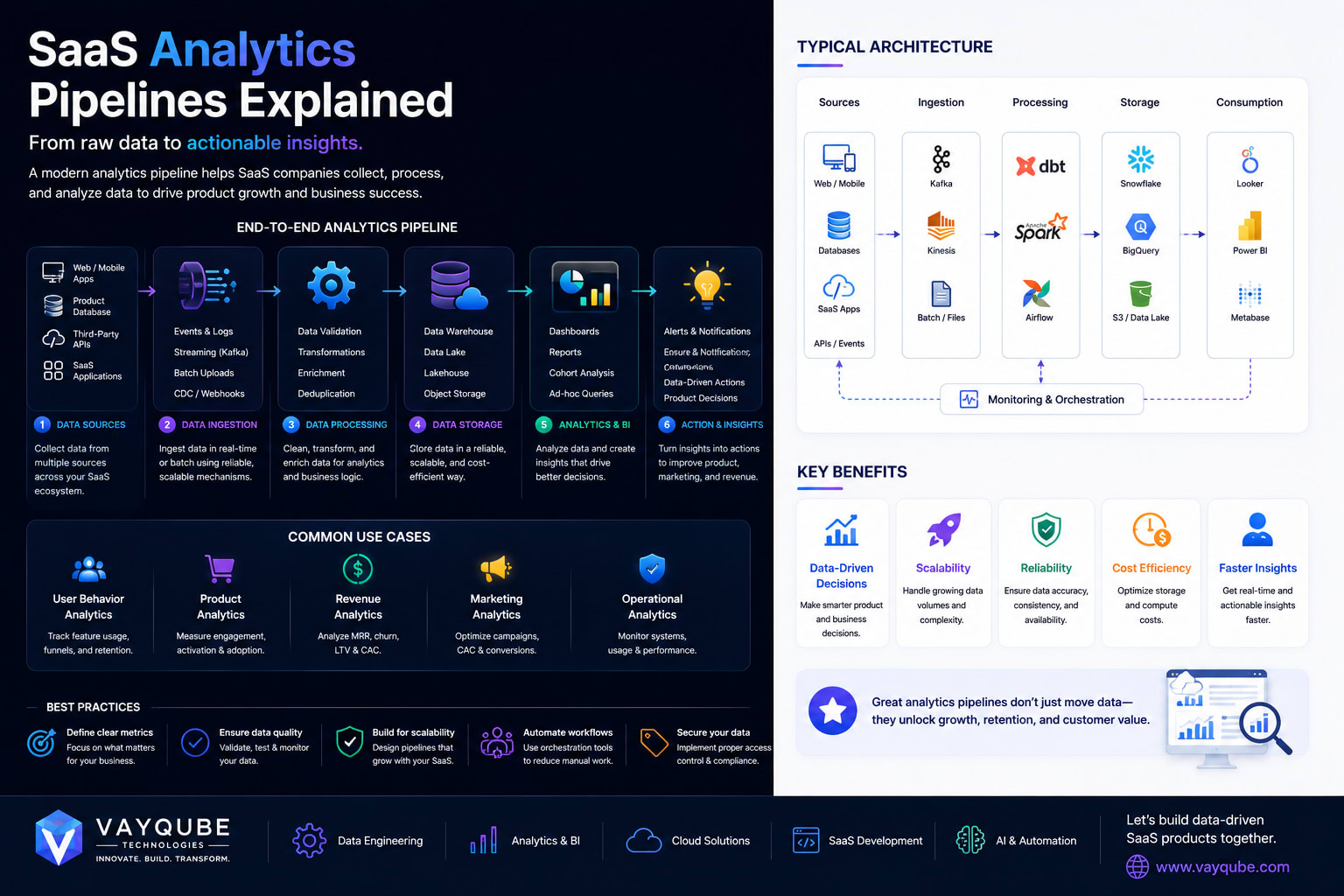
Introduction to SaaS Analytics Pipelines
SaaS analytics pipelines are a crucial component of modern software-as-a-service (SaaS) applications, enabling businesses to make data-driven decisions and drive growth. At their core, SaaS analytics pipelines are designed to collect, process, and analyze large volumes of data from various sources, providing valuable insights into customer behavior, product usage, and business performance.
The Importance of Data-Driven Decision Making
In today's fast-paced and competitive SaaS landscape, data-driven decision making is more important than ever. By leveraging analytics pipelines, businesses can gain a deeper understanding of their customers' needs, preferences, and pain points, allowing them to develop targeted marketing campaigns, optimize product development, and improve overall customer satisfaction. Some key benefits of data-driven decision making include:
- Improved customer retention and acquisition
- Enhanced product development and innovation
- Increased revenue and growth
- Better resource allocation and optimization
Overview of SaaS Analytics Pipelines
A typical SaaS analytics pipeline consists of several key components, including data ingestion, processing, storage, and analysis. Data ingestion involves collecting data from various sources, such as application logs, customer feedback, and market trends. This data is then processed and transformed into a usable format, stored in a centralized repository, and analyzed using various tools and techniques, such as machine learning and statistical modeling. The insights gained from these analyses can then be used to inform business decisions, drive growth, and improve overall performance.
Key Considerations for Implementing SaaS Analytics Pipelines
When implementing a SaaS analytics pipeline, there are several key considerations to keep in mind. These include:
- Data quality and integrity
- Scalability and performance
- Security and compliance
- Integration with existing systems and tools
- Cost and resource allocation
By carefully evaluating these factors and designing a robust and effective analytics pipeline, businesses can unlock the full potential of their data and drive long-term growth and success.
Why It Matters
Effective SaaS analytics pipelines are crucial for driving business growth and improving customer satisfaction. By leveraging data analysis, businesses can gain valuable insights into their operations, identify areas for improvement, and make informed decisions to optimize their strategies.
Business Outcomes
Data analysis plays a significant role in achieving improved business outcomes. With a well-designed analytics pipeline, companies can:
- Monitor key performance indicators (KPIs) and track progress towards their goals
- Identify trends and patterns in customer behavior, allowing for more targeted marketing efforts
- Optimize pricing strategies and revenue models to maximize profitability
- Streamline operational efficiency and reduce costs
Customer Experience
A robust analytics pipeline also enables businesses to enhance the customer experience. By analyzing customer data, companies can:
- Develop personalized marketing campaigns and product recommendations
- Identify pain points and areas for improvement in the customer journey
- Implement data-driven support strategies to improve customer satisfaction and reduce churn
- Create targeted retention programs to increase customer loyalty and advocacy
Real-World Applications
In real-world scenarios, SaaS companies have leveraged analytics pipelines to drive significant business growth. For example, a company might use data analysis to identify a correlation between customer engagement and retention, and then develop targeted strategies to increase engagement and reduce churn. By doing so, the company can improve customer satisfaction, increase revenue, and drive long-term growth.
Implementation Considerations
When implementing a SaaS analytics pipeline, businesses should consider several key factors, including:
- Data quality and integrity
- Scalability and flexibility
- Integration with existing systems and tools
- Security and compliance
- Talent and resource allocation
By carefully considering these factors and designing an effective analytics pipeline, businesses can unlock the full potential of their data and drive improved business outcomes and enhanced customer experiences.
Core Architecture
The core architecture of a SaaS analytics pipeline consists of several key components that work together to collect, process, and analyze data.
Data Ingestion and Processing
Data ingestion is the process of collecting data from various sources, such as application logs, customer interactions, and sensor data. This data is then processed to extract insights and meaningful information. Key considerations for data ingestion and processing include:
- Handling large volumes of data
- Ensuring data quality and accuracy
- Supporting multiple data formats and sources
Data Storage and Warehousing
Once data is processed, it needs to be stored in a scalable and secure manner. Data warehousing solutions, such as Amazon Redshift or Google BigQuery, provide a centralized repository for storing and managing large datasets. When designing a data storage and warehousing strategy, consider:
- Data schema and modeling
- Data partitioning and indexing
- Data security and access controls
Data Visualization and Reporting
The final stage of the analytics pipeline is data visualization and reporting. This involves presenting complex data insights in a clear and actionable manner, using tools such as Tableau, Power BI, or D3.js. Effective data visualization and reporting requires:
- Understanding business requirements and key performance indicators (KPIs)
- Selecting the right visualization tools and techniques
- Ensuring data accuracy and consistency across reports and dashboards
To ensure a seamless flow of data through the pipeline, it's essential to consider the interplay between these components and design an architecture that supports scalability, flexibility, and reliability. By doing so, SaaS companies can unlock the full potential of their data and drive informed decision-making.
Some common challenges in implementing a SaaS analytics pipeline include:
- Integrating with existing systems and infrastructure
- Managing data quality and integrity
- Ensuring compliance with data regulations and standards
- Providing timely and relevant insights to stakeholders
By understanding the core architecture and components of a SaaS analytics pipeline, companies can better navigate these challenges and create a robust and effective analytics capability.
Business Benefits
The implementation of SaaS analytics pipelines can have a significant impact on a business's bottom line. By leveraging data-driven insights, companies can increase revenue through targeted marketing efforts, improved customer experiences, and optimized pricing strategies.
Revenue Growth
Some key ways that SaaS analytics pipelines can drive revenue growth include:
- Identifying high-value customer segments and tailoring marketing efforts to effectively reach them
- Developing predictive models to forecast customer churn and proactively intervening to prevent revenue loss
- Analyzing usage patterns to inform product development and ensure that new features meet the needs of the target market
Operational Efficiency
In addition to driving revenue growth, SaaS analytics pipelines can also help optimize operational efficiency. By streamlining data workflows and automating manual processes, companies can reduce costs and improve productivity. This can be achieved through:
- Implementing automated data validation and quality control checks to reduce manual errors
- Developing real-time dashboards to provide instant visibility into key performance indicators
- Using machine learning algorithms to identify areas of inefficiency and provide recommendations for improvement
Risk Management
SaaS analytics pipelines can also play a critical role in better risk management. By providing real-time visibility into key metrics and trends, companies can quickly identify potential risks and take proactive steps to mitigate them. Some examples include:
- Monitoring system logs and performance metrics to quickly identify and respond to security threats
- Analyzing customer feedback and sentiment to identify potential issues before they escalate
- Developing predictive models to forecast potential risks and develop strategies to mitigate them
Scalability
To ensure the long-term success of a SaaS analytics pipeline, scalability is a critical factor. As the user base grows and the volume of data increases, the pipeline must be able to handle the added load without compromising performance.
Handling Large Volumes of Data
Handling large volumes of data requires a scalable architecture that can process and store increasing amounts of information. This can be achieved through the use of distributed computing systems, cloud-based infrastructure, and data warehousing solutions. By leveraging these technologies, SaaS analytics pipelines can efficiently manage large datasets and provide fast and accurate insights to users.
Supporting Growing User Bases
Supporting growing user bases requires a pipeline that can handle increased traffic and usage. This can be achieved through the implementation of load balancing, autoscaling, and caching mechanisms. By distributing the workload across multiple servers and scaling resources up or down as needed, SaaS analytics pipelines can ensure high availability and responsiveness even under heavy usage.
Ensuring High Performance
Ensuring high performance in a SaaS analytics pipeline requires careful consideration of several factors, including data processing latency, query performance, and data visualization rendering. By optimizing these factors through techniques such as data indexing, query optimization, and caching, pipelines can provide fast and responsive analytics capabilities that meet the needs of growing user bases. Some key considerations for ensuring high performance include:
- Optimizing data processing workflows to minimize latency
- Implementing efficient data querying and retrieval mechanisms
- Leveraging advanced data visualization technologies to reduce rendering times
- Monitoring pipeline performance and adjusting resources as needed to ensure optimal operation.
Implementation Challenges
Implementing a SaaS analytics pipeline can be complex, and several challenges may arise. One of the primary concerns is data quality and integrity issues. Ensuring that the data being collected and analyzed is accurate, complete, and consistent is crucial for making informed business decisions. However, data quality issues can occur due to various factors such as incorrect data formatting, missing values, or duplicates.
Data Quality and Integrity
To address data quality and integrity issues, it's essential to implement data validation and cleansing processes. This can include data normalization, data transformation, and data deduplication. Additionally, implementing data quality metrics and monitoring can help identify and resolve issues promptly. Some common data quality metrics include data completeness, data consistency, and data accuracy.
Integration with Existing Systems
Another significant challenge is integrating the SaaS analytics pipeline with existing systems. This can include integrating with customer relationship management (CRM) systems, enterprise resource planning (ERP) systems, or other external data sources. Ensuring seamless integration with these systems is critical to provide a unified view of the data and to enable informed decision-making. Some common integration approaches include APIs, webhooks, or file-based integration.
Ensuring Data Security and Compliance
Ensuring data security and compliance is also a critical challenge. SaaS analytics pipelines often handle sensitive customer data, and it's essential to ensure that this data is protected from unauthorized access or breaches. This can include implementing robust security measures such as encryption, access controls, and auditing. Additionally, ensuring compliance with relevant regulations such as GDPR, HIPAA, or CCPA is also crucial. Some common security measures include data encryption, secure data storage, and access controls.
Some key considerations for ensuring data security and compliance include:
- Implementing robust access controls and authentication mechanisms
- Ensuring data encryption both in transit and at rest
- Conducting regular security audits and penetration testing
- Ensuring compliance with relevant regulations and standards
- Providing transparent data privacy policies and procedures
By addressing these implementation challenges, organizations can ensure that their SaaS analytics pipeline is reliable, secure, and provides accurate insights to inform business decisions.
Use Cases
SaaS analytics pipelines have a wide range of applications, from enhancing customer experiences to informing business decisions. Some key use cases include:
- Customer segmentation and personalization: By analyzing customer behavior and preferences, businesses can create targeted marketing campaigns and personalized product recommendations, leading to increased customer satisfaction and loyalty.
- Predictive analytics for forecasting: SaaS analytics pipelines can be used to build predictive models that forecast future customer behavior, allowing businesses to proactively prepare for changes in demand and make informed decisions about resource allocation.
- Real-time monitoring and alerting: Real-time analytics enable businesses to quickly identify and respond to issues, such as system downtime or unexpected changes in customer behavior, minimizing the impact on customers and reducing the risk of revenue loss.
Customer Segmentation and Personalization
Customer segmentation and personalization are critical components of any successful marketing strategy. By leveraging SaaS analytics pipelines, businesses can gain a deeper understanding of their customers, including their preferences, behaviors, and pain points. This information can be used to create targeted marketing campaigns, personalized product recommendations, and tailored customer experiences, leading to increased customer satisfaction and loyalty.
Predictive Analytics for Forecasting
Predictive analytics is a powerful tool for forecasting future customer behavior. By analyzing historical data and real-time trends, businesses can build predictive models that forecast future demand, allowing them to proactively prepare for changes in demand and make informed decisions about resource allocation. This can be particularly useful for businesses with seasonal or cyclical demand patterns, as it enables them to optimize their resources and minimize waste.
Real-time Monitoring and Alerting
Real-time monitoring and alerting are essential for quickly identifying and responding to issues. By leveraging SaaS analytics pipelines, businesses can monitor their systems and customer behavior in real-time, enabling them to quickly identify issues and respond promptly. This can help minimize the impact on customers and reduce the risk of revenue loss. For example, if a business notices a sudden spike in customer complaints, they can quickly investigate the issue and take corrective action to resolve the problem and prevent further complaints.
Best Practices
To ensure the success of SaaS analytics pipelines, it's crucial to follow best practices that promote scalability, flexibility, and data quality.
Designing Scalable Architectures
Designing scalable and flexible architectures is essential for handling large volumes of data and supporting growing business needs. This involves selecting the right tools and technologies, such as cloud-based data warehouses and scalable ETL tools, that can handle increasing data volumes and user demands. A well-designed architecture should also be able to accommodate changing data sources and structures, ensuring that the analytics pipeline can adapt to evolving business requirements.
Data Governance and Quality Control
Implementing data governance and quality control measures is vital for ensuring the accuracy, completeness, and consistency of data. This includes establishing data validation rules, data cleansing processes, and data monitoring mechanisms to detect and correct data errors. Data governance also involves defining data ownership, access controls, and data retention policies to ensure that sensitive data is protected and handled in accordance with regulatory requirements.
Fostering a Data-Driven Culture
Fostering a culture of data-driven decision making is critical for maximizing the value of SaaS analytics pipelines. This involves educating business stakeholders about the benefits and limitations of data analytics, providing training on data interpretation and analysis, and encouraging a culture of experimentation and continuous improvement. By empowering business users to make data-driven decisions, organizations can unlock the full potential of their analytics investments and drive business growth and innovation.
Some key considerations for implementing these best practices include:
- Developing a comprehensive data strategy that aligns with business objectives
- Establishing clear roles and responsibilities for data management and analytics
- Investing in ongoing training and education for business users and analytics teams
- Continuously monitoring and evaluating the effectiveness of analytics pipelines and making adjustments as needed
- Encouraging collaboration and knowledge sharing between business stakeholders, analytics teams, and IT teams to ensure that analytics insights are integrated into business decision making processes.
FAQ
To address common questions and concerns, we've compiled a list of frequently asked questions about SaaS analytics pipelines.
Understanding SaaS Analytics Pipelines
What is a SaaS analytics pipeline? A SaaS analytics pipeline is a series of processes that collect, transform, and load data from various sources into a centralized system for analysis and reporting. It enables businesses to make data-driven decisions by providing a unified view of their operations.
Getting Started
How do I get started with building a SaaS analytics pipeline? To get started, identify your data sources, determine the key metrics you want to track, and choose an analytics platform that can handle your data volume and complexity. It's essential to design a scalable pipeline that can adapt to your growing business needs.
Key Metrics to Track
What are the key metrics to track in a SaaS analytics pipeline? Some essential metrics include:
- Customer acquisition costs
- Customer lifetime value
- Monthly recurring revenue
- User engagement metrics
- Retention rates These metrics provide insights into your business's financial health, customer behavior, and overall performance. By tracking these metrics, you can identify areas for improvement and optimize your business strategies accordingly.
Additional Considerations
When building a SaaS analytics pipeline, consider the following:
- Data quality and integrity
- Data security and compliance
- Scalability and performance
- Integration with existing systems
- User adoption and training By addressing these considerations, you can ensure that your analytics pipeline provides accurate and reliable insights that drive business growth and informed decision-making.
Conclusion
In summary, SaaS analytics pipelines are a crucial component of any successful SaaS business, enabling data-driven decision making and driving growth. The key takeaways from this discussion include:
- The importance of a well-designed core architecture in handling large volumes of data
- The numerous business benefits, such as enhanced customer experiences and improved revenue forecasting
- The need for scalability and reliability in pipeline implementation
- The various implementation challenges and best practices to overcome them
- The diverse range of use cases, from user behavior analysis to predictive modeling
Final Thoughts
The importance of SaaS analytics pipelines cannot be overstated. By leveraging these pipelines, SaaS businesses can unlock the full potential of their data, drive informed decision making, and ultimately, achieve sustainable growth. As the SaaS landscape continues to evolve, the role of analytics pipelines will only continue to expand, making them an essential investment for any forward-thinking SaaS organization.
Some of the most critical considerations for SaaS businesses include:
- Ensuring production readiness and reliability
- Implementing robust security and data governance measures
- Fostering a culture of data-driven decision making
- Continuously monitoring and optimizing pipeline performance
By prioritizing these considerations and investing in a well-designed SaaS analytics pipeline, businesses can position themselves for long-term success and stay ahead of the competition in an increasingly data-driven market.
Related Vayqube Resources
- Cloud Cost Optimization Strategies For Saas Startups
- Best Software Development Company In Usa
- Best Software Development Company In New York
- Best Saas Development Company In Usa
- Best Saas Development Company In New York
- Best Fintech Software Development Company In Usa
Next Step
If your systems are struggling with scalability, automation, architecture complexity, or operational efficiency, it's time to modernize your infrastructure and workflows.
👉 Talk to a Vayqube solution architect and build systems designed for long-term production growth: